
Knitting leadership psychology and governance for better psychopolitical outcomes and peaceful democracies.
Dear Friend,
Nations do not fail by accident or bad luck. They fail when a narrow elite captures the institutions that once served everyone, and when the people lose the shared knowledge required to notice it happening. This is not a prophecy of doom. It is a diagnosis of trajectory. And trajectories, unlike fates, can still be changed.
I want to be honest with you about the title of this edition, because honesty is the whole point of it. When I first sat down to write, the question in front of me was blunt: will America fail? And I found I could not, in good conscience, write those words as a prophecy. Not because the danger isn’t real. In fact, it is more real than most Americans allow themselves to feel. But because the two great books that frame this edition both teach the same liberating and terrifying truth that national failure is not a fate. It is a choice, made through institutions, and it can be unmade the same way.
So I have titled this “The Failure Trajectory” instead. Because a trajectory is not a destiny. A ball thrown toward a window will break it, unless someone catches it. America is, by the honest reading of Daron Acemoglu and James Robinson’s Why Nations Fail and Ray Dalio’s Principles for Dealing with the Changing World Order, a ball thrown toward a window. This edition is my attempt to trace the arc and to show you the physics of where it is heading, precisely so that the catching remains possible. IF YOU CARE!
I write as someone with unusual reasons to care about this. I chose America for its inclusive promise, the very quality Acemoglu identifies as the engine of national prosperity. I swore an oath to defend the constitutional order that makes that inclusion possible. And I currently work in an industry, where Dalio’s Big Cycle is not an abstraction but the water we swim in, where the forty trillion dollars national debt that prompted this edition, is a number my colleagues and I watch with the quiet dread of people who understand what it means when a reserve-currency empire borrows against a future it is simultaneously dismantling.
This is a hard edition. It names an extractive turn in American governance and a dangerous erosion in the public’s capacity to understand it. But I promise you it does not end in despair, because the frameworks themselves do not. They end in a choice. Let me show you the trajectory, so that we can still choose to change it.
THE FIVE MOVEMENTS in THIS DEEP DIVE
The Two Frameworks: How Nations Actually Fail, According to Acemoglu and Dalio
The Extractive Turn: Reading MAGA Policy Through the Lens of Institutional Capture
The $40 Trillion Signal: Debt, Empire, and Dalio’s Big Cycle of Decline
The Uninformed Citizenry: Why a Democracy Cannot Defend What It Cannot Understand
The Off-Ramp: What Both Frameworks Say It Would Take to Change the Trajectory
SECTION I · THE TWO FRAMEWORKS
To ask whether America will fail is to ask a question that two of the most important works of political economy in the last two decades have already given us the tools to answer, not with prophecy, but with diagnosis. Let me lay the two frameworks side by side, because their convergence is the intellectual spine of this entire edition.
In Why Nations Fail, a work so significant that Daron Acemoglu shared the 2024 Nobel Prize in Economics for the research underlying it, Acemoglu and James Robinson advance a single, powerful thesis: the prosperity or poverty of nations is determined not by geography, culture, or the knowledge of their leaders, but by their institutions. And institutions come in two fundamental types.
Inclusive institutions distribute political power broadly, enforce property rights for the many, permit “creative destruction,” reward innovation, and allow ordinary people to benefit from their own effort. They generate prosperity because they harness the talent and energy of the entire population. Extractive institutions, by contrast, concentrate power and wealth in the hands of a narrow elite, who use the machinery of the state to extract resources from the many for the benefit of the few. They may generate growth for a time, but it is fragile, unequal, and ultimately self-limiting, because the elite that controls the state fears the creative destruction that would threaten its position.
The book’s most important insight for our purposes is this: nations fail when their institutions turn extractive, when a narrow group captures the political and economic system and reorganizes it to serve itself at the expense of the whole. And crucially, this can happen to nations that were once inclusive. Inclusiveness is not permanent. It must be defended, generation after generation, against the perennial effort of elites to capture and extract.
THE CORE DISTINCTION WHY NATIONS FAIL
Inclusive institutions share power widely, protect the property and rights of the many, reward innovation, and permit the “creative destruction” that drives prosperity. They make a nation rich because they unleash the whole population.
Extractive institutions concentrate power and wealth in a narrow elite that uses the state to extract from the many. They can produce growth briefly, but it is fragile and self-limiting because the elite fears the very innovation that would threaten its grip.
The warning: Inclusiveness is never permanent. A nation that was inclusive can be captured and turned extractive. When that capture succeeds, the nation begins to fail, not by accident, but by design.
Ray Dalio’s Principles for Dealing with the Changing World Order approaches the same question from a different angle, the rise and fall of reserve-currency empires across 500 years of history, but arrives at a strikingly compatible conclusion. Dalio identifies a recurring “Big Cycle” through which dominant powers pass: they rise through strong institutions, education, competitiveness, and productivity; they peak; and then they decline through a predictable sequence of internal decay.
The markers of Dalio’s decline phase read like a checklist a diagnostician could run against the present: unsustainable debt accumulation and money-printing; widening wealth and values gaps that fuel populism on both left and right; the erosion of shared truth and the rise of irreconcilable political conflict; declining education and competitiveness relative to rising rivals; and the weakening of the reserve currency that had underwritten the empire’s power. Dalio’s framework is explicitly probabilistic, and not deterministic. Yet, he presents these as the typical mechanics of decline, which nations can either succumb to or resist through wise, unifying leadership.
WHERE THE TWO FRAMEWORKS CONVERGE
Acemoglu diagnoses the structure of failure (extractive institutional capture), while Dalio diagnoses the dynamics of failure (the Big Cycle of debt, division, and decline). But they point at the same organ. Both identify the concentration of power and wealth in a narrow elite as the mechanism of decay. Both identify the erosion of the broad-based institutions and shared civic knowledge that sustain a healthy society. And the essential point is that both insist that decline is a trajectory that leadership and citizens can still alter and not a fate that must be endured. The convergence of two independent frameworks on the same diagnosis is what makes the warning credible. The insistence of both on the possibility of reversal is what makes it worth writing.
“Freedom is never more than one generation away from extinction. It must be fought for, protected, and handed on.”
— RONALD REAGAN, 40TH PRESIDENT OF THE UNITED STATES
SECTION II · THE EXTRACTIVE TURN
With Acemoglu’s framework in hand, we can now ask the diagnostic question directly: are the defining policies of the current era pushing American institutions toward the inclusive pole or the extractive pole? I will make the case as fairly and evidentially as I can, because the strength of the argument depends on the strength of the evidence, not the heat of the rhetoric.
Acemoglu identifies several signatures of extractive institutional capture. Let us run them against the record documented across recent LeadPsych editions and the broader reporting.
Concentration of power in a narrow elite. The hallmark of extraction is the redirection of state machinery to serve a narrow group. We have documented the One Big Beautiful Bill, the $1.776 billion “Anti-Weaponization Fund,” public money channeled to compensate the president’s political allies through an agency he controls. We have documented the effective end of IRS scrutiny of the president’s own finances. We have documented the attempt to install a president-controlled Freedom 250 to supersede the bipartisan America250 commission. Each of these, in Acemoglu’s terms, is a small act of converting a shared institution into an instrument of a narrow interest.
The weakening of “creative destruction” and broad opportunity. Inclusive institutions protect the many and reward innovation from anywhere. The remaking has cut an estimated $911 billion from Medicaid over a decade, shifting cost downward onto states and the vulnerable; it has driven net migration negative for the first time since the 1930s, removing the immigrant innovators and workers Acemoglu would identify as engines of inclusive growth; and it has hollowed the federal workforce by roughly 212,000 people, depleting the institutional capacity on which broad governance depends.
The capture of the referee institutions. Most tellingly, extraction requires neutralizing the institutions that would otherwise check it, such as the courts, the press, the independent agencies, and the electoral machinery. The pattern of pressure on these referee institutions, chronicled across our past editions, is precisely what Acemoglu would predict from an elite seeking to entrench its position against the creative destruction that would threaten it.
“Imagine limiting extraction, promoting creative destruction, and creating strong political institutions that share power,” this, the scholars note, is the recipe for national success. The extractive turn is the reversal of every clause in that sentence. (Adapted from SCOTT E. PAGE’S ASSESSMENT OF WHY NATIONS FAIL).
Intellectual honesty requires that I state the strongest case against my own reading. Defenders of these policies would argue that they are not extraction but correction, that they return power from an entrenched administrative elite to the elected representatives of the people; that immigration enforcement protects the wages of working citizens; that fiscal discipline, however painful, is inclusive in the long run because it prevents a debt catastrophe that would harm everyone. These are serious arguments, and a fair analysis must acknowledge them.
But Acemoglu’s framework provides the test that adjudicates between “correction” and “extraction,” and it is a simple one: does the policy distribute power and opportunity more broadly, or concentrate it more narrowly? Does it strengthen the institutions that constrain whoever holds power, or weaken them? A genuine correction would return power to broad democratic institutions and strengthen the referees. Extraction returns power to a narrow elite and weakens the referees. Run the record against that test, honestly, and the pattern that emerges is not, on balance, one of broadening. It is one of concentration. That is the diagnosis, offered not as an insult but as an application of the framework the evidence supports.
“The liberty of a democracy is not safe if the people tolerate the growth of private power to a point where it becomes stronger than the democratic state itself.”
— FRANKLIN D. ROOSEVELT, 32ND PRESIDENT OF THE UNITED STATES
SECTION III · THE $40 TRILLION SIGNAL
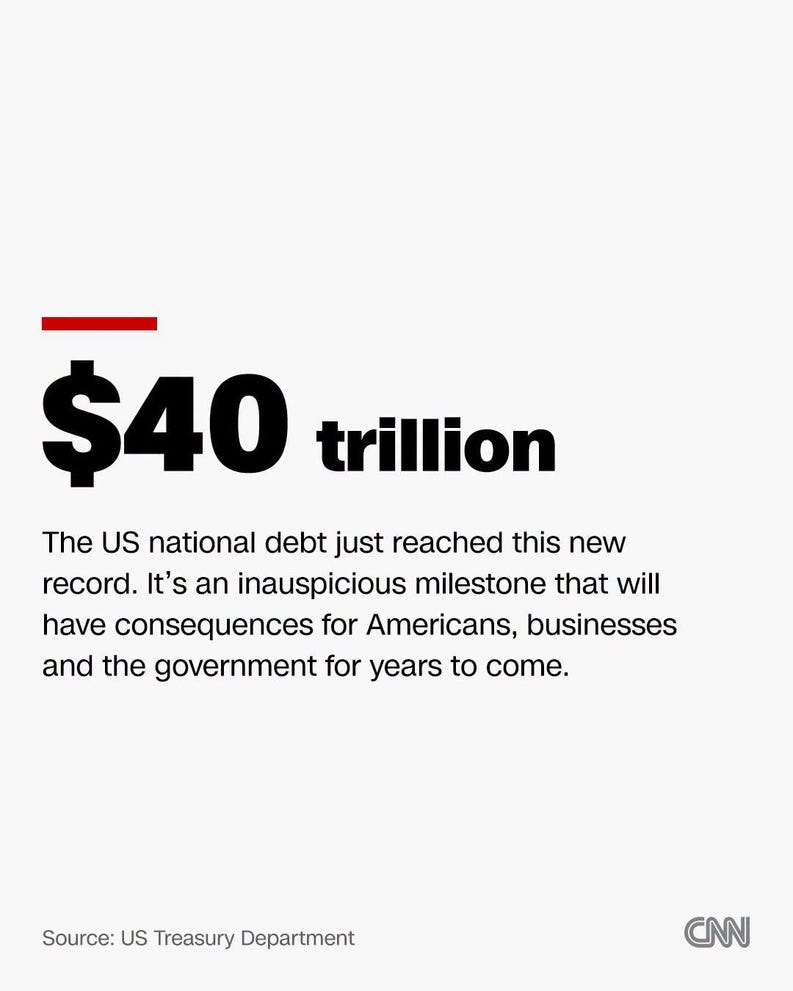
On the event that prompted this edition sits a single, staggering number: the United States national debt has reached $40 trillion, described, accurately, as “an inauspicious milestone that will have consequences for Americans, businesses and the government for years to come.” To a reader of Ray Dalio, that number is not merely a fiscal statistic. It is a flashing indicator on the dashboard of imperial decline.
$40T: U.S. NATIONAL DEBT HITTING NEW RECORD (US TREASURY / CNN)
$8B+: ADDED TO THE DEBT EVERY SINGLE DAY
~$9T: DEBT MATURING IN 2026 — REFINANCED AT 4–5% VS. NEAR-ZERO
$5,500: GOLD PRICE PER OUNCE AT RECORD HIGHS AS RESERVES HEDGE THE DOLLAR
Dalio’s study of 500 years of reserve-currency empires, from the Dutch to the British, and now the American, identifies a recurring late-stage pattern. The dominant empire, having enjoyed the “exorbitant privilege” of issuing the world’s reserve currency, begins to abuse it: borrowing more than it can sustainably repay, monetizing the debt, and gradually eroding the confidence that made its currency dominant in the first place. As confidence erodes, holders of the currency begin to diversify into gold, into rival currencies, and into hard assets. The empire enters the phase Dalio describes as the decline of the monetary order, which historically accompanies and accelerates the decline of the empire itself.
The $40 trillion debt does not sit in isolation. It sits alongside a national debt that grew $2.25 trillion in a single year, roughly $9 trillion in debt maturing in 2026 that must be refinanced at 4–5% rather than the near-zero rates at which it was issued, central banks buying gold at record levels, and as this newsletter documented in its “Post-American World Order” edition, a documented erosion of the dollar’s share of global reserves and an accelerating search among nations for alternatives. Every one of these is a marker on Dalio’s decline checklist. Together, they do not prove that America has passed the point of no return. But they establish, with uncomfortable precision, that America is exhibiting the classic late-cycle symptoms Dalio identified across five centuries of imperial history.
My perspective is that the Forty trillion dollars is not just a debt. It is a message from the future, written in the same handwriting that once appeared on the ledgers of every declining empire before ours: we borrowed against a greatness we were simultaneously spending down, and we called the borrowing strength.
Here is where Acemoglu and Dalio fuse into a single, sharper insight. The debt is not separate from the extractive turn. It is one of its mechanisms. An extractive elite, Acemoglu teaches, uses the state to transfer resources to itself. Debt-financed tax reductions that flow disproportionately upward, paired with cuts to the broad-based programs that serve the many, are precisely such a transfer, except that the bill is deferred to the future rather than paid in the present. The $40 trillion is, in part, the accumulated invoice of extraction: wealth moved upward now, with the cost loaded onto the generations who will inherit the debt and the diminished institutions alike.
A Note From My the Wall Street Desk
I do not write the debt section as a representative of any financial or partisan organization. Fiscal irresponsibility has been a bipartisan American habit for decades, and honesty requires saying so. But Dalio’s framework is indifferent to party. It measures trajectory, not intention. And the trajectory of record debt, refinancing at higher rates, reserve diversification, and gold at record highs is the trajectory of a late-cycle reserve empire, regardless of which party holds power. The danger is not that any one administration caused it. The danger is that the current extractive turn is accelerating it while simultaneously weakening the institutional capacity that would be required to manage it.
“The problem is not that we have a debt. The problem is what the debt reveals about whether we are still investing in our future or merely consuming it.”
— ADAPTED FROM RAY DALIO, PRINCIPLES FOR DEALING WITH THE CHANGING WORLD ORDER
SECTION IV · THE UNINFORMED CITIZENRY
We arrive now at the second half of this edition’s thesis and, in my assessment as a leadership psychologist, the more dangerous half. Because extractive institutional capture, however aggressive, can be resisted by an informed and vigilant public. What makes the failure trajectory truly perilous is the simultaneous erosion of the public’s capacity to understand what is being done to them. An extractive turn combined with an informed citizenry produces resistance. An extractive turn combined with an uninformed citizenry produces capture without consequence.
The inclusive institutions that Acemoglu identifies as the engine of prosperity do not defend themselves. They are defended by citizens who understand their value, notice when they are threatened, and mobilize to protect them. The entire mechanism by which a nation resists the extractive turn depends on a public that can perceive the turn as it happens, one that can distinguish genuine correction from disguised extraction, that can read the ledger rather than the marketing material, and can recognize when a referee institution is being captured.
This is why the health of a democracy’s information ecosystem is not a secondary concern. It is the load-bearing wall. When citizens cannot access reliable information, cannot distinguish fact from manufactured narrative, and cannot follow the complex mechanisms through which power is concentrated, the extractive elite gains its most valuable asset: the ability to extract in plain sight, without triggering the resistance that an informed public would mount.
My other perspective is that an extractive turn against an informed public is a fight. An extractive turn against an uninformed public is a formality. The difference between the two is the single most important variable in whether a nation on the failure trajectory changes course.
As a student leadership psychologist, I want to be precise about the mechanisms of civic uninforming, because they are not accidental. They are, in part, engineered. We have documented across recent editions the deliberate sanitization of national history, the pressure on the press and universities that Berkeley’s research identifies as the “big tent” institutions of shared knowledge, the flooding of the information environment with superlative narrative (”PERFECT,” “America is back”) that substitutes a pre-packaged conclusion for independent judgment, and the exploitation of information vacuums by misinformation when reliable information is withheld.
Each of these degrades what democratic theory calls the epistemic commons, the shared pool of reliable knowledge that a self-governing people requires to govern itself. And the degradation is compounded by the structural changes in how Americans consume information: the collapse of local journalism, the algorithmic sorting of citizens into mutually unintelligible information bubbles, and the rise of a media economy that rewards engagement over accuracy. The result is a citizenry increasingly unable to perform the one function on which the resistance to extraction depends: seeing clearly what is being done, and to whom.
THE COMPOUNDING DIAGNOSIS
Here is why the combination is so much more dangerous than either element alone. Extraction and uninforming are not two separate problems. They are both active and a self-reinforcing loop. Extraction requires uninforming to proceed without resistance. Uninforming is itself a product of extraction, as the extractive elite captures or degrades the very institutions (press, education, independent expertise) that would inform the public. Each drives the other. An extractive elite that has captured the information ecosystem can extract indefinitely, because it has disabled the public’s capacity to notice. This is the loop that turns a failure trajectory into a failure spiral, and it is the specific mechanism that both Acemoglu and Dalio identify as the point where decline becomes difficult to reverse.
“If a nation expects to be ignorant and free, in a state of civilization, it expects what never was and never will be.”
— THOMAS JEFFERSON, AUTHOR OF THE DECLARATION OF INDEPENDENCE
SECTION V · THE OFF-RAMP
I promised you at the outset that this edition would not end in despair and it will not, because the frameworks themselves do not. Both Acemoglu and Dalio are explicit that decline is a trajectory, not a destiny. A ball thrown at a window can still be caught. Let me close by describing, as concretely as the frameworks allow, what the catching would require.
If failure comes from the extractive capture of institutions, then the off-ramp is the defense and restoration of inclusive institutions. Concretely, this means: protecting the independence of the referee institutions such as the courts, the press, the electoral machinery, and the independent agencies, against capture; broadening rather than concentrating economic opportunity; restoring the immigration that has always been an engine of American inclusive growth; and rebuilding the broad-based programs and institutional capacity that distribute opportunity widely. Acemoglu’s history is full of nations that reversed extractive turns and pulled back from the brink through the mobilization of citizens who defended their inclusive institutions before the capture became permanent. The Glorious Revolution, the Progressive Era, and the Civil Rights Movement were each a moment when an inclusive society defended itself against an extractive turn. America has done this before. That is the most important fact in this edition.
Dalio’s prescription for a late-cycle empire is equally concrete: reduce unsustainable debt through disciplined, shared sacrifice rather than extraction; close the wealth and values gaps that fuel destabilizing populism; reinvest in education, competitiveness, and productivity; and, above all, find the unifying leadership that can hold a divided nation together through the hard adjustments decline requires. Dalio is clear that the nations that navigate the Big Cycle’s decline phase successfully are those whose leaders choose unity over division and long-term investment over short-term extraction. The off-ramp is not mysterious. It is difficult, but it is also known and surmountable.
THE CONVERGENT OFF-RAMP BOTH FRAMEWORKS REQUIRE
Defend the referee institutions. Courts, press, elections, and independent expertise which are the institutions that constrain whoever holds power must be protected from capture. This is the single highest priority in both frameworks.
Broaden, don’t concentrate. Reverse the extractive turn by distributing opportunity, restoring inclusive growth, and rebuilding the broad-based institutional capacity that serves the many.
Restore the epistemic commons. Rebuild the shared pool of reliable knowledge such as local journalism, trusted institutions, and civic education on which an informed public’s resistance to extraction depends.
Choose unifying leadership. Both frameworks converge on the same final requirement: leaders and citizens who choose to rebuild shared trust rather than deplete it, and long-term investment over short-term extraction.
But here is the deepest lesson, and the one that returns us to leadership psychology. Both frameworks, in the end, place the decisive variable not in the hands of leaders but in the hands of citizens. Acemoglu’s inclusive institutions are defended by mobilized publics. Dalio’s successful navigations depend on societies that can still cohere around shared purpose. And both of these require the one thing this edition has argued is most under threat: an informed, engaged, vigilant citizenry capable of seeing the trajectory clearly and choosing, collectively, to change it.
This is why the erosion of the informed public is the most dangerous element of all and why its restoration is the most important work available to any of us. You do not need to hold office to defend an inclusive institution. You do not need to control the Treasury to refuse the comfort of the manufactured narrative. The defense of the epistemic commons begins with each citizen who chooses to stay informed, to read the ledger rather than the marketing, to seek out reliable knowledge, and to help others do the same. That is not a small thing. In the physics of the failure trajectory, it may be the hand that catches the ball.
“The ultimate rulers of our democracy are not a President and senators and congressmen and government officials, but the voters of this country.”
— FRANKLIN D. ROOSEVELT, 32ND PRESIDENT OF THE UNITED STATES
My Final Reflection: Trajectory Is Not Destiny
I began this edition by refusing to write “America will fail” as a prophecy, and I want to end by explaining, as plainly as I can, why that refusal is itself the most important argument I have to offer. To say “America will fail” is to surrender, to treat as settled what is still, by the honest reading of the very frameworks that diagnose the danger, a choice. And surrender is exactly what an extractive elite and a degraded information ecosystem require of a public in order to complete the capture. Despair is not the opposite of denial. Despair is denial’s collaborator. Both end in the same place where a citizenry stops resisting.
The honest reading is harder and more demanding than either denial or despair. It is that America is on a failure trajectory. The extractive turn is real, the $40 trillion signal is flashing, the informed public is eroding, and the frameworks of Acemoglu and Dalio both indicate that a nation exhibiting these symptoms is a nation in danger. AND, not “but,” AND, that trajectory is not yet a destiny. The window can still be caught. Nations have reversed extractive turns before. America itself has reversed them before. The off-ramp is known, difficult, and open.
Whether America takes it depends on the one variable both frameworks place at the center: whether its citizens remain informed enough to see the trajectory, and committed enough to change it. That is not a question historians will answer about us. It is a question we are answering, right now, through every choice to stay awake rather than to look away. I choose, and I hope you will choose with me, to catch the ball.
“The true test of a nation’s character is not whether it can avoid the trajectory of decline, but whether, seeing it clearly, it summons the will to change course.”
— LEADPSYCH EDITORIAL · ON THE FAILURE TRAJECTORY
See the trajectory clearly. Refuse both the denial and the despair. And remember: a nation fails only when its people decide the failure is inevitable. It is not.
Evaristus Odinikaeze
PsyD Candidate, Organizational & Leadership Psychology
Exploring the intersection of human behavior and governance. As a public policy enthusiast, they advocate for psychopolitical strategies that promote peaceful democracies.
LeadPsych Newsletter: Knitting leadership psychology and governance for better political outcomes and peaceful democracies. For further insights and discussions on leadership psychology and public policy, subscribe to The LeadPsych Newsletter.
If you’re enjoying what you’re reading, please consider recommending it to others.
Have feedback? Ideas for topics? I’d love to hear from you. LeadPsych Newsletter is a reader-supported publication. To receive new posts and support my work, consider becoming a free or paid subscriber.
Frameworks:
1. Acemoglu & Robinson, Why Nations Fail.
2. Dalio, Principles for Dealing with the Changing World Order.
© 2026 LeadPsych Newsletter · Boston, Massachusetts · All rights reserved
Thanks for reading LeadPsych! This post is public so feel free to share it.
No posts
Comments
Nothing yet. Say the first thing.
Sign in to join the conversation.