
When COVID-19 took my father-in-law in 2021, one thought lingered in the quiet months that followed: why do the brightest minds ignore the problems that hit closest to home?
I sense that it’s because the most fundamental problems are the hardest to solve. Compared to social networks or CRM software, they are messy, rarely obvious, and offer a less legible risk-reward profile. Over time, venture capital optimized for the latter, leaving critical systems (manufacturing, healthcare, bio, supply chains, and real-world automation) to incumbents, governments, and the occasional scientific moonshot.
Recently, that has begun to shift.
The cascading effects of COVID-19 exposed the fragility of global supply chains and the medical system. Military conflict reminded nations that critical capabilities cannot be concentrated in a single country. Tariffs forced companies to rethink the geography of supply and demand.
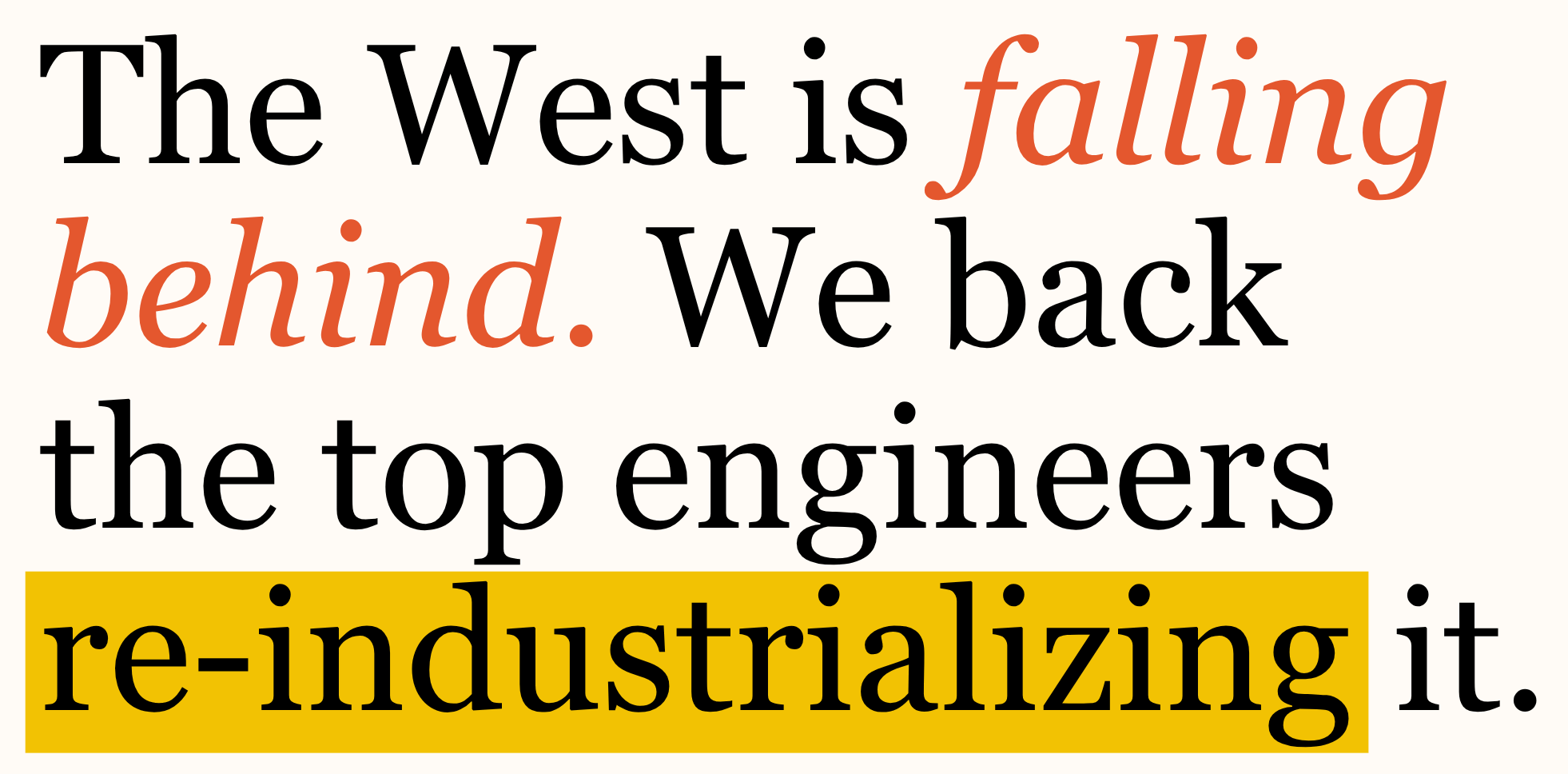
The West is now rebuilding the critical systems it once led, at a pace accelerated by AI. ODDBIRD exists to support the engineers carrying that work forward.
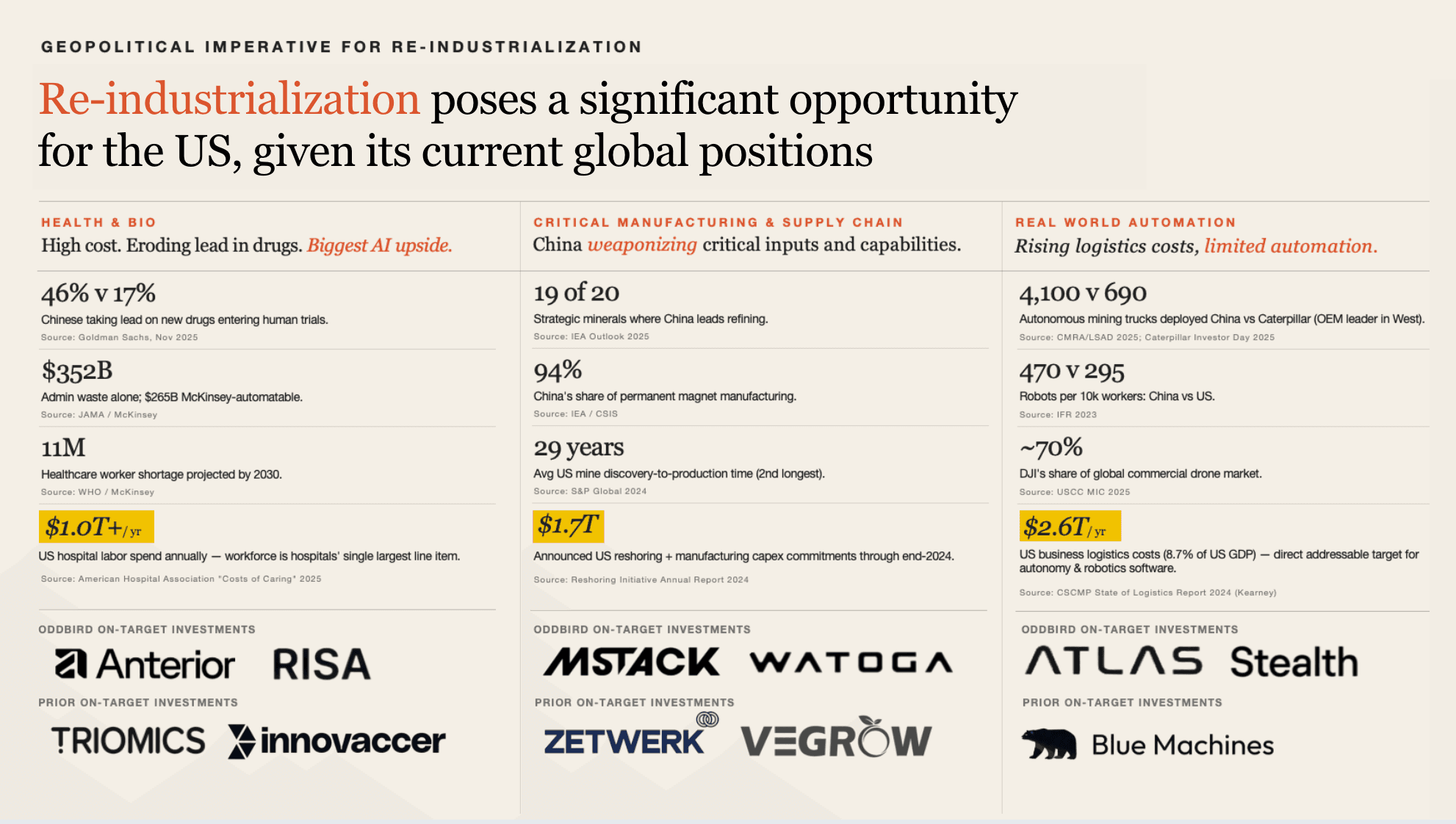
For decades, startups targeting re-industrialization faced four converging forces working against them. Those forces have quietly reversed, setting the stage for an explosion of new ventures.
The buyers are ready. Traditionally rigid industries are beginning to realize the productivity gains enabled by recent advances in AI, though adoption remains in its infancy. A 2025 McKinsey study found that 88% of businesses use AI in some capacity, while only 1% consider themselves fully AI-mature.
The talent is ready. As re-industrialization accelerates, the best engineers are following the opportunity. Those once locked up by Google, Meta, and Airbnb are now flocking to where the potential for real impact is greatest: SpaceX, NVIDIA, and Anduril.
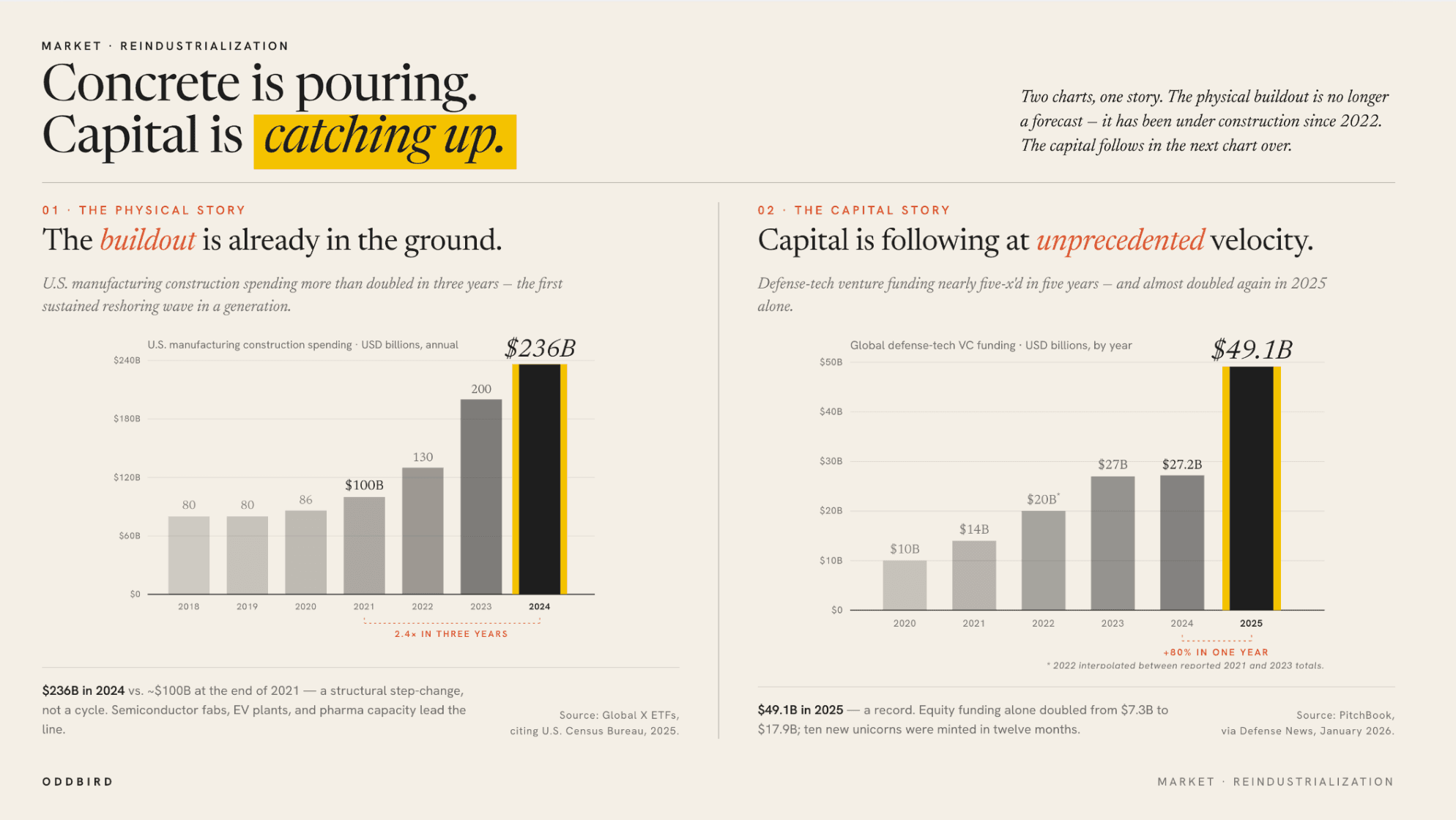
The capital is ready. For decades, growth venture capital avoided anything that wasn’t software or networks. The prevailing wisdom held that physical businesses could not return venture-scale outcomes. The rise of NVIDIA, SpaceX, and Tesla, together worth roughly $8.5 trillion, has detonated that assumption. Robotics alone drew $40.7B in 2025, 9% of all venture funding, while enterprise SaaS, the asset class that defined the last cycle, is seeing its multiples compress.
The moats are deep. We have observed that the businesses underpinning re-industrialization tend to be remarkably durable. Once they become the rails everyone else runs on, they are nearly impossible to rip out. The most successful companies in the category deepen that advantage by stitching together capabilities across disparate domains (intelligence, data, distribution, financing) into a single integrated whole. The sheer complexity of assembling those pieces into a coherent product keeps the vast majority of would-be entrants at the door. We believe this dynamic forms a deep moat against the likes of OpenAI and Anthropic, and perhaps even against AGI, protecting enterprise value over the long arc.
Venture is fundamentally the business of funding imagination. The work, therefore, is not evaluating what an idea is today, but envisioning what it can become. With that conviction in mind, we:
Buy puzzles, not pieces. Re-industrialization is physical and unromantic by nature. It rewards founders who build past the API, the ones willing to step back from the piece in their hand and see the whole board. At ODDBIRD, we screen for this vantage point: founders who command not just the software but the implications around it. How does their product shift current bottlenecks, and what new opportunities open up once those constraints are lifted?
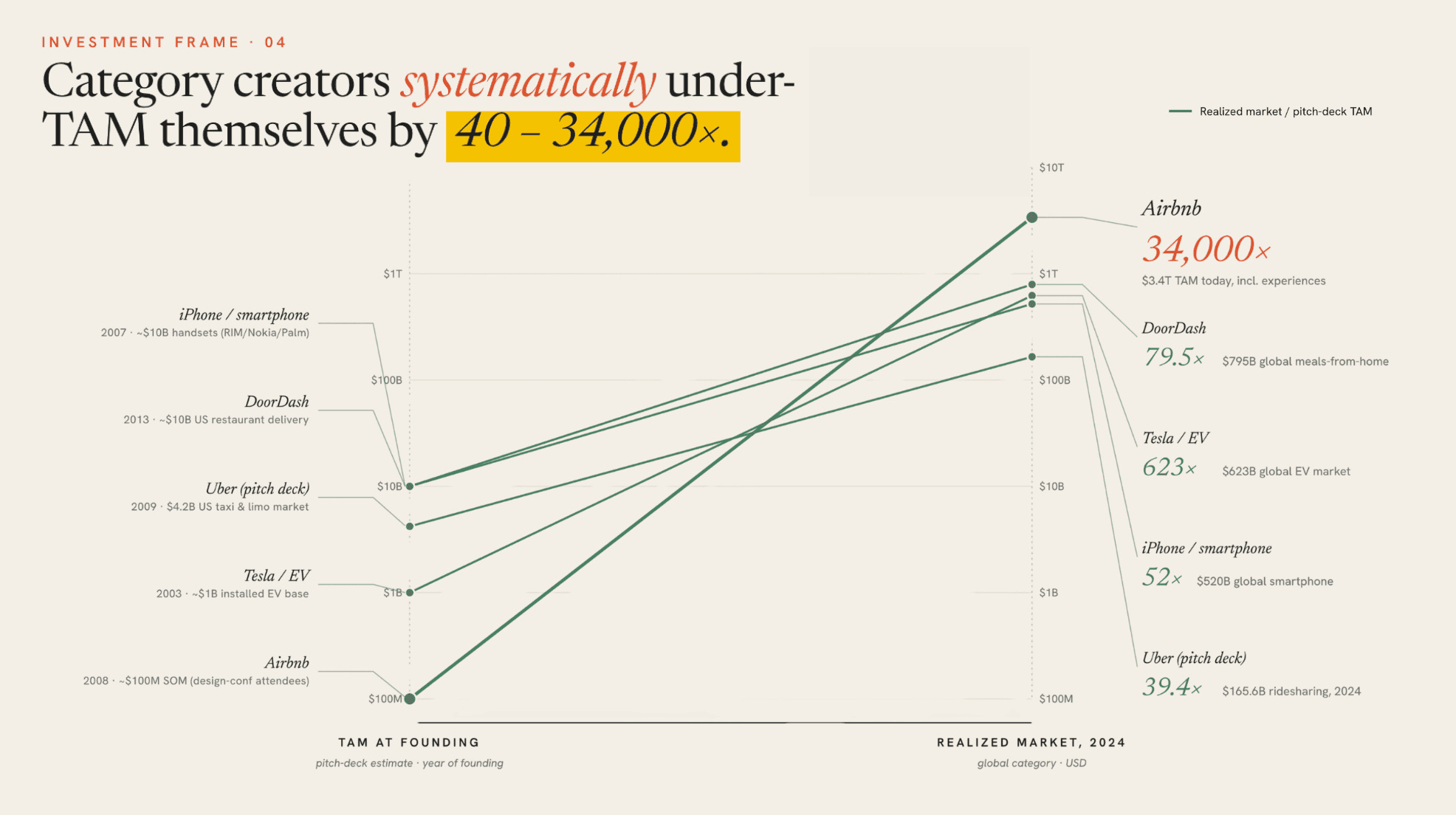
Don’t under-TAM. As of 2026, Airbnb’s realized market is roughly 34,000x larger than its original projection. That gap between realized market and initial TAM is not unique to Airbnb. The best founders consistently expand a market rather than accept its early framing. Dr. V has seen the pattern firsthand in his own investments. Manufacturing software was widely viewed as a niche until Zetwerk reimagined the business model and scaled into billions in gross trade. Population health software was regarded the same way until Innovaccer emerged as the data platform powering AI workflows across the industry, now generating over $200M in annual revenue.
An investment in ODDBIRD is not an investment in a new firm. It is an investment in a seasoned team that has previously helped secure over $1.7B in growth capital from leading institutional investors. ODDBIRD is led by Dr. V, who spent a decade at Lightspeed, where he led several of the firm’s earliest venture investments in manufacturing and healthcare. In our view, that depth of institutional experience is uncommon at the pre-seed and seed stage today.
The network edge. Dr.V’s decade at Lightspeed provides the firm with a network rarely found at the seed stage. He actively engages peers from the past to connect portfolio companies with later-stage investors and strategic partners. As a Stanford alum, he stays plugged into the community and consistently sources some of the sharpest emerging talent on campus.
Fundraising experience hardened through cycles. Helping unicorn companies raise from the most sophisticated investors has produced a sharp instinct for how to communicate with a wide range of investors, build agility into operating plans, and sequence capital with discipline.
Intuition that matters at seed. About twenty years ago, Dr. V left medicine to start Prima, a primary care clinic chain. The experience taught him where technology leverage actually matters, when to vertically integrate, and how to attract top talent. At seed, before financial validation exists, founders need partners with the intuition to spot the next opportunity or risk. That intuition is difficult to develop without having operated yourself. It is the rare ability to look around corners.
Valuing hindsight as much as foresight. We screen for founders who have built before but are not satisfied with “once,” founders who built something small and now want to build something expansive. The combination of past entrepreneurial experience and the hunger to do it again at greater scale is what, in our eyes, makes a founder truly worth backing.
Invest in global builders. Re-industrialization is, by its nature, a global undertaking. Supply chains routinely cross national borders, and clinical trials run across multiple continents. In our experience, founders with a global perspective, often earned by operating in markets beyond the United States, consistently demonstrate a more holistic worldview, one that proves foundational to building a category-defining business.
Proof, not promise.
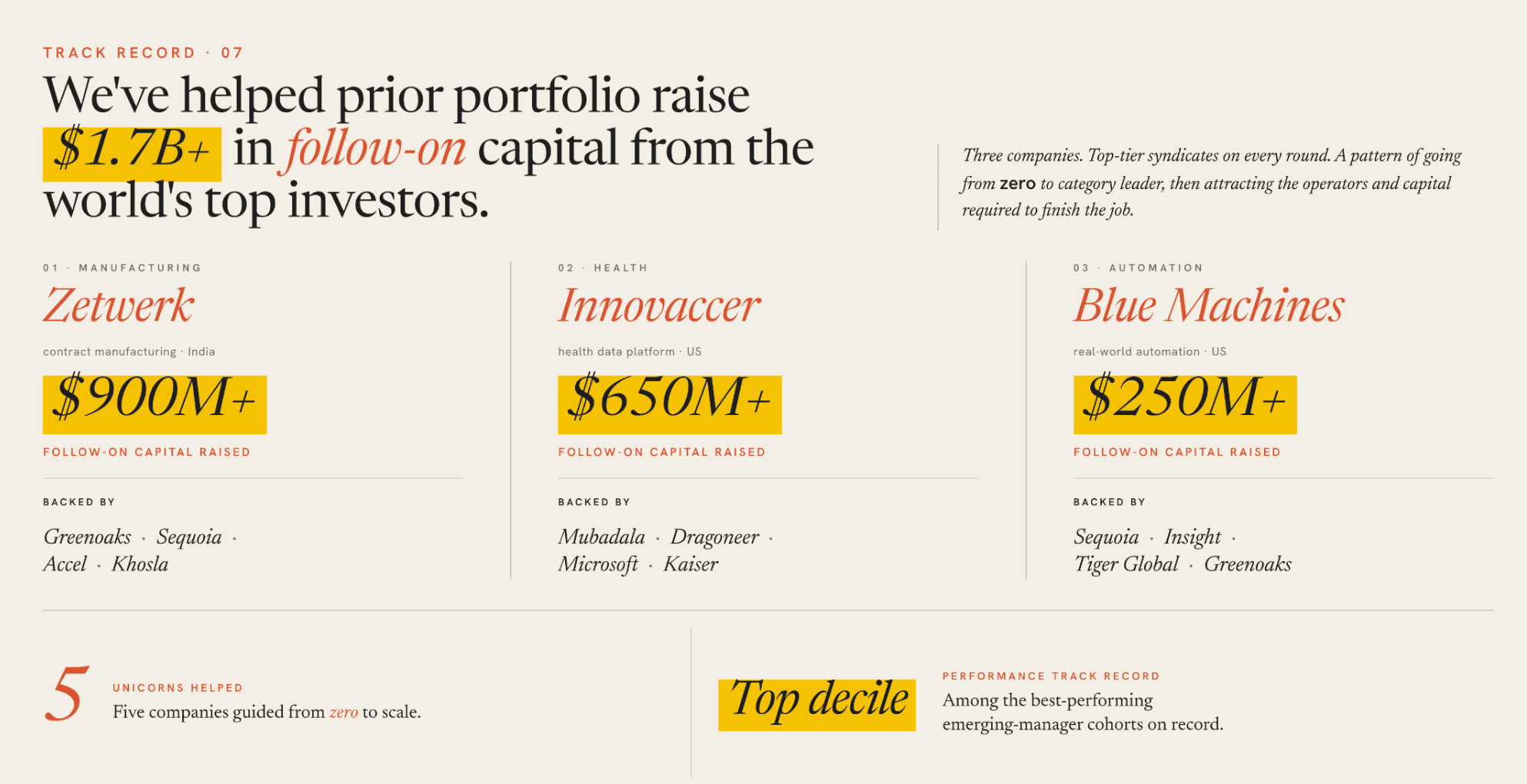
Ravi Mhatre and Bejul Somaia, Global Managing Partners of Lightspeed ($50B+ AUM) and builders of billion-dollar venture businesses from the ground up, were the first to back ODDBIRD. A decade ago, the two hired Dr. V into the firm, oversaw his development, and served as sounding boards through difficult board situations. We are grateful to have some of our closest friends and mentors backing us on day zero.
We are building a legendary investment firm. If you are a Limited Partner or founder who resonates with our view of the world, we would love to meet you. LPs, grab a time with us through this link. Founders, send your pitch deck to team@oddbirdvc.com.
No posts
Comments
Nothing yet. Say the first thing.
Sign in to join the conversation.