
Something is changing across the landscape…
Large buildings are appearing outside towns, beside industrial parks and across stretches of land that never expected to become part of a global artificial intelligence buildout. New substations are being proposed, utilities are warning of rising demand, and headlines are filled with concerns about electricity, water, farmland, noise and corporate agreements negotiated beyond public view.
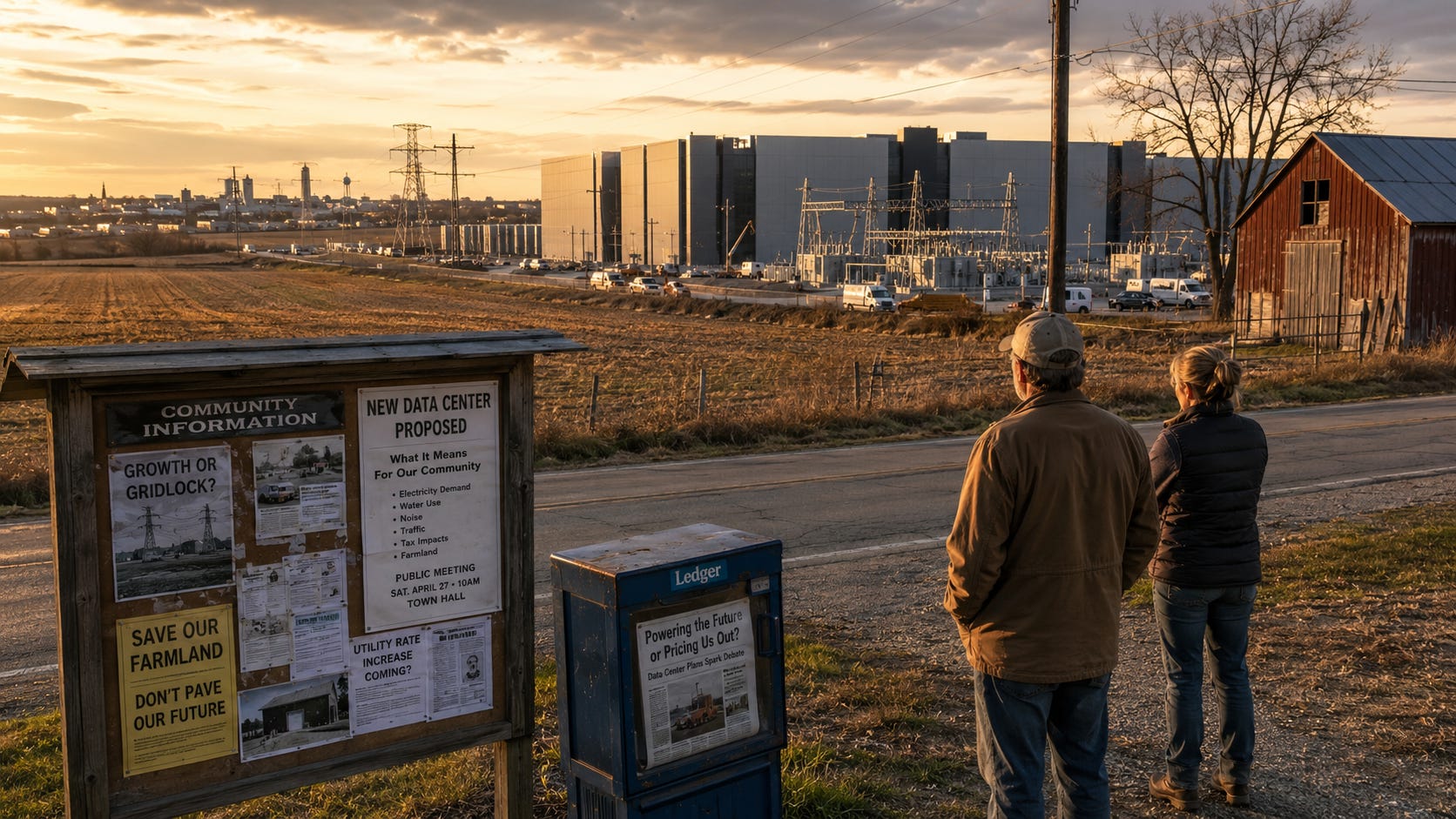
People are understandably nervous.
A data center can seem to appear almost overnight in the public conversation, even though planning may have begun years earlier. By the time residents hear about it, the project can feel enormous, unfamiliar and far enough along that local influence appears limited.
The negative coverage then fills the space where understanding should have been.
People see photographs of massive windowless buildings and hear that data centers consume extraordinary amounts of electricity. They begin wondering what these structures will mean for utility rates, water, property, local control and the familiar character of the community around them.
Those questions deserve real answers because infrastructure always reaches people through place.
It reaches the homeowner watching a familiar horizon change, the family whose land has carried generations and the town trying to weigh new investment against pressure on roads, power, water and public services. The concern begins long before anyone debates artificial intelligence because the physical structure has already entered someone’s lived environment.
Understanding starts by seeing what the building actually is. A data center is the physical place where the digital world lives.
Every photograph stored in the cloud, payment cleared through a bank, medical record retrieved by a hospital, route calculated by a navigation system and message moving across an online platform depends upon computers operating somewhere. Those computers require buildings, processors, memory, storage, electricity, cooling, fiber-optic connections, backup power, security and skilled people capable of maintaining them.
The cloud has always had a physical body.
For years that body remained mostly invisible because many facilities were smaller, distributed across existing buildings or concentrated near major cities. Artificial intelligence has increased the amount of computation being requested so quickly that the supporting infrastructure can no longer remain hidden from view.
Training advanced artificial intelligence requires large numbers of specialized processors working together. Every processor uses electricity and produces heat. Once a model has been trained, every question asked, medical image examined, scientific simulation performed or industrial system assisted requires additional computation.
Multiply that activity across hospitals, universities, laboratories, farms, factories, vehicles, businesses, public agencies and millions of individual users, and the scale begins to make sense.
The buildings are growing because civilization is asking computation to carry more complexity. Data centers consumed about 4.4 percent of total United States electricity in 2023, and the Department of Energy estimates that their share could reach roughly 6.7 to 12 percent by 2028.
That growth is real, which makes the design of the system surrounding it one of the most important infrastructure questions of our time.
The conversation becomes larger than whether data centers should exist. It becomes a question of where they belong, how they should be powered, how much land and water they should require and what lasting value should remain with the communities hosting them.
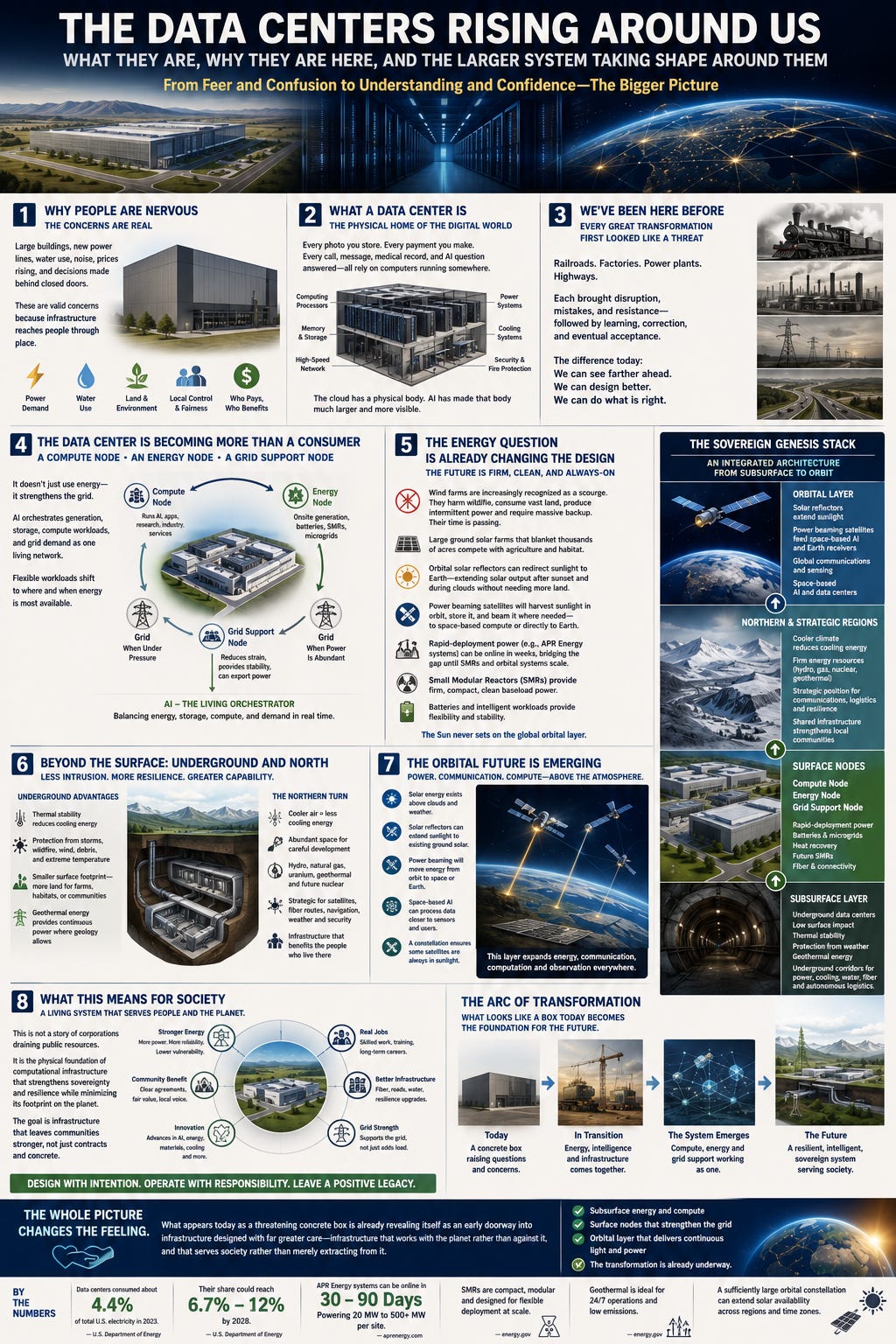
Every great transformation first entered society through unfamiliar physical infrastructure.
Railroads crossed farms, forests and towns before people understood how completely they would transform commerce, transportation and the movement of food and materials. Factories appeared beside rivers and cities before society could see the industrial world they would create. Electrical plants and transmission lines reshaped the landscape before electricity became essential to hospitals, refrigeration, communication and daily life.
Highways arrived as massive physical intrusions, cutting through land and communities before connecting regions and changing where people could live and work.
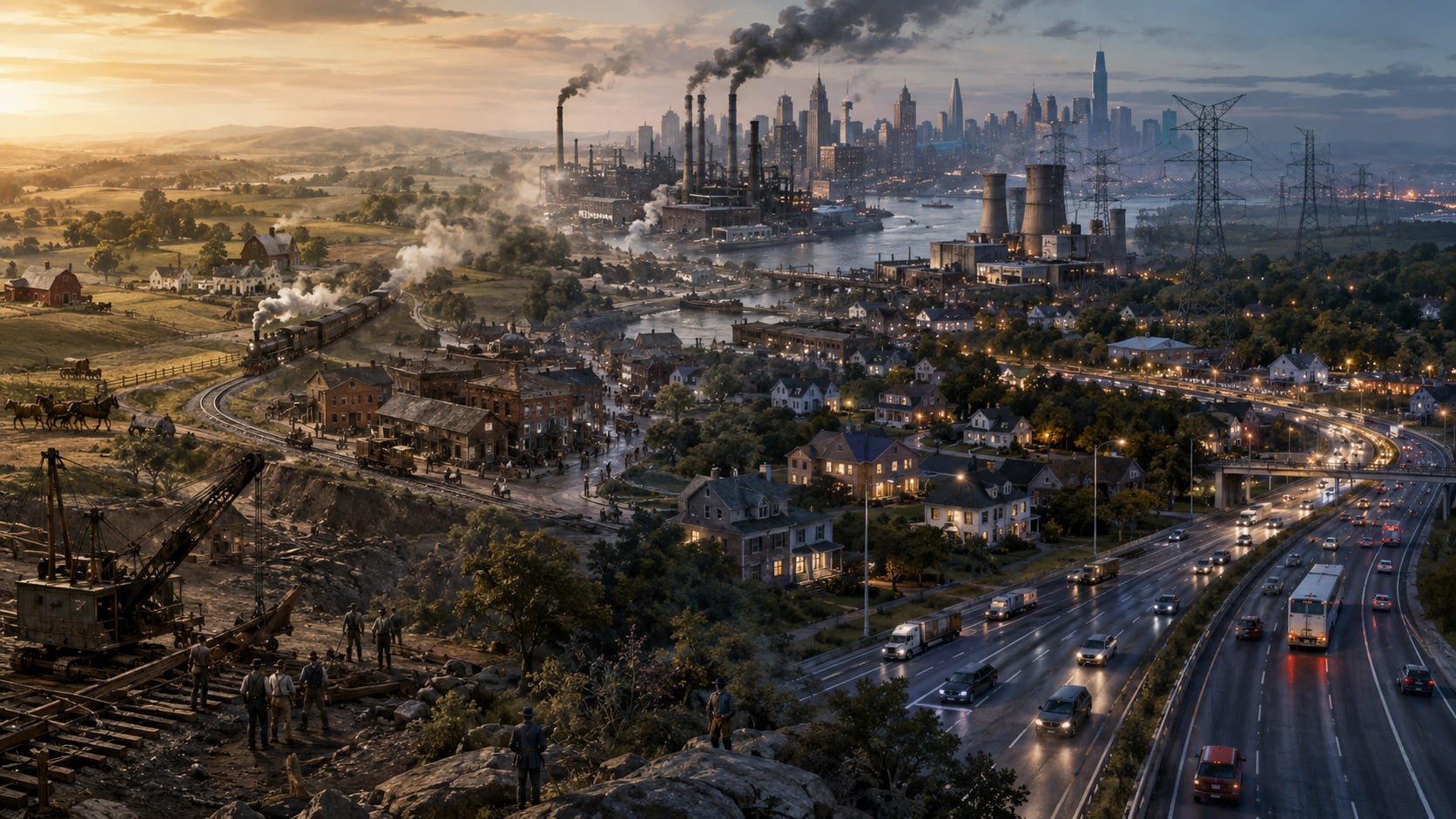
Each transformation carried possibility, disruption, mistakes, resistance and eventual learning within the same unfolding.
The systems people once feared gradually became accepted as their value entered ordinary life. That acceptance often arrived after serious harm because earlier industries expanded faster than public understanding and environmental knowledge could follow.
Factories polluted rivers before the relationship between industrial waste, ecology and human health became widely visible. Roads were built before planners understood how deeply they could divide communities. Energy systems grew through models centered on extraction and scale, often leaving the public to absorb consequences that never appeared inside the original business calculation.
The data-center buildout is entering a different environment.
We now possess the tools to study many consequences before the infrastructure is fully built. Engineers can model electricity demand, water movement, heat, noise, traffic, drainage, weather and future expansion. Sensors can monitor operating conditions continuously, while digital twins can test designs before steel is placed or concrete is poured.
Artificial intelligence can help improve the systems supporting it by forecasting demand, adjusting cooling, shifting flexible workloads and identifying stress before it becomes failure.
Civilization is learning while it builds.
That capacity gives us the opportunity to change the objective.
The monopolistic industrial systems of the previous era often measured success through how much could be extracted, produced and controlled. The infrastructure emerging today operates within a much more visible field of consequence because communities are watching, utilities are measuring and citizens are asking who pays, who benefits and what remains after construction is complete.
The objective now coming into view is infrastructure that strengthens the systems surrounding it.
A data center should bring energy capacity with it. It should help modernize the grid, expand fiber, create skilled work and leave the surrounding region more resilient. Its agreements should remain understandable to the public, and the infrastructure built around it should continue serving the community even as technologies and corporate ownership change.
Private companies will continue pursuing profit because profit drives investment and speed. Competition becomes productive when advantage flows toward companies capable of producing more computation from less energy, using less water, recovering more heat, reducing their land footprint and bringing dependable generation online faster.
Those gains eventually move beyond the data center.
Advances in processors, batteries, cooling, power electronics, autonomous maintenance and intelligent energy management flow outward into manufacturing, transportation, utilities and the household economy. Private ownership creates competitive pressure, deployment produces learning, and learning drives efficiency across the larger system.
The emerging architecture is being built through companies competing across energy, computation, communications, tunneling, manufacturing and space. Each layer places pressure upon the others to become faster, smaller, cheaper and more capable because weakness anywhere slows the entire system.
Most coverage describes the data center as a massive electrical load entering an already strained grid.
That description captures the facility people see today while missing the direction of the system forming around it.
The next generation of data centers will continue serving as compute nodes, providing the processing and memory required for artificial intelligence, medicine, research, communications and industry. They will increasingly become energy nodes as dedicated generation, batteries, microgrids and power-management systems are built around them.
Their third role may become equally important because they can support the wider electrical grid.
Some computational work needs an immediate response. Medical systems, communications, vehicles and industrial controls often belong in that category. Other work can move across time or geography. Model training, scientific simulation and large analytical workloads can often be scheduled when energy is more available or transferred toward another connected facility carrying greater capacity.
This flexibility allows a data center to reduce selected demand when the grid is under pressure and increase computation when generation is abundant. Batteries can bridge shorter disturbances, while dedicated generation and microgrids can reduce pressure on the surrounding electrical system.
The Department of Energy is already treating onsite generation, storage and flexible data-center operations as tools that can turn these facilities into grid assets. Its current strategy also includes microgrids, advanced nuclear, next-generation geothermal, long-duration storage and more efficient semiconductors.
The data center begins functioning as a compute node, an energy node and a grid-support node within the same physical system.
Artificial intelligence becomes the orchestrator connecting those roles.
It can observe generation rising and falling, energy moving into storage, processors creating heat, workloads entering the system and demand changing across the surrounding region. It can coordinate batteries, cooling and flexible computing while directing available power toward the place where it carries the greatest value.
Generation, storage, computation and distribution begin functioning as one integrated relationship.
The building people see beside a road gradually becomes part of a living energy and intelligence network capable of responding to conditions instead of simply consuming whatever electricity the grid can provide.
The energy question remains central because data centers operate continuously.
Hospitals still need information after sunset. Financial systems keep moving. Communications continue across every hour, and artificial intelligence serves people and machines throughout the night.
This creates demand for firm, dispatchable power capable of carrying the system through seasons, changing weather and unexpected disruption.
Wind and utility-scale solar can contribute electricity where local conditions support them, although their changing output and broad land requirements limit their ability to serve as the firm foundation beneath an always-on computational civilization. Their role becomes supplemental within an architecture built around continuous power, flexible storage and intelligent management.
Solar energy can remain valuable without requiring endless expansion across the ground. Batteries can smooth rapid fluctuations and bridge shorter interruptions. Rapid modular generation can close immediate gaps while permanent systems are being constructed. Geothermal energy can provide steady power where geology supports it, and the Department of Energy specifically identifies it as well suited to constant data-center operations.
Small modular reactors may eventually provide the compact, firm foundation required across decades, while orbital systems introduce a future path for extending solar availability beyond local daylight and weather.
The strongest design brings these layers together according to what each place can carry well.
The immediate energy challenge facing many large data centers is time.
A major grid connection may take years. New transmission, substations and power plants require engineering, permits, equipment and construction before the first unit of electricity reaches the facility.
Rapid-deployment generation creates a practical bridge.
APR Energy says its modular systems can deliver power within 30 to 90 days, scale from approximately 20 megawatts to more than 500 megawatts and provide behind-the-meter generation designed for hyperscale and artificial intelligence data centers.
A May 14, 2026 Federal Trade Commission notice identifies Elon Musk as the acquiring party for the entity controlling New APR Energy. The filing confirms the transaction, although the exact operational plan connecting APR with Musk’s wider artificial intelligence and space companies has not been publicly detailed.
The significance reaches beyond a single acquisition.
A company building massive computing capacity can no longer depend entirely upon utilities eventually delivering the required electricity. Generation, storage and fuel increasingly become part of the same end-to-end architecture as processors, cooling and communications.
Rapid modular plants can operate while permanent systems move through development. Large battery installations can stabilize the flow, and artificial intelligence can coordinate power production with the actual computational workload.
These bridge systems carry fuel, emissions, permitting and local obligations that deserve public visibility. Their purpose is speed within a larger transition, creating immediate capacity while firmer and more durable generation reaches scale.
The acquisition reveals a relationship that will continue shaping the entire buildout. Energy security and computational security are merging.
The organization controlling the intelligence increasingly wants direct influence over the power sustaining it.
Small modular reactors may eventually provide one of the most important foundations beneath major computing campuses.
Nuclear power delivers continuous electricity from a compact footprint. Modular designs are being developed around factory fabrication, repeatable components and the ability to add generation as demand grows.
The Department of Energy’s Generation III+ SMR program is explicitly intended to accelerate the construction and deployment of new reactors for rising electricity demand driven partly by data centers, artificial intelligence and industry. DOE describes their compact size and modular design as advantages for flexible deployment.
A future data-center campus could combine a small modular reactor with batteries, rapid backup generation and a microgrid capable of supporting the surrounding region. The computing facility becomes the durable customer that helps finance the reactor, while the completed generation can support factories, public services, water systems, homes and additional industry.
This is where the energy-node model becomes visible.
The data center brings power into the region and expands the total capacity available around it.
The same campus can recover heat from processors, circulate cooling through closed loops and direct thermal energy toward greenhouses, nearby buildings, industrial processes or water systems where local conditions allow.
Power, computation, cooling and community infrastructure begin operating as one ecosystem.
The data center stops looking like an isolated box draining resources from the world around it and begins functioning as an anchor for a more capable regional system.
Another layer is beginning above us.
A single satellite moving through low Earth orbit experiences periods of sunlight and darkness. A sufficiently distributed constellation changes the larger relationship because some assets can remain illuminated while others pass through shadow.
That is the practical meaning behind the phrase that the Sun never sets on the global orbital layer.
Solar energy exists above weather and cloud cover. The challenge is capturing it, storing it and moving it toward the systems requiring power.
Orbital solar reflectors offer one possible path.
Reflect Orbital received approval to launch its first demonstration satellite, Eärendil-1, to test whether sunlight can be redirected from low Earth orbit toward a precise location on the surface. The company describes this as an incremental demonstration whose results will guide any future scaling, environmental safeguards and operating practices.
A reflector could eventually direct sunlight toward an existing solar installation after local sunset, extending the productive hours of infrastructure already built on the ground. A constellation moving across regions and time zones could increase solar output without requiring proportional expansion across more land.
This concept remains at the demonstration stage, and questions involving astronomy, wildlife, human health, public consent and control remain central to whether it can responsibly scale. Reflect Orbital has publicly committed to exclusion zones, environmental review, brightness controls and the ability to turn its system off when conditions require it.
The deeper value lies in the direction.
Orbital augmentation could allow society to produce more energy from solar infrastructure already present on the ground.
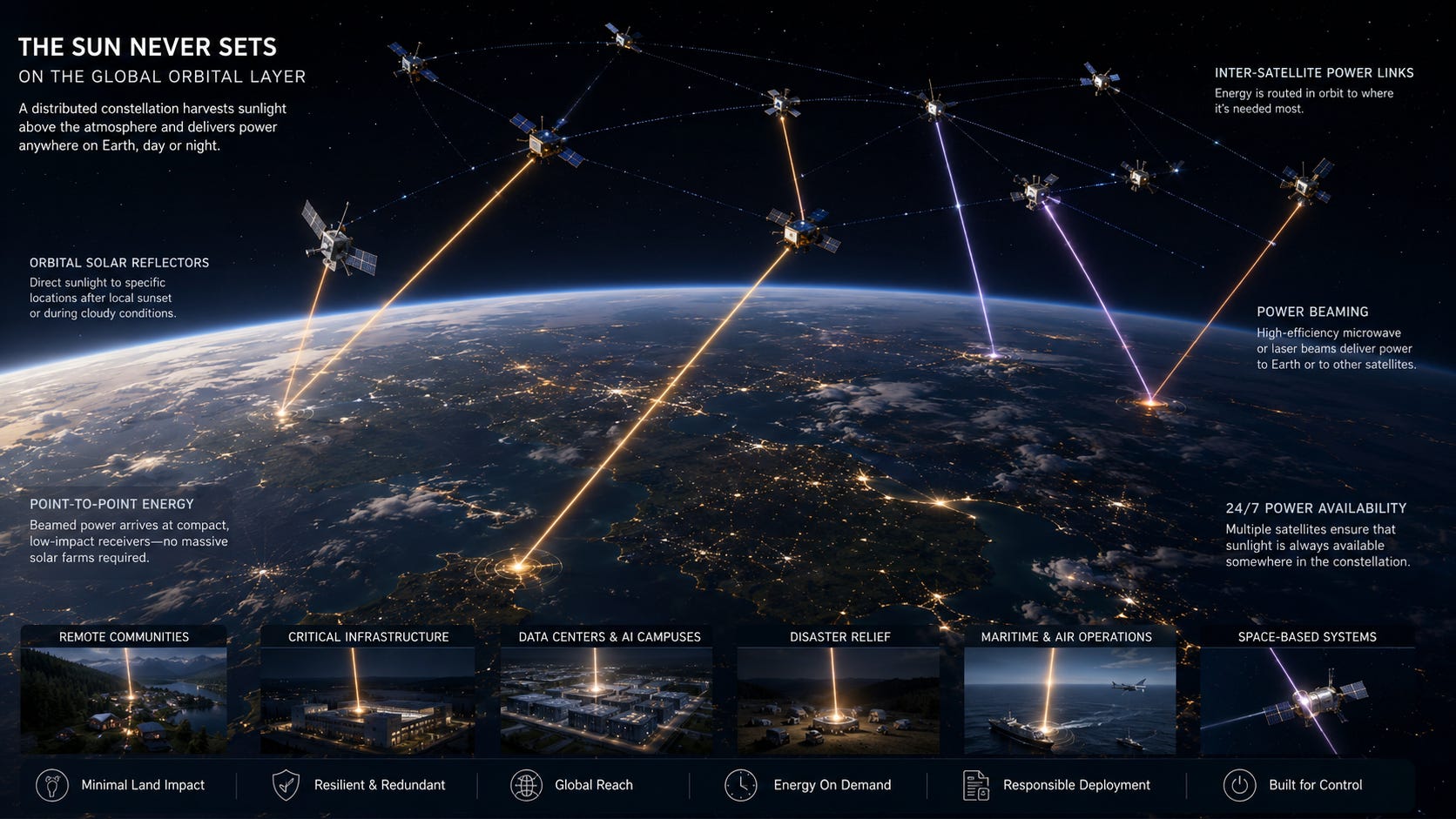
Power beaming extends the relationship further.
The Defense Innovation Unit is seeking prototypes for both space-to-space and space-to-terrestrial power transmission. Its stated future applications include orbital edge computing, in-space manufacturing, unmanned systems and power delivery across multiple orbital regimes and terrestrial locations.
Energy gathered above the atmosphere could eventually be transmitted toward another satellite, an orbital compute platform or a terrestrial receiver. Space-based artificial intelligence could process information closer to the sensors collecting it, while orbital power networks could support platforms whose energy needs exceed the output of their own panels.
The orbital layer then begins carrying communication, observation, computation and energy within the same distributed network.
This remains an emerging architecture with significant engineering, safety, economic and regulatory questions ahead. The recognition comes from seeing several developments beginning to occupy the same map.
Solar reflectors, power beaming, orbital computation and global communications are moving toward one another.
While part of the system moves upward, another part moves down.
The surface has been carrying nearly everything civilization builds. Homes, roads, farms, factories, warehouses, transmission lines and data centers all compete for the same visible land.
Depth creates another dimension.
Underground spaces offer thermal stability, physical protection and separation from severe weather. Mines and tunnels already show how large systems can operate beneath the surface, while modern sensors and autonomous equipment make these environments increasingly visible and manageable.
An underground data center could use liquid cooling and closed loops inside a thermally stable environment. Rock and soil can protect equipment from storms, wildfire, wind, debris and rapid temperature changes.
The visible footprint becomes smaller because additional compute chambers can extend along underground service corridors while the land above continues supporting agriculture, industry, energy generation, restored habitat or community use.
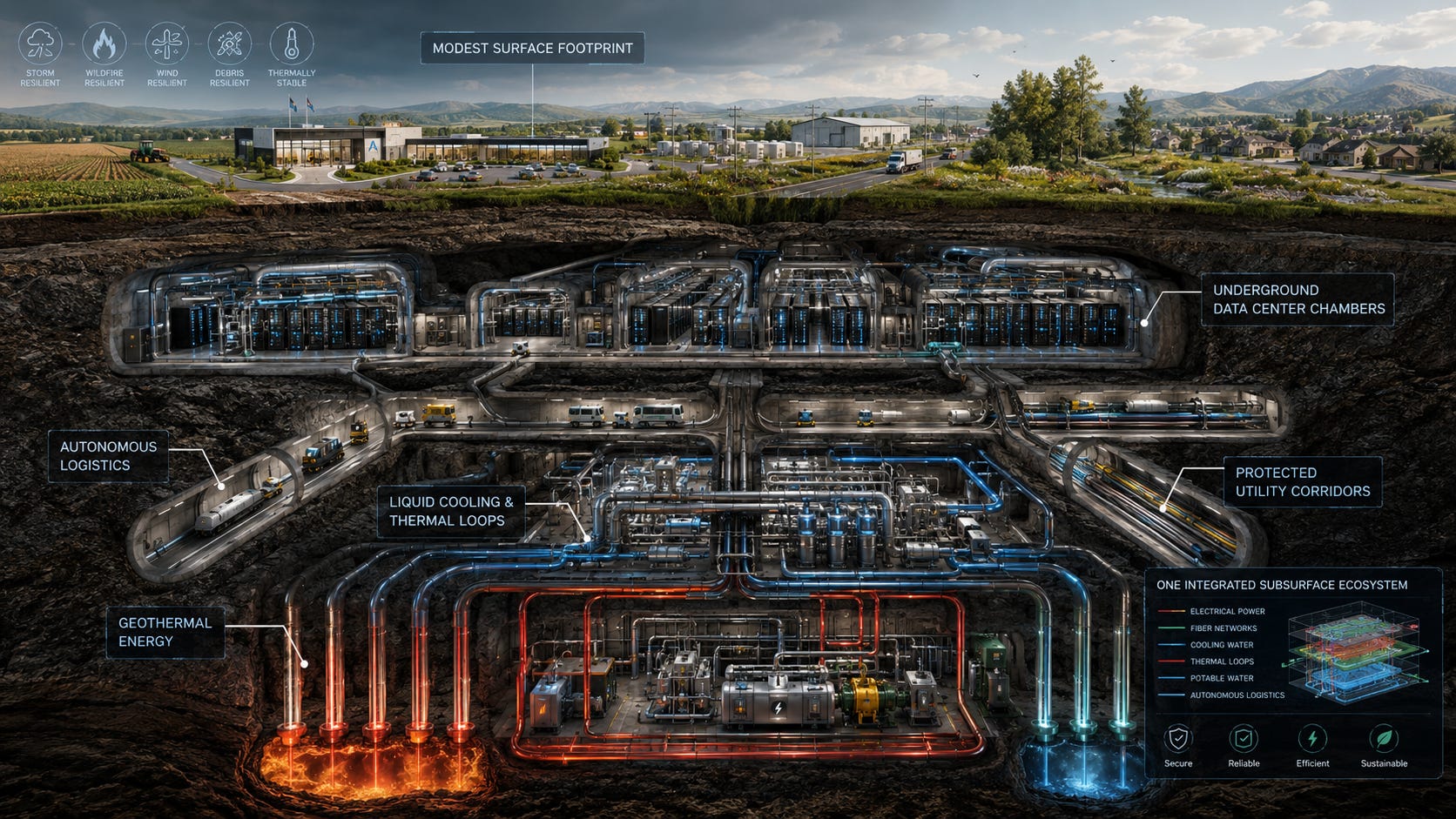
The subsurface layer also includes energy.
Geothermal systems can provide continuous generation where local geology supports them. Underground thermal loops can move heat between compute facilities, buildings and industrial systems, while protected corridors carry electricity, cooling, water, fiber and autonomous logistics beneath the surface.
Subsurface energy and subsurface computation become parts of the same protected architecture.
A future campus may have only a modest visible entrance while much of its computation, storage, cooling and power distribution operates below.
Progress becomes less obtrusive because intelligence allows the infrastructure to occupy space more carefully.
The map of computation is also moving toward cooler and more energy-rich regions.
Some workloads must remain close to the people and machines using them. Others can move toward power, climate and secure geography.
That is why Alaska, northern Canada, Greenland and other Arctic regions continue entering the conversation.
Cooler air can reduce the energy required to manage heat. Large territories provide room for carefully placed infrastructure, while hydroelectricity, natural gas, uranium, geothermal resources and future nuclear generation create several paths toward firm power.
Northern geography also carries strategic value for satellite communication, fiber routes, navigation, weather observation, logistics and national resilience.
The North can become more than another extraction zone where distant institutions remove value and leave little durable capacity behind. A sovereign build strengthens the people already living there.
Generation developed for computation can improve local electrical reliability. Fiber installed for a campus can reach underserved communities. Roads, ports, technical education, health services and skilled employment can become shared infrastructure.
The value becomes visible through what remains after the initial construction is complete.
Northern conditions also reward smaller, modular and protected systems. Long winters, remote logistics and sensitive landscapes create strong incentives for underground computation, closed-loop cooling, autonomous maintenance and infrastructure capable of continuing through disruption.
The Arctic, subsurface and orbital layers are appearing together because each solves a different part of the same problem. One reduces cooling demand, another reduces the visible surface footprint, and another expands communications, sensing, computation and future energy access beyond the atmosphere.
Their relationship becomes visible when they are understood as parts of one end-to-end design.
The pieces no longer appear as isolated headlines.
They form an architecture extending from beneath the Earth to orbit.
I call it the Sovereign Genesis Stack… link to article…
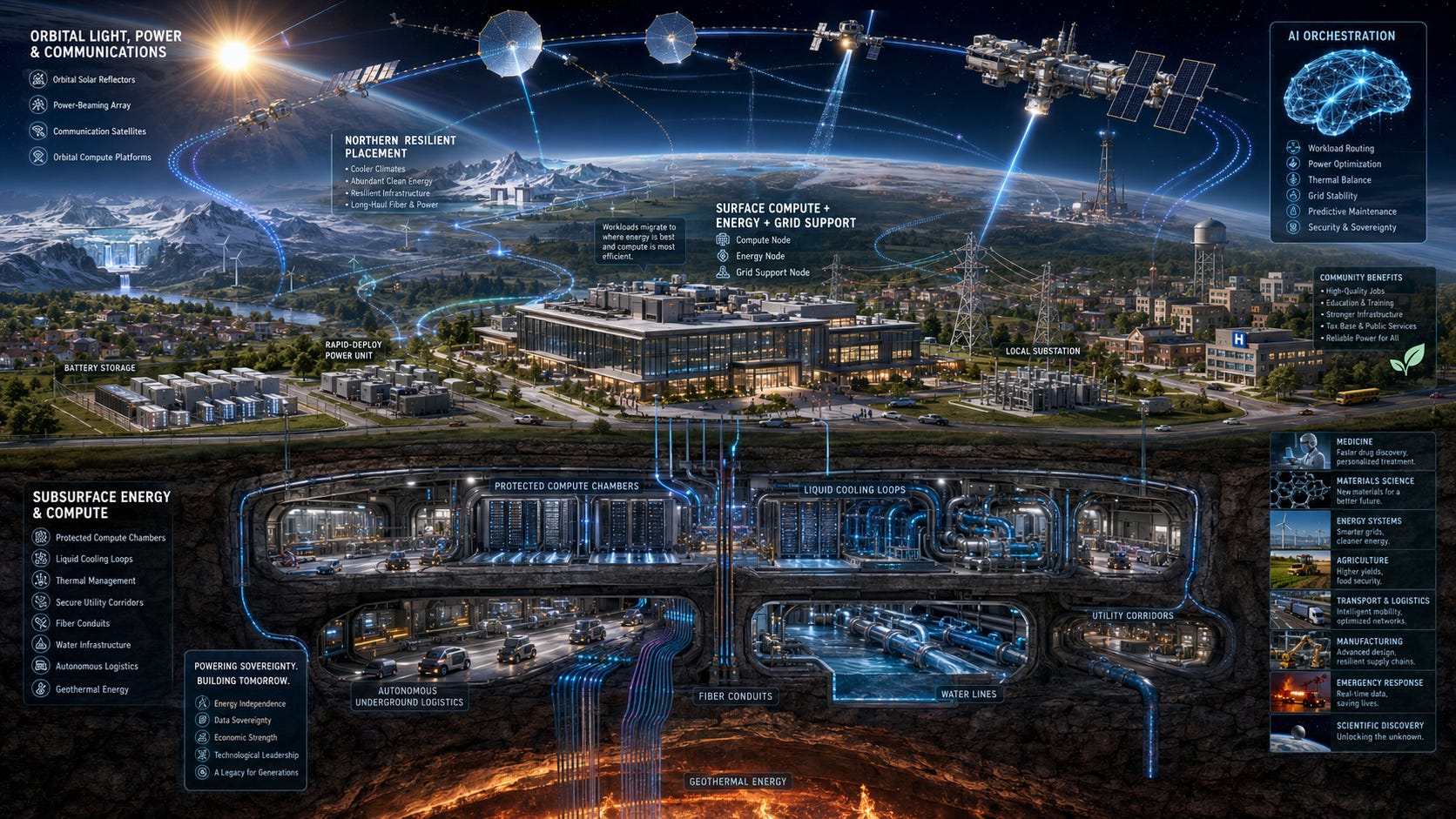
The subsurface layer carries protected computation, locally appropriate energy, thermal management, secure fiber and underground corridors connecting the physical system. The surface layer contains data centers functioning as compute nodes, energy nodes and grid-support nodes, paired with rapid modular generation, batteries, intelligent microgrids, heat recovery and eventually small modular reactors.
Northern regions provide cooler geography, strategic position, firm-energy potential and distributed resilience. Above them, the orbital layer carries communication, sensing, reflected sunlight, power transmission and space-based computation.
Artificial intelligence coordinates the relationships among them.
It balances workloads, generation, storage, heat, grid demand, terrestrial receivers and orbital assets as one connected system. The intelligence is no longer confined to the processors inside the building because it becomes the orchestration layer helping the wider architecture respond.
Private competition accelerates this development. One company finds a faster power solution while another improves cooling, processors, batteries, reactors, reflectors, power transmission or tunneling. Each advancement places pressure on the rest of the architecture to become more capable.
The companies compete to build the strongest infrastructure, and the accumulated efficiency flows outward into energy, manufacturing, transportation and daily life.
This is the larger pattern hidden beneath the separate announcements.
The data center is becoming one visible node in a distributed system designed to see, learn, generate, coordinate and continue through disruption.
Its sovereignty comes from the degree to which its essential layers remain understandable, secure, repairable and capable of serving the people and nations depending upon them.
The data center is becoming less of an isolated concrete box and more of a node inside a living, multilayered system.
It supports discovery in medicine, materials, energy, agriculture and science. It helps coordinate transportation, manufacturing, logistics and emergency response. It gives civilization greater ability to understand relationships that have grown too complex for any person or institution to hold alone.
The concerns about power, water, land, emissions and community benefit remain real because the physical structure still reaches ordinary people through a particular place.
Those concerns belong inside the design from the beginning.
A project serving distant users should leave its host community with stronger energy, better infrastructure, real employment, meaningful public value and a clear voice in the conditions surrounding it.
Underground systems can reduce the surface footprint. Northern regions can place selected workloads where cooling and energy conditions are more natural. Rapid generation can bridge the immediate power gap while small modular reactors create a firm long-term foundation.
Batteries and AI-managed workloads can support the grid, while orbital reflectors and power beaming may eventually extend energy into places and hours the surface system cannot easily reach.
The buildings appearing today are only the first visible piece.
Beneath them, subsurface energy and computation can operate within protected environments. Around them, rapid power, storage and intelligent grid support can strengthen the surrounding region. Above them, orbital light, communication, power transmission and space-based intelligence can expand the system beyond the limits of the surface.
What appears today as a threatening concrete box is already revealing itself as an early doorway into infrastructure designed with greater care.
The media shows us the building because the building is easy to photograph.
The larger system reveals the purpose.
The fear begins to soften when the whole Sovereign Genesis Stack comes into view and the separate pieces find their relationship.
Civilization is building downward to reduce intrusion, northward to reach climate and energy, outward into orbit to extend communication and power, and inward through artificial intelligence to coordinate the whole.
This is the transformation already underway.
The data center is becoming the physical foundation through which a sovereign civilization learns to see more clearly, coordinate more intelligently and build what comes next.
No posts
Comments
Nothing yet. Say the first thing.
Sign in to join the conversation.