
If you’ve followed me for a while, you’ll remember how I mapped Texas as the judicial template engine, with Ken Paxton driving court cases into national precedent and giving other states a path they could immediately follow. You’ll also remember how I mapped Florida as the policy factory, with Ron DeSantis turning state legislation into working models that can be stress-tested, refined, and exported across the country. In this article, I bring those two patterns together and show how Texas, Florida, the federal stack, SCOTUS, and the aligned state network are forming one replication architecture, where law becomes the spear, policy becomes the factory, the courts become the codification chamber, and America begins rebuilding from the states upward.
The pattern has moved beyond theory and settled into structure. Texas and Florida have become the two clearest state template factories in the country, each carrying a different layer of the same national rebuild. Texas moves through law, litigation, discovery, injunctions, appellate pressure, settlements, state investigative authority, multistate attorney general coalitions, and Supreme Court codification. Florida moves through policy, statutory velocity, administrative control, property-tax pressure, school choice, university reform, election enforcement, insurance restructuring, immigration compliance, health freedom, local-government audits, anti-ESG finance, online child protection, and executive discipline. Around them, the aligned state network carries the models outward. Above them, the federal stack turns state-tested structures into national operating rails.
That is the part some people still miss.
This operates as a sovereign system of systems…
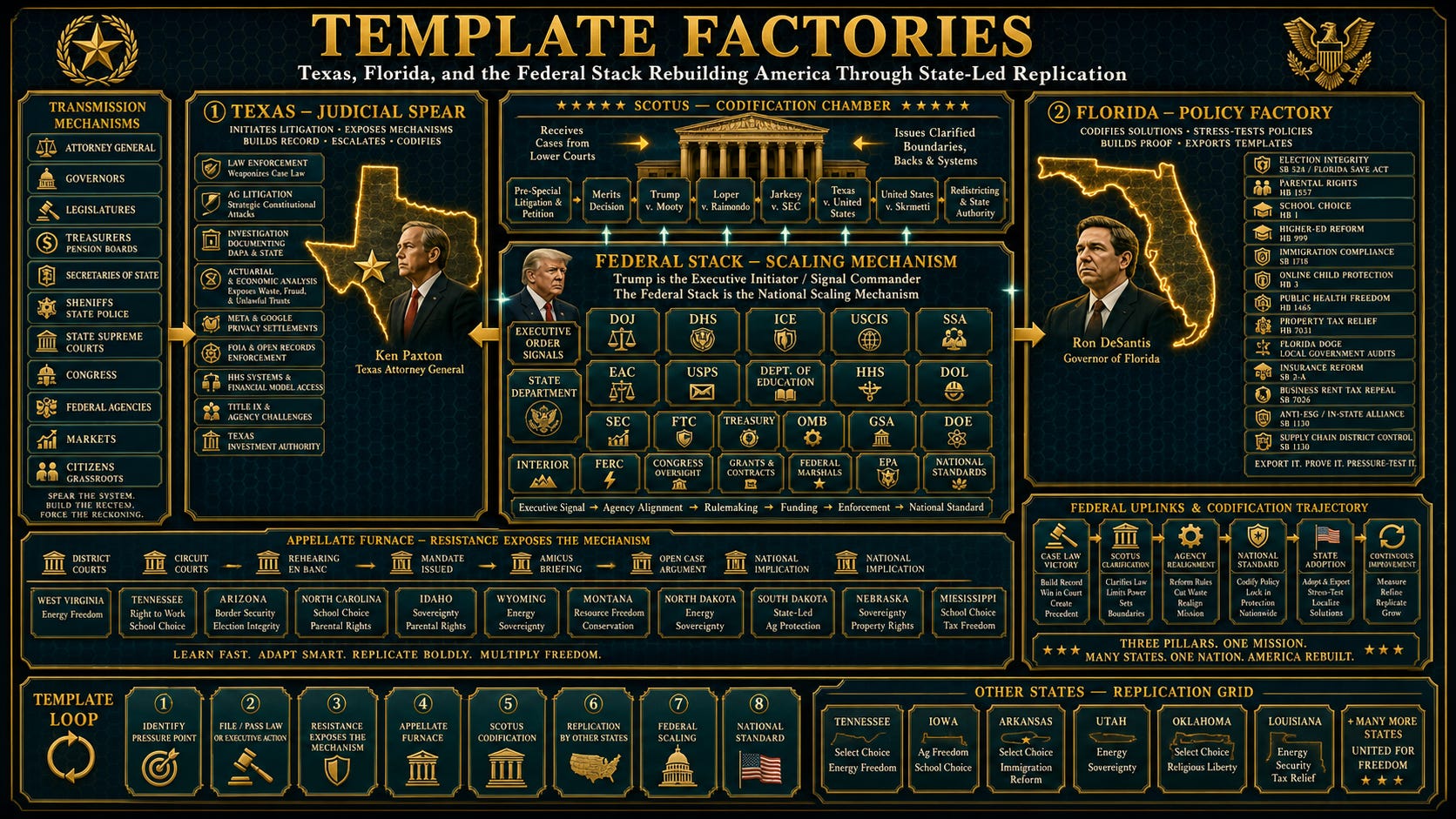
Texas is the judicial spear. Florida is the policy factory. The other states are the replication grid. The federal layer is the scaling mechanism. SCOTUS is the codification chamber. The people are the observation layer that finally sees how power has been hiding inside separate rails that were always connected.
The federal layer must be understood correctly because it is far larger than Trump alone. Trump is the executive initiator and signal commander. The federal stack includes executive orders, DOJ litigation, DHS enforcement, ICE operations, USCIS identity records, SSA data, State Department citizenship and passport records, the Election Assistance Commission, USPS election procedures, Department of Education guidance, HHS rulemaking, DOL retirement oversight, SEC proxy and market authority, FTC competition enforcement, Treasury financial intelligence, IRS nonprofit and donor rails, OMB budget control, GSA procurement structure, DOE and Interior energy authority, FERC grid regulation, congressional oversight, appropriations pressure, federal grants, contracts, rulemaking, appellate strategy, and Supreme Court review. This is the national scaling mechanism that takes state-tested templates and routes them through agencies, databases, funding, procurement, enforcement, and judicial codification.
Trump sets the direction, the agencies become operating arms, and the DOJ becomes enforcement and defense. While Congress becomes oversight and statutory amplification as federal databases become the identity backbone. Federal grants and contracts become compliance levers and SCOTUS becomes the boundary-setting chamber. The administrative state becomes the battlefield where Loper Bright, Jarkesy, and the APA now give states and the executive branch sharper tools to reverse overreach and constrain agency drift.
That is the real federal layer…
The state template begins the moment a pressure point appears inside the captured system and a state engages it directly. The target resists, and that resistance exposes the mechanism. Corporations counter, federal agencies push back, nonprofits sue, district judges block, platforms claim constitutional cover, financial actors deny coordination, and federal administrations invoke discretion. The conflict climbs through the system as the record hardens, the circuit courts engage, and SCOTUS either receives the case directly or shadows the fight through emergency posture. From that pressure comes a ruling, stay, remand, settlement, injunction, or clarified boundary that turns conflict into usable structure. Other states adopt the pathway, the federal stack aligns behind the tested model, and what began as one state action becomes a national template.
This is how restoration moves when the Republic remembers its own design…
As you recall, my earlier mappings demonstrate Texas as a live template engine, with Ken Paxton acting as the legal tip of the spear by turning lawsuits, injunctions, and enforcement moves into repeatable national patterns that other states can adopt. The cadence is visible in the way each move enters the field with purpose, forcing discovery, exposing the mechanism, setting precedent, and carrying the tested structure across state lines until one action becomes a replicable national pathway. Shift the center of gravity as multiple states begin operating from the same playbook. The same spine identifies the template stack itself, legal warfare, immigration enforcement, election integrity, corporate accountability, energy dominance, federal pushback, AG coalition synchronization, judicial precedent pipelines, economic leverage, narrative alignment, and the prove, scale, standardize loop.
Texas has built that stack across nearly every major control surface in national life. Digital platforms, adult-site age verification, biometric privacy, data extraction, AI systems, CCP-linked technology, ESG coordination, proxy-advisor influence, fossil-fuel boycotts, energy-market manipulation, pharmaceutical inducements, PBMs, food dyes, heavy metals in baby food, pesticides on organic produce, adulterated kratom, medical-record gatekeeping, parental medical access, immigration authority, sanctuary funding, birth tourism, H-1B abuse, ActBlue donation rails, voter-registration conduct, redistricting, Title IX, religious liberty, firearms regulation, state investigative authority, and federal administrative overreach all move through the same legal rhythm.
The digital layer gives the cleanest example of the judicial spear becoming national precedent. Texas HB 1181 moved through the appellate furnace and reached the Supreme Court in Free Speech Coalition v. Paxton, where the Court upheld Texas’s adult-content age-verification structure, holding that the law only incidentally burdens adults’ protected speech and survives intermediate scrutiny under the First Amendment. That ruling turns child protection, age verification, adult-content access, and online accountability into a national drafting pathway. States now have a tested constitutional structure they can replicate.
Texas HB 20 and Florida SB 7072 moved together through NetChoice v. Paxton and Moody v. NetChoice, where the Supreme Court vacated and remanded because the lower courts failed to properly analyze facial First Amendment challenges to the Texas and Florida laws regulating large internet platforms. That decision kept the platform-accountability question alive while forcing application-level scrutiny rather than allowing broad facial challenges to kill the whole field at the surface. Texas and Florida pulled Big Tech power into SCOTUS review, received instruction from the Court, and sent the fight back down with a sharper constitutional frame.
This is the appellate furnace…
The uphill battle is part of the design because every state law that draws resistance begins strengthening the path the moment the challenge arrives. A plaintiff sues, a district judge blocks, the media declares the move finished, and the case begins its climb as the record hardens, the circuit court refines the question, SCOTUS enters the field, and the national boundary comes into clearer form. The lower-court resistance that appeared to stop the movement becomes the very pressure chamber that exposes the judicial choke point and creates the record needed for codification. The resistance bench becomes a diagnostic layer. It shows where lower courts are acting as policy brakes, where universal injunctions are used as national vetoes, where facial challenges are stretched to freeze whole laws, and where SCOTUS must step in to restore constitutional proportion.
That furnace now runs through the federal layer as well. Trump v. CASA is the keystone because three district courts entered universal injunctions against Trump’s birthright-citizenship executive order, and the Supreme Court used the case to limit the power of lower federal courts to issue universal injunctions that extend relief beyond the parties before them. The Court did not decide the full merits of birthright citizenship in that emergency posture. It addressed the obstruction tool itself. That ruling matters across every domain because one district bench had been able to freeze national policy through a single case. Trump forced that mechanism into SCOTUS, and SCOTUS narrowed the weapon.
That is the federal uplink in its purest form. Texas and Florida face district-court resistance on state templates. Trump faces district-court resistance on federal templates. The Supreme Court begins limiting the obstruction tools themselves. The template factories build state pathways, federal power scales the tested logic, district courts attempt to freeze motion, circuits sort the signal, and SCOTUS codifies the operating boundaries of the Republic.
The administrative-state layer has its own codification spine. Loper Bright restored the judiciary’s duty to exercise independent judgment when reviewing whether an agency acted within statutory authority, overruling Chevron deference. SEC v. Jarkesy narrowed in-house administrative enforcement by holding that SEC civil-penalty fraud actions require a jury trial. Those cases shift power away from self-expanding agencies and back toward courts, juries, statutes, and constitutional process. Texas cases now operationalize that changed environment by challenging federal agency overreach in firearms, healthcare, Title IX, environmental policy, immigration, and regulatory funding conditions.
This is why the open cases matter. They are live codification pipelines. HB 20 and SB 7072 remain on the platform-accountability path after NetChoice. Texas SB 4 remains on the state-immigration-authority path. ActBlue remains on the election-finance and donation-rail path. BlackRock, Vanguard, and State Street remain on the ESG-antitrust and energy-market path. Florida HB 3 remains on the online-minor-protection path. Trump’s DEI and election-integrity orders remain on the merit-governance and citizenship-verification paths. Every open case teaches the network how to draft, plead, appeal, preserve standing, frame injury, survive injunctions, and climb toward codification.
The capital layer shows Texas converting financial control into legal exposure. Texas SB 13 targeted companies boycotting oil and gas, and SB 19 pressured financial institutions discriminating against firearm and ammunition industries. Paxton then escalated into the multistate antitrust lawsuit against BlackRock, State Street, and Vanguard, alleging coordinated market manipulation tied to coal and climate-driven capital pressure. A federal district court denied the asset managers’ motion to dismiss in August 2025, allowing the litigation to continue under Texas and federal antitrust law and Texas consumer-protection law. Vanguard settled in February 2026, resolving part of the lawsuit while BlackRock, Vanguard, and State Street remained in the broader fight.
That case matters because it shows the ESG template maturing. The fight begins as state finance law. It moves into public contracts and pensions. It reaches antitrust. It reaches proxy voting. It reaches fiduciary duty. It reaches shareholder influence. It reaches the core question of whether capital markets serve investor return or ideological steering. The Trump federal stack then aligns with the same rail through the December 2025 proxy-advisor executive order, which the White House framed around ending the outsized influence of proxy advisors that prioritize political agendas over investor returns.
Florida attacks the same capital rail through policy. DeSantis led an 18-state alliance against the Biden ESG financial agenda, with governors from Alabama, Alaska, Arkansas, Georgia, Idaho, Iowa, Mississippi, Missouri, Montana, Nebraska, New Hampshire, North Dakota, Oklahoma, South Dakota, Tennessee, Utah, West Virginia, and Wyoming joining the push. Florida framed the alliance around rejecting ESG control of pensions, procurement, contracting, and financial access.
That alliance reveals how the replication grid works beyond attorneys general. Governors carry policy alignment. State treasurers and comptrollers carry pension and investment pressure. Legislatures carry anti-ESG language into statutes. Pension boards redirect capital. State financial officers create lists, letters, and standards. Texas litigates. Florida codifies. The aligned state network carries the capital-sovereignty rail across the map. Trump then routes the same structure through proxy oversight, retirement policy, SEC, DOL, FTC, and federal procurement.
The Google antitrust story shows the attorney general network in its clearest form. Paxton led 50 attorneys general in a multistate, bipartisan investigation of Google’s business practices under state and federal antitrust law. That was Texas functioning as national legal origin node, using the AG network as a transmission line across the country. One state becomes the lead node. Other attorneys general enter. Federal antitrust law becomes common language. State consumer-protection law adds leverage. A corporation faces pressure from every jurisdiction at once.
That same Texas privacy rail later produced massive single-state settlements. Paxton secured a $1.4 billion settlement with Meta over unauthorized biometric data capture and a $1.375 billion settlement with Google tied to Texans’ data privacy rights. Those outcomes build a state-level privacy enforcement template around facial geometry, voiceprints, location tracking, browsing activity, biometric identifiers, and opaque surveillance practices.
The data rail then merges with child protection and national security. Texas launched investigations into platforms and AI systems under the SCOPE Act and Texas privacy law, while also opening pressure against foreign-linked technology concerns such as DeepSeek and CCP-aligned companies. The structure is clean because privacy becomes child protection, child protection becomes AI regulation, AI regulation becomes foreign-influence screening, and foreign-influence screening becomes critical-infrastructure defense. That is how one legal theory migrates across the control surface.
The food and health layer turns the state attorney general into a biological sovereignty node. Paxton secured a legal agreement with Kellogg’s tied to artificial dyes, investigated baby-food manufacturers over alleged heavy metals, investigated organic produce sprayed with pesticides, pursued toothpaste packaging claims involving children’s fluoride amounts, sued kratom retailers over 7-OH concentrations, sued Eli Lilly over alleged inducements tied to profitable drugs, pursued insulin manufacturers and PBMs, and sued Epic Systems over alleged electronic health-record gatekeeping and parental access restrictions. These are separate cases at the surface and one rail underneath. The body becomes a jurisdiction. The food label becomes evidence. The package becomes representation. The prescription path becomes a revenue map. The health database becomes a sovereignty rail, and MAHA via RFK Jr communicates it into policy for all to see.
Florida builds the parallel health and family rail through policy. Florida’s public-health freedom structure, parental-rights laws, consent frameworks, and education transparency all move responsibility back toward family authority and state-defined limits. Texas hits products, inducements, databases, and corporate practices through lawsuits. Florida codifies health choice, parental notice, and state authority through statute. The federal layer can then align through HHS rulemaking, federal funding conditions, agency rollback, and family-policy guidance.
Florida’s power comes from statutory velocity. It is the controlled build environment where policy is engineered, implemented, challenged, refined, and exported. The Florida template stack includes election integrity, parental rights, universal school choice, higher-ed DEI removal, anti-ESG finance, immigration compliance, online minor protection, property-tax pressure, local-government audits, business-rent tax repeal, insurance reform, civil-justice reform, condo safety, corporate special-district control, public order, permitless carry, emergency-management preemption, and disaster recovery.
The property-tax layer belongs near the center because it touches the deepest relationship between citizen, land, home, and government. Florida already has a homestead architecture, and DeSantis moved the deeper question into open structural pressure by proposing an average $1,000 property-tax rebate for homestead property while tying the burden to local-government spending. Florida DOGE then becomes the exposure mechanism behind that reform. DeSantis and CFO Blaise Ingoglia highlighted Florida DOGE audits after teams traveled to 12 jurisdictions and reviewed data requests sent to all 411 municipalities and 67 counties, identifying waste, fraud, abuse, and opportunities for improvement.
That rail is missing from most analysis because property-tax reform brings the structure directly to the citizen’s front door, where the cost of government is felt through the home itself. DOGE becomes the audit mechanism that exposes the spending beneath the burden, local budgets become the field of visibility, homestead protection becomes the sovereignty frame, and constitutional amendment strategy becomes the long path for turning homeowner pressure into durable structural reform. Other states can copy the same model by auditing local spending, exposing budget inflation, tying waste to property-tax burden, protecting homeowners, and forcing the question of whether land ownership remains real when government extracts rent forever.
Florida’s fiscal model also includes business formation and debt discipline. The state’s budget materials describe large reserves, debt reduction, a goal to pay down 50 percent of tax-supported debt by fiscal year 2027-2028, and the elimination of 741 government positions. That fiscal posture becomes part of the template because property-tax pressure, local audits, business-rent tax repeal, reserves, debt reduction, and lean government all move inside one state operating model.
The election stack is one of Florida’s most exportable models. SB 524 created the Office of Election Crimes and Security inside the Department of State, revised voter-roll maintenance frequency, and strengthened election-law investigation structure. Florida then signed the Florida SAVE Act in April 2026, with DeSantis and Secretary of State Cord Byrd framing it as a continuation of Florida’s effort to lead the nation in secure, transparent, efficient elections and ensure only citizens vote in Florida elections.
Trump’s federal election stack scales that same direction. His March 2025 election-integrity order strengthened voter citizenship verification, directed federal agencies such as DHS, SSA, and the State Department to provide states access to databases to verify eligibility and citizenship, and targeted foreign-national interference. His March 2026 order invoked HAVA, NVRA, and the federal obligation to guarantee a republican form of government to every state. The White House fact sheet says the 2026 order requires citizenship verification for federal elections and modernizes mail-in and absentee ballot procedures through USPS.
Now the election system becomes a full stack. Florida builds election enforcement offices and ballot-administration discipline. Texas presses ActBlue, voter-registration conduct, redistricting, and donation-rail transparency. Trump connects citizenship verification, federal databases, USPS procedures, HAVA, NVRA, EAC, DHS, SSA, State Department, and federal election standards. Secretaries of state become operational nodes. County election offices become execution nodes. Federal databases become the identity backbone.
The ActBlue case is the live donation-rail pipeline. Paxton sued ActBlue in April 2026, alleging deceptive donation processes that allow fraudulent and foreign donations to undermine election integrity. The case places political fundraising platforms, donor verification, prepaid and gift-card concerns, foreign-money risk, consumer protection, payment rails, campaign infrastructure, and federal oversight into one codification path. This does not yet account for the potential passage of the national SAVE Act or a Trump election-integrity executive order that could further tighten the federal layer around citizenship verification, voter-roll integrity, and election enforcement.
Florida’s education stack may be the most copied policy architecture in America. HB 1557, the Parental Rights in Education law, requires procedures for notifying parents about specified student information, reinforces the fundamental right of parents to make decisions regarding upbringing and control, restricts school procedures that encourage withholding critical information from parents, requires notice around healthcare services, and authorizes parents to sue for declaratory or injunctive relief.
HB 1 expanded school choice options for all students in Florida, with state education materials describing the expansion as empowering every family and every child to pursue educational goals. SB 266 reshaped higher education by prohibiting institutions from spending funds for certain purposes tied to DEI and social-activism programming, revising general education core-course rules, and changing oversight structures.
Trump’s federal education layer carries the same structure upward. The January 2025 education freedom order states that his administration supports parents in choosing and directing the upbringing and education of their children and directs the Secretary of Education to issue guidance on how states can use federal formula funds to support K-12 choice initiatives. The March 2025 order and fact sheet frame the direction as returning power over education to families instead of bureaucracies.
That is the state-to-federal rail…
Florida proves parental rights and universal choice. Texas adds Education Freedom Accounts and higher-ed DEI removal. Tennessee, Iowa, Arkansas, Utah, West Virginia, Arizona, and other states carry school-choice and parental-rights templates through their legislatures. Trump aligns federal guidance, formula funds, agency posture, and the Department of Education with the same direction. The education monopoly loses automatic control as the funding rail begins following the child and the authority rail begins returning to the parent.
Florida’s immigration stack runs through SB 1718, which prohibits counties and municipalities from funding IDs for people lacking proof of lawful presence, invalidates certain out-of-state licenses issued exclusively to unauthorized immigrants, requires hospitals to collect patient immigration-status data, and ties employer violations to economic-development incentive consequences.
Texas presses the sovereignty boundary through courts, border enforcement, SB 4, birth tourism, H-1B investigations, sanctuary funding, and NGO pressure. Florida proves employment compliance, licensing, hospital data, local-funding restrictions, and state coordination. Trump scales the federal immigration posture through executive orders directing faithful execution of immigration laws, protecting communities from criminal aliens, and enforcing federal law against sanctuary jurisdictions.
Other states carry specialized pieces of that immigration template. Oklahoma and Louisiana carry state-enforcement pressure. Tennessee and Iowa carry employment, law-and-order, and school-choice alignment. Arizona remains an early border and school-choice proof point. The Dakotas, Montana, Idaho, Wyoming, and Nebraska carry land, sovereignty, energy, and federal-overreach resistance. West Virginia carries energy, coal, school choice, and anti-ESG force. Missouri carries speech and federal-overreach litigation, especially through the censorship line that produced Murthy v. Missouri, which itself became a standing lesson for the next generation of cases. North Carolina is now part of the redistricting replication grid. Mississippi and Utah carry digital child-protection and age-verification signals. Arkansas carries school-choice and child-protection policy. These states are replication nodes and specialization nodes inside the same national field.
Florida’s online child-protection stack now speaks directly to Texas’s age-verification win. HB 3 requires regulated social-media platforms to prohibit certain minors from creating accounts, requires termination options, sets conditions for minors entering contracts with platforms, authorizes enforcement through the Department of Legal Affairs, and allows Civil Investigative Demands. Litigation has blocked major parts of Florida’s social-media restrictions, while Texas’s adult-content age-verification law has already been upheld at SCOTUS. That means the two state templates now teach the next drafting wave together. Texas shows where the child-protection theory holds. Florida shows where social-media access restrictions face harder First Amendment terrain.
Florida’s insurance and civil-justice stack adds a physical property and market-stabilization rail. SB 2-A created the Florida Optional Reinsurance Assistance program, added post-hurricane examination authority, set conditions for mandatory binding arbitration, and prohibited assignment of post-loss benefits under residential or commercial property policies issued after a specified date. HB 837 created broad civil-remedies changes, including attorney-fee presumptions, negligence statute-of-limitations changes, bad-faith standards, medical-damages evidence standards, and comparative-fault adjustments.
That is Florida as risk-pricing laboratory. Insurance, tort incentives, claims behavior, reinsurance, assignments, bad faith, attorney fees, and litigation exposure become one state market architecture. Add condo reforms, storm recovery, emergency management, building safety, and local-government discipline, and Florida becomes a physical-resilience template for states facing insurance stress, disaster exposure, and housing instability.
Florida’s corporate special-district fight with Disney belongs in the same architecture because it shows how a state can reclaim quasi-governmental privileges granted to a private actor. That template reaches special districts, development authorities, tax privileges, bond obligations, cultural leverage, and corporate-government fusion. A corporation that functioned with unique public powers was pulled back into state-defined accountability. That model can travel wherever private institutions hold delegated public power or special public privilege.
Now the other-state network comes fully into view…
Texas and Florida are the flagship origin factories. Tennessee, Iowa, Arkansas, Utah, Oklahoma, Louisiana, West Virginia, Missouri, Arizona, North Carolina, Idaho, Wyoming, Montana, North Dakota, South Dakota, Nebraska, Mississippi, and Alabama are replication and specialization nodes. The aligned state network carries specialized pressure across the map, with each state holding a different rail inside the larger replication field. School choice, immigration, energy, anti-ESG finance, digital child protection, firearms, election integrity, redistricting, federal-land authority, and state-sovereignty pressure all move through their own state-level channels, then converge into one national grid where each specialized template strengthens the whole. Together they form a distributed operating field where Texas litigation and Florida policy become multi-state structure.
The mechanics of transmission are now clear because every layer of the system has a role in carrying the template forward. Attorneys general move the legal pressure through lawsuits, amicus briefs, multistate investigations, Civil Investigative Demands, rulemaking comments, and settlement structures that other states can reuse. Governors carry the executive signal through alliances, emergency authority, agency discipline, public posture, and coordinated policy direction. Legislatures turn the pattern into statutory language, while treasurers, comptrollers, and pension boards move capital pressure through public funds, fiduciary standards, procurement rules, and investment rails. Secretaries of state carry the election mechanics. Sheriffs, state police, and local law enforcement carry physical enforcement. State supreme courts define state constitutional boundaries, while federal courts refine the pathway through appellate pressure. Congress amplifies the exposed rails through oversight, subpoenas, appropriations, SAVE Act pressure, ActBlue scrutiny, ESG hearings, DEI hearings, censorship hearings, and statutory follow-through. Federal agencies carry implementation, DOJ carries enforcement and defense, SCOTUS carries codification, federal databases carry identity, federal grants and contracts carry compliance, and citizens carry the observation layer that allows the whole system to be seen, understood, and replicated.
This is the full system…
The circuit geography matters because every state template travels through a judicial terrain that shapes how quickly it hardens, where resistance appears, and how much gravity builds around the question. Texas often moves through the Fifth Circuit, Florida through the Eleventh, and the Missouri and Louisiana censorship fights carried their pressure through the Fifth before reaching SCOTUS. Other aligned states feed the Sixth, Eighth, and Tenth Circuits, creating multiple refinement chambers across the federal judiciary where arguments sharpen, records mature, and conflicts begin to form. As those conflicts deepen, circuit splits create Supreme Court gravity, and that gravity creates codification potential. District-court resistance becomes part of the exposure layer, revealing which benches still function as control points inside the old architecture while the appellate system turns that resistance into a clearer path upward.
Settlement agreements also need to be recognized as soft codification. Meta, Google, Vanguard, Purdue, Kellogg’s, toothpaste manufacturers, and other settlement structures create enforceable behavior change without requiring a final Supreme Court ruling. A settlement changes industry behavior, creates compliance terms, builds model language, and gives other states a ready-made agreement structure. This is how corporate behavior shifts before full judicial codification arrives.
Congress is the federal statutory amplifier. Committees issue subpoenas, demand Treasury records, investigate ActBlue, hold hearings on censorship, DEI, ESG, immigration, Big Tech, proxy advisors, school funding, and agency abuse. Those findings become appropriations pressure, statutory language, oversight letters, criminal referrals, agency restrictions, and public exposure. Congress does not replace the state template factories. It amplifies them after the states expose the rail.
The national-security layer runs through the entire architecture. DeepSeek, TP-Link, Alibaba, CapCut, CATL, DJI workarounds, birth tourism, foreign land concerns, foreign donations, H-1B fraud, CCP-linked technology, data extraction, port access, energy infrastructure, supply chains, and university funding all belong in one rail. Texas uses lawsuits, investigations, and CIDs. Florida uses immigration compliance, state agency control, and election integrity. The federal stack uses Commerce, CFIUS, Treasury, DHS, DOJ, State Department, export controls, procurement bans, sanctions, and congressional China oversight. That is how foreign influence becomes visible across technology, land, data, labor, elections, education, and capital.
Energy is the physical sovereignty rail. Texas carries oil, gas, coal, pipelines, LNG, grid stability, ERCOT, fossil-fuel finance, and anti-ESG energy-market litigation. Florida carries hurricane resilience, insurance markets, ports, space coast infrastructure, disaster recovery, property hardening, and fiscal reserves. The federal stack carries DOE, Interior, EPA, FERC, permitting, LNG approvals, emergency powers, grid policy, and procurement. Energy, infrastructure, capital, and law form one spine.
The narrative layer is the consciousness rail. Every lawsuit, ruling, injunction, settlement, executive order, agency reversal, DOGE audit, congressional hearing, and state bill educates the public. People begin seeing what had been hidden in silos. They start recognizing that an election roll, a donation platform, a proxy advisor, a school curriculum, a medical database, a social-media account, a food label, a property-tax bill, a special district, and a federal database are all rails inside a larger operating system.
Once the architecture is seen as a system, every surface reveals itself as a rail. A voter roll carries identity, a ballot carries custody, ActBlue carries donation flow, E-Verify carries labor verification, proxy advisors carry capital influence, and pension funds carry market pressure. School curriculum carries consciousness, university DEI offices carry institutional programming, hospital portals carry medical authority, social-media accounts carry attention, biometric databases carry surveillance, and food labels carry biological trust. Birth-tourism centers carry citizenship, property-tax bills carry land sovereignty, special districts carry corporate-government power, county budgets carry local authority, insurance statutes carry risk pricing, and condo reserve rules carry physical infrastructure. Federal grants carry compliance, procurement contracts carry industry control, databases carry identity at scale, and Supreme Court rulings carry codification, turning what looked like separate systems into one living map of how power moves, how templates form, and how the Republic can reclaim each rail through lawful structure.
Texas and Florida are forcing each rail back into lawful structure…
The federal layer now resolves as the national scaling stack, where executive orders set direction and the machinery of government carries tested templates into operating form. Agencies implement, DOJ litigates, DHS and ICE enforce, and USCIS, SSA, the State Department, EAC, and USPS connect citizenship, identity, eligibility, and election procedure into one verification field. The Department of Education routes parental rights and school choice through guidance, formula funding, and institutional pressure, while HHS carries health rules, grant conditions, and medical policy. DOL, SEC, FTC, and Treasury carry the retirement, proxy, fiduciary, competition, and financial rails. OMB and GSA carry budget control, procurement structure, and contract leverage. Energy, Interior, EPA, and FERC carry the energy and infrastructure rails. Congress carries oversight, subpoenas, appropriations, and statutory amplification. SCOTUS carries codification. The APA carries the challenge path against agency overreach. Federal grants and contracts carry compliance pressure, databases carry identity at scale, and together the full stack becomes the national mechanism that takes state-tested templates and turns them into federal alignment.
Trump is the commander of that stack, and the stack is the mechanism that scales the state templates…
This is why the movement feels larger than politics. It touches the body through food, drugs, dyes, fluoride, heavy metals, kratom, medical records, and health consent. It touches the mind through schools, curriculum, libraries, pronouns, parental rights, DEI removal, platform accountability, AI safety, and age verification. It touches the border through SB 4, birth tourism, H-1B enforcement, E-Verify, licensing, detainers, sanctuary pressure, and federal immigration posture. It touches capital through ESG, proxy advisors, retirement accounts, fiduciary duty, fossil-fuel boycotts, firearm-industry discrimination, antitrust, pensions, business taxes, and commercial rent. It touches elections through voter rolls, citizenship verification, redistricting, mail procedures, drop boxes, ballot custody, election-crimes offices, donation rails, voter-registration conduct, and foreign-money screening. It touches land through homestead exemptions, Save Our Homes, property-tax rebates, property-tax elimination proposals, special-district reclamation, emergency rebuilding rules, insurance reform, condo safety, and local-government audits.
The old system relied on fragmentation, training people to see each control surface as separate while the same architecture quietly moved beneath them all. Education sat inside one silo, elections inside another, food inside another, data inside another, immigration at the border, ESG inside capital markets, proxy advisors inside corporate governance, medical records inside hospital software, property taxes inside local budgets, insurance inside actuarial tables, social media inside private moderation, donation platforms inside campaign infrastructure, special districts inside obscure charters, federal databases inside agency walls, grants inside bureaucratic conditions, and procurement inside contracting language. Once the pattern is held as one field, the separation dissolves and the system reveals itself as a connected operating structure where every silo carried a rail, every rail carried leverage, and every leverage point can now be brought back into lawful alignment.
The template factory model collapses those silos because the states are treating each rail as part of one system of systems…
Texas exposes the mechanism through law, Florida hardens the response through policy, and the rest of the aligned state network carries the model outward through specialized replication. Attorneys general move the litigation, governors carry the alignment, legislatures write the statutory code, treasurers enforce capital discipline, secretaries of state manage the election mechanics, sheriffs and state police carry enforcement, and state supreme courts define the constitutional boundaries inside each state. Congress amplifies the exposed rails through oversight, federal agencies carry implementation, DOJ carries enforcement and defense, SCOTUS carries codification, and citizens carry the observation layer that allows the whole structure to be seen, understood, and replicated across the Republic.
The organism of control feels pressure across too many ribs at once because the template factories are striking lawfully across every domain. It cannot protect capital, data, education, food, medicine, immigration, elections, land, insurance, local government, judicial obstruction, and administrative agencies with equal strength while every defense exposes another seam. Texas uses law to expose the seam. Florida uses policy to close the seam. Other states carry the closure across the map. Trump uses federal authority to scale the closure. SCOTUS uses codification to harden the boundary.
That is the rebirth mechanism…
The Republic is being restored by remembering its own design. State sovereignty is an operating layer. Federalism is a replication engine. Attorneys general are legal force multipliers. Governors are executive force multipliers. Legislatures are policy force multipliers. Treasurers and pension boards are capital force multipliers. Secretaries of state are election force multipliers. Sheriffs are enforcement force multipliers. Federal agencies become national implementation rails when aligned under lawful executive direction. SCOTUS becomes the final boundary chamber when cases climb through the furnace.
The old center of gravity trained Americans to look upward toward Washington while the restoration was being built outward through the states…
Texas moves first through litigation, and the lawsuit becomes a pathway. Florida moves first through policy, and the statute becomes a model. Tennessee, Iowa, Arkansas, Utah, Oklahoma, Louisiana, West Virginia, Missouri, Arizona, North Carolina, Idaho, Wyoming, Montana, the Dakotas, Nebraska, Mississippi, Alabama, and other aligned states enter through specialized replication. Trump takes tested models and routes them through executive orders, federal databases, agency guidance, procurement rules, investor oversight, education policy, immigration enforcement, election integrity, grant conditions, and regulatory rollback. SCOTUS codifies the strongest structures, clarifies weak points, limits obstruction tools, and sends the next wave back into the states with sharper instructions.
The uphill battle is the proof of design. Every time a district judge blocks a Texas law, a Florida law, or a Trump order, the resistance bench identifies the next control point. Every emergency appeal creates a record. Every appellate correction sharpens the edge. Every Supreme Court stay or ruling tells the states where the path holds, where the language needs refinement, and where the old judicial weapon has reached its limit. The templates keep advancing while cases remain open because the climb is the codification path. The resistance is the exposure layer. The courts are being forced to show America where power has been hiding, and the states are learning how to take that power back lawfully, repeatedly, and at scale.
Texas carries the spear by forcing hidden mechanisms into law, Florida runs the factory by hardening those discoveries into policy, and the federal stack becomes the scaling mechanism that turns tested state models into national alignment. Other states form the grid that receives, adapts, and extends the templates, while SCOTUS serves as the codification chamber where conflict becomes boundary, precedent, and durable structure. America becomes the replication field itself, where one state action can become many, one ruling can become a pathway, and one tested model can reshape the operating system of the Republic.
The architecture is visible now as the cases stack, the statutes spread, the courts define, the agencies adjust, and the markets begin reading the signal moving through the system. States are learning from one another with greater speed, agencies are aligning around tested pathways, courts are turning conflict into structure, and the people are beginning to see the full field as one living system rather than a scatter of disconnected events.
This is how one state becomes fifty, as a single act of courage creates a pathway other states can enter with confidence. This is how one lawsuit becomes a legal corridor, one statute becomes a national model, one executive order turns state-tested policy into federal alignment, and one Supreme Court ruling compresses years of uncertainty into usable structure. This is how scattered pressure becomes coordinated movement, how lawful resistance becomes architecture, and how the Republic begins rebuilding through templates strong enough to travel.
The Republic is rebuilding from the states upward, under God, through law, through truth, and through the disciplined replication of structures that return power to the places it was always meant to remain alive. What began as isolated pressure has become a living architecture of sovereignty, carried by states that remember their authority, courts that are being forced to define the boundaries, and a people who are learning to see the system clearly enough to reclaim it. This is how power returns to lawful ground.
This is how a nation remembers its design…
This is how America rises through the living sovereignty of its people…
No posts
Comments
Nothing yet. Say the first thing.
Sign in to join the conversation.