
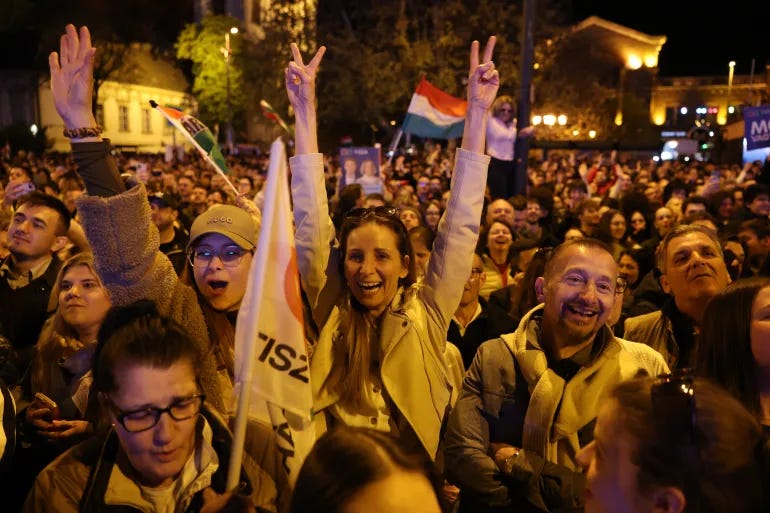
What lessons could Hungary, a small land-locked country of less than 10 million people, teach the world? A lot! Although election forecasts were hinting at it, it could not be taken for granted that autocrat Victor Orban would lose in last Sunday’s elections. Too strong seemed his grip on power, his party’s control over the media and the judiciary, his – open or less open - support by two strong allies, the USA and Russia. Against all odds, an overwhelming majority ousted Orban with a record voter turnout.
So, which lessons can be learned?
1. First and foremost, there are always choices despite all obstacles, nothing in history is “inevitable”. Not even Hitler’s ascent to power was it as the eminent historian Fritz Stern once remarked. And yes, “ordinary people” can make a difference.
2. In order to overcome an autocratic regime, the opposition has to be united behind a charismatic leader. 46-year-old Peter Magyar is also significantly younger than overweight Orban which makes the latter look even more geriatric than his actual 62 years. In Hungary, splinter opposition parties renounced their participation in order to strengthen Magyar’s party Tisza, putting their own ambitions aside for the greater good. This is a lesson that other countries, sighing under a dictatorship or an autocratic rule, should take to heart.
3. Magyar, the new Prime Minister, had been a member of Orban’s Fidesz party until he broke with the kleptocratic clan which had hijacked it. In other words, renewal of the conservative movement, purging it from usurpers who pursue their own interests IS possible. Maybe this is a lesson the Republican Party of this country could study?
4. “Europe, Europe, Europe”, these were the celebratory shouts of the electrified crowd after Tisza’s overwhelming victory. With increasing EU fatigue in the “old” member states where right-wing parties cash in on this sentiment, it was elevating and moving to see the enthusiasm of young people exuberantly dancing and singing in the streets. Maybe the “rejuvenating” of the European spirit has to come from these new(er) member states. They seem to grasp the enormous value a united Europe brings to its members as they remember the times when they were cut off from the rest of the world.
5. Last but not least, it was remarkable how quickly incumbent Orban conceded his defeat and congratulated the winner. No ambiguity, no talks about “stolen elections”. A decent transition of power is still possible, even in an autocratic environment.
Maybe these elections have turned the tide. It was not only the victory of one party in a small country, it was a pledge to democracy itself, it was a commitment to a United Europe - which had been written off by people on both sides of the Atlantic - and it is a signal to wake up from apathy. Nothing is inevitable.
Comments
Nothing yet. Say the first thing.
Sign in to join the conversation.