
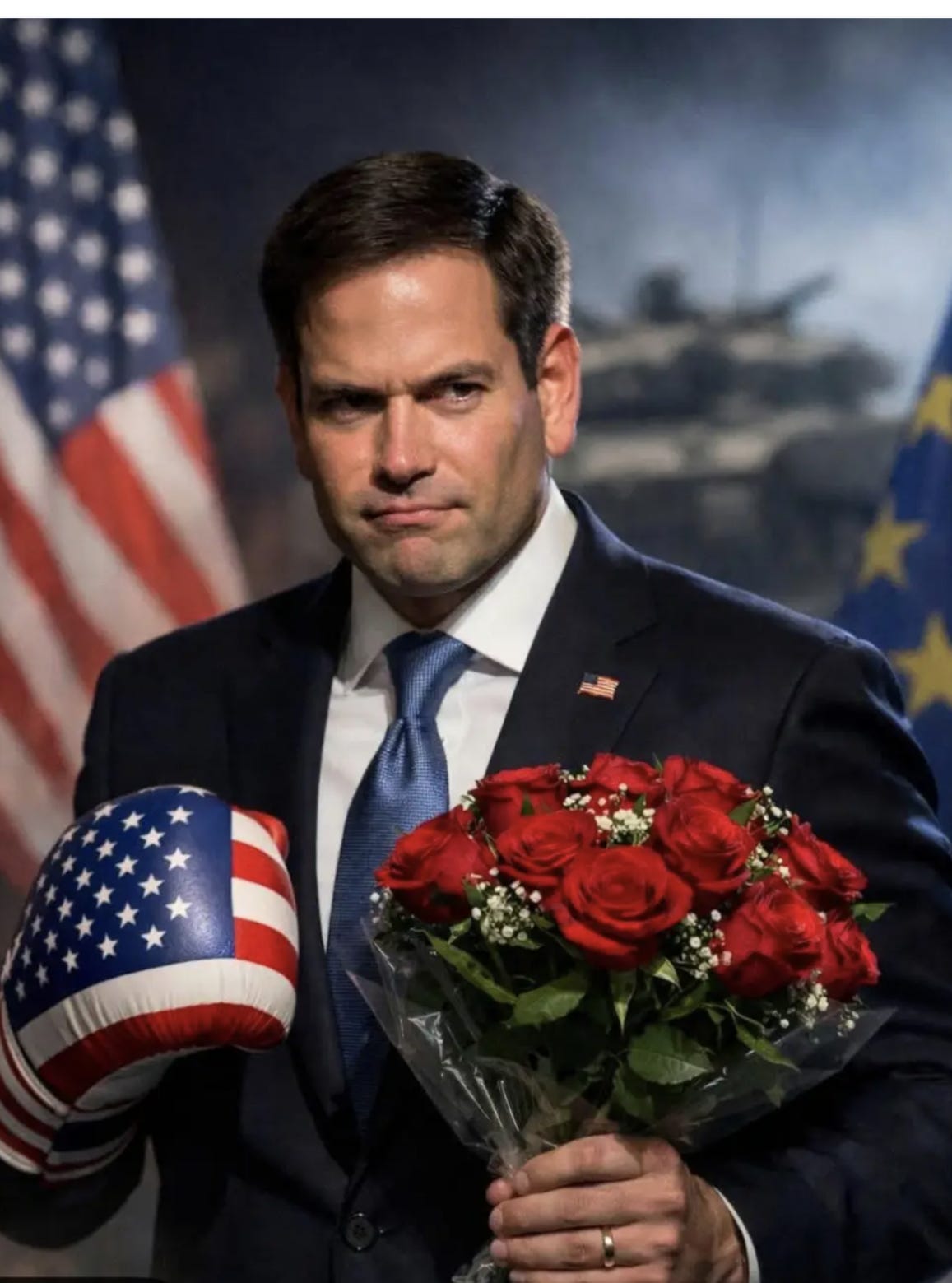
When Marco Rubio ended his speech at the Munich security conference last month, he received standing ovations. A sigh of relief wafted through the room. Indeed, the tone was different from J.D. Vance’ talk a year ago, when he had swung the wrecking ball on Europe. Unlike unkempt self-stylized hillbilly Vance, Rubio looked groomed, talked with a pleasant voice and in a civilized manner. Was the message so different? Not really.
To cut it short: His administration’s goal is disruption, the destruction of the rules-based global order as we have known it, the end of supra-national organizations like the UN, and in particular the European Union. “Divide et impera”, as the Romans knew and successfully practiced. A fragmented Europe will less likely withstand American pressure to bow to its wishes. Why would Rubio otherwise honor autocrat Victor Orban of Hungary as the only European statesman with his visit? Orban reliably torpedoes every decision made in Brussels while simultaneously pocketing any possible financial aid from the EU. American money and misinformation were instrumental in convincing the Brits that leaving the EU was a good idea, and French extremist Rassemblement National leader Marine Le Pen – an open opponent of the EU – can equally rely on American support. The rest of Europe is being bullied. And the tactic often works: Spinelessly, German chancellor Merz didn’t stand up for his fellow EU member’s Spain decision to not allow the U.S. the use of its military base for its attack on Iran. Is this how European unity looks like?
Don’t get me wrong: European bureaucracy does everything to play into the hands of its critics. It developed a life of its own, often detached from the reality of the people it is supposed to represent. Its regulatory frenzy strangles the economy, dashes initiatives. There is indeed an urgent need for reform. And the European states, which felt comfortable and became lazy under the military umbrella of “big brother” certainly have to wake up and get on their own feet.
Now let me “decipher” Rubio’s talk:
After some flattering and hollow words about Western civilization and common purpose he quickly zeroes in on his main bogeyman: the rules-based global order, in his opinion an “over-used term”, a “delusion”, a “foolish idea that ignored human nature”. Adherence to agreed rules, to international law and norms – as the loathed order is defined – and national interests are, in his view, antagonistic and incompatible. In other words: “National Darwinism” should prevail. Isn’t the purpose of an order to curb instincts and impulses, to establish objective rules, to prevent conflicts? It also lets me wonder how he defines “human nature”. Is it only “man is a wolf to man“? Isn’t it then even more necessary to establish an order and not let the wolf run freely? Rubio’s assurance, that his administration’s intention is not to destroy, but to “rebuild” the international organizations is less convincing when the newly installed “board of peace” intends to sideline or even to replace the UN, when funding for the WHO and other global organizations is withdrawn, and anti-EU parties are openly supported and less openly financed. Rubio lets us know what in his view should replace the ineffective diplomacy: bombs “dropped with precision from American B-2 bombers”. Future will show what will have more lasting results to restore security. So far, his method didn’t prove to be overly effective in Iraq and other places. Now, Iran is the new test field.
The decline in manufacturing in the USA, its deindustrialization, is equally blamed on the despised “rules-based order”, conveniently ignoring shifting markets, an increasingly connected global economy – a worldwide phenomenon which not only affects the United States. No ominous “order” forced the American manufacturer to outsource their production to other countries. It was the law of the market which dictated it: “Produce cheaply and sell at a high price”!
The next culprit Rubio made out is what he calls the “Climate Cult” as the regulations to stem climate change – which he elegantly avoids to deny or to confirm – “are impoverishing our people”. Wait a minute, didn’t the U.S. leave the Paris Climate agreement, didn’t the current administrations do away with as many regulations as possible – and doesn’t the American economy boom in the words of the president? Why are the people then impoverished in his country? I willingly admit that some governments are blindsided in their activism and go overboard, trying to enforce rules regardless of their consequences for the economy. But it is America’s arch rival China which successfully pushes the agenda for cleaner energy, producing half of the world’s electric cars and having by far the largest installed solar capacity on the globe. It doesn’t seem to “shackle” its economy.
Last but not least Rubio addresses another favorite specter: The imminent “erasure” of European culture through mass migration. Undoubtedly, it is the undisputed right of every country to control its borders. Yes, the mass migration ten years ago confronted the European countries with challenges they not always tackled fortunately. “When in Rome do as the Romans do” – it should have made clear(er) that newcomers have to respect the local culture and not vice-versa. But no, we don’t witness the “Downfall of the Occident” to quote once popular Oswald Spengler. First and foremost, rarely does someone leave one’s home just for the fun of it (forget nomads like my family), dire circumstances dictate the decision, and Americans should be the first to remember why their ancestors came to this shore. By the way, the majority of the refugees in Europe are currently – Christian – Ukrainians. And please be reminded that misled, failed U.S. Foreign Policy contributed a good deal to the much-vilified migration from countries like Afghanistan, Iraq, Syria. Europe didn’t ask for it. Deadly knife attacks make head-lines, the quiet integration does not. As I refuse to tally corpses, I will not compare these attacks with the numerous mass shootings in the U.S. committed by U.S. citizens. When the Assad regime fell about a year ago, Syrians were expected to return home. Wait a minute, not so fast: Not the doctors (more than 6000 in Germany alone) protested the health care system, not the apprentices, not the mechanics, shouted the industry, not the bakers, echoed others. Let’s not forget, the old continent is aging and someone has to pay our pensions, right?
Let us remember that the much-acclaimed European civilization is a mixture of many influences, an amalgam of West and East. The two cradles of European cultures - the Greeks and the Romans - both trace their mythical origins to the East. “Europe” was the name of the Phoenician princess who came – not entirely voluntarily I admit – from present-day Lebanon to the island of Crete, laying the foundation of the Minoan culture which later heavily influenced “Classic Greece”. The Romans claimed their roots in Troy, in Asia Minor, in present-day Turkey. Modern science tells us that ancient Rome was genetically extremely diverse, truly “cosmopolitan”. Being a “Civis Romanus”, a Roman citizen, had nothing to do with religion, race or skin color. He could hail from Africa, the Middle East or somewhere else. Europe greatly benefitted from and eagerly absorbed “foreign” influences. The Gothic cathedral, the quintessential symbol of medieval Christianity, was inspired by Islamic architecture. And do I have to remind anyone where Christianity originates from? Would Europeans be so obsessed with their coffee culture, had the Ottoman troops not left some sacks of these mysterious beans after the siege of Vienna? As we see, the mutual influence was not always peaceful, but it did exist.
Rubio rightfully invokes the genius of European civilization, quoting among others Mozart, Dante, Da Vinci (and the Beatles). What about the two fundamental values European civilization gave to the world: The concepts of democracy and of rule of law? After many errors and deviations, Europe is now determined to preserve this legacy and looks with concern across the ocean where these quintessential values of Western civilization seem to be increasingly under siege. It is an overused tool in the arsenal of demagogues to depict a situation in darker colors than it is in reality. Hence his portrait of Western societies as plagued by “a malaise of hopelessness and complacency”, “paralyzed by “a fear of climate change, fear of war, fear of technology”. Legitimate concerns defamed as fears.
Which is Rubio’s, respectively his master’s, vision? To dismantle the global order and to re-enter the age of imperialism, of expansionism. “For five centuries […] the West has been expanding, […] building vast empires extending out across the globe”, but since the end of World War II – so he deplores – Western dominance has come to an end. He leaves no doubt that his administration is determined to reverse this trend – without following rules if necessary.
At the conclusion of his speech, Rubio returns to the flattering and appeasing praise of the Europeans, hollow words, considering how his president treats “our cherished allies and our oldest friends”. His pretended “concern” for Europe’s future conceals his threat only thinly: If you Europeans don’t follow the U.S. on the path I just laid out - you are on you own.
“We are the children of Europe”, assured us Rubio. It can happen to parents that their children go estray, that they turn against them. So, what shall the parents do? Get off the sofa, throw the cane in the corner, and show the kids that they still have to reckon with you!
Comments
Nothing yet. Say the first thing.
Sign in to join the conversation.