
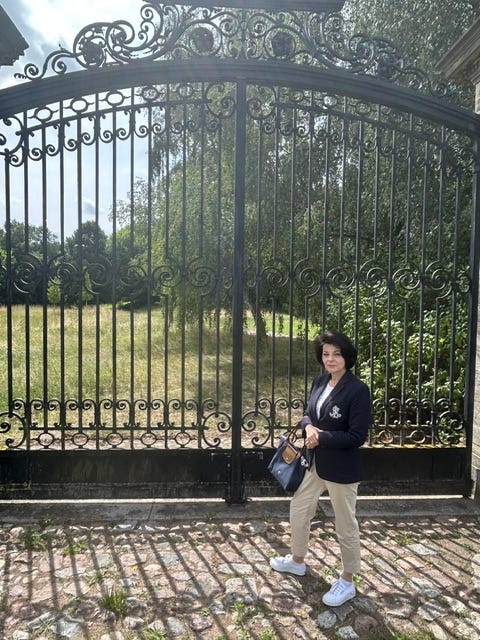
A mere forty kilometers from Berlin, my husband and I find ourselves entering a world where the Great War seems to have ended only yesterday. No sooner have we left the motorway that a narrow country road, shaded by gnarled avenue trees, leads us towards Kerzendorf, a tiny village of only a few hundred souls. Neat houses, many with photovoltaic panels installed on their roofs, stand amid immaculate gardens ablaze with flowers; not a scrap of litter mars the carefully swept pavements.
We have come in search of the estate of Leonie—known to all as Lally—and Alfred Horstmann, once simply called “the Castle,” or rather, of whatever remains of it today.
An elderly couple, making the most of the sparse sunshine on this late Sunday morning, immediately understands both what we are looking for and why. The woman has read the memoirs of Lally, the last mistress of the estate, and gladly points us in the right direction. We leave the car beside the Neo-Romanesque church, endowed long ago by Lally’s father, Paul von Schwabach, who had been born Jewish, and continue strolling. Before long we encounter another couple. “Just around the corner you’ll see the great wrought-iron gate,” they tell us. “And where that mound is now—that’s where the Castle once stood.”
The gate is indeed the only signpost. Beyond it... nothing. A no-man’s-land. The “mound” itself is little more than the overgrown ruins of the manor house, from where a solitary tree stretches its branches towards the sky. A table-tennis table, a portable football goal, a picnic table with benches from a DIY store—bleak emblems of small-town banality. Only a single stone amphora, half-hidden beneath tangled undergrowth, has somehow survived the destruction. Nothing about this abandoned wilderness would suggest that it was once an exquisitely landscaped park, where gondolas glided across a tranquil lake, statues lined winding paths, and the Castle housed Alfred Horstmann’s unique art collection.
The fate of this estate encapsulates, en miniature, an entire chapter of German history. Acquired in the 1870s by Lally’s Jewish grandfather, Julius Leopold Schwabach—co-owner of Bismarck’s banking house, S. Bleichröder—as a summer residence, it became a welcome refuge for his granddaughter and her husband, Alfred “Freddy” Horstmann, after Hitler’s rise to power prompted him to resign from the German diplomatic service without hesitation.
Gone were the days when they presided over one of Berlin’s distinguished salons, frequented by intellectuals, artists, and diplomats. Lally sees the looming danger with open eyes, her husband decides to close his. Even after a bomb strike in September 1943 leaves the manor house severely damaged and forces them to seek shelter in the steward’s house; even as families fleeing the advancing eastern front pause briefly at Kerzendorf imploring them to make their own escape westward—they stay. He remains out of defiance and denial; she, out of loyalty.
The end of the war—with its marauding, violent soldiery, hunger, and later bitter cold—they endure it as millions of others do. Yet a year after the fighting ceased, the brutal reality deals its most cruel blow. Freddy, who had never sympathized with the Nazis, quite on the contrary, is dragged by the occupying Soviets to the Sachsenhausen camp, where he miserably starves to death. Lally learns of his fate only much later and only through indirect channels. Nine years after the war’s end, she herself dies “under mysterious circumstances” on the other side of the world, in São Paulo, Brazil.
Why is it that, in this place, one still seems to feel so vividly the collapse of an entire era? Is this the endlessly invoked—and all too often trivialized—”breath of history”? We cannot escape the feeling. Here, amid the tranquility of the countryside, rather than in Berlin with its visible scars of war, I find myself grasping the cruelty of a war, as though it had ended only yesterday.
Comments
Nothing yet. Say the first thing.
Sign in to join the conversation.