
Hi TechMates Community,
🎙️ Hendrik Remigereau here—bringing you another frontier-building conversation, powered by NZVC, the venture firm backing the next generation of iconic companies from New Zealand and beyond.
This time, they sit down with Stefan Powell — CEO of Dawn Aerospace — a founder who has quietly built one of the most capital-efficient space companies on the planet from Christchurch, New Zealand, generating more real revenue than VC funding raised, while controlling roughly 90% of the nitrous bipropellant satellite propulsion market in orbit. In this episode, Stefan unpacks the two massive bets his company is making on the future of space: in-space satellite refueling and a reusable spaceplane called Aurora that already outclimbs an F-15 — for as little as $50,000 a flight.
In this episode, you’ll discover:
🌱 Why capital discipline beats capital abundance – Stefan explains how raising too much money too early can trap companies on bad ideas, and why Dawn’s revenue-first model has kept them grounded in what actually matters.
💡 The chicken-and-egg problem killing refueling startups — and how Dawn solved it – Instead of jumping straight to building a gas station in space, Dawn started at the thruster level, and made refueling readiness a standard feature of every propulsion system they ship.
🔥 Adversary satellites are actively draining defense assets – Foreign nations are forcing unnecessary maneuvers on geostationary defense satellites to deplete their fuel — and orbital refueling is fast becoming a non-negotiable piece of strategic deterrence.
🌍 The New Zealand advantage (and its double-edged sword) – Lower costs and lighter regulation make NZ a genuine edge, but getting on US investors’ radar from the other side of the world is a real challenge Stefan knows firsthand.
🚀 From 64 spaceplane flights to 100 a year at Oklahoma’s Infinity One Spaceport – Aurora is heading to the US in 2027, set to become the busiest suborbital spaceport in the world, opening up missile defense testing, microgravity research, and more.
Don’t miss out on these exclusive insights!



00:00 — Building Dawn while the world wasn't watching: the update from a year later
04:11 — Aurora finds product-market fit it never set out to find
04:46 — The $25M Series B: what it unlocks and why now
05:11 — 52 of 63 nitrous systems in orbit are Dawn's — market domination explained
08:11 — In-space refueling: targeting 2028 and why defense is the first customer
10:19 — The satellite arms race: bodyguard satellites, adversary maneuvers & deterrence
11:04 — Solving the chicken-and-egg problem of refueling infrastructure
14:56 — Why other thruster companies never made it to propulsion systems
17:49 — Aurora's 64 flights and the upgrade to 100km altitude
21:45 — "Rocket performance, fleet economics" — why that changes everything
22:26 — How Aurora replaces a $10M missile test with a $50K flight
25:45 — DARTY mission: helping the New Zealand Navy train for missile warfare
28:45 — Aurora vs. hypersonic threats and the limits of missile defense
30:05 — The Oklahoma Spaceport deal and 100 flights a year from Infinity One
32:09 — SpaceX IPO: what the largest IPO in history means for the space industry
33:34 — What SpaceX gets wrong (and the XAI merger debate)
36:56 — Why Europe is spending $35B on space — and why Starlink dependency is a risk
40:18 — Will Dawn ever be bigger than SpaceX? Stefan's honest answer
41:30 — Elon, Peter Beck, and what great space CEOs have in common
42:45 — More customer revenue than VC raised: why Stefan wants to keep it that way
45:22 — Raising capital as a New Zealand company — advantages, trade-offs & ITAR
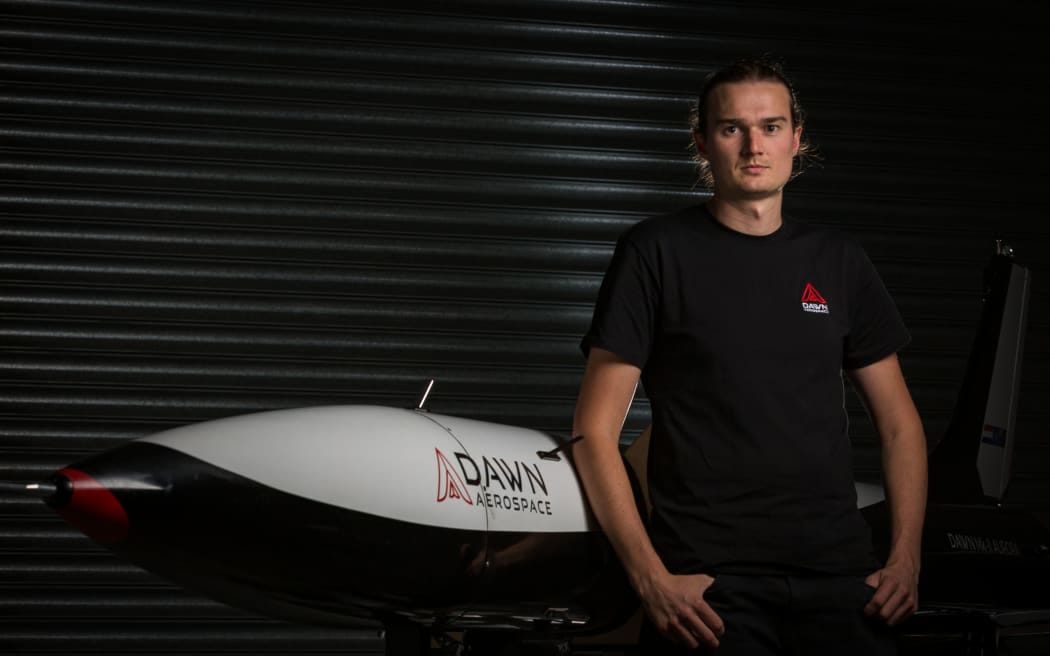
Most satellite refueling startups skip the hard part — they raise big, aim straight for the application, and cross their fingers that the market will catch up. Stefan Powell took the opposite approach. Dawn Aerospace started with the fuel itself, then built a thruster, then a full propulsion system, and only then began engineering a path toward in-space refueling.
“Every step of the way, you know, building thrusters, that was a profitable endeavor. Building propulsion systems now, that’s a profitable endeavor,”
Stefan explains. The result: a company that can absorb setbacks because every layer of the business already stands on its own.
The reason refueling has become urgent isn’t just commercial — it’s military. Adversary satellites are circling high-value geostationary assets, forcing defensive maneuvers that drain limited fuel reserves.
“Their satellites need to be refuelable so that they don’t have their capability depleted,”
Stefan says. Dawn’s plan is to make every propulsion system it ships refueling-ready by default — replacing the standard fill-drain valve with a dockable port — so that by the time the orbital refueling infrastructure exists, there’s already a significant fleet of satellites ready to plug in.

Aurora isn’t just a technology demonstrator anymore. Having flown over 64 times and already beaten an F-15’s climb rate to 60,000 feet, it’s becoming a genuine commercial product — one that can simulate a missile trajectory for a defense client for as little as $50,000 per flight, versus tens of millions for a real missile.
“Rocket performance, fleet economics — that’s the huge unlock,” Stefan says. “That means you can do so many things that you could never do before with a rocket because the economics is just limiting.”
The $25M Series B closes a rare chapter: even after the raise, Dawn will have generated more real revenue than total VC funding received. Stefan is deliberate about keeping it that way.
“Too much capital can very quickly let you stay on a bad idea for too long,”
he says, pointing to the cautionary tale of companies that raised hundreds of millions before ever proving product-market fit. The lesson for any founder: let your customers validate the idea before your investors do.
If there’s one takeaway from Stefan’s story, it’s that the most defensible position in space isn’t the biggest rocket — it’s the most disciplined business, built layer by layer, until no one can catch up.
For more in-depth insights from Stefan Powell, be sure to listen to the full TechMates podcast episode!
Thanks for your support—we’re excited to have you with us!
We’d love for you to follow and tag us on social media:
Youtube · Spotify · Apple Podcast
Instagram · LinkedIn · Twitter · TikTok
Happy listening,
The TechMates Team
Comments
Nothing yet. Say the first thing.
Sign in to join the conversation.