
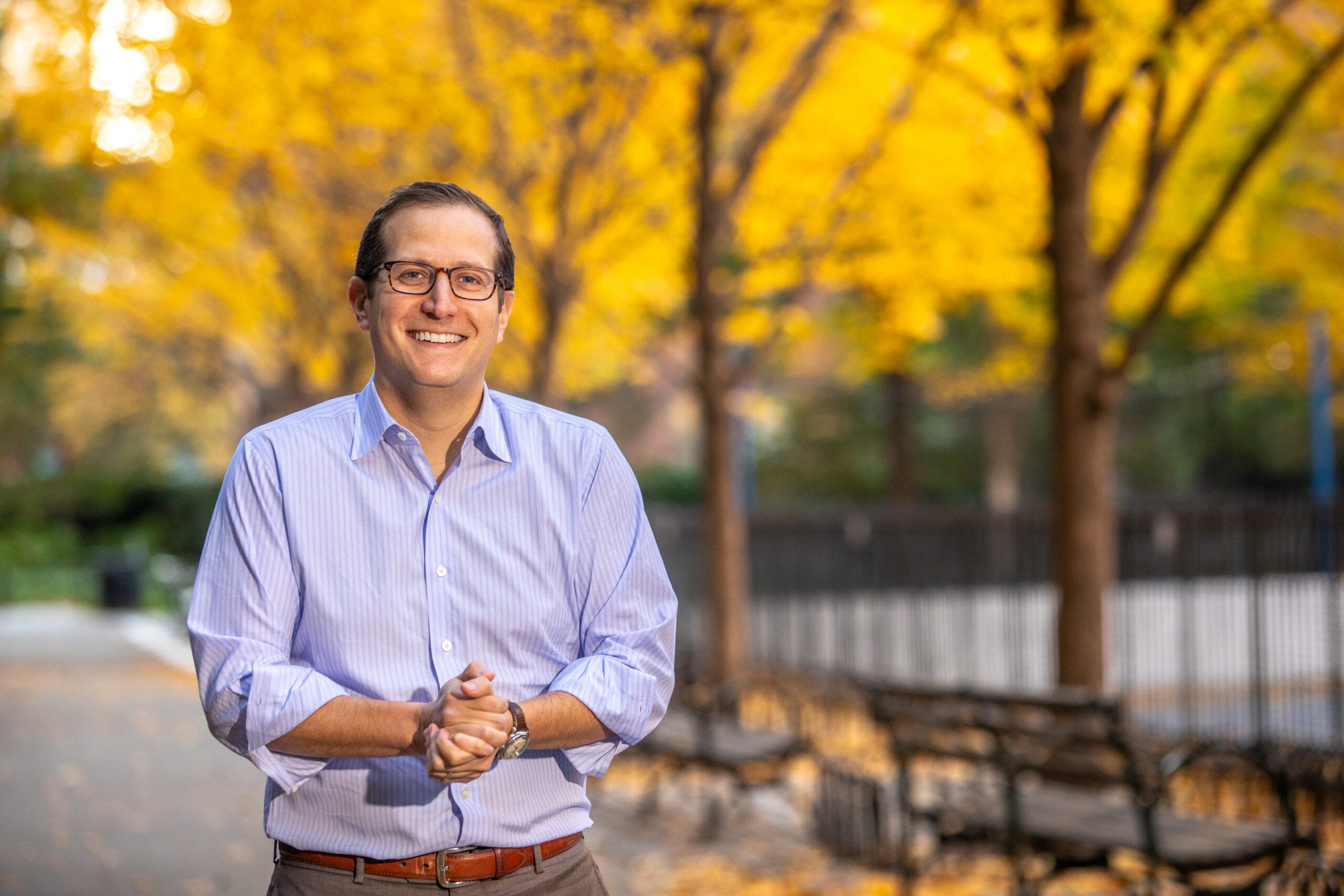
The New York Editorial Board spoke with Assembly Member Micah Lasher, who represents parts of Manhattan’s West Side, about his campaign in the Democratic primary for New York’s 12th Congressional District (parts of Manhattan’s East and West Sides and Roosevelt Island) on the morning of June 8, 2026. Lasher is among the candidates running to succeed retiring Rep. Jerry Nadler. The primary election takes place in June. (photo: Lasher campaign)
Participating journalists: Nicole Gelinas, Josh Greenman, Ben Max, Akash Mehta, Ben Smith, Liena Žagare.
Full Transcript
Ben Smith
Thank you for coming in. I always say this at the top, but politicians are less required to engage journalists than they used to be, so we appreciate you coming in. We appreciate one of your competitors, Alex [Bores] coming in. Note that Jack Schlossberg totally ignored us. But basically every other major candidate [we’ve invited] did come in. Josh?
Josh Greenman
So you do have a few different opponents. I would say your chief opponent, Alex Bores, is running on taming, attacking, dealing with AI as a transformative threat to the American economy and so much else. What is your campaign about? What do you think are the central themes of your campaign? And related to that, what is your approach to dealing with AI, and how significantly does it differ from his?
Micah Lasher
My campaign is about making the Democratic Party a more effective fighting force in this immediate moment of crisis, and returning its focus to core economic issues facing the American people. And both of those aspects of a vision are tied to the belief that making change in government is still hard and complicated work, and it matters to know what you’re doing.
With regard to AI, I think that the question on the table is less one of significant, substantive differences in this moment, but on an issue that’s going to play out over time, whether or not the district’s going to have a member of Congress who is truly independent-minded on these issues.
Josh Greenman
So you’re saying he’s not truly independent-minded on AI?
Micah Lasher
I think I will be truly independent-minded on AI.
Josh Greenman
What’s your position on the sovereign wealth fund idea that [Bernie] Sanders has thrown out there?
Micah Lasher
I am supportive of it. I think it’s a good idea. I think it addresses a bunch of different concerns, both with regard to how taxpayers are going to be beneficiaries of the enormous wealth that is going to come from artificial intelligence, potentially at the expense of the broader workforce, and also how we align the financial incentives of artificial intelligence companies with the public interest that is bound up in their actions.
Josh Greenman
One last thing on this. Specifically for what Sanders proposes, a 50% stake in the companies that would then basically be held by a U.S. Sovereign Wealth Fund. Are those particulars things that you’re signing onto? Would you co-sponsor the legislation if that’s what it said today?
Micah Lasher
I would. Obviously, with the recognition that these things always tend to get negotiated and evolve out. But yeah, I think the idea that these companies are going— are already so massive both in terms of economic value and societal impact, that there’s a really compelling argument for a direct public stake.
Ben Smith
I meant to keep AI for a little later, but I actually have a question: Do you think people in the district actually care about this, or is this just something that we’re talking about, and Alex is talking about, and you’re talking about?
Micah Lasher
I think it is an important issue, and I think there are a lot of people in the district that, to a greater or lesser extent, are concerned about it. I think there’s no question that the attacks by OpenAI on Alex, and his effective use of those attacks to obscure other parts of the story, have made it more of an issue in the race than it would have been otherwise.
Ben Smith
What is he obscuring?
Micah Lasher
Well, I think the fact that there has now been more money spent in support of his candidacy by AI and crypto executives than there has been in opposition to his candidacy has been completely lost in the conversation. I think the fact that the crypto money that’s being spent on his behalf probably has something to do with his public position that he supports every aspect of the crypto lobby’s agenda, has been completely lost in the conversation. The fact that Anthropic is very interested in sending him to Congress has been completely lost in the conversation.
Josh Greenman
Is Google/Alphabet one of the companies that the U.S. Sovereign Wealth Fund should have 50% stake in?
Micah Lasher
I don’t know.
Nicole Gelinas
So you were a co-sponsor of the one-year data center moratorium. What is your long-term strategy for local participation in if and where data centers are located in New York State?
Micah Lasher
I think that right now, we have a significant horse-and-barn risk with data centers, and you have significant collateral impacts that we need to figure out how to manage, and until we do, I think there should be a moratorium.
Nicole Gelinas
But what would the hint be of how do you address this five years from now?
Micah Lasher
I think you have to— I think there has to be a serious conversation about how you’re managing the environmental consequences, how you’re managing the impact on costs to ratepayers. And that requires a serious conversation that I don’t think we’ve had, that we’ve scarcely begun.
Akash Mehta
On outside spending, it is one of the most notable things about this race. I think it’s the most expensive House primary in this cycle and one of the most expensive in history. What do you think accounts for that? What is OpenAI’s interest? What is Chris Larsen’s interest? What is Anthropic’s interest? Why are they all spending so heavily? What is the Palantir co-founder who’s attacking Alex Bores for working for Palantir, what is his interest?
Micah Lasher
I think there’s a crypto piece of this that is its own thing, which is while the crypto industry was the villain of the 2024 election cycle, and less the 2026 election cycle, this is still, in my view, a deeply problematic industry with a significant political agenda that is, remains very active in the political landscape and may be benefiting from having receded from public attention because of the AI battles. So the crypto interest to me is fairly clear. Alex proactively sought, effectively sought the support of the crypto lobby, filling out their questionnaire, acceding to every request getting an A-plus rating, and I believe now reaps the benefits of that from Mr. Larsen.
The AI issue, I think, is a proxy fight between the two highest-profile players in the industry, each of which wants dominance in the halls of power. And I don’t take the view that either OpenAI or Anthropic should be writing our AI policy. And to me, it harkens back to a moment in time where the Democratic Party thought that Facebook was an enlightened company that could both be a great source of funds for the party and a good partner in figuring out where we— how we approach social media and emerging technology of that time. And I think that we would be making a terrific mistake if we think that the answer is to take the, to rely on any AI company to guide us and to fund our party. But I think that both of these companies are fighting for influence, and I think this race, for a bunch of reasons, has become a proxy fight in that battle.
Akash Mehta
On crypto, at my newsroom, New York Focus, we were looking into Bores’ relationship with the crypto industry for a potential story. We couldn’t find enough there for a story. We did see that questionnaire. But for instance, I think he signed on to and was in the press release for Attorney General James’ big proposed crypto regulations a few years ago. Are there major federal regulations on crypto that you support and he doesn’t? Where do you see the divide?
Micah Lasher
Well, I would not minimize the idea, I would not minimize the significance of first and foremost even engaging in a support-seeking way with the industry. You will not find my answers to the Stand With Crypto questionnaire on their website, let alone one that is completely to their liking. So I would begin there. I think there’s a fundamentally different starting place for the conversation, which is I see them as, at best, a self-interested lobby that should be treated with an enormous amount of skepticism, and at worst, a corrosive force in our economy and a major tool of the Trump administration’s kleptocracy, and would approach them with that skepticism in Congress, as I would the major industry players in AI.
Ben Max
Were you more optimistic about crypto at one point?
Micah Lasher
I don’t think I’ve ever been particularly optimistic about crypto.
Josh Greenman
You did work in tech for a little while.
Micah Lasher
I did.
Josh Greenman
So did your perspective on the industry, and Google is now a major player in AI just as much as the other two probably. Did your perspective change over those few years?
Micah Lasher
I think the reality is I’ve always had a pretty healthy skepticism about the political power of large technology companies in our society, and that goes back...Frankly, it goes all the way back to my time when I was working for Jerry [Nadler] and Airbnb was emerging, and we saw what was going on with the conversion of apartments into illegal hotel units, which actually predated Airbnb, but they kind of supercharged that practice. That fight then carried into my time in the Bloomberg administration.
When I was chief of staff in the state attorney general’s office, I was a driver of significant actions involving most of the household names in big tech from Uber to Lyft to Airbnb to Facebook. And, frankly, we spent a lot of time looking at the question of whether there was a way to pierce [Section] 230 immunity with regard to Google. So I did spend three years working at Sidewalk Labs, which was a company that was created by Alphabet. It was a very different kind of company. But I don’t think my views on this have really changed much over the years.
Nicole Gelinas
Would that skepticism continue to the driverless car issue, and how would you approach driverless car regulation at the federal level? Should it preempt state and local regulation?
Micah Lasher
I am concerned about driverless cars. Let me say one— Here’s the positive: I think there is real opportunity for… I’m trying to think how to prioritize my takes on this because it is a complicated issue. I think we have to tread very carefully. You have a hundred thousand people plus who work in the for-hire vehicle industry in this city. Their lives were turned absolutely upside down when Uber came to town. The workforce and the economy in the for-hire vehicle industry, after years of turmoil, has stabilized. And I think we have to be very careful not to kick that cycle off again.
Ben Smith
Do you think that’s more important than passenger safety? Like, if you have to trade them off, is it more important that someone’s employed? Like, is it more important that you have employment or that passengers are safe?
Micah Lasher
I think that you can’t look at one to the exclusion of the other.
Ben Smith
Really? So you would be comfortable with some lost lives in car accidents in exchange?
Micah Lasher
With enormous amounts of affection, Ben, I don’t think the trade-off is quite that stark. But I think that as we proceed— Nor by the way, would the gradual introduction of autonomous vehicles into the New York streetscape, with all of its messy glory, produce instant improvements in safety.
Josh Greenman
Or major job losses if it’s a slow introduction.
Micah Lasher
Well, and I think to that point, I think that there just needs to be thoughtful planning around these issues, that I do not think that the companies that want to get autonomous vehicles on the streets as quickly as they can are particularly interested in having.
Ben Smith
Have you ever been in one?
Micah Lasher
I have not.
Nicole Gelinas
Would it be a good idea to use regulation to nudge the rollout toward the most dangerous sector of drivers, who would not be the for-hire vehicle drivers?
Micah Lasher
Sorry, Say that again?
Nicole Gelinas
Should we start with the bad drivers?
Josh Greenman
And/or truckers….I think the feds would probably have the strongest role in figuring out federal highways, right?
Micah Lasher
Yeah. Look, I think that there are real potential safety benefits from autonomous vehicles. I think there are real economic implications, as well as implications for the number of vehicles on the road, depending on how you structure the regulatory framework, and I just think it requires a thoughtful conversation. And I think that if history tells us anything, it is that the companies that stand to reap the benefits from the implementation of this technology are not particularly interested in a genuinely independent and thoughtful dialogue about a regulatory framework.
Liena Zagare
Do you think the government can move fast enough to regulate these industries?
Micah Lasher
I think that’s always a question. I think that would have been a very reasonable question to ask about social media, and I think we would be far better off if we had erred on the side of a greater tolerance for government’s clunkiness when it comes to regulating social media than what was ultimately a completely hands-off approach.
Nicole Gelinas
And how do you square this perennial problem that by the time people hear about it politically, it’s too late? I mean, that happened with social media, it happened with Uber and Lyft. How do you get them to care before it’s too late?
Micah Lasher
That’s coming full circle on our conversation. That’s part of what our elected representatives are supposed to do, is to be seeing around corners and being willing to take on the self-interested entities and parties that are often the drivers of these conversations.
Ben Smith
I want to move to some non-tech questions.
Ben Max
As you may have read, when Alex Bores was here, we asked him what separates the two of you beyond the AI stuff. He had a pretty detailed answer. He basically boiled it down to five things. We’ve already sort of covered — he said he’s the one that the AI overlords are really afraid of. So we don’t need to keep going there. He said he’s had a top secret security clearance. I don’t know if that’s worth that much conversation. But the other three things he said were that he’s passed a lot more legislation than you, more effective in office, that he has extensive private and public sector experience, more than you, and that he works better with your Democratic colleagues than you. So how would you respond to those critiques, and what would you say are the biggest differentiators other than the AI and tech conversation we’ve already had?
Ben Smith
Yeah, particularly as legislators in the same house.
Micah Lasher
Well, look, we talked about this, I guess before the tape recorder started rolling about the notion that we might all be better off if we didn’t view legislation as a volume business. He is absolutely correct that he has passed a higher number of bills. Some of the greatest hits are prohibiting the use of the phrase “Chinese throwing stars” from the New York State statute books and granting a liquor license to a single macaroon store. So I can’t claim such a voluminous legislative record as Mr. Bores. I will concede that point.
But I think that when it comes to making a meaningful difference, at all three levels of government over a period of nearly two decades, from indexing the minimum wage to inflation, to crafting the state’s billion-dollar plan to reinvest in mental health, to doubling access to childcare assistance, and all of that before I stepped foot in the Legislature. I’ll happily stack my record of accomplishment in government against Alex’s any day of the week. And to the extent he views his time in the private sector at the venerable institution of Palantir as an asset in this race, I’ll leave that to him.
Ben Smith
Do you think he’s a good legislator?
Micah Lasher
I think he’s a fine legislator, yes.
Ben Max
One of the things, though, he said is, look at all the people you’ve both worked with, and he has far more endorsements from your fellow Assembly members than you in this race. What’s that attributable to?
Micah Lasher
It is attributable to the fact that I wouldn’t think to ask a colleague who does not represent this congressional district to choose between two colleagues who are running for it. And the result of that different choice that Alex and I made is that every single sitting elected official who represents any human beings who live in this congressional district has endorsed my candidacy. Alex has endorsements from colleagues that he decided to press for support who represent wonderful communities in Long Island and Brooklyn and elsewhere.
Ben Smith
Do you think that they’re doing that because there’s sort of a sluice of AI money that he represents as well?
Micah Lasher
That’s a fascinating thought.
Ben Max
You’ve been in government for all this time that you just mentioned. Do you regret any pieces of that work? Are there parts–
Micah Lasher
Oh! You spend 18 years—
Ben Max
So what would you name?
Micah Lasher
You know, you guys can watch the debates too. Listen, I’m not running for office premised on the idea that I haven’t made mistakes, let alone premised on the idea that every position that everyone I’ve ever worked for was right at the time or has aged well. I would say a central argument for my candidacy is that I have been in this as seriously as I have been for as long as I have been, that there are plenty of mistakes that my opponents can use as grist for their mills. And it is easy to do that when you are more or less a blank slate.
Josh Greenman
U.S. Congress is a very different place than the New York Legislature. This is pretty much a one-party state. The House is not a one-party body. How would you approach working with Republicans? Because most of the energy has been about how to counter Trump. Do you see any opportunity for partnership?
Micah Lasher
I think we’d be really clear-eyed about the moment we’re in, which is not one that in the most immediate is going to be overcome with cooperation from Republicans. I wish it were otherwise.
Josh Greenman
“The moment.” But there’s so many issues and so many opportunities to theoretically partner.
Micah Lasher
Yes. And on any issue where there is an opportunity for common ground, whether it is housing or childcare investment, I would happily seek that out. But I also think that we should not understate the existential stakes of what the Trump administration is doing with the cooperation of their allies in Congress, and that a failure to beat that back will make cooperation on other issues look very much a tertiary matter.
Ben Max
You wrote, I believe, “Don’t give them a single vote.”
Micah Lasher
Yeah.
Ben Max
On anything. That’s good policy and politics?
Micah Lasher
I believe one of the failures of the party right now has been a failure to create a stark contrast with the majority party. I think if we were in a parliamentary system, which obviously we are not, but to some extent we are in a parliamentary moment. The Republicans are fully in charge. They control the White House, the House, the Senate, the Supreme Court. And if we were in a parliamentary system and we were the opposition party, we would have a party leader that represented the voice of the party. We would have an agenda that said to voters, “This is what you get if you throw these guys out and put us in.” And there would be a very clear distinction between the choices before voters. And I think that we are in a— we are effectively in that dynamic, and we have failed to respond appropriately.
Ben Max
With no agenda.
Ben Smith
So you’re really saying Hakeem Jeffries specifically has failed?
Micah Lasher
I’m saying that I think that we as a party need to offer a very stark and clear contrast with the party that is in charge.
Ben Smith
Would you vote for him as leader?
Micah Lasher
I would.
Nicole Gelinas
So one of the reasons we’re in this moment is because of the Biden-era failure to control the border. In retrospect, do you think that Congressman Nadler could have worked better with leadership in New York City to bring home to the President at the time that he needed to do something about the border? Because this seemed to unfold at a time with no leadership from New York City’s Democratic delegation.
Micah Lasher
Candidly, I’m not at all well-versed in what the interactions were between any of the members of the congressional delegation and the Biden administration on border policy. I do think there’s no question that the Biden administration made a hash of the border policy and that voters— That was part of what voters were responding to sending Trump to the White House a second time.
Nicole Gelinas
You want to abolish ICE.
Micah Lasher
Yes.
Nicole Gelinas
How would the US government enforce immigration policy with no ICE?
Micah Lasher
Through a federal agency that was not— whose central organizing principle was not thuggery and deportation.
Liena Zagare
Do you think there is a immigration level that’s politically unsustainable in this country?
Micah Lasher
I think people want to have confidence that the question of immigration is being managed competently and thoughtfully, and I think that that is not what is happening now, for sure. I think that if you look at New York City, we have not had a single year of population growth in my lifetime if you exclude international immigration. And if you were to carry the current Trump administration policies and their effect on the numbers forward, we will see steady population decline in New York City, and I think that would be tremendously unhealthy for New York.
Josh Greenman
Who should get deported by the feds? And what should the city or the state’s role in cooperating with ICE or some future federal—
Micah Lasher
I think in a world— I think these are conversations that are a lot easier to have when you’re not in a moment where the animating principle of our federal immigration policy is cruelty.
Nicole Gelinas
But so for someone who came during the Biden-era open borders, and it turns out they don’t qualify for asylum, or they didn’t go through the process to apply for asylum, what should happen to those people?
Micah Lasher
I think as a general matter, we should have an immigration policy that is focused on pathways to citizenship. If you are here and you’re living in— you are playing by the rules, it has long been the ethos of this country to make it possible for you to live a safe and productive life. It’s how my family came here. It’s how I assume most of the families of the people sitting at this table came here, and I think we need to get back to that.
Nicole Gelinas
And what if you’re not playing by the rules? What should the rules for engagement in criminal behavior be?
Micah Lasher
We have laws on the books that deal with that.
Nicole Gelinas
And we would have a new ICE to enforce that?
Micah Lasher
I think what we need is— we were not without federal entities enforcing our laws with regard to immigration long before we had ICE. We had an agency called the Immigration and Naturalization Service, which for all of its flaws, its very name conveyed a very different orientation on this issue than the agency that was created as part of the post 9/11 reaction. And I think we can, I think we did alright for 200 years, and I think we can probably find our way back to something that better reflects the better angels of our nature.
Akash Mehta
You’re co-sponsor of the New York For All Act, which would ban collaboration between local police departments in New York and state police and federal immigration agents. Hochul passed a compromise but did not pass that bill, and collaboration continues. You spent three years as her policy director. What do you make of her stance on it? And given your close relationship with her, have you spoken to her privately about it or urged her administration to pass it?
Micah Lasher
I think I’m going to, as a general matter, take a pass on the genre of questions about conversations that I have with people I worked for. But I was a supporter of New York For All, and I’m glad we made as much progress as we did. I also was the sponsor of legislation to prohibit warrantless arrests by ICE agents at schools and houses of worship and healthcare facilities that was included in the package. I’m very proud of that. I also was a sponsor of legislation to create a right of action in state court for New Yorkers to hold individual ICE agents legally responsible for the deprivation of civil rights and civil liberties, which was also included in that final package. So we did a lot of good, and I’m very proud of that.
Josh Greenman
On Housing. You helped craft the New York Compact.
Micah Lasher
The Housing Compact. And named it!
Josh Greenman
And named it. It’s a great name.
Micah Lasher
Thank you.
Josh Greenman
I think you believe that there ought to be a lot more housing in a lot more places. If you were to go to Washington, the question is what actual federal authorities you would want to use to force there to be more housing built in local communities.
But before we get there, just a quick one on SALT [state and local tax deduction from federal taxes]. The people who benefit from a higher SALT cap or from there being no SALT cap are wealthier people who own their homes. It is not a particularly progressive piece of legislation, if you’re looking from a purely economic perspective. Are you for it because you’re a New York homer, or do you see that complexity?
Micah Lasher
While I see the complexity, I see SALT as a deeply progressive tool. And the reason is because what the SALT deduction enables is for states and localities to have expansive safety nets. And when Donald Trump repealed the SALT deduction, what he was saying to a state like New York was, “I’m going to pit your liberal values, your progressive programs, the fact that you are a city and a state that relies on the socioeconomic diversity of your population and your state and local government’s capacity to provide aid to significant portions of that population — I’m going to pit all of that against your tax base. And put your state and other states that are similarly situated under enormous strain.”
Josh Greenman
Did it hurt your ability to make those investments?
Micah Lasher
Sure. And that attack on blue states with expansive safety nets has continued in the second Trump presidency as they have slashed away at federal assistance for safety net programs. And so my view is that the restoration of the SALT deduction is one of the most important things that the federal government can do to make it possible for blue states like New York to hold on to progressive governance.
Ben Smith
Do you accept the view that these blue states with extensive social nets are just kind of badly governed? I mean, I think you see people have broadly viewed in New York and Los Angeles and Chicago, they have bigger safety nets and more generous, but just I think there’s wide view in among their voters and then nationally, there’s just something wrong with governance of these places, and populations are leaving for the South and the West.
Micah Lasher
I think…There are a whole bunch of issues that are packed into the question you just asked. I think that, first of all, there has been a decades-long effort by the Republican Party to diminish people’s faith in government, to convert that diminished faith into diminished support for taxation and governmental investment. In doing so, to diminish the capacity of government and thereby to create a vicious cycle. And so I think that is a big part of what is going on, certainly nationally, number one.
Number two, New York has long been a high tax jurisdiction. It was a high tax jurisdiction when Mike Bloomberg was the mayor of this city, and I think there was not a view that it, that New York was badly governed at that time
Josh Greenman
So, I’m sorry, I asked you a very compound question about housing. You can go back to what should the feds do to make it easier for housing to be built, including in your district?
Micah Lasher
Sure. Well, there are obviously a few pieces at the federal level, NEPA [National Environmental Protection Act] chief among them, where reform at the federal level can make it easier to build things. I think the greatest power that the federal government has in this space is the massive amounts of money that we send to states and localities. And I think that that money should start coming with some very real strings attached, tied to the question of whether states and localities have policies and laws that make it possible or even easy to build a lot of housing.
Josh Greenman
And is it currently possible or even easy in your district by that definition?
Micah Lasher
No.
Josh Greenman
OK. So what things would you want to target to make it—
Micah Lasher
Look, I think as a general matter, what we had in the policies that were advanced in the Housing Compact were the right set of policies, and we saw some of them taken up in City of Yes, and we saw some of them taken up in the ballot referenda. And I have no small amount of pride that to have played a role in kicking off a conversation that led to some of those changes. But there’s a lot that remains undone, and so I think that policies like growth targets for communities and builders remedies—
Josh Greenman
At the federal level. It’s complicated at the federal level is why I’m asking, because we have such a complex—
Micah Lasher
I think the tool that the feds can use most effectively is leveraging the money that they’re sending to states and localities to drive policy change at the state level.
Ben Max
So two more things on that. One is you just mentioned the ballot referenda which passed, and it looks like potentially this congressional district is going to have some of the community districts that will be subject to the new fast track policy because there’s been relatively little affordable housing growth. Do you like that? Are you excited about the idea that community districts within this congressional district are going to be subject to this new fast track, potentially going to be subject to it?
Micah Lasher
I am excited about the possibility that we are going to start building housing again at anywhere approaching the pace that we need to if we’re going to dig our way out of this. And I have no doubt that the local battles that ensue will take several years off my life.
Ben Max
On the Housing Compact, the second one is: what at its core went wrong there, and why was there no second attempt at it?
Micah Lasher
At its core, what we hit up against was an intractable Legislature, particularly in the suburbs. It’s not a lot more complicated than that.
Akash Mehta
Was it just their fault, or could the governor’s team have built more legislative allies?
Micah Lasher
I know that is a common refrain on this and I say this not because I don’t think we could have done a better job on the politics, but I don’t believe that that would have been a meaningful difference maker.
Ben Smith
Is there a federal role in— because that pattern is also what you see in San Francisco. It’s what you see in lots of places where the obvious housing growth would be in the suburbs, but they’re controlled by a different branch of government. Is there a role in federal policy for sweeping aside some of the power of the suburbs to control their own housing?
Micah Lasher
Well, look, a lot of what we were doing in the Housing Compact was an attempt to bring decision-making up, at least in some circumstances, from the most hyperlocal level. That is also what you see in City of Yes. I have to give some thought to the question of whether there are ways to do that in a federal context.
Nicole Gelinas
How many units do you think your district needs to build to satisfy global demand for affordable housing in your district?
Micah Lasher
I think that we in general need to think about this both as a collective responsibility, that every neighborhood and every community has a role to play, and that no place can be a no-build zone, and also that this is a regional issue. And most of the no-build zones I would observe are in the suburbs. I believe this is the most densely-populated congressional district, or the smallest in terms of geographical area, of all 435 congressional districts. So I think it is fair to say we are not going to solve the housing crisis in the 12th congressional district.
Ben Max
But that’s part of what I was trying to get at with the fast track. Do you have qualms about that given how dense the district is? Is there a lot of capacity in this district?
Micah Lasher
I think there is probably more capacity in this district than we are using, and far less capacity than would be required to make a meaningful dent in the regional need. So the question is how do you make a real— You know, we probably need something like a million new units of housing in the New York metropolitan region over the next decade, and there are lots of places in commutable distance from the central business district with an enormous amount of housing opportunity. That idea was at the center of the Housing Compact.
Ben Smith
What’s the population of New York City in that scenario? Like what’s the ideal population of New York City?
Micah Lasher
I don’t know.
Ben Max
The mayor said he’s done endorsing. Did you try to get his endorsement in this race? Did you want it?
Micah Lasher
I would love to have the mayor’s endorsement in the race.
Ben Max
Did you try to get it?
Micah Lasher
I… [pause]
Ben Max
That would have been an interesting coalition.
Micah Lasher
It would have been an interesting coalition.
Ben Max
Did you try to get it?
Micah Lasher
It would have been an interesting coalition.
Josh Greenman
An education question: Governor Hochul backed the federal tax credit for private parochial education. She was the second Democratic governor to do it after Jared Polis. Did you, do you support that move?
Micah Lasher
Well, I think what she’s attached is something of a caveat to that, which is contingent on what the federal regulations say.
Josh Greenman
OK. And so is that the same caveat you would have?
Micah Lasher
Yes.
Josh Greenman
But in theory, you’re OK with there being a tax credit to—
Micah Lasher
No, I mean, I think I would strongly oppose a national school voucher scheme, which is certainly what this seems like.
Josh Greenman
OK. But under certain circumstances, you think it might work in New York? I mean, because there are a lot of– your district has a lot of people who send their kids to private and charter schools.
Micah Lasher
Yeah, I was opposed to the legislation, and would be opposed to the state signing on to anything that diverts resources from public schools.
Josh Greenman
So when you say that, you were a sizable charter school advocate, I think fair to say, a few years ago. Are you still a big believer in the potential of charter schools? Do you think that they have a lot of room to grow in New York right now?
Micah Lasher
I think that— Well, first of all, I should say I’m a parent of three New York City public school kids, and we have gotten a great education at those schools. I want that opportunity to be available for all of our kids, and I think that we are in a moment right now where some of the battles of a decade ago seem rather quaint because there is a very concerted effort, I think, to do damage to our public education system on a very ideological basis, and I think this district needs somebody who’s going to stand up to that.
Josh Greenman
But we also have a state where we have passed a class size bill that is arguably funding the schools even as they lose enrollment, and there’s kind of a mismatch on the left as well, you could argue, with the current moment, no?
Micah Lasher
I will tell you as just from my own personal experience, my son Ben’s middle school has implemented the class size reduction mandate, and it has been met with enormous positivity from everybody in the school community — the kids, the teachers, and the parents. So I certainly recognize some of the challenges with implementation. Those challenges have emerged in some fights over space in my district. But I will tell you that the goal is, I think, a very good one.
Josh Greenman
But you think it was smart legislation?
Micah Lasher
The Legislature— We just— I think there are real implementation issues, but I think the goal of it is a very good one.
Liena Zagare
Do you think UFT [United Federation of Teachers] has too much power?
Micah Lasher
I think as a general matter, in Albany and in Washington, you have an array of interest groups that drive a lot of policymaking. And I wish, in general, that legislators, and I have tried to do this, look at each piece of legislation on the merits and with a little more distance from the politics of the many groups that are coming before them.
Nicole Gelinas
Two federal questions. One big Trump interest right now is the rebuilding of Penn Station. Do you support the plan that the Trump administration came out with a couple weeks ago? And would you commit to not knocking down an existing dense block in your district to make way for some iterations of this project?
Micah Lasher
I think the problem with where we’re at right now with Penn Station is that there is absolutely no reason for anybody to trust the process or decisions that are coming out of the administration.
Nicole Gelinas
And why is that? I mean, Amtrak did a traditional RFP process. They picked a bidder. They’ve been reasonably transparent.
Micah Lasher
Because at the same time as you have Amtrak running the process, you have Donald Trump holding court for donors and cronies who are in that process, opining on the results of that process before decisions are made. And so one can’t help but ask the question of how it could possibly be the case that decision-makers at Amtrak are not susceptible, at the very least, to the public messaging of the White House, let alone what’s happening behind the scenes. I think with regard to Block 780, I don’t think it needs to be torn down, and I think there is a way to redesign doesn’t have that happen.
Nicole Gelinas
And what about federal budget deficits in general? Are you concerned about the level of the federal budget deficit, and what would you do about it? Do you think taxes need to go up?
Micah Lasher
I am concerned about the level of federal budget deficit, and also am concerned about attempts to use the deficit as an excuse to cut programs that people depend on. And so I think that revenue needs to be a big piece of the conversation.
Nicole Gelinas
So tax increases?
Micah Lasher
Yes. I think when you look at the tax code, you know, the way that wealth is generated in this country has transformed twice during my lifetime. Used to be that the preponderance of wealth was generated as ordinary income, taxed through income taxes. Then the preponderance of wealth becomes generated through capital gains, taxed at half the rate of ordinary income. And now wealth is generated, at the highest levels, by borrowing against assets, deducting the interest payments, and never actually reporting the gains because they’re stepped up upon demise. I think if we could bring the tax code into the modern era and a situation in which Jeff Bezos is paying an effective tax rate of 0.9%, there would be a great deal more resources to the federal government, both to meet the needs of Americans and do deficit reduction.
Ben Smith
And would you end the practice of resetting the basis?
Micah Lasher
Stepped-up basis. In short, yes. There are— Yes.
Akash Mehta
What should New York do on taxes?
Micah Lasher
I think that New York has to continue to be progressive and try and meet as many of the needs of our population as we can, recognizing that the federal government is putting us under enormous strain. And I think that we will not— And I think what we, what needs to be very clear and spoken very loudly is that we need a federal government that gets back in the business of providing a baseline of support to all of our states.
Ben Max
Were the decisions in this [state] budget the right ones in terms of what happened with taxes?
Micah Lasher
I think budgets are always messy compromises. But I think it did a reasonably good job of balancing all the competing concerns.
Akash Mehta
450,000 New Yorkers are about to lose their health insurance. The budget didn’t do anything for them.
Micah Lasher
Yeah. Well, I’m a co-sponsor of legislation that would’ve expanded state benefits to cover the Americans that are being kicked off of federal healthcare. Again, I’m running for Congress because I think we’re never going to find our way out of this if the federal government doesn’t get back in the business of making sure that people are taken care of. And I think it puts New York in a very difficult position in which there are no good answers.
Josh Greenman
If Democrats take the House, should they move to impeach immediately?
Micah Lasher
Yes.
Josh Greenman
Whether or not they were in control of the Senate? Doesn’t matter?
Micah Lasher
Yes.
Ben Max
Over what in particular?
Micah Lasher
I think probably, I mean…I think this president has probably committed more impeachable offenses than every one of his predecessors combined. I think that the self-enrichment schemes would be a good place to start.
Nicole Gelinas
But why didn’t the first two impeachment work? I mean, the voters didn’t care the second time around.
Micah Lasher
I think this is an issue of whether or not we’re going to declare— we’re going to join the Supreme Court in saying that presidents can flout the law. To me, this is a basic question of: we have a constitutional provision for the impeachment and removal of a president, and Donald Trump has clearly and repeatedly met the standard for impeachment and removal. And so to not pursue that would be declaring that part of our Constitution a dead letter, and I do not think we should do that.
Nicole Gelinas
So you think J.D. Vance should be president now?
[Laughter]
Micah Lasher
We can have a long and enormously entertaining conversation about the hypothetical political consequences of the action. To me, it is a fundamental question of whether or not we are going to normalize the commission of high crimes and misdemeanors by the President of the United States.
Josh Greenman
Can you rate briefly the effectiveness of New York State’s senators in Washington?
Micah Lasher
No.
Ben Max
Why not?
Micah Lasher
[pause]
Ben Smith
Huh. Doesn’t sound like a glowing endorsement of their performance.
Micah Lasher
You know, I’m focused on my own performance.
Ben Smith
Do you think Schumer should run for re-election?
Micah Lasher
I will leave that to Senator Schumer.
Ben Smith
Do you think more broadly that…there should be an age limit in American public life?
Micah Lasher
I think we need a lot of fresh blood and new voices in the process. I think Congressman Nadler set an example in his decision not to run again.
Josh Greenman
What do you think is the best thing he did in his career?
Micah Lasher
I think he has a really strong record of legislative achievement on civil rights, on LGBTQ equality. I think he was a strong moral voice against the war in Iraq. He pushed the party to hold Donald Trump accountable not once but twice. And I think in totality, he’s been someone that voters in this district and Democrats nationally saw as a voice of moral clarity in the Congress at a time when that was not the norm.
Ben Max
I have a two-parter on this race. I think there was a lot of thinking going in that you were, once you got Congressman Nadler’s endorsement, especially, the strong favorite here. Do you consider yourself a favorite in this race? As we discussed early on, it sort of got turned on its head by all this AI money and Assembly Member Bores seems to be doing pretty well in the polling. Do you consider yourself the favorite in this race? Why or why not?
And separately, but as part of it, what do you make of the Schlossberg candidacy? Can he win? Is he going to be a spoiler in this race? How do you sort of see his role in this?
Micah Lasher
You know, I will leave the punditry on the race to others.
Nicole Gelinas
So if you had ranked-choice voting in this race after voting for yourself, which of your opponents would you rank second?
Micah Lasher
I don’t know. We still have a few debates left.
Liena Zagare
Can you be an effective leader in this day without being a social media star?
Micah Lasher
Yes.
Ben Smith
I have a follow-up on that. My TikTok is, like, entirely New York local politics. That’s sort of how I consume it, and I see a lot of your TikToks. And I noticed, it’s changed, but a little earlier on, from the engagement numbers that I was, like, the only one seeing them. What have you learned; I mean, so much politics is conducted on social media now. What have you learned in the course of this race about that? It seems like you’ve changed what you’re doing.
Micah Lasher
Mm. Good question. I think that there’s an assumption that the way to success on that medium is through reductive or even absurd commentary, performance, and so forth. And that there is a way, I think, to connect with people that is not reductive or absurd on social media. But it’s hard.
Ben Smith
Do you think Jack Schlossberg’s social media presence is reductive or absurd?
Micah Lasher
I will again leave that to others.
Ben Max
You are declining to answer quite a few questions here. This is probably the most questions we’ve asked of anybody that you’ve declined to answer.
Micah Lasher
Yeah, well because I think that— Look, I think in general the questions that I’m declining to answer are the questions that are kind of the punditry, grading, private conversations. Yeah, I’m going to decline to answer those questions.
Ben Smith
We haven’t had any questions about Israel, which is shocking.
Micah Lasher
Well, it would be a profound disappointment.
Ben Smith
And I think I’ll steal one of Josh’s here. What’s your specific red line on conditioning U.S. military aid to Israel?
Micah Lasher
I think the question that I’m going to ask every time a question on policy in Israel comes before me is, is it actually going to improve the conditions of life for people on the ground? And is it going to push the parties toward a dialogue that advances the goal of peace? And so to me, it’s not about red lines. It’s about examining any given policy proposal through those lenses.
Ben Smith
And then if nothing else, Alyssa had, I thought, a good final question. She couldn’t make it, but sent this on, which is “What did being a magician teach you about politics?”
Micah Lasher
I have thought about that question a great deal over the years, and at some point I will write an essay about it. it is a question that obviously lends itself to all kinds of... The jokes write themselves…But I think that one thing that I would say: the process by which magicians come up with their methods is an interesting one.
It basically starts with the question of what is the effect that you want to accomplish? And effect with an “e” is the euphemistic word that magicians use for tricks. Often in magic books you will see the word effect used instead of the word trick. But it’s a useful— it’s an interesting word because the idea is what is the effect that you want to create for the person watching what you’re doing?
And so you start with the question of what is the effect, and sort of the baseline assumption is that there is some means to accomplish any given effect. Those means may be not practically possible, may be economically infeasible, but that there’s some way in some theoretical universe to accomplish the effect. And if you’re David Copperfield and you have unlimited resources, you can make the Statue of Liberty disappear.
And so I have over the years in government and in the policymaking roles that I’ve had, tried to start with the proposition that every problem is solvable. It may not be, as a practical matter, solvable. It may not be, in an economically feasible way, solvable. But there is some world in which the problem can be solved, and I think that that is a very useful and important way to think about government, that there are solutions, and it is simply a question of how do we get at those solutions? How do we get at as many of those solutions as we can given the resources at our disposal?
Ben Smith
Thank you.
Micah Lasher
Thank you.
Comments
Nothing yet. Say the first thing.
Sign in to join the conversation.