
0:00
-1:24:49
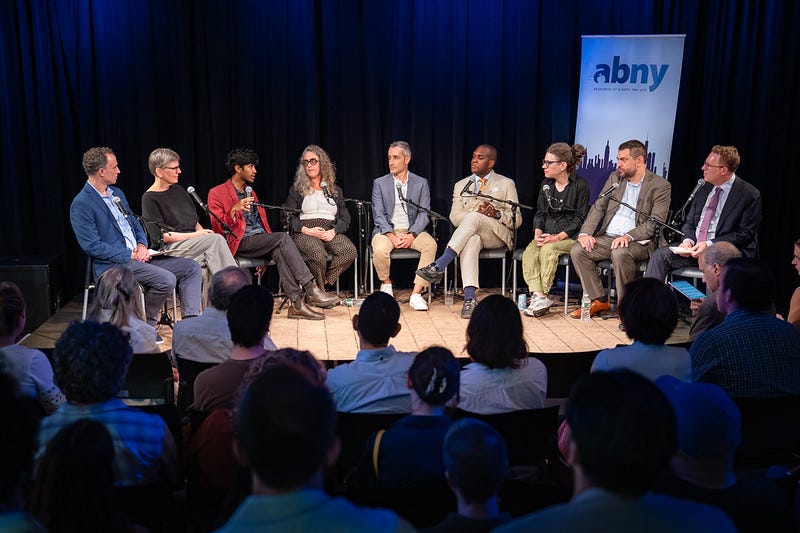
On Thursday, July 23, 2026, members of The New York Editorial Board appeared at a live-audience event hosted by The Association for a Better New York (ABNY) to discuss Mayor Zohran Mamdani’s tenure thus far, broader New York political trends, and a little bit of what comes next. The conversation, held at The Greene Space, included 9 of the Board’s 11 members, and featured audience Q&A. Emma Pfohman, ABNY’s CEO, gave opening remarks. (photo by Mara Zalite Photography for ABNY)
Participating journalists: Juan Manuel Benítez, Nicole Gelinas, Alyssa Katz, Ben Max, Akash Mehta, Myles Miller, Harry Siegel, Ben Smith, Liena Zagare.
Full Transcript
Emma Pfohman
Hi, everyone. Good evening. And welcome. My name is Emma, I’m the CEO of the Association for a Better New York, and I want to thank you all for being here. And thank you to The New York Editorial Board for joining us. I also want to start by thanking Matt Wing and his civic studio Wingspan for sponsoring tonight’s festivities.
And because our first podcast recording was such a hit, we’re thrilled to be back for another political nerd fest here at The Greene Room. So for those of you who are new to ABNY, we aim to strengthen New York civic fabric and create opportunity for New Yorkers by convening 260 nonprofit, corporate, labor, and philanthropy leaders in partnership with government. Many folks know us through our convenings and events. We also do research and grant-making through our foundation.
We launched a recent breakfast salon called At the Table with city commissioners that we kicked off with DOT Commissioner Mike Flynn. We had a power breakfast with the police commissioner. We have an upcoming tour of the Gateway’s Hudson Tunnel Project next week. And we recently released a report at an ABNY Talks panel on defining economic justice called Making Growth Matter that really looks into the state of the New York City workforce and how to make sure economic growth provides opportunity and mobility. We also had a really exciting trip with the ABNY Women Leaders Network to see New York’s newest team, Gotham FC, trounce the Washington Spirit at Citi Field. And with the Knicks triumphant win and the 39 days of World Cup mania, it has been quite a summer of sports. And since I worked on the World Cup when I was at City Hall, I wanted to make sure that in my role here at ABNY that we were bringing the fun and the economic benefits all across the city. So we launched the World Cup for All initiative and partnered with about 30 organizations across all five boroughs to bring watch parties and youth tournaments and community festivals to every corner of the city.
So we’ve been quite busy. But since the primary, I’ve actually just been kind of emotionally counting down to tonight’s podcast taping with a brilliant team at the Editorial Board. And for those of you who aren’t familiar, The New York Editorial Board is an informal group of veteran journalists working to fill some of the space left by the retreat of newspaper editorial boards from civic life. You may have read or heard some of their candidate interviews before the last primary, but I will say this, we are all just smarter sitting in this room with them.
So I’m excited to hear their thoughts about the recent primary. Also, we’re about 200 days into Mayor Mamdani’s tenure, and eager to hear their thoughts on what’s next for the general, and start thinking of your questions because we’ll have time at the end. So think of them now. And without further ado, I’m going to introduce Ben Max, who will introduce all of the folks on The New York Editorial Board.
Ben Max
Thank you to Emma. Thank you to ABNY, and The Greene Space, and most importantly, all of you for being here tonight. I’m Ben Max…I work at New York Law School. I’m the Program Director at the school’s Center for New York City and State Law. And we have set up there a journalism project to help give some infrastructure and support to initiatives like The New York Editorial Board. So very happy to have that connection. I’m going to briefly introduce the members of the Board who are here and then we’re going to get into our conversation. We had 11 members of the Board at the start of it, and everyone’s still participating. So we’re missing two of our folks tonight, Christina Greer and Josh Greenman, who we miss.
But let me introduce everybody who’s here. And many people here have other parts of their titles, but I’m going to give you the brief ones.
-Ben Smith is co-founder and editor-in-chief of Semafor, and he took the initiative to get this group going in the first place, and he’ll be our moderator tonight.
-Juan Manuel Benítez is a professor of local journalism at Columbia University.
-Akash Mehta is editor-in-chief and founder of New York Focus.
-Alyssa Katz is editor-in-chief of The Forward.
-Myles Miller is a senior reporter for Bloomberg News in New York.
-Liena Zagare, next to me, is editor of the Manhattan Institute’s The Bigger Apple policy newsletter.
-Nicole Gelinas is a senior fellow at the Manhattan Institute and a contributing editor of City Journal.
-And Harry Siegel is a senior editor at the City Reporter.
Many of you in this room are probably familiar with all of those outlets and institutions. Many people on this stage have their own podcasts as well, which I didn’t mention, but you can find them all. And Ben [Smith] is one of those people, and I’ll turn it over to you.
Ben Smith
Thank you! Thank you Emma, thank you Matt. Thank you for that introduction. It’s really so fun to see the hardcore of the sickos who are obsessed with New York City here. And also among the many, many friends and familiar faces, including the great Bob Liff, who when he was at the Daily News, taught me to not treat politicians with too much respect, which is something that, it’s hard to learn as a young reporter, but when I heard him, the way he talked to people on the phone, it was like, OK, yeah.
So anyway, this project is really about the role of journalism in New York civic life and really was sparked by our shared frustration when The New York Times got out of the business of endorsements, which were one of the few pulls toward a kind of public spirited conversation with politicians who mostly just deal with special interests all day. If you’re running for office, all you do is have meetings with people who want very, very, very specific things out of you. And I think our view is this kind of conversation is a way to sort of pull people back toward a kind of shared interest and often to challenge people who don’t spend a lot of time talking to people who don’t necessarily share their worldview.
And it was one of the best things about New York politicians is that with, I think, the sole exceptions of Andrew Cuomo and Jack Schlossberg [the two candidates who did not accept New York Editorial Board invitations for interviews], they’re eager to engage with the media. They see the media as a really important and valid part of, they see journalism as a very important and valid part of civic life, which was really reassuring actually in this process.
And when we kicked it off, we were interviewing mayoral candidates, and I think Brad Lander and Andrew Cuomo were sort of the obvious credentialed two people were going to. And Akash, you were like, no, you have to talk to this Assemblyman, who I had never heard of, from Queens. And so Zohran was, I think, the second interview. Over my total skepticism, honestly, I don’t know how other people felt. I just wanted to go back there. What did you see in Zohran Mamdani in that moment that made you think, wait a second, this guy is one of the really serious candidates for this office?
Akash Mehta
I don’t remember it this way, but I will take the credit.
Ben Smith
Just go with it.
Akash Mehta
Yeah, I think it’s a really interesting document to look back on now because he was polling at 2%. And it was, I think, the first really substantive conversation he had. And I remember being really impressed that, despite the fact that this was his first, in some places at least, tough interview, he was so ready with, I mean, like we asked questions, we stopped doing this, but for the first few interviews, we would ask questions about specific facts and sort of budget numbers and he blew them out of the water, like he knew his stuff, despite never having worked in city government.
And I think in retrospect, I don’t think any of us had a theory of the case at that time, but I think in retrospect, looking at his tenure as an Assembly member, it is really interesting to see…I mean, of course he had statements and he was in the press conferences on the biggest things that you would expect a DSA member to be on, like the Tax the Rich campaign. But what he repeatedly did was to make issues sort of not at the center of New York politics, like the taxi worker strike, like his bill to have Columbia and NYU pay property taxes and send that money to CUNY, and of course, his bill to strip charities that are funding illegal settlement activity in the West Bank of their nonprofit status. He would center these issues that sort of spoke to larger conversations and then get a huge amount of media and mobilization around them. And that’s what he did in the campaign.
Ben Smith
Yeah, I think we all lived through the campaign, so I’m gonna skip ahead to the mayoralty. And I think just ask some of you who’ve studied a number of these issues so deeply, how he’s doing and what you see as his central challenges. And I think I wanted to start with public safety, which is, I think Mamdani would actually probably be the first to say, kind of the table stakes of a successful mayoralty. And Nicole…you know, we’re living in a moment of really unprecedented low crime in America and in New York, even though people don’t necessarily feel that way. So what is your report on the state of public safety in New York and how Mamdani is doing?
Nicole Gelinas
Well, thanks Ben, and thank you everyone for coming to see us this evening. This holds true across the issues that Mayor Mamdani campaigned on, with one exception, which we can talk about later: Mamdani does well as a mayor and as an executive when he is either repudiating or ignoring the very things that brought him to the mayoralty. So last year—
Ben Smith
Spoken like a Manhattan Institute fellow.
Nicole Gelinas
Once he saw that he actually could win, he made it very clear he was no longer a “defund the police” candidate. He had been posting in 2020, 2021, very clear that he was an ideological ‘defunder.’ Ran away from that very quickly in the campaign once he actually started to get some traction. One of his campaign proposals last year, though, was to create a Department of Community Safety — billion dollar-plus agency a year that would take over many of the aspects of the police department, particularly the police department dealing with people in mental distress. But this was kind of splitting the difference between defund and fund the police. We are going to take a lot of these NYPD jobs where the public sees these interactions that end up in tragedy and move them from the police.
Never did that. We have an Office of Community Safety, very different from a department, where a department would need a City Council vote and need to be created. This office only has a couple of people and so far, seven months into his mayoralty, it really hasn’t taken any duties away from the police. So it’s a long way of saying the Mamdani NYPD looks a lot like the Eric Adams NYPD, including, of course, who is commissioner. And the Jessica Tisch NYPD tried-and-true preventative policing tactics, updated for a new age, is basically what is letting Mamdani say that crime is down on his watch, which is true. If you look at the seven felony index crimes, down about 7% this year. Murders are at extraordinary rates. I mean, we may end this year with less than 300 murders for the first time in 10 years.
Other felony crimes, assaults, although they’re down this year, they’re still 1/4 higher than they were before 2020. But that’s not something that we can blame Mamdani for. He is now the third mayor — de Blasio, Adams, and now this mayor — where we have gotten away from this idea that we want to bring total index felony crime back down to where it was before 2020. And the further we normalize these levels of assaults, that’s not good, but certainly any idea that we were going to see an explosion of crime on the watch of a democratic socialist mayor— he knew, because he’s very good at what he does, that would not be good for him or for the city. And so far, that has not happened.
Ben Smith
And what do you make of…and maybe it’s just that like every summer in the tabloids is the summer of blood, obviously. There’s never been a year in the city…Obviously any crime is too much; there was a very scary stabbing on the Upper West Side today. But what do you make of the sense that…I’m curious if you could elaborate a little in the sense that kind of broad crime is down, but there are very visible categories that are freaking people out right now.
Nicole Gelinas
Yeah, I mean, people are not crazy to perceive public safety differently than they did from, say, depending on how long people have been around, 1990, of course, was the peak of crime until 2019. Virtually all types of crime steadily fell every year. You could see this slow and steady, sometimes fast and steady, progress and basically feel safer every year.
In 2020, 2021, we had a 53% increase in the murder level. That was the biggest such increase in such a compressed time period ever. And assaults soared. And we see that continuation. Murders and shootings are down because the police has always been good at and is still good at containing the gang crime, the gun-related crimes in the hotspot, high-crime neighborhoods, particularly in the summer months. Random assaults continue to be a serious problem, both above ground and below ground [in the subways]. They’re up compared to seven years ago. And it just seems, you’re not likely to be the victim of a random assault, but if you’re thinking about “how do I protect myself from crime?” it’s very difficult to figure out what you can do as a person to avoid being the victim of a random assault on the subway. So this is both a perception and a reality that drives public concern.
Ben Smith
And Ben, just to sort of tick through the big issues on the Mamdani agenda, housing is another place where…I’ll just ask broadly, how’s he doing? And how is he doing compared to, I guess, what we expected when we talked to him?
Ben Max
Well, I think we’ve seen from him even an acknowledgement, and action to back it up, that he’s rethought some of the sort of older progressive approaches to housing development and taken what you might call abundance-minded politics and has taken an approach that I think he’s even called an all-of-the-above approach, which I think has a lot of appeal to a lot of people. And he’s, I think, trying on housing and other issues to kind of do it all, which I don’t know how long that can last. And I’m always reminding myself, you know, he’s been in office X number of months, not even 7 at this point. So all these points that we’re making up here tonight can quickly shift.
But I think it’s extremely important for his political brand that he came through with the rent freeze. Is that good policy? That’s another conversation, right? I mean, there’s a lot of questions about what’s going to happen with the rent-stabilized housing stock in this city, especially some of the most distressed properties that are largely rent-stabilized. That’s a real issue. And I think there’s a lot to discuss on that about the question of whether he and some of the people in his administration want that housing to become more distressed so they can help buy it up or help nonprofits do so. That’s a very interesting theme to watch.
On the other side of the equation, he’s seemingly taking a very pro-growth, pro-housing supply approach. We still need to see what that looks like because he hasn’t had to make a lot of decisions on that yet. They put out a housing plan that’s got a lot of interesting elements to it. But one of the biggest things that’s in that plan that we’re going to have to see how it comes to fruition is a promise to go even further than the City of Yes did on transit-oriented development. And that’ll be a fascinating piece of the puzzle because it’s going to coincide with the development, we think, of the Interborough Express. And so they’re already talking about some of those rezonings. And I think these are going to be very interesting tests, not to mention the very specific projects that come up along the way, about whether he is a very sort of YIMBY mayor or not.
Ben Smith
Yeah, we talked to a handful of the socialist candidates and my impression was a lot of them hadn’t…weren’t so much like motivated by hostility to the private sector as having never really dealt with it, having spent their lives in academia or nonprofit or political work. And it was very interesting to see Mamdani kind of discover on the campaign trail this other path to building housing, which was private markets. And Myles, you as the voice of capital: How is Mamdani doing with business in New York? And it’s particularly, you know, people love to talk about small business and Mamdani loves to talk about deregulating bodegas, but like this is ultimately…Most employers, the big employers in New York are huge businesses, huge global businesses. How is that going?
Myles Miller
I think this week’s announcement of Lina Khan as chair of the Economic Development Corporation [EDC], obviously we heard from the Partnership for New York that they have concerns with that.
Ben Smith
Triggering.
Myles Miller
Right. Correct. Our [Bloomberg] Terminal customers shudder when they see Lina Khan do anything, really, considering that at the FTC, she was very focused on the consumer and sort of making sure the business world was sort of in line. When you look at the pied-a-terre tax and what is going on today with the mailers going out, the business community still is very cautious about Mamdani.
But you do hear from members, I mean, he’s got a good number of folks in the business community who’ve met with him and have liked their conversations and their experiences with him. But what was going on with EDC was of particular concern. Specifically, EDC has for decades been focused on economic growth in this city. Bringing in a person like Julie Su, who has always focused on sort of worker rights and worker injustice and labor, and to focus on economic justice, was a marked change. We did an interview with her right after she took office, and I was shocked because in the interview, the first thing she wanted to talk about was city-run grocery stores. And as I’m sitting in the Governor’s Room at City Hall, I was like, “oh, that was a real thing.” I was shocked. I was like, “are you serious?” And she’s like, “yeah, we’re scouting locations.”...
On his economic message, I think he’s been sort of very upfront about what his economic focus is going to be. And no one should be shocked by any of the things that he does from an economic perspective. Bringing in Tony Shorris is not exactly the, how do I say this? as a former de Blasio person, worked in the de Blasio administration, it’s not exactly innovative, but it is interesting, right? A steady hand at an agency that really needs a steady hand right now. Andrew Kimball was a powerhouse, and to have no leader for quite some time puts the business community really in disarray.
Ben Smith
What is Mamdani’s and sort of his administration’s theory of economic growth?
Myles Miller
Julie Su should answer that at some point. And I say this as a person who really likes Julie Su from my time covering her at the Labor Department. But I would love to see that realized. You know, when I go to them and ask them about having people on Bloomberg or talking about sort of like economic growth, what Hunts Point will look like, all of that, you know, the focus is always on small business, which is great. But big business is what moves the city. And so the more we can—
Ben Smith
You’re warming a lot of hearts at ABNY. Feel free to jump in here.
Juan Manuel Benítez
What I would say is that I think it’s a little shocking that Mamdani got elected saying that he wanted to cater to the working class in New York City, and here we have a politician who, after how many months, seven months in office, he’s still in his messaging, his policies, he’s still laser focused on that same community of voters and New Yorkers that he was trying to address from the beginning. We had another mayor, Eric Adams, who, he loved to say that he was the first working class mayor of New York City. And then as soon as he got elected, he started traveling lavishly to many different world locations.
Myles Miller
He didn’t start. He continued.
Juan Manuel Benítez
He continued. He spent his nights at Zero Bond, socializing with the rich and famous and lobbyists. And now we have this mayor who initially said, like, “this is the group of New Yorkers who need some attention right now. So that’s what’s going, that’s going to be my focus at City Hall.”
But then we hear all the business community and the wealthy in New York City. “Well, what about us? What about our interests? What about, we are the leaders of the city and we’re the ones giving you economic growth?” And do they really need that much attention right now? When it comes to getting attention from the city government, when we have a middle class and working class in New York City who can barely afford childcare or many different things that would be basic in a city like New York.
So I’m trying to be less, in a way, cynical and I’m trying to be less cynical because I think we have right now a politician that is once in a lifetime. I think he’s a generational talent. We saw that when we interviewed him. And he’s trying to appeal to the voter who is tired of being cynical. I think a lot of voters, they vote for a politician, and at the end of the day, they say, politicians, they’re all the same. And right now, Mamdani, at least for now, his message is, this is what I said that I was going to do; some things are going to take more time than others, some positions might have to change a little bit because he’s not an ideologue. He’s more of a pragmatist. And I’m going to cater to those New Yorkers who feel that they’re being squeezed right now.
Ben Smith
How do you fit that theory of how he’s operating into the conversation about socialism? And like you say, he’s not an ideologue. He comes out of a genuinely kind of ideological and sort of sectarian group. But I mean, was he using them? Are they using him? What do you think of his relationship to a more ideological system?
Juan Manuel Benítez
I love that we are in 2026 and still in this city, in this country, you hear the word socialism and people believe that we’re going to go back to the Soviet Union or something like that. He talks like an average or like a mainstream social democrat in any European country. And I think as one of only two immigrants on this stage I think right now, I can say that you leave the U.S. and the world sees politics or the political spectrum in totally different terms and certain words. And I’m saying this because Mamdani himself is an immigrant. He comes from Uganda and grew up in other countries. So he has a different political culture, I think. And when it comes to the political spectrum, he is measuring things in a different way. So, OK, so he’s just like proposing things that at the end of the day, they are not that radical. Radical is just like getting elected and then just giving your back to the people who put you in that position.
Ben Smith
I want to tick through a couple more of the really big issues. There was relatively little discussion of education, which is the biggest city agency. It’s what the city spends its money on. Liena — and I won’t make you weigh in on the Soviet Union where you were born — but you know, a week when everybody’s talking, it’s sort of the annual week of talking about selective high school admissions. You published something today kind of looking at the broader statistics about the education system.
Liena Zagare
Everybody likes talking about the SHSAT tests that admit very few children of color. And so what I wanted to do is look at the bigger picture and actually who gets to take this exam and the reasons behind it. And what comes across is that attendance is the biggest issue that is facing the school system. And it is the one thing that gets no attention that I’ve seen. And it affects about a third of the city’s children, which is 300,000 children who are missing about a month or more of school every single year. And 150,000 of them, or half, are Hispanic children, which is like every sixth child in the city. And those numbers are just crazy. And not to be talking about them is also kind of unconscionable.
The focus of the Mandani administration has been entirely on expanding early childhood education, which is a nice thing to do, which affects a relatively small number of children. But at the same time, we really, really should be talking about how we get children, including…a lot of the children who don’t show up, are kindergartners, are first-graders. So this is a question of families being responsible enough and understanding that it is important that children go to school, and getting them there. Because by the time you get to high school, everyone skipped class every now and then, but it’s a very different story about a fourth-grader or an eighth-grader that needs to be there to get ready for their exams to advance to different schools.
So yeah, that was startling to look at that data and realize that we really are not talking about something that we should be talking about. And something that honestly, Mayor Mamdani, given that he has such a platform and he is so popular that he really could move the needle on attendance if he really focused on messaging that school really, really matters and that it’s a responsibility of the families and the children to show up. His Office of Mass Engagement could go out there and get the kids back to school.
Ben Smith
Let’s see…a core part of his politics is Israel-Palestine, not necessarily part of the day job of mayor, and he is not in fact going to arrest Benjamin Netanyahu. But I guess, Alyssa, the Jewish community, parts of it are incredibly stressed out about this mayoralty. How’s that going, Alyssa?
Alyssa Katz
Where to begin? I mean, New York City, as with Jews around the globe, has so many Jewish communities. And I think the statistics are about at least 1/3 of Jews, Jewish voters in New York City, voted for Mamdani. It could be more, it could be less. And what you have is this intense polarization where you have major parts of the Jewish community, including significant parts of the Jewish establishment, not limited to the Orthodox Jewish establishment, although certainly including much of it, although also not all of it, because you have both Zionist and anti-Zionist Orthodox Jews — but these establishment institutions, establishment rabbis, who went out of their way from the very beginning to paint Mamdani as a threat, with, to be clear, a lot of substantial basis for that. I mean, when you have a mayor who his leadership experience, his grounding in politics, was entirely based in pro-Palestinian politics that were extremely hostile to Israel.
And at the same time, when you actually look at what, I can’t speak to his record before he was in politics and before we could really widely see what he was saying and doing, but certainly since he’s been in New York political life, Mandani has been incredibly astute at drawing an incredibly bright line where he is on the one hand extremely, he’s been an activist more or less against the existence of Israel as it stands now, which is as a Jewish state. And I believe he said that to us in our editorial board interview, right? We interrogated him a bit on that.
And where at the same time he has, in fact, if anything, as he has become mayor, been more strident against Israel as a Jewish state, and to be clear, not just for its existence, but specifically around Palestinians’ lives and experiences and the militarization in the West Bank, obviously the war in Gaza. This was the movement for their rights and for Palestinian liberation was the movement he had come out of. And we’ve just seen this week, Mamdani really intensify these efforts in a way where we don’t quite know where the next chapter will go, but it will be very interesting with his threat to arrest Benjamin Netanyahu, the Prime Minister, that he is now backing down from, but he’s in fact continued to escalate, using his platform as mayor now, his official social media channels, his official desk at City Hall, to draw this line saying Israel cannot go on as it has, but he’s specifically targeting Netanyahu, which is interesting.
But at the same time, as he’s doing all this, he’s hugging Jews and Jewish communities closer and closer and closer, and saying, “we care about you, we’re going to protect you.” He made a very significant choice in keeping Jessica Tisch as police commissioner. That was a really kind of threshold decision. And one that really pissed off his base. He had a lot of people who’d come out of the movement who are very angry and continue to be as he has had the NYPD respond to protests at synagogues and as Tisch has marched in the Israel Day Parade, the movement folks are very pissed off at him.
But, so when you say, how is the Jewish community doing? What the balancing act that Mamdani has been trying to play is to try to assure Jewish community safety, which at the end of the day, he cannot guarantee it, right? But he’s pledged to do what he can and to work with Tisch to do what he can. And again, now he gave us this indictment on video saying “Benjamin Netanyahu is a war criminal. I can’t arrest him, but the federal government should. And the right to protest is a bedrock of our democracy.” Now he said it in a very careful way. He’s essentially urging people to step up and I don’t, we don’t know what will come of this energy.
Ben Smith
Do you think it’s working? Like the sort of ‘criticize Israel, try to hug New York Jews?’ Is it calming people down? Is it working in the Jewish community?
Alyssa Katz
It’s escalating tensions significantly with Jews who are strongly committed to Israel as remaining a Jewish state and as the place of the Jewish people. He actually escalated things today. It’s Tisha B’av and he escalated things by last night saying, “OK, may you have an easy fast” and so on. Tisha B’av is the holiday commemorating the destruction of the temple in Jerusalem, right? So I think he’s really escalating tensions with that faction. But overall, I think he’s in a very strong position, including with a lot of New York Jews.
Myles Miller
…You have to look at the Jews he’s surrounded himself with, right? You think of the ones in City Hall, but like to go to Devorah Halberstam’s house and to meet with Devorah and to, you know, make that a conscious effort is one thing. To go to the Satmars and to be with Rabbi Niederman is another thing, right? The Satmars are very much, I guess, sort of independent of the folks in Crown Heights. It was very meaningful to Devorah to have that audience with him and to really speak about what atrocities happened to her son, but also to understand the differences in the communities and the differences in what they need to continue having a presence outside of 770 Eastern Parkway and to continue to fight for safety and when there is an issue in the community to sort of be out front about it. And then you have the measuring stick, which is like, “well, how soon did he tweet or how soon did he condemn?” That continues. But to make those inroads is notable and important because, from what we heard on the campaign trail, people did not believe that was going to happen.
Ben Smith
Yeah. I love the level of detail of mapping the Jewish community required to be a New York journalist or politician. Like, nobody needs to be told what happened, we know what 770 Eastern Parkway is. Akash, before I get to Harry, Alyssa said something about his base being mad at him. You’ve covered the New York left a lot. Can he actually alienate his base or is his base with him no matter what? Is it like Trump? He could shoot somebody in the middle of Fifth Avenue?
Myles Miller
It would be in the Commie Corridor, actually.
Akash Mehta
That’s a good question. The New York City DSA has—
Ben Smith
AOC fell out with them and paid no political cost. Like, seems like maybe it’s 100 people on Twitter, is the sort of the outside perception. Do you think there’s a base that can hold him accountable to what he had promised on, say, policing?
Akash Mehta
Yeah, I mean, so the New York City DSA objected to his plan to hire 500 more cops and unclear if it was in response to that criticism, but he did sort of zero that out. I think it’s still sort of and we’re circling around this, I don’t know what it means to be a socialist governing New York City, and seven months in, I still don’t really know what that means. And I don’t know to what extent, four years in, we’re going to be thinking of this as a significantly different mayoralty than the type that de Blasio had, or as the same kind of mayoralty with way better and more compelling communications and politics for a lot of people.
And I think actually EDC is a really interesting place where we’ll maybe start to answer some of those questions, where some of what it does is like give private schools tax breaks for their renovations and do a lot of corporate tax breaks that there’s a lot of debate about whether or not it in fact creates jobs. You could imagine because it’s unencumbered by the city bureaucracy it doing lots of really interesting new projects that are instantiations of his sort of socialist vision of a muscular government doing new things.
The thing I really want this agency to do is create a public option for funeral caskets, because anyone who’s ever had to deal with a funeral home is, you know, like every part of that…now I’m really going off on a tangent.
Ben Smith
No, this is great. I don’t know if anybody, is anybody from the administration here? Please take notes.
Akash Mehta
No, I mean, my grandfather died earlier this year and I was just on the phone with a bunch of funeral home companies and they’re required to maintain an itemized price list, but they’re not required to give it to you until like long into these negotiations. They’re not required to post them online. They really should be. Sam Levine and Lina Khan tried to do this actually at the federal level and maybe they’ll do it at the city level. But then the individual things that they’ll try to sell you on, and upsell you on…like a cardboard box should not cost $600. And so anyway, I am curious to see if EDC is sort of re-envisioned in a way that wouldn’t have happened under, say, de Blasio.
Ben Max
I think the grocery stores is one of the most perfect examples of a little bit more of the actual socialism coming in here, because I totally agree with what Juan Manuel was saying before, and I’ve said for a long time, if you didn’t know Zohran Mamdani came out of the New York City DSA, you’d be like, “oh, he’s like Bill de Blasio.” The platform was similar. It wasn’t, you know, this was not some massive sort of radical movement. And I think the grocery stores are one of these areas that could really, I think, actually sabotage the whole thing. I think there’s like boondoggle potential there that could really be a problem for him, but not getting into all those details now.
Myles Miller
Wait, what specifically? I’m interested in that.
Ben Max
Oh just, the cost of building these places out could become just an ongoing scandal and fodder for like, “you can’t manage a capital project.” Then there’s the question of whether the prices are going to hurt the local bodegas. I mean, it just seems like endless possibilities of bad headlines and stories for him for, I’m not sure what the best case scenario really is, that, you know, is this an eight-year project where they wind up with five in each borough? Well, then that’s something extremely different. What is this going to become?
Alyssa Katz
I just want to weigh in on a bit of a tangent, but an important one when you say headlines and stories, because we are all here because the New York Times abdicated a very important part of its local civic role. And we all in a different ways are part of the media ecosystem. But Mamdani is testing the proposition, and I think he is prevailing, that he can govern regardless of what is happening in the media and that he controls his communication platforms. I mean, other mayors have tried, Adams tried, de Blasio tried. Mamdani may be the first you can actually get away with that. I don’t know if others agree with that.
Myles Miller
He was hurt certainly during the big snowstorms with the amount of snow deaths and you know the hardest thing for a new press team was a spokesperson saying “people die all the time.” And luckily for that team, that story sort of went away, but that was not good, very not good. And as much as you use new media to get the message out, the headlines will stay. And Legionnaires’ is another one. It’s like on these two big health issues, it’s weird, like, there’s something…
Alyssa Katz
But they’re not part of this platform. I think there’s a distinction, and there could be a narrative that we end up seeing that, and this is something that Julie Menin, the City Council Speaker, was already kind of holding him to, is saying, you know, “you’re forgetting about the basics here as you’re chasing the grocery stores and the childcare and everything.” So that could be—
Myles Miller
Ben, do you have a question about Julie Menin later?
Ben Smith
No, but would you like to talk about Julie Menin?
Myles Miller
She wrote that op-ed and it got a really unfortunate headline. “The mayor’s minions bungled Legionnaires’.”
Nicole Gelinas
On the issue of the cold weather deaths, that was an example of the mayor showing he will quickly be very flexible and give up what appeared to be an important principle to him when it looks like that’s going to be bad for him and bad for the city.
So one of his issues last year, he said multiple times and answered multiple questions, is “we are not going to do involuntary commitments. It will only be a last resort.” And he never defined what last resort means. It already by definition is a last resort. And once we went into this cold freeze in January, February, despite the fact that there’s actually still no evidence that this year saw more cold freeze deaths than previous years, the Department of Vital Statistics puts it out every year. Unfortunately, people do die every year from these types of deaths, and we had a particularly cold winter this year. He’s actually the one who brought up the fact that people were dying. This was what got the press attention on this in the first place. And as soon as he saw that not using involuntary commitment is going to be a problem here, he reversed himself and not only reversed himself, but started to say every day how many people that they were committing on an involuntary basis.
So a particularly striking example of how being flexible in, whether it’s a cynical or a not cynical way actually ends up being good for the governance of New York City and the flip-flopping from a bad position is good.
Another example of that was the rental ripoff hearings. So he held these five hearings, one in each borough, so that tenants who are not the people who show up every year to protest against the rent regulated rent increase, market rate tenants, other people not used to this process, could come and basically complain about their landlords. And the first iteration left out NYCHA tenants. You couldn’t go if your landlord was NYCHA. It immediately became a place where he got tremendous criticism and you had people funding these trucks outside the rental ripoff hearings: “You’re silencing NYCHA.” You had people wearing coordinated t-shirts in the hearings saying, “let us talk, let us talk.” Many mayors would have maintained this fight on principle. Mamdani immediately said, “you know what? We’re going to set up a table for NYCHA. We’re going to listen to NYCHA,” and solved the problem immediately, where you had a couple hecklers stand up at the Bronx hearing that he attended and say, “you’re ignoring NYCHA, you’re not listening to NYCHA.” And he just shut down the heckling by saying in a very calm, friendly manner, “I hear you. That’s why we have the NYCHA table.” It’s a very efficient and seemingly obvious way of neutralizing problems and criticism, but many elected officials with years and years in office never learn this lesson.
Ben Smith
And we want to get to both some of the statewide and federal races and to your questions in a minute. But Harry, I want to call on you as the house historian here before we get off Mamdani. Where do you place him in the…post-war New York mayors. Like, how do you sort of situate him historically?
Harry Siegel
So listening to everyone here. I’m going to answer a slightly different question.
Ben Smith
That’s fine.
Harry Siegel
Look, here’s how Mamdani is significantly like Bill de Blasio, and unlike every other mayor: he ran for office on stuff he cannot do.
We just saw this with the arrest Netanyahu thing, which he knew was practically nonsense when he was at 2%, when he was a front-runner, when he was the nominee, and now as mayor, he’s been sort of forced to concede that. And is still succeeding in that as a moral message. It was a smart thing for him to bring up, but he was playing dumb about that part.
He ran on Tax the Rich — not he’s going to tax the rich, Albany needs to tax the rich. Same as Bill de Blasio. It’s a really interesting thing to do and it is a theory of the case. And the theory is we’re going to build so much political momentum and this wave is going to rise, the things that aren’t possible are going to become possible and my election is the proof of that. which is an extension of the same ridiculous flywheel and having great success in opponents’ timing, running in Trump’s second term when regular Democrats are just absolutely sick of all the other options they have, recognizing this exhaustion with austerity. So he runs on stuff he cannot deliver sensibly. And his theory is, “bring me in, I’ll show that I’m decent, I’m trying, I’ll be able to deliver it.”
Now, how is he not like de Blasio? First off, his timing is much better. The wave is still rising. He’s doing something to help that. But a lot of it is, you know, he’s actually keeping up with rather than doing that, number one. Number two, de Blasio got pre-K, did not get his, you know, “cup of coffee a week” tax hike that de Blasio talked about and sort of gave up. And he’s like, “I have a thing. I’m going to pocket it. I’ll implement that one thing and that’s it.”
So you have an energetic mayor who knows that his mass engagement office is very important, that he needs to keep churning. He needs to show that momentum is still rising, which brings us right into the congressional races, and is aware that messaging is the first thing. And if he does that and he shows goodwill, that he’s interested, he’s going to dance with them that brung him, that’s who he’s interested in, first and foremost, that he has space to keep generating momentum, and that and messaging, as he said to us, back when he was at 2%, what’s most important in a mayor: “I’m a messenger.” That’s what’s going to allow this to continue. And so far, that theory of the case is really playing out.
Juan Manuel Benitez
I’m going to disagree with Harry, because I do believe that—
Ben Smith
I was just thinking, like, it’s amazing these politicians came in and talked to such a kind of cantankerous group.
Juan Manuel Benitez
He ran on things that he can’t fully deliver, but he is really good at setting an objective and settling for something that goes midway. So he promised New Yorkers he was going to freeze rents, right? And people thought he was going to freeze every single rent. But then seven months in, the Rent Guidelines Board has frozen the rent for rent-stabilized buildings. That’s…a million apartments in the city. So that’s something that many New Yorkers are going to feel and they are going to see. It’s something concrete. He ran on free and fast buses and OK, they’re not free, but now the Fair Fares program, the discounted fares program is now wider, and now there are some routes where the buses are going to be faster. He ran on taxing the rich, and today we saw the first mailing going out to pied-a-terre owners, telling them what to do to see how much they’re going to have to pay. Those are concrete things that New Yorkers who are right now excited about the new mayor and new charismatic, energetic mayor who sounds principled, who sounds—
Harry Siegel
I totally disagree that you’re disagreeing with me. This is his theory of the case. It’s “as long as people sense goodwill and that I’m moving toward this and that the city is getting a little more affordable and breathable, no one cares that much about the fine print,” which really was and continues to be things he cannot deliver on, as you were actually just running through, as Nicole was mentioning with the Office of Community Safety, which is nonsense at this point.
Ben Max
But again, it’s six-and-a-half months in. We have to look at this as at least a three-and-a-half year project that he’s undertaking, until he has to run for re-election.
Nicole Gelinas
So he got the one promise that matters to his re-election. He was very systemic last year in the three concentric circles of voters that he needed. So the DSA base, it’s a place to start with. No candidate had competently exploited this base, and nobody with his charisma had looked at these voters as a valuable resource. But he couldn’t win office just with the DSA base. So then he needed the de Blasio progressive voters. He worked on making them comfortable. But the third group of people that he needed were people who were thinking about voting for Andrew Cuomo. He made them comfortable with two things: promising to keep Jessica Tisch as police commissioner, which he did during the general election, not during the primary because he needed those Cuomo voters for the general, but also the rent freeze because you’ve got 900,000 households, many of whom, actually most of whom, are not ideological DSA people. They’re not sitting at home reading socialist tracts, but they see, “I can save a couple hundred bucks a month and I’m gonna vote for the guy who’s promising that.” And it’s bad policy over the long term, but that delivers him that third block of votes that was critical to his winning.
But the bad news or the challenging news for him is he needs to do that again. Once you’ve done a rent freeze once, you can never raise the rent. It’s like the subway fare from 1904 to the 1950s. He’s put himself in a trap, really.
Juan Manuel Benitez
He’s trying to do everything he promised or close to the things he promised year one, because then New York City mayors are going to encounter many different big crises and everything is over for them. They need to get everything year one when they have political capital.
And let me say one thing about Jessica Tisch because we’ve talked about her a lot. Yes to everything we’ve said here about Jessica Tisch, but she also has a job right now because she is damn good at what she does. And she was really good as a commissioner of the sanitation department, and she had roots in the NYPD from many years back. So she is a good person to have in your team too — she’s effective, right? So I think sometimes we tend to see all this…it might be a political play, obviously, but at the same time, she deserves to be there.
Ben Smith
There’s obviously this kind of pragmatism to Mamdani, and “there’s no Democratic or Republican way to pick up the garbage.” And one of the things that struck me in our conversations was, even as this year, as Mamdani was making a lot of very pragmatic choices, we talked to his chosen candidates for Congress, who were both very new to politics, and I think particularly Claire Valdez and Darializa Avila Chevalier — Lander is somewhat sort of a different category — and also, I would say, not that particularly pragmatic. Claire Valdez told us that she didn’t really believe in housing being constructed by anybody other than the government. And Darializa said that she didn’t believe in borders or prisons, just sort of full-stop; bordering, sorry. And I guess I’m curious… if you’re a member of Congress, it’s obviously a different job. Do you think that the left is continuing to rise and that we’re going to see more really potentially successful socialist challenges against everybody to, I don’t know, Yvette Clarke to Hakeem Jeffries, or is there kind of a moderation following there?
Myles Miller
I mean, challenge Yvette Clarke if you want. I don’t think you’ll be successful. I think stepping into the Hakeem Jeffries challenge by Chi [Osse] was very smart, but there are, I mean, challenging Yvette Clarke is kind of crazy.
But to talk about Claire Valdez, it was very clear, and you saw it in the transcript from our interview…what’s a nice way to say this? It wasn’t clear that she knew what she was going to do if she got to Congress, right? Like it just was like, “who would you find coalition with? What are some things you’ll take on? Who are some members of Congress you know?” And it was brutal.
Ben Max
Well, she’s a perfect example of the DSA movement candidate. Mamdani was not that. He was tied to the movement, of the movement, but also his own star. AOC is her own star. Then there’s candidates for federal or state office who are kind of just like movement candidates who are not necessarily as distinct on their own and would probably have no chance of winning or no chance of making a big amount of noise if they didn’t have that movement and now the stars of the movement behind them. And so I think there’s interesting distinctions there.
There was a big difference between Avila Chevalier coming in and talking with us. She may have said a bunch of things that people find objectionable or whatever it is, but she was ready to go. And Claire Valdez was much more unsure of what she seemed to believe in or want.
Myles Miller
That was a great race. I mean, Reynoso is like…But it just was, it was such an interesting race because here’s this guy who’s devoted so much time to this neighborhood, this community, and could not break through, like truly couldn’t break through. And I just wonder— the interview was so fun, but he just couldn’t break through.
Harry Siegel
Voters don’t care about any of this stuff. They don’t care about what people like us think. They don’t care about editorial boards right now. They want to throw these bums out. They’re sick of it. And candidates with very different approaches and very different settings made that clear.
And so in that moment, it’s still our job to vet these people and make sure voters have that information. “What are you going to do if you get to Congress? Are you thinking about who you’re going to align yourself with? Do you want people who think that the very concept of borders or jails is morally obscene?” And voters said, “that’s fine. Don’t be that guy.” And that’s it.
And so someone like Reynoso, who’s a natural, who’s talented, who’s come up through part of this movement, but is tied to the establishment, it’s like “we just, we don’t care.” And you just saw that in race after race after race. And our job is to take people through these motions and then they decide.
Ben Smith
And yet, Kathy Hochul, a pure creature of the establishment, is sailing to re-election right now through a pact with Mamdani, through the usual kind of Republican ineptitude. What, and I guess Akash, say what you were going to say, but then tell us, what is term two Kathy Hochul once she’s gotten through this and no longer needs Mamdani? What’s that going to be like?
Akash Mehta
Just on the point before, there is a question about what is DSA going to do and do they continue to field candidates — they will. I’m curious what the Democratic Party establishment does in response and whether they try harder because they’re just not trying very hard. And the best thing I read on the election was an analysis by the researcher Michael Kinnucan who looked at Erik Dilan’s seat — Dilan is an Assembly Member who represents Bushwick and Cypress Hills, a twelve-year incumbent. The DSA ran a candidate against him four years ago and came within 200 votes of beating him. Erik Dilan scraped by with 2,500 votes in a 130,000 person district. Four years later, the DSA candidate won, Christian Celeste Tate. And Eric Dilan posted those same 2,500 votes. He had four years. He had a warning shot. He knew that they were on his heels. And he and the party and all of the…he got all the union support in the race — 1199, 32-BJ, etc. — they could not marshal a single more vote.
And Andrew Cuomo did not run very hard.
They did spend $400,000 against the DSA candidate in this [Dilan] race through a Super PAC. And in general in this race, the DSA overcame a literally unprecedented level of Super PAC spending. But, you know, Errol Louis has also written about this. The Democratic Party establishment has just lost the ability, which it once really did have, to organize voters and to show people that it’s, you know, delivering for them.
Ben Smith
Except for Kathy Hochul.
Ben Max
Well no, because in 2022, she only won by 6 points because a lot of Democrats stayed home. And that is, I think, her bet with Mamdani is “please get some percentage of your voters out for me,” because in New York City in 2022, she struggled very, very deeply with turnout. It wasn’t a big Republican wave that helped Lee Zeldin. It was similar to what happened for Kamala Harris. It was Democrats and people who had voted Democrat were not enthusiastic and stayed home. And so that’s her problem. She needs voters to come out. And so she has no New York City base. She’s from Western New York, obviously. I think she’ll win, but—
Ben Smith
Anybody have a theory of what she’s going to do once she wins? It is amazing how little we talk about the governor of New York always in New York City.
Juan Manuel Benitez
You don’t have a Republican Party in the state that can field a candidate that can be credible all over the state.
Ben Smith
So let’s move on to that because I think that’s a really interesting question. To me, one of the most entertaining conversations we had was with [Republican] John Catsimatidis…who, when we asked him about how they were going to reach out to immigrant voters who had voted for Trump and presumably would be willing to vote for Republicans, said that actually they were illegal and didn’t exist, which he knew because the vibes. And it was just— maybe Nicole, this goes to you, maybe you and Liena too, but what is wrong with the right? I mean, talk about parties that cannot bring people out, like the Democratic Party obviously has its problems, but the Republican Party in this state just seems in a state of total collapse.
Nicole Gelinas
Yes, Liena, tell us.
Ben Smith
Are there any signs of life?
Liena Zagare
I don’t think so. Have you seen it?
Nicole Gelinas
We have more Republicans in the City Council over the past seven years. I mean, they’ve gone from three to six. So there is some evidence that—
Liena Zagare
And a lot of that was over education.
Nicole Gelinas
And crime.
Liena Zagare
And crime. So those two in Southern Brooklyn in particular?
Ben Max
There’s also a relationship between Trump being in office again, like there’s a bigger context here, right? Bill de Blasio bumbling through a second term on the way out, sort of ham-handedly trying to get rid of the SHSAT. You know what I mean? It’s a lot of response politics, right?
Myles Miller
Mike Lawler should have run [for governor this year]. It’s just like, I think about that all the time. Like, I think he would have been a really interesting, strong candidate. He’s doing it from the sidelines with his race and trying to tie his race to.
Ben Max
He knew he wasn’t going to win in a Trump mid-term.
Myles Miller
Yeah, but he’s got that, he’s got that fight in him though. You know, like, who else, like, Bruce Blakeman’s not bringing the fight.
Ben Smith
I’m going to ask two quick federal questions. Is AOC going to run for president? Anybody here?
Juan Manuel Benitez
She should.
Ben Smith
Why do you think?
Juan Manuel Benitez
She’s a great communicator. She’s a great messenger. She has a lot of energy. And I think if there’s something that the Democratic Party needs in Washington, DC right now to energize the base, it’s to feel candidates who are younger, who know how to communicate in the new environment and in the new media and information environment. And she is one of the best people to do that. Is she going to win? That’s another thing, right? But I think she would be a formidable candidate.
Ben Max
She has to give up her seat in the House to run for President or Senate. She could probably walk into Chuck Schumer’s Senate seat, whether it’s against him or if he doesn’t run.
Ben Smith
That’s my other question. Is [Schumer] going to run for re-election? Who knows? OK, Bob. Do we have a mic [for audience questions]?
Catherine Vaughn (audience member)
Thank you. Catherine Vaughn from Abundance New York.
One thing I wanted to touch on was kind of, I think Mamdani has tried to make public sector excellence and efficiency part of his brand, from the “pothole politics” that we saw over the past six months to the “pit crew” announcement around in-house tech teams. But some of the bigger fish there — like New York Focus recently reported on Mamdani planning not to opt into New York Helps to speed up civil service hiring. You know, he’s kind of not going for that. And so curious to hear your thoughts on, you know, is it all sizzle and no steak? Do you think that Mamdani is really pursuing government efficiency to the maximum that he could?
Ben Smith
New York Focus?
Akash Mehta
Yeah, to me this is like at the core of also that same question of what would it mean to have a socialist mayor of the city. The pothole politics thing, someone can correct me if I’m wrong, but I think like, yeah, he’s filled more potholes than mayors have for the past like three years or five years or something, but it’s really just the average for like the past 15 or 16 years.
Ben Smith
But better TikToks about potholes.
Akash Mehta
Yes, exactly. So it is funny that that has become the synecdoche.
For me, the biggest question, yeah, absolutely civil service rules, but for me, the very biggest sort of barometer here is the relationship between the city staff and contractors, where the city spends more money right now on contractors than it does on salaries and core to a sort of socialist vision of governing a city is bringing those in-house. And also the abundance movement and the sort of civic tech movement and a point of agreement in at least a lot of sectors. And, there have been a couple of contracts, including the McKinsey one, which is interesting, that he’s cut, but broadly he has not broadly, and or maybe it’s too early to see whether he will, but—
Ben Smith
If he is bringing this stuff in-house and so focused on sort of civic excellence, does this at some point bring him into conflict with public sector unions?
Akash Mehta
Yeah, absolutely. I mean, those unions are why he, for instance, is not opting into the rules to essentially to get rid of the civil service examination process.
Ben Max
But bringing more in-house is good for the unions. So I think that’s the positive there. I think the risk with the unions is, what’s he going to insist on in the next round of contract negotiations? Like, is he actually going to dig in and ask for any reforms, which Eric Adams did none of, in exchange for salary increases and other things?
Nicole Gelinas
Well, Myles brought up Speaker Menin before. It was striking in this year’s budget, and actually after the budget, that it’s Speaker Menin who has positioned herself as the fiscal moderate, but she wanted more spending on traditional Democratic constituencies. So we have this new $325 million payout to the teacher’s aides that Menin and the Council just voted on outside the budget. And you have Mamdani saying, “we’re going to try to see if there’s a way for us not to do this.” And the same thing with the housing vouchers, which is the traditional Democratic nonprofit constituency. It was the City Council who added this new spending in resistance to the mayor.
So it’s kind of a weird situation where we already spend so much money that we can’t afford socialism. And Mamdani actually seems to realize that. He is trying to carve out a little tiny space in the budget for his priorities, and that’s already very difficult for him to do because the union money, the non-profit contracts, I mean, this is all just inertia.
Ben Smith
And Liena, what’s in the education space? In the early childhood space, there’s sort of a tussle over the public sector union’s role, I think, as well?
Liena Zagare
Yes, in terms of the workforce and bringing pay equity and unions are very much involved in that.
Ben Smith
Bob?
Bob Liff (audience member)
Juan Manuel was talking about the working class basis of the rhetoric. But the DSA, now the DSA nationally is far more rigid and authoritarian than the New York City DSA. But you know, I went to Brooklyn College, I remember my socialism and the Leninist vanguard of the proletariat. This is a vanguard without a proletariat. This is, you know, you have essentially the affordability argument appealing to Gen. Xers who can’t afford to live in this city, and that’s real. I’m not, you know, I’m not dismissing it, but with the exception of the Espaillat race, where you had the complication that a lot of Harlem had not forgiven him for going up against Charlie Rangel years earlier, you know, this is not a minority-based movement, and even if their candidates have tended to be from communities of color. So it’s a very complicated analysis.
Juan Manuel Benitez
I think more than Gen. Xers…
Ben Smith
Yeah it’s Millennials. Come on.
Juan Manuel Benitez
It’s more Millennials and Gen. Zers.
Bob Liff
I was born in the Truman administration, so they’re all—
Ben Smith
You’re an old millennial, Bob.
Juan Manuel Benitez
And what we see is that we have all these new, young New Yorkers who are moving to the city or who grew up in the city, who did everything right, what they were told to do, they went to school, they got a degree, and now they’re trying to get a job, and they realize that they cannot afford the city. So I think that’s a constituency that he was looking for as part of his base.
I think we talk a lot about the DSA. In reality, the DSA is a great movement that can help you knock on many, many doors, something that is needed if you want to do this kind of retail politics and door-to-door politics that has been so effective, I think, with all these candidates. When it comes to the Espaillat and all these other candidates, I think there is an anti-establishment feeling among a wide sector of the Democratic Party. They don’t care about their positions that much these new, younger, candidates, Democrats, they just want the other guys out. They think that the House Democrats are not doing anything to counter Donald Trump.
And then one more thing, because we’ve spoken about this, but I think the Palestinian issue is a generational issue. It’s a defining political issue of this generation. And I think we live in a bubble, obviously, here in New York City and in the U.S., but the moment you leave the New York City and the U.S. bubble, you realize that most of the world agrees with Mamdani when it comes to his positions on Israel, on Benjamin Netanyahu. And obviously he knew he couldn’t arrest Benjamin Netanyahu. However, he’s going to make his life miserable if he decides to come to the U.N. General Assembly in September. And those images all around the world of the Prime Minister of Israel coming to the U.N. and being not welcome in New York City and having all these protests that he’s already alluding to, I think it’s going to be great messaging also for the mayor.
Ben Max
I also think it’s — and this is not an original thought, plenty of people have pointed this out — but it’s almost better to think of Mamdani and the movement as a populist movement, not a socialist movement, right? There’s 13,000 members of the New York City DSA by their numbers. I don’t know if…I’m not sure I believe this, but they had over 100,000 people volunteer on the campaign. So it’s different. It’s anti-establishment, it’s youth, it’s lots of, I think, old school sort of socialists and liberals who are just sick of the Andrew Cuomo types and wanted a Bill de Blasio who’s just better at being Bill de Blasio — you know, what Bill de Blasio promised, but not corrupt, enjoy being mayor, and run the government a little better.
Myles Miller
Cooler. You know, good looking. I wonder like what’s the reason why...you saw the fight on the cover of the New York Post, right, with [Queens Borough President] Donovan Richards and saying like, this is white supremacy and stuff...But it does raise a good point in like how does the DSA start to look more like the communities that the candidates they’re going to be running against look like? You know, for a good part of the last 10 to 15 years, the Working Families Party sort of filled that role. And you saw that fight between Claire Valdez and Antonio Reynoso, that is the question that sort of needs answering. It’s like, I think Bob raises a good point about…the groups in these neighborhoods where they’re running, like how do you get more Black support? How do you get more Hispanic support? And sure, there are Black and Hispanic people who have voted for these candidates. But I think we all understand what I’m getting at.
Ben Max
But you’re also getting at one of the biggest stories of New York politics, which is labor unions don’t move votes anymore. There’s a bunch of attention on UAW Region 9 — maybe they are just picking the right horses, I don’t know. I mean, I’m interested in…is there any evidence that the unions are moving votes?
Nicole Gelinas
They don’t move votes, but they can make life miserable for a mayor who really—
Ben Max
100% agree.
Nicole Gelinas
I mean, this is the story of John Lindsay. He wanted the police to work at night, and they didn’t want to. He wanted efficiencies to waste collection, and they resisted that. And I think Mamdani’s smart enough, just as every mayor since Lindsay has been smart enough, not to go near them, which is a big part of our fiscal problem.
Alyssa Katz
And just to take your example of UAW Region 9, that is a movement that is not for the mainstream Democrats. That is a movement that is front and center in the Mamdani moment, and particularly on pro-Palestinian advocacy on the anti-AIPAC campaigns that took out Espaillat, that defeated Reynoso. Valdez and Chevalier both worked for, and were members of UAW.
Ben Smith
Not as auto workers.
Alyssa Katz
Not as auto workers. I mean, they’re organizing academics, you know, Columbia University, libraries, museums, they’ve been very intentionally as an international going into these left politics.
Ben Max
Anti-rich, like “tax the rich,” very sort of “the corporatists are bad.”
Ben Smith
I think we have time for one more question.
Mike (audience member)
Doesn’t that present that it’s not as much socialism as it is an anti-colonial and anti-colonialism, whether the colonialism is the ultra-rich in New York City or the struggle in Palestine or gentrification or affordability, it’s really more of an anti-colonial movement than it is socialism, but the DSA happens to be the vehicle for it?
Alyssa Katz
Absolutely, I think the answer is yes. I 100% agree with you. I think that is the common denominator here, and I think there’s a lot to contemplate about what that means about New York City, about people’s perceptions of New York City, why Mamdani won. I think that is absolutely the right analysis.
Ben Smith
Now we have time for one more question, because that was such a short answer, which was just, you’re right, Mike.
Audience Member
So, you know, I work at DCAS as a city worker. I’m a lonely technocrat in a populist world. Man, what do I do? They’re coming for me. No, my question is, if you are like an abundance-minded, not necessarily moderate, but there’s definitely an overlap, how do you, to use Gen. Z lingo, bring the sauce to the kids? Like, do establishment Democrats just need more vertical form videos? Is that it? Is it a TikTok? Should they just have Temple Run on their foreheads while they do speeches to get the visual stimuli going? Or is it rather that we need an entire new faction of Democrat that’s also running against the establishment and really it’s like a kind of like a three-way triangulation thing going where it’s like, I don’t necessarily want to overthrow capitalism, but I also don’t want Sleepy Joe. He’s a real nice guy, but you know, he’s not exactly the picture of dynamism—
Ben Smith
Where are the liberals going to get their shock troops other than him? Does anybody see? Because I think it’s totally like abundance has sort of captured the intelligentsia, but does not seem to be able to produce 10,000 people to knock on doors. And does that seem likely to change? Does anyone see it?
Ben Max
You have to have a vision. This was Andrew Cuomo’s problem. What’s your vision? We’re in a time where you have to promise people something, you know, interesting, good, exciting. So I don’t know, I’m not going to write a prescription for the abundance movement, but you’ve got to show it better. Like, what’s the next wave of the New York City subway system? Run on that, you know? Something.
Ben Smith
Ezra Klein for mayor.
Ben Max
Well, but it’s not about the process and, it’s about the outcomes, right? That’s what Mamdani understood. It’s, what are you promising people you’re actually going to do for them?
Juan Manuel Benitez
I think we have another question in the back.
Zach Jaworski (audience member)
Hi, how’s it going? My name is Zach Jaworski. I think one of the really fascinating things about this administration, obviously you guys have talked all night about the changes in the city itself and the vibes, but I think one thing, especially all of you being journalism adjacent at least, that’s been really fascinating is the transformation of the press and how they’re covering Mayor Mamdani. You’re seeing the gentleman up here mention vertical form videos. I never thought in a million years I’d see [CBS 2’s] Marcia Kramer do an Instagram reel, but you’re seeing people adapt to it. How do you think that has changed under this administration and where do you think journalism goes forward when it’s all about getting views on social media now as opposed to holding power to account?
Ben Smith
Yeah, maybe I’ll take that one. I mean, I think what Mamdani is sophisticated about actually is that he understands that the press has a role, if a diminished one. I think there’s an impulse for particularly successful new politicians to think the media has no role for the first six months of their honeymoon and then realize that it does. And New York media is obviously still very relevant.
Yeah, but I think in a way what you’re getting at…there’s always a moment with every, each particularly these new digital technologies we’ve lived through that people think like, “oh, only one side, only one slice of the ecosystem can figure this out.” Like there was a sense the internet was for liberals. Like Facebook was of the left and Obama went and visited there. And there was just this conventional wisdom when I was coming up as a reporter that only Democrats were on the internet. It was because Democrats were younger and younger people were on the internet. And then it turned out that Trump and Republicans could also be on the internet.
And I think there was this sense for five minutes that like only socialists can do vertical video. And I think this is obviously not true. And the sort of technocrat who is crushing it at this, your guy, is Dan Lurie in San Francisco, the most popular elected executive in the country, and just does these very kind of dorky moderate videos about how he’s like cleaned up a section of a street and there’s a restaurant opening. And I think you’re just going to see sort of mass adoption of these new forms in a way that like it isn’t going to be only the left, only the right, only the mainstream, only the fringe can do it. Mamdani is so adept at them and is a little ahead, but I think that’s not, that’s not an enduring advantage.
Juan Manuel Benitez
But if you can tell us a little bit, because you’ve been covering Mamdani doing vertical video for the last six to eight months or more. And you’ve been in those press conferences. So do you see as a young journalist coming in that the whole thing is changing?
Zach Jaworski
I think that in the last six months there’s definitely been a significant shift towards vertical videos. I mean, like I was mentioning, you’re seeing mainstream outlets doing it now, where that wasn’t necessarily the case pre-Mamdani. And I think that is sort of endemic of having a mayor that is a national figure for a not bad reason like the last one, I suppose, where Eric Adams was making national news because he was being indicted by the federal government. Mamdani is making national news because candidates he’s endorsing are going on to win primaries in contested districts. And he’s sort of viewed as a national leader of this new leftist movement.
I think that part of what the media is seeing and what people who are going into it are seeing is that there’s sort of an immense potential to get engagement online from somebody [Mamdani] like this. And I think that people and news outlets are trying to use that engagement to go towards their print or their broadcast. If that’s necessarily working, I’m not entirely sure, but I do think there’s been a significant shift towards that.
Ben Smith
That’s probably what’s so special about him. I think what Trump said when they went to meet [Mamdani] was like, “you see all these cameras? Like, this is amazing. I have heads of state in here and they don’t have so many cameras.” That was the sort of core of the goodwill of that meeting was Trump was just so impressed with how many cameras had come. And I do think, I mean, ultimately, one of you wrote this, but just Mamdani’s capacity to focus attention is so extraordinary.
Well thank you for your focused attention. Thank you all for doing this. And thank you, thank you, Emma, for hosting us!
Comments
Nothing yet. Say the first thing.
Sign in to join the conversation.