
Two weeks to go. The speakers are confirmed, we’ve got brilliant partners on board and we can’t wait to see you!
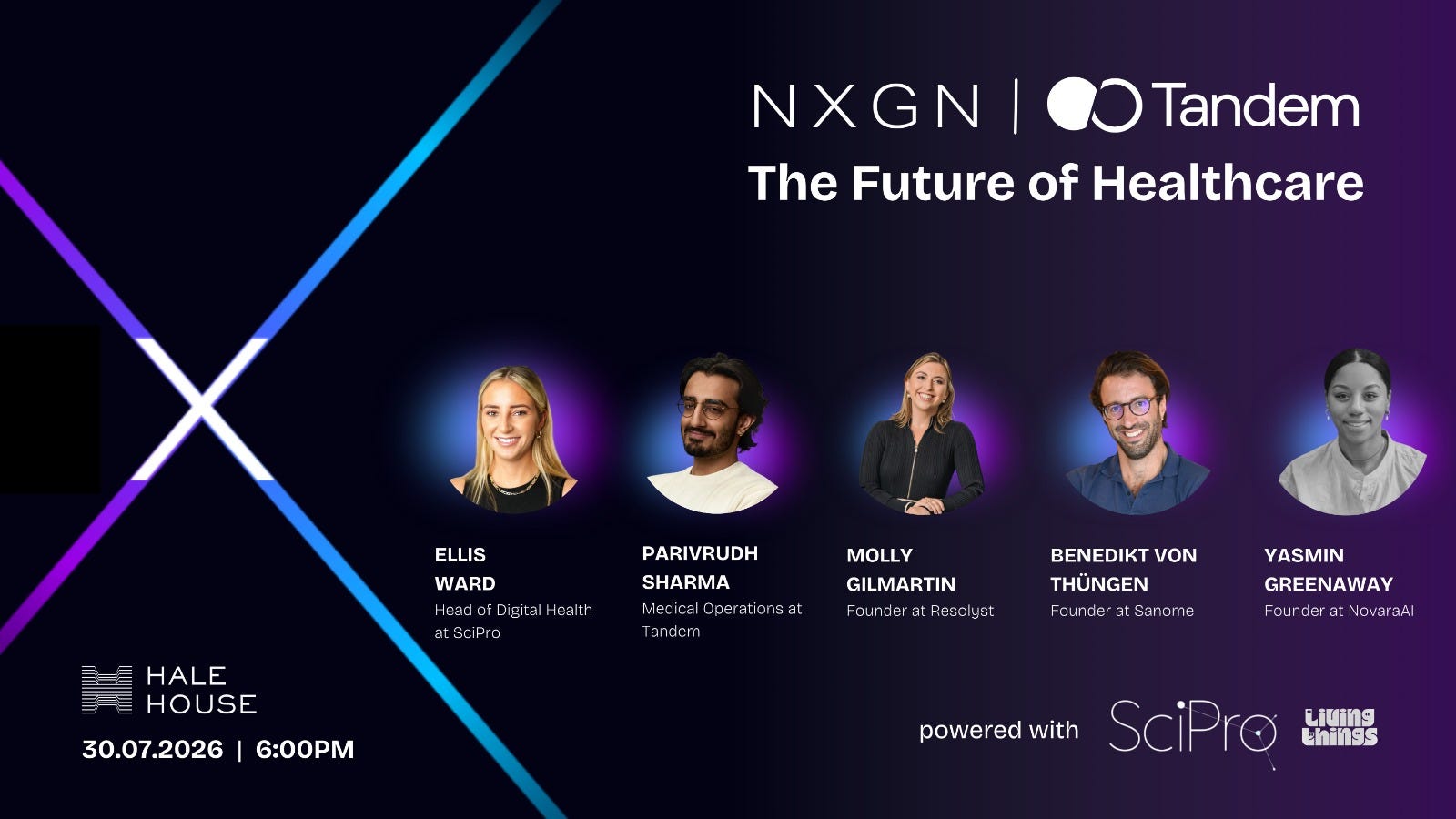
🗓️ Date: Thursday, 30 July
🕕 Time: 6:00pm - 9:00pm
📍 Location: Hale House, London
Healthcare isn’t asking whether AI belongs in the system anymore, that question has been answered. The real one is what healthcare looks like when AI becomes part of every clinical interaction. That’s what this event is about.
We are thrilled to have Tandem Health as our headline partner. AI scribes are already changing how clinicians work and creating an unprecedented foundation of structured clinical knowledge. But the conversation doesn’t stop there. What becomes possible when you build on top of that? Could digital twins become part of everyday care? What does the future of specialist care look like? And ultimately, will the future belong to foundation models, or to specialist clinical AI?
Four people building the future from completely different angles:
Parivrudh Sharma: Medical Operations at Tandem Health
Molly Gilmartin: Founder of Resolyst, former AlbionVC investor
Benedikt von Thüngen: Founder of Sanome
Yasmin Greenaway: Founder of Novara AI
Joined by our panel moderator Ellis Ward: Head of Digital Health at SciPro
We are also delighted to welcome SciPro as our event partner. As specialists in healthcare and life sciences recruitment, they work closely with the founders, clinicians and innovators building the teams behind tomorrow’s healthcare.
And shout out to Living Things, who will be providing us with their delicious bubbly soda!
The future of healthcare isn’t one breakthrough, it’s the continuous conversations, collaborations and bold decisions we’re making right now. Come be a part of it.
Spaces are limited. Sign up here.

Preventative health startup, Neko Health, raises a $700M Series C with 100,000+ scans done and 5 of 7 health markers showing improvement on repeat scans for returning members. Already running clinics in the UK and Sweden, now expanding to New York.
Draig Therapeutics banks $65M in funding to help advance testing of drugs targeting psychiatric conditions.
Alchemab Therapeutics extends its Series A with a £25M investment, its first asset is an ALS drug licensed by Eli Lilly.
In our previous members’ insights sections, we heard from a VC about what gets funded and a financial advisor on how to fundraise. This week, its about the transition itself: how clinicians can actually break into healthtech.

Our Education Lead, Andrew Kerr, is a clinician who has made this move. Currently an NHS doctor, who is transitioning full-time into Medical Operations at Tandem Health (yes, our SZN 2 headline partner; small world and a good sign of how connected this community is becoming).
Andrew studied medicine at Cambridge, where he founded Cambridge Medical Entrepreneurship Society, building a hub for collaboration across life sciences, healthcare and tech. Before medicine, he spent six years as a pharmacist (Strathclyde graduate) across community and pharmaceutical practice. In short, he has made the move into healthtech, so we asked him the practical questions our members want answered.
I have always been interested about the cross-section between healthcare and business, thanks mostly due to my backgrounds in both pharmacy and medicine. I believe there is so much space to innovate within healthcare, and I think a clinician’s perspective offers an invaluable viewpoint of what challenges to tackle.
I love working as a clinician, but I have always been interested in looking at the bigger picture, seeing how technology can improve patient care from an individual up to a global level.
For me, it was university competitions such as the Strathclyde Enterprise Pathway and Cambridge Biospark that lit that initial entrepreneurial spark. It was then the invaluable support of mentors, alongside networking events, such as those run by NXGN and others, that took that initial spark and developed it into a fully-fledged career path.
The clinician role is great, you are trained to be excellent communicators, problem solvers and technicians who can work under tremendous pressure. All traits that can be translated into any job role. Other key areas to look at include:
Pharmaceutical industry: where you can help design and run clinical trials or even work in regulatory or medical affairs, working up to a chief medical officer role.
Medical Consulting: where you can advise across the breadth of life sciences and healthcare.
Healthtech: where there is a whole range of startups and companies changing the healthcare landscape. You can leverage your clinical expertise or just make use of the extensive skills you’ve gained as a clinician, which would be translatable to many roles, such as clinical product or medical operations.
It can often feel overwhelming, especially in the current climate for clinicians, where the job market is so precarious. It can be difficult to know what steps are needed to even begin thinking about a move to healthtech. This is something I get asked constantly from friends and colleagues. I do think exposure is best, networks like NXGN are crucial to start making connections and seeing what opportunities are out there. I then think it’s just down to hard graft, lean into those connections, make use of LinkedIn and become friends with people in the spaces you think you could work in. There’s no winning formula but it’s great fun meeting interesting people doing exciting things, so put yourself out there and you never know when your opportunity will appear.
The problem with clinicians in the NHS is that we have so many hoops to jump through to get training positions, be that presentations, QI projects, teaching qualifications. All very important, but sometimes not the most translatable, especially on a CV. I think the important thing to bear in mind when writing a CV for health tech or any industry, you want to stand out and I would argue the importance of a well-rounded CV, with less emphasis on shiny titles and more focus on actual substance that shows transferable skills.
There are now so many opportunities within the NHS to gain business and entrepreneurial experience. The NHS Clinical Entrepreneurs programme, DigitalHealth Launchpad and InnovateEOE are a few examples that jump to mind. All free and geared towards people working within the NHS.
I would also say to be proactive, attend conferences and even make use of study time to work with entrepreneurs or volunteer. All of this shows initiative and will stand out on a CV.
I think there is so much exciting work in healthtech happening now. In my clinical capacity I am currently working in primary care, and I can see so much opportunity to improve the patient experience. Women’s health and mental health are two crucial areas that jump to mind with much untapped potential to improve patient pathways and streamline care. Daye, who are utilising technology to improve gynae health and Limbic that is using AI to reduce the wait time for ADHD and Autism diagnosis, are both examples that I am keeping an eye on currently.
My take home message to any clinicians thinking of moving into healthtech is to just go for it! You clearly already know about NXGN and it is networks like this that will give you the space to see what is out there. I don’t think I will ever completely leave clinical practice, but I do believe my experiences in healthtech will make me a better clinician. Take the leap and enjoy the journey, we’ve all got long careers ahead of us!
📚 Resources:
Got a question you’d like us to ask Andrew, or someone else in the community? Drop it in the comments or reach out directly.
Build acceleration programme at Imperial College Health Partners
Clinical Innovation Lead, UK Public Sector Healthcare at Amazon Web Services (AWS)
Clinical Reporting Doctor at Thriva
Clinical Team Lead at Numan
Digital Implementation Lead at Chelsea and Westminster Hospital NHS trust
Programme Manager - Digital, Data and AI at Health Innovation Kent Surrey Sussex
Quality and Regulatory Officer at Hertility
Venture Builder (Healthtech) at Founders factory
MedTech, Pharma Innovators & Startup-Investors Networking, 20th July 2026
Startup Lab x Specialist Briefings: AI Innovation vs. Regulation - Is the UK Falling Behind or Playing it Safe?, 22nd July 2026
Consumer Health Hackathon at Encode Hub, July 25–26, 2026
Health Tech World Live 2026, 21st August
WHH Women’s Health Horizons London Autumn Summit, 22 September 2026
HETT show 2026, 29-30th September 2026
This community is full of people doing interesting things like building companies, leading research, launching products, writing newsletters and speaking at events. We want to start celebrating that.
We need your nominations: tell us about yourself, someone you think the community should know about, or a project worth amplifying. Drop it in the comments below or send us a message directly.
Enjoy your weekend 👋

No posts
Comments
Nothing yet. Say the first thing.
Sign in to join the conversation.