
I gave a talk about AI agents at NUS yesterday. The audience was mainly CS undergrads, and I was surprised to know how few of them had used the latest AI coding tools like Claude Code and Codex.
Putting AI adoption on a spectrum.
On one side, we have the people who are maximizing their AI usage, as AI becomes an important part of their work and life, always keeping up to date with the latest OpenAI/Anthropic/Google release.
On the other side, we have people who use ChatGPT's free version occasionally, finding how magical it is to have a machine that sounds like a human, but eventually coming to the conclusion that AI is pretty dumb since it is not that useful to help finish their work.
And we heard the most from the people who are near the right side, either “utopia is near thanks to AI”, “AI will end humanity”, or anything in between. That creates an illusion of how well state-of-the-art AI is adopted, but it’s actually not the case.
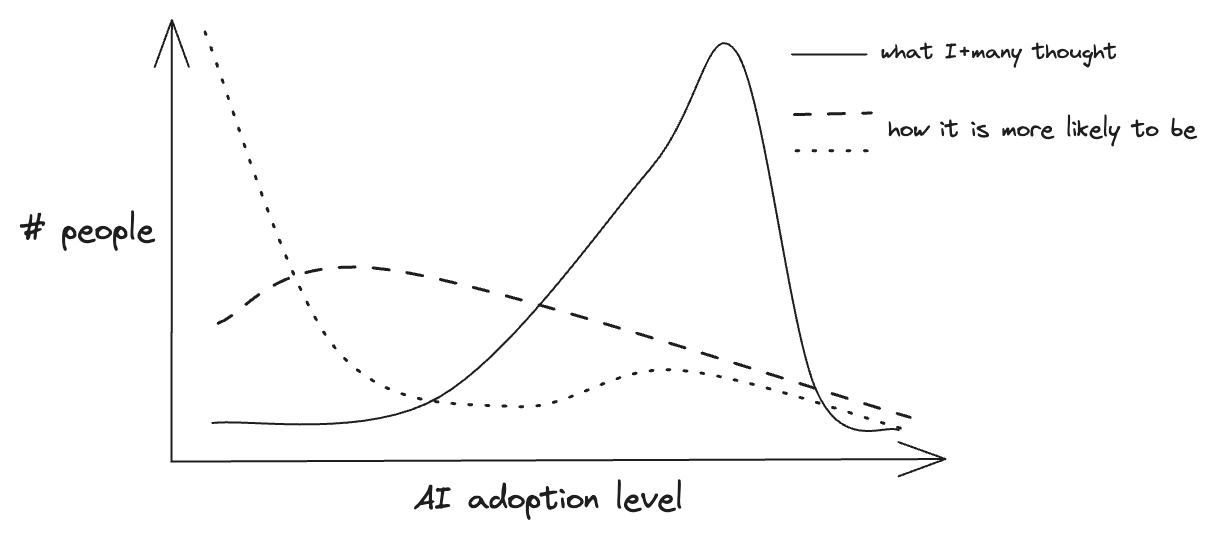
And there are valid reasons for it.
Most importantly, AI is expensive. The cheapest subscription (around $20/month for most general-purpose AI tools like Claude and ChatGPT) is limited.
To get more meaningful work done with AI, you need to use higher tiers that cost 5-10 times more, which only makes sense if 1) someone else (most commonly your company) pays for it, or 2) your return is X times more than the subscription, with X reasonably large.
That pricing problem creates a second-order effect. Since a lot of people have not paid for AI or have not used the more expensive subscriptions, the power of AI they see and the value they get is minimal, which discourages them from paying more.
AI should not be used for everything, but I think everyone should at least try using it, and use a more expensive version of it if possible, to know what it is capable of.
I have two main reasons to embrace AI:
It helps me do things that I had been doing better, faster, and cheaper.
It helps me do things that I would not have done myself.
Before AI, the questions that I would ask myself before building something were 1) is it really valuable, 2) is it technically possible, and 3) can I do it or learn to do it within a reasonable time.
I crossed out most of the ideas because of the third question, and it’s no longer the case.
Nevertheless, when building is cheap, everyone can just … build. Producing lots of output makes people feel productive, but output is not outcome. AI is very good at producing things that “look right”. But building great products still requires a lot of craft, attention, and expertise.
So if you are paying for AI yourself, and cost is one of your main concerns, it’s actually your advantage.
Scarcity forces better thinking. So you cannot just “Claude, please do …, make no mistake”. It takes time, brain power (and tokens) to create tools, skills, and workflows that work best for yourself.
All of this may be irrelevant when AI becomes more powerful. Things you learn along the way are what matter.
Comments
Nothing yet. Say the first thing.
Sign in to join the conversation.