
For all our talk of “people first”, we live in a world that rarely behaves that way. The word human is used everywhere now; politicians invoke it to frame urgency, corporations sprinkle it into mission statements, and leaders use it to signal empathy even when their systems contradict it. The term has become elastic, stretched thin across agendas, campaigns, and shareholder decks.
But beneath the buzzwords lies something older, stranger, and far more powerful. To talk about being human is to talk about our origins, our stories, our survival patterns, and our need for meaning. It’s to acknowledge that we evolved as communities long before we evolved as companies.
So if modern organisations want to thrive, they need to realign their human centricity; not as branding, but as design.
This article explores how the meaning of “human” has shifted, how it’s been co-opted, and how businesses can reclaim it in ways that create healthier cultures and more sustainable success.
Before we had language, tools, or tribes with names, we had a shared instinct:
To belong.
Our evolutionary survival didn’t depend on the strongest individual but on the strongest collective. Homo sapiens succeeded not because we were the sharpest-toothed creature in the grass, but because we were the best at forming flexible, adaptive, collaborative groups.
To be human, originally, was to participate.
To contribute.
To protect one another against uncertainty.
Fast-forward several millennia and most organisations have forgotten this. We’ve built systems that prize metrics over meaning.
But our biology hasn’t changed.
We are still wired to thrive in environments that give us:
Clarity (What are we trying to do?)
Safety (Do I have what I need to succeed?)
Belonging (Do I matter here?)
Growth (Is there space for me to evolve?)
When any one of these is absent, we compensate with anxiety, disengagement, or resistance. What we call “performance issues” are often mislabelled survival responses.
Organisations tend to treat symptoms. Humans respond to environments.
Somewhere along the way, the word human stopped being an intrinsic reminder of our shared nature and became a rhetorical device.
Politicians use it to:
make their policies sound empathetic
justify decisions in the name of humanity
frame opponents as inhumane
But the danger is that the word becomes emotional currency rather than actual practice. It creates a moral shortcut; an illusion of care without the requirement of action. This leaves the public feeling manipulated rather than represented.
This matters to business because leaders often replicate the same shortcuts:
“We’re a people business.”
“We care about our employees.”
“Culture matters here.”
These lines are as empty as political slogans unless the environment matches the message.
Humanity is not a declaration. It is behaviour.
Corporations have realised that “human” sells. It makes brands sound progressive, ethical, and socially aware. Yet the structure of many organisations works directly against the conditions required for human flourishing.
Consider these contradictions:
Companies talk about well-being while designing roles that cause burnout.
Leaders preach trust while requiring surveillance-level visibility.
Businesses speak of inclusion while rewarding conformity.
Organisations claim to be communities while acting like command chains.
The mismatch between language and lived experience creates cultural slip; wide enough, in some companies, to drive entire turnovers through.
If humanity is used only as a veneer, employees feel the gap immediately.
They withdraw.
Disengage.
They emotionally detach…
… and a detached workforce cannot care about your future plans.
If you are enjoying the Nuutology’s SuperStack, this post is public so feel free to share it.
Most leadership teams want to be people-first.
The problem isn’t their intent.
The problem is their design.
Organisations have been modelled on:
militaries
factories
efficiency movements
shareholder return models
None of which were built around human needs. Most of which are still operating from the 19th and early 20th centuries: When the world was less connected and technologically advanced.
So when leaders try to “add” humanity on top, it isn’t enough. You can’t add humanity as a feature. It has to be the operating system. It has to pre-ceed technological and systematic design.
Businesses are not machines. They are communities with commercial responsibilities.
When leaders embrace that mindset, everything shifts; the way decisions are made, how power flows, how success is defined, and how growth is sustained.
More-over, how profits are generated, and they are certainly generated through purpose-led initiatives.
The data is undeniable but often not understood.
Purpose creates conditions that pull discretionary effort, creativity, and long-term thinking out of people. When employees believe in what the company stands for and can see their role in delivering it, three things happen:
Decision-making becomes quicker and more consistent because people understand the “why”, not just the “what”.
Engagement rises, which directly correlates with productivity, lower turnover, and higher customer satisfaction.
Innovation increases, because psychologically safe, mission-aligned teams take smarter risks.
These are not soft outcomes. They are commercial drivers:
Companies with a clearly articulated purpose outperform the S&P 500 by 10–13% over a decade in multiple longitudinal studies.
Firms with strong cultural alignment see up to 50% lower turnover, drastically reducing the cost of hiring and onboarding.
Employee engagement scores correlate with profitability increases of 21%, according to well-established global datasets such as Gallup.
Purpose-aligned brands consistently outperform competitors by 2.5x in customer loyalty, affecting repeat revenue and lifetime value.
In downturns, companies with strong cultural identity rebound faster, because aligned teams adapt rather than panic.
Purpose becomes the hidden architecture behind every operational behaviour; how people prioritise, how teams collaborate, and how leaders allocate resources.
How do we know?
Two companies illustrate, more clearly than any theory, why purpose either strengthens an organisation or exposes its weaknesses. And contrary to popular belief, WeWork didn’t collapse because of the rise of remote work. Remote work simply revealed what was already broken.

Patagonia: Purpose as a Structural Advantage
Patagonia doesn’t just talk about purpose; it uses purpose to govern how the business operates.
Their environmental mission dictates product design, supply chain decisions, hiring philosophy, activism, and customer engagement.
Employees understand the “why”, which makes decision-making fast, aligned, and ethically consistent.
Customers trust the brand because its actions match its words; even when those actions reduce short-term revenue.
This alignment translates directly into commercial outcomes:
Billions in revenue with strong margins.
High retention and strong internal culture.
Lower marketing spend due to trust, loyalty, and advocacy.
A reputation so strong it became an economic moat.
In Patagonia’s case, purpose is operational and the financial resilience proves it.
WeWork: Purpose as Performance Art
WeWork’s public mission to “elevate the world’s consciousness” was emotionally charged, memorable, and (crucially) disconnected from the way the company actually worked.
Long before anyone worked from home, WeWork suffered from:
A structurally fragile business model (long-term leases + short-term tenants).
Aggressive, unrealistic valuations built on hype rather than sustainability.
Chaotic leadership and governance issues that eroded trust internally and externally.
A culture centred around the founder, not the community it claimed to serve.
A purpose that acted as theatre, masking misalignment instead of driving accountability.
Remote work didn’t break WeWork.
It simply exposed that it was never commercially or culturally stable.
When tenants cancelled flexible desk contracts:
Their long-term building leases remained.
Their cash burn became unmanageable.
Investor confidence evaporated.
A purpose that isn’t embedded cannot survive a shock.
Why does this matter?
When purpose informs the architecture of a business (not just the branding) the commercial benefits stop being abstract ideals and start appearing in measurable outcomes. You see it in stronger retention, faster innovation cycles, deeper customer loyalty, more efficient operations, and, ultimately, in more resilient profitability.
Purpose isn’t the opposite of profit; it’s the engine that produces it sustainably, consistently, and with far higher long-term returns.
Companies don’t outperform because they care more; they outperform because their people know exactly what they’re fighting for and will fight harder when the world shifts beneath them.
Let’s challenge the typical thinking here.
A genuinely human-centred organisation is not one where employees are endlessly cushioned or spoon-fed comfort. That’s a common misconception; and a political misrepresentation.
A true human-centred organisation is one where:
Humans crave meaning.
Ambiguity breeds hesitation.
Micromanagement kills trust.
Total freedom without structure kills momentum.
Balance is the art.
Systems drive behaviour.
Behaviour drives culture.
Culture drives outcomes.
When authority flows more evenly, so does accountability.
Humans adapt by experimenting, failing, reflecting, and improving.
Organisations should do the same.
Work happens in networks more than in lines.
People don’t fight for your KPIs; they fight for your story.
This isn’t idealism.
It’s biological science applied to business.
If businesses truly want to be human-centric, not as a brand aesthetic but as a competitive advantage; they need to return to fundamentals.
Here’s a practical blueprint leaders can act on:
Decide the behaviours you want.
Design the systems that produce them.
Remove the ones that don’t.
Stories build shared reality.
Broadcasts build noise.
The clearer the path, the faster the execution.
The future belongs to coaches, not controllers.
People create value.
Community sustains value.
Economy is the outcome.
Measure cultural health (the environment not the people).
Measure alignment.
Measure empowerment.
But interpret through human judgement.
When trouble hits, it won’t be a spreadsheet that saves you;it’ll be your people.
The companies that survive the next decade will not be the ones with the cleverest tools or the sleekest AI automation. They will be the ones that understand:
Humans are still the most adaptive operating system on the planet.
And communities outperform command chains every time.AI and other technologies are tools to enhance humanity;
not replace it.
A truly human-centred business is not soft.
It is resilient.
It is innovative.
It is disciplined.
It is aligned around a shared purpose that is strong enough to withstand complexity and change without the need for an internal brand refresh every 6 months and an annual transformation project that never ends….
The future belongs to the organisations that choose humanity not as branding but as design, with leaders who are brave enough to build from those designs.
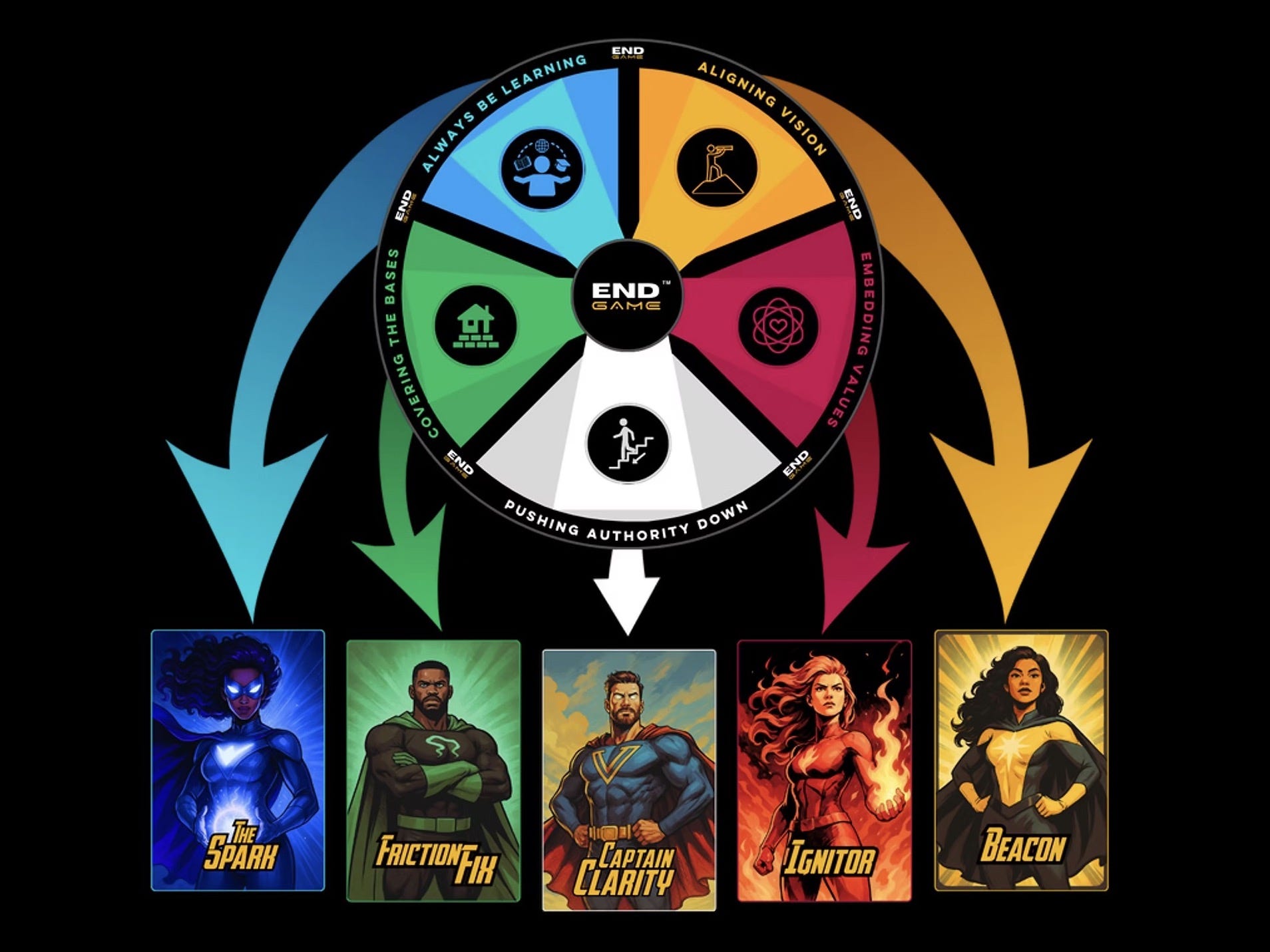
If this resonated, you’re already part of the shift towards more human, purpose-led organisations. At Nuutology, we help leaders design cultures where people can thrive and businesses can grow because of it, not despite it.
Subscribe to our SuperStack and start your journey with us and let’s build the future of work, one aligned culture at a time.
Comments
Nothing yet. Say the first thing.
Sign in to join the conversation.