
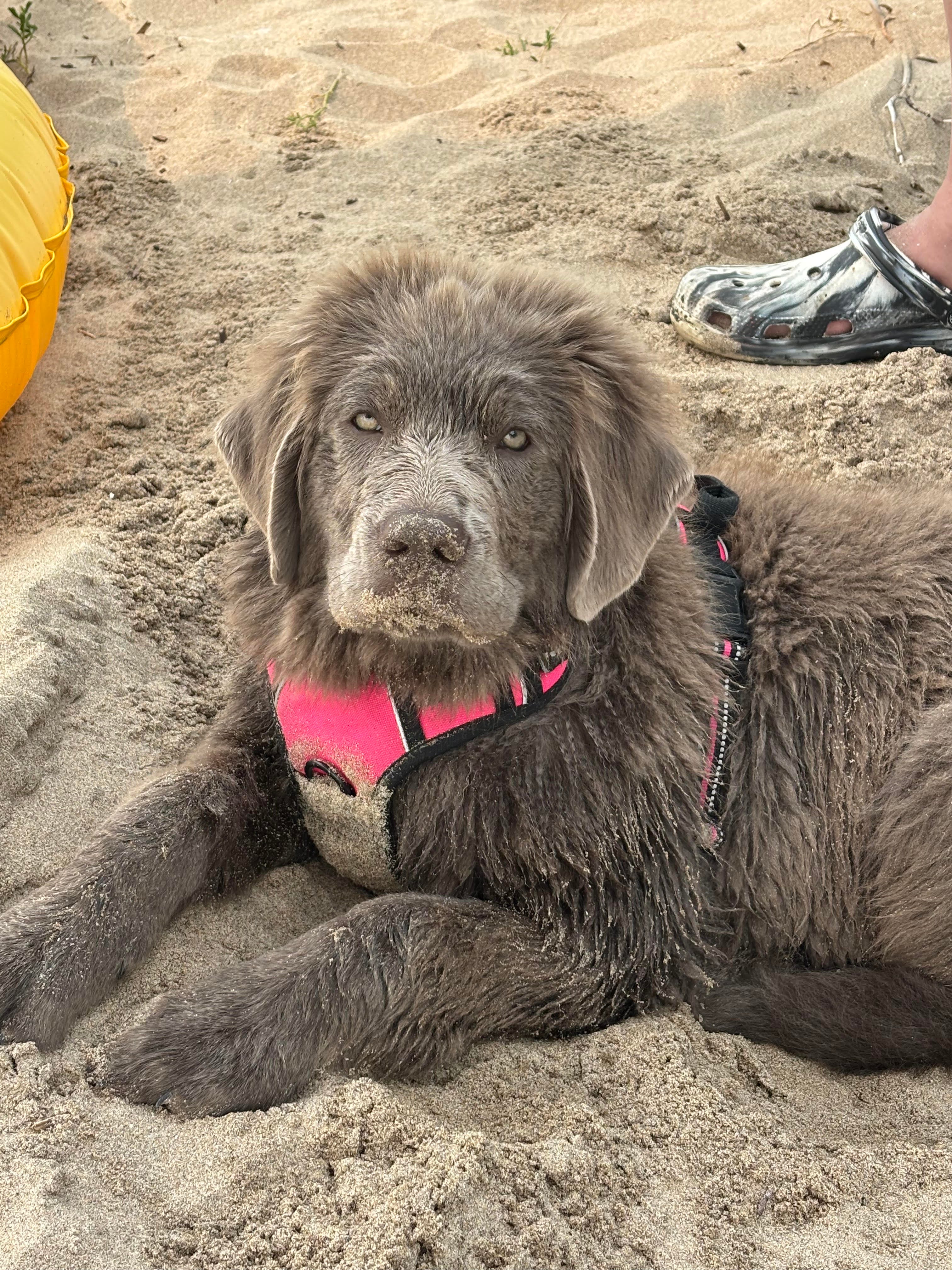
There are certain things a puppy should be taught by the people who own her. Sit. Stay. Come. Do not eat the electrical cord. The black cat is not a chew toy. A skunk is not a black cat with racing stripes. These are the fundamentals of civilized canine life, and Sharon and I have been diligently attempting to teach them to Isabel, our Newfoundland puppy, with approximately the same success Belgium has historically had teaching its governments to form quickly.
The problem is that Isabel appears to have another instructor. Oliver. Oliver has been dead for 18 months, which under ordinary circumstances would seriously limit his participation in puppy training. But Oliver was never particularly impressed by ordinary circumstances. I have become convinced that somewhere above the house, probably stretched out in a cool celestial hallway where the floors are marble and nobody owns a vacuum cleaner, Oliver is conducting Isabel’s continuing education. I cannot prove this. I can only present the evidence.
The first evidence is begging. Isabel arrived in our house knowing almost nothing about the world. Birds were astonishing. Leaves required investigation. A twig could occupy an entire afternoon. The first few weeks of her life were essentially a Newfoundland version of university, except the curriculum consisted mostly of smelling things and occasionally peeing on them. And yet, somehow, without formal instruction, she quickly mastered the ancient Casteels Newfoundland technique of sitting beside a human who is eating and looking as though she has not been fed since the German occupation.
This is not begging in the crude sense. There is no barking. No jumping. No vulgar pawing at the table. Oliver would never have tolerated that. No, this is advanced begging. You sit. You stare. You allow the human to become aware of your presence. Then you lower your head slightly and produce the eyes. Oliver had perfected the eyes over many years. They conveyed hunger, disappointment, abandonment and a vague suggestion that the SPCA might be interested in hearing about conditions in the Casteels household. Apparently this knowledge can now be transmitted from the afterlife.
I imagine Oliver whispering to her. Do nothing. Isabel waits. He has seen you. She waits. Now look at the toast. She looks at the toast. Now look at him. She looks at me. Good. We have him. And they do.
The toast situation is particularly damning. Isabel will eat toast, but this statement requires qualification. Plain toast is unacceptable. I discovered this one morning when I handed her a perfectly respectable piece of toast. She sniffed it, looked at me and declined it with the quiet dignity of a Michelin inspector who has just been served frozen peas. Then came the message from Oliver. He has butter. So the toast acquired butter. Isabel ate it. A few days later we discovered that butter alone was merely the introductory course. The preferred configuration is toast with butter and homemade jam. Not store bought jam. Apparently we have standards.
Somewhere in heaven Oliver is sitting upright. Good girl. Never let them think you are desperate. This is a dog who will occasionally consider eating something she found underneath a shrub, but commercial strawberry jam is where civilization apparently collapses. I blame Oliver.
There is Isabel’s increasingly elaborate position on meat, which suggests Oliver has not merely been providing celestial guidance but has opened a small culinary academy in the afterlife. Chicken is not acceptable unless roasted, because apparently boiling a perfectly good chicken is an offence against both poultry and Newfoundland dignity. Pig is for lesser beings. Pork may have sustained European civilization for centuries, but Isabel has reviewed the evidence and remains unimpressed. Beef, on the other hand, passes muster. Beef is serious food. Beef receives immediate attention and requires no committee meeting. Duck feet are approaching nirvana, although watching a Newfoundland puppy eat one makes you wonder whether evolution occasionally takes an afternoon off. Salmon is a firm no, which is particularly impressive for a dog whose ancestors worked alongside fishermen, but smoked salmon changes the constitutional question entirely. Smoked salmon is acceptable because smoke apparently transforms disgusting fish into cuisine. I understand this reasoning completely and may have accidentally encouraged it.
Cheese has undergone a similar reassessment. There was a time when cheese was cheese and therefore welcome, because Isabel was young and naive and had not yet developed the palate of a Belgian restaurant critic who has just discovered the chef is Dutch. Those innocent days are over. Cheddar is now greeted with suspicion bordering on contempt. You can offer her a perfectly respectable piece and watch her inspect it as though you have slipped her a supermarket coupon. Jarlsberg, however, is a different matter. Jarlsberg gets the ears up. Jarlsberg gets immediate clearance. Bring it on. Somewhere above us Oliver is undoubtedly nodding approvingly and explaining the fundamental principle of living with Hans: never accept the first thing offered. There is almost certainly something better in the refrigerator, and the idiot eventually caves.
There is also the garden. We have gardens. I use the word gardens in the traditional human sense, meaning areas where Sharon and I intentionally put plants in the ground and expect them to remain there. Isabel uses a different definition. To Isabel, a garden is an archaeological site. She digs. She does not casually scratch at the soil. She excavates. There is purpose. There is commitment. There is the unmistakable sense that somebody has told her there may be something important under Belgium and she has decided to start in Ontario.
I watch her from the window, front paws working furiously, dirt flying behind her, and I can almost hear Oliver. Deeper. She digs. Ignore Hans. You’re faster. She digs faster. He will make noises. They mean nothing. I open the door and yell her name. She stops, looks at me and produces the face of a dog who has absolutely no idea how this enormous hole appeared beneath her front paws. Oliver taught her that too. Never confess.
Then there is the neighbour's black cat. The black cat moves through our neighbourhood with the confidence of an animal who has studied dogs and concluded that most of them are idiots. Isabel is fascinated. The cat appears. Isabel freezes. The cat moves. Isabel leans forward. The cat stops and looks at her. Isabel looks back. There is a moment of international diplomacy. From above comes Oliver. Careful. Cats are not squirrels. They have lawyers. So far, relations remain peaceful, although I would describe the peace as heavily armed.
The squirrels are another matter. We have a local squirrel family that appears to have been living near our house long enough to qualify for municipal services. They know the property. They know the trees. They know exactly how far a Newfoundland puppy can accelerate before reaching the end of whatever physical restraint happens to be attached to her. (in our house and the gardens, there are none). They torment Isabel. One sits on the lawn. Isabel sees it. The squirrel sees Isabel. Nobody moves. Then the squirrel performs the tiniest possible hop and Isabel becomes 27 kilograms of fur, paws and crisis. The squirrel reaches the tree approximately four seconds before Isabel reaches the end of her jurisdiction.
I suspect Oliver is conflicted about this. Part of him is trying to provide mature celestial guidance. You will never catch it. But another part of him remembers being a dog. Almost had him. The squirrels, meanwhile, have begun treating Isabel as free entertainment. I have seen one sit on a branch looking down at her with the expression of a retired Belgian bureaucrat watching someone fill out the wrong form.
But none of this compares with the skunk. The skunk has become Isabel’s great scientific obsession. It wanders through the neighbourhood in the evening with the relaxed confidence of an animal that knows nobody wants trouble. Isabel wants to meet it. She desperately wants to meet it. Every molecule of puppy curiosity tells her that this magnificent black and white creature deserves immediate investigation. I imagine the communication from heaven becoming unusually urgent. Isabel. No. She leans forward. Seriously. No. The skunk waddles closer. Listen to me. I chased many things. Squirrels. Rabbits. Suspicious leaves. I made mistakes. This is not a mistake you need to make personally. Isabel’s tail begins to wag. ISABEL.
Perhaps this is the true purpose of ancestors. Not to provide wisdom about the grand questions. Not to explain mortality or the meaning of existence. Mostly to stop the next generation from sticking its nose into a skunk.
And that is when the whole ridiculous arrangement becomes something else, because every so often Isabel does something Oliver used to do. Nothing dramatic. She lies in a particular place. She gives me a particular look. She waits beside the kitchen with a patience far beyond her months. She studies my toast. And for half a second the years fold together.
Oliver is gone. I know that. Death is many things, but it is not negotiable, despite our remarkable human ability to behave as though sufficient paperwork might eventually overturn the decision. But perhaps dogs leave instructions behind. Not mystical instructions. Nothing embroidered on a pillow. Habits. Expectations. The knowledge that the kitchen is where important negotiations occur. That humans can be trained. That gardens are provisional. That squirrels are bastards. That cats require diplomacy. That skunks should be admired from another postal code. That plain toast is an insult when butter exists. And that once the butter appears, one should remain perfectly still because homemade jam may yet follow.
Isabel never met Oliver. That is the part that gets me. She never followed him down the trail. Never slept beside him. Never watched him negotiate a piece of toast from me. Never learned which corners of the house belonged to him or how a Newfoundland can occupy an astonishing amount of emotional real estate simply by lying on the floor and breathing. And still, somehow, she is learning him.
Perhaps that is just me seeing Oliver where I want to see Oliver. I am perfectly willing to concede that possibility. But yesterday morning I gave Isabel a piece of plain toast. She sniffed it. She looked at the toast. Then she looked at me. She did not eat it. I added butter. She reconsidered. Then she waited. I added homemade jam. She ate it immediately.
And somewhere, I swear to God, Oliver smiled. Good girl.
If I May… While Isabel waits for the Jarlsberg and Oliver apparently runs a celestial culinary school for spoiled Newfoundlands, there are babies in the NICU whose first experience of this ridiculous world is considerably less comfortable. My daughter Ashley is a NICU nurse, and I write these stories partly to keep my own brain misbehaving productively and partly to help her hospital buy two desperately needed bassinets, at roughly $30,000 each. I do not charge for my writing and have no intention of starting. If something I wrote made you laugh, think, swear, or briefly forget whatever nonsense humanity was producing that day, consider tossing a few dollars toward the NICU fundraiser. Isabel will continue receiving butter, homemade jam and Jarlsberg regardless. The babies deserve at least as good a start.
If you are able, the donation link is below. Every contribution, no matter the size, helps give a newborn the chance to grow up and one day argue about something much more sensible.
The essays will remain free. The bassinets, unfortunately, are not.
No posts
Comments
Nothing yet. Say the first thing.
Sign in to join the conversation.