
Today is International Nurses Day. Florence Nightingale's birthday.
Most people know her as the lady with the lamp. She was also one of the most consequential data scientists in history.
In the Crimean War, she did not just care for soldiers. She gathered data, built visualizations, and proved that preventable disease was killing more men than battle wounds. Then she took that evidence to Parliament and forced change. Thousands of lives were saved not by more nursing, but by a nurse who understood the numbers and refused to be ignored.
I am a board-certified informatics nurse. That lineage is mine. It is yours too.
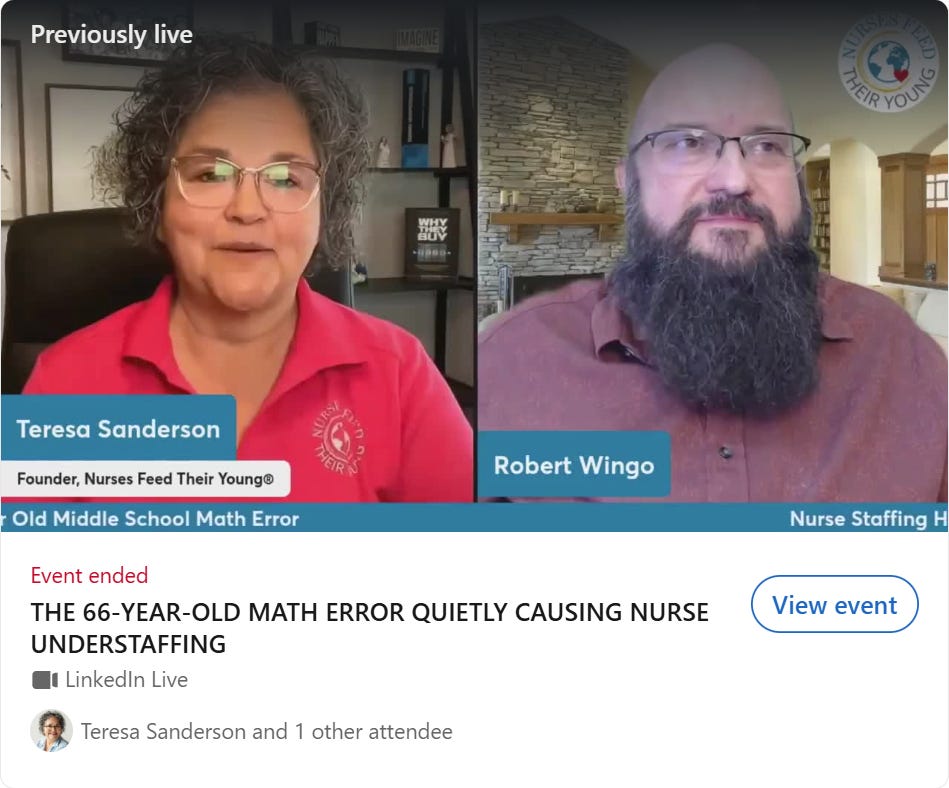
Last week I recorded a podcast with Teresa Sanderson of Dare to Do Nursing Differently. It was the first time I spoke publicly about my moral injury.
The source of it is a tally I have kept for nine years. Every nurse's story about a bad shift. Every burnout report, every turnover study, every resilience initiative aimed at nurses rather than the conditions nurses work in. Every flawed CE offering that teaches the wrong formula. Every textbook and journal article that carries it forward. Caregivers. Patients. Their families. The timeline spans decades. That much suffering, for a simple math error.
Because here is what a staffing budget built on the wrong formula does: it shorts the unit before the schedule is ever written, holds nurses accountable for conditions that were never adequately resourced, and leaves no visible decision to appeal. The system is functioning as designed. Just on the wrong math.
Nursing has been the victim of a 66-year-old middle school math error.
For every 100 nurses a unit actually needs, the formula is already shorting the budget by 2 to 6 positions. Before PTO. Before FMLA. Before call-outs. Before anyone says we just need to be more resilient.
Florence Nightingale did not accept the conditions she inherited. She quantified them, named them, and demanded correction with data.
We have that same opportunity today.
If you have ever felt like staffing was broken before the schedule was even written, watch this episode.
Podcast Link: The 66-Year-Old Math Error Quietly Causing Nurse Understaffing
Podcast Description:
Nurse managers have been blamed for staffing problems they may never have had the math to solve.
In this episode of Dare to Do Nursing Differently, Teresa Sanderson sits down with Robert Wingo, BSN, RN, NI-BC, a board-certified informatics nurse, to talk about a 66-year-old math error hiding inside nurse staffing budget formulas.
The impact?
For every 100 nurses a unit actually needs, the formula may already be shorting the budget by 2–6 positions.
And that is before PTO.
Before FMLA.
Before vacancies.
Before call-outs.
Before turnover.
Before anyone says, “We just need to be more resilient.”
This conversation matters because chronic understaffing is not just an operations issue.
It affects burnout.
It affects moral injury.
It affects incivility.
It affects patient care.
It affects whether nurse leaders are set up to succeed or quietly handed an impossible assignment.
Robert also challenges the language nursing has accepted for years: “productive” and “non-productive” time.
Because education, orientation, PTO, professional development, and recovery are not waste.
They are patient care support.
And when we cut patient care support, we are not becoming more efficient.
We are defunding the fuel and maintenance that keep nursing running.
Nursing has to understand the math.
Not because nurses need one more responsibility.
Because the people making financial decisions need to hear from nurses who can speak the language, challenge the assumptions, and name the real root cause.
Watch this episode if you have ever felt like staffing was broken before the schedule was even written.
No posts
Comments
Nothing yet. Say the first thing.
Sign in to join the conversation.