
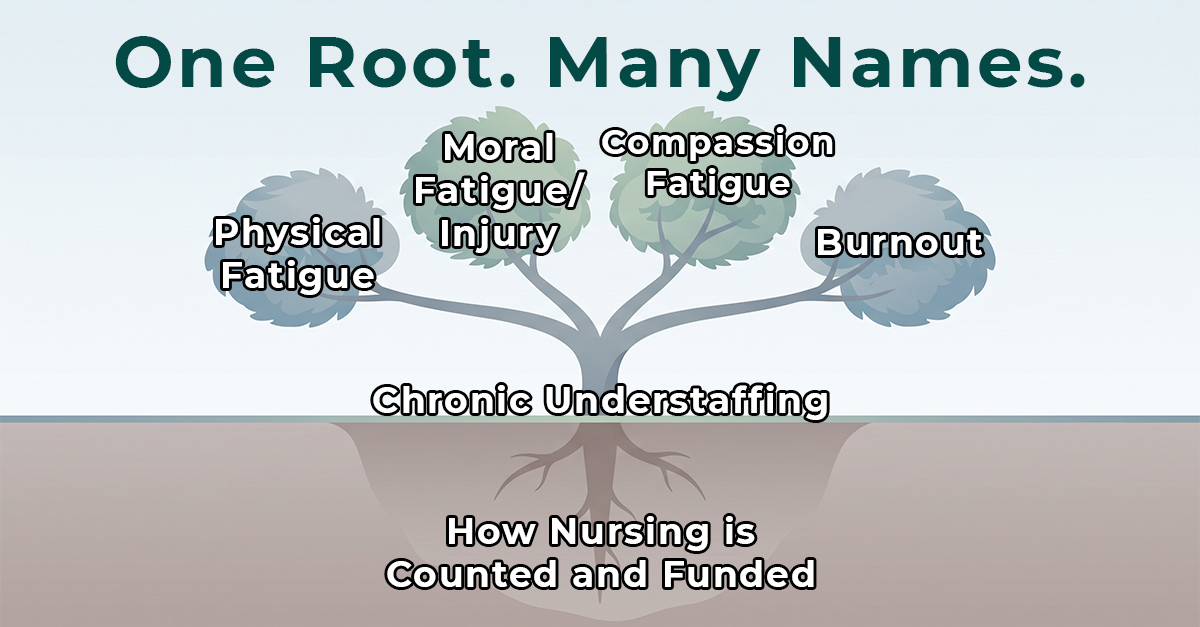
In May, the American Nurses Association published a revised position statement, “Addressing Nurse Fatigue to Promote Health, Safety, and Well-Being for All.” It is a serious piece of work, and on the question that matters most, it gets the answer right. Nurse fatigue, it says, is “not a personal failing but a predictable outcome of system failure.” Every self-care recommendation in it carries a warning label: these things “supplement, but cannot replace, structural fatigue mitigation.” It even says the quiet part out loud. “Fatigue management is a safety function, not a wellness perk.”
That framing is a real advance over the 2014 statement it replaces, and it deserves credit. Healthcare has a long habit of handing the problem back to the exhausted nurse. This statement puts the structure first.
Which is what makes one sentence, early in the statement, worth stopping on.
“Please note that this position statement does not directly address moral fatigue, compassion fatigue, or burnout.”
That line is worth an article. Because those three are not a separate subject the statement wisely set aside. They are the same problem wearing different names.
The statement draws a clean circle around one kind of fatigue: physical and mental exhaustion from long hours, heavy workload, and disrupted circadian rhythm. Moral fatigue, compassion fatigue, and burnout are placed outside the circle.
That boundary is administrative. It exists on the page, not at the bedside. A nurse three hours past the end of a short-staffed shift is not experiencing “physical fatigue” in one compartment and “moral fatigue” in another. It arrives as one state.
Trace the four back to their driver and the circle disappears. The statement itself names that driver, repeatedly, as the top contributor to fatigue: inadequate staffing and unsustainable workload. Physical fatigue is what that feels like in the body. Moral fatigue, or moral injury, is what it feels like when you cannot give the care you know the patient needs. Compassion fatigue is what emotional depletion under that volume becomes. Burnout is the name for where all of it ends up. One cause, four manifestations. Splitting them into separate statements, each with its own program, repeats the misdiagnosis nursing keeps making: treating the outputs of a single problem as if they were separate diseases.
There is an irony in the exclusion. The statement works hard not to blame the nurse for physical fatigue, then excludes the exact category where the blame lives.
“Burnout” is already a blaming word. It locates the failure inside the worn-out individual, as though the person simply lacked the stamina to keep up. That is precisely why Wendy Dean and Simon Talbot reframed it. What looks like burnout, they argued, is often moral injury: the damage done when clinicians are repeatedly kept from doing what they know is right by systems built around other priorities. The word moves the fault from the nurse to the conditions.
So the statement’s anti-blame argument stops at exactly the boundary where it is needed most. Burnout and moral fatigue are where the language already blames the individual, and they are the two the circle leaves out. The exclusion reads as tidy scope-setting. What it does is withhold the statement’s best argument from the ground where it would do the most work.
Now the harder question, the one the statement circles but never asks.
It names inadequate staffing as the primary driver of fatigue, over and over. And then it stops there, as though adequate staffing were a dial employers could simply turn. If it were that simple, they would have turned it decades ago.
So why is staffing chronically inadequate? Two structural reasons sit underneath, and neither is a mystery.
The first is how nursing is paid for. On the inpatient side, nursing care is not billed as its own service. It is folded into the room rate, absorbed into the bundled payment for the stay. A service that is never separately measured reads on the ledger as a cost to be minimized, not a contribution to be resourced. That sets the ceiling on the money available for staffing before any manager builds a single schedule.
The second is how staffing is counted. The most common formula taught in nursing finance education understates the number of positions a unit actually needs. It has propagated through the literature, through practice, and through accredited continuing education for decades, and it builds the shortfall into the budget before the fiscal year even begins. I have documented that history elsewhere and will not retrace it here.
These are two expressions of one condition: nursing is not counted or funded as the value it produces.
That single condition is what makes the nurse manager’s job impossible. Finance hands the manager a budget shaped by a payment model that already treats the manager’s staff as an expense to contain. Where that budget was built with the common formula, the position count was short before the fiscal year began, and the manager is told to manage to it anyway. Fatigue is one of the predictable things that spills out of the gap. The statement asks managers to protect breaks, guard against unsafe overtime, and ensure staffing adequacy, while leaving untouched the budget math that can put all three out of reach.
Nurse managers were not set up to fail. Their budgets were.
Which brings the exclusion back into focus. The statement gets to inadequate staffing and stops. But moral fatigue, compassion fatigue, and burnout are the same shortfall surfacing in different tissue: in the body as exhaustion, in the conscience as moral injury, in the heart as compassion fatigue, in the whole person as burnout.
Fragmenting them carries a cost beyond the conceptual. Each name has grown its own industry. Burnout has resilience training. Compassion fatigue has its certifications. Physical fatigue is getting its wearables and its fatigue-scoring apps. The pull is strong enough that this statement, having just called fatigue management a safety function rather than a wellness perk, opens its very next section by recommending wellness checks, resilience training, and mindfulness programs. Money flows to managing each symptom on its own while the root that produces all of them stays unfunded and, mostly, unnamed. Keep the four apart and every one of those programs has a reason to exist. Name the single cause and they lose their footing.
A fuller statement would treat physical fatigue, moral injury, compassion fatigue, and burnout as one syndrome with one structural root. It would extend its own anti-blame logic to burnout out loud, adopting the moral-injury lens instead of stepping around it. It would connect “inadequate staffing” to the reimbursement structure and the budget math that keep staffing inadequate. And it would say plainly that a nurse manager cannot be held to account for a budget the manager did not build and cannot fix.
The ANA has done the harder half of this already. It has stopped blaming the nurse. The next step is to stop treating the wreckage as four separate problems and name the one thing upstream that produces all of it.
One root. Many names.
© 2026 Robert L Wingo - All rights reserved.
Robert Wingo, BSN, RN, NI-BC is the author of the Nurse Staffing Information Structures (NSIS) framework, a mathematical and conceptual approach to understanding and describing the nurse staffing life cycle from reimbursement through outcomes. He is a board-certified nursing informatics specialist and Nursing Economics Fellow (FINE Fellowship, Commission for Nurse Reimbursement).
No posts
Comments
Nothing yet. Say the first thing.
Sign in to join the conversation.