
On June 24 a federal court handed nursing a win. A judge granted a nationwide preliminary injunction blocking the part of the Department of Education’s RISE rule that left post-baccalaureate nursing off its list of professional degrees, the classification that would have cut graduate nursing students’ federal borrowing limits roughly in half. The court found the narrowed definition likely unlawful and the challengers likely to prevail. For now, future nurse practitioners, nurse anesthetists, and nurse-midwives keep access to the higher limits.
It is an interim ruling, not a final one, and the broader RISE changes take effect today, July 1. But the win marks something nursing rarely manages at this scale. Over the last few weeks, the profession mobilized.
The response to the rule was fast and organized. Twenty-four state attorneys general and the District of Columbia sued. The American Nurses Association and nine other nursing organizations filed their own suit. A coalition of professional associations, led by the nurse practitioners, brought the case that produced the June 24 injunction. Legislators moved, and a bill to fix the classification was introduced. The legal argument was straightforward: the agency had narrowed a definition Congress already wrote into law. The court agreed enough to act, staying the exclusion nationwide and ordering the Department to fall back to the broader, preexisting definition while the case proceeds.
That is real power, and the injunction proves it. Nursing does not assemble it often. Attorneys general, national associations, legislators, and public attention pointed at a single nursing economics issue at the same time. So where is that power aimed?
It is aimed at a symptom.
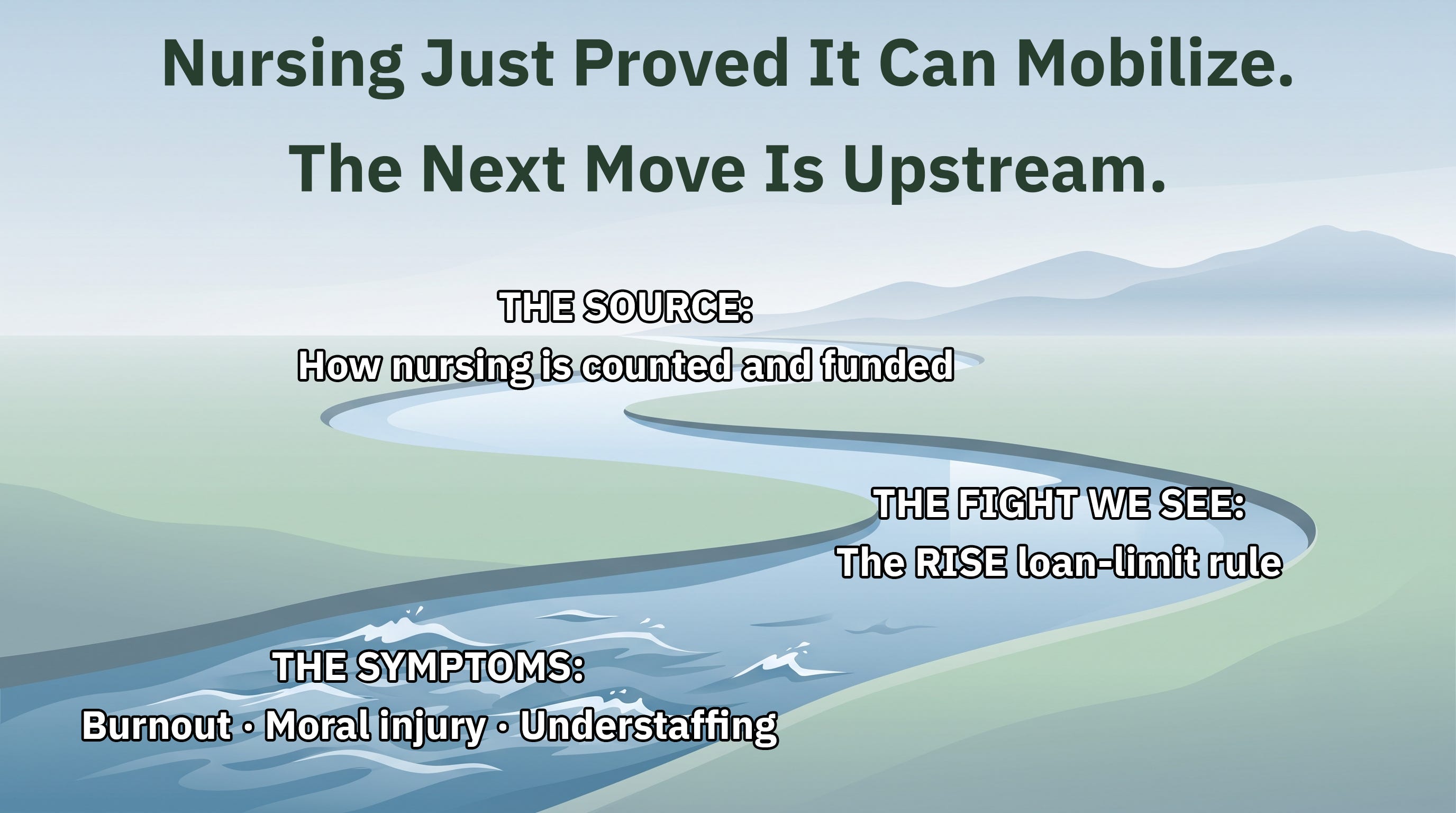
The loan-limit exclusion is not the disease. It is the latest expression of a deeper condition: nursing is not counted or funded as the value it produces. On the inpatient side, nursing care is not billed as its own service. It is folded into the room rate and absorbed into the bundled payment for the stay. A contribution that is never separately measured cannot be separately negotiated, advocated for, or recognized in the downstream models that policy decisions like RISE rely on. The classification that left nursing off the list was drawing on a system that was never built to see nursing in the first place. Briana Posanka and I traced that reimbursement architecture in detail in an earlier piece on how nursing’s value goes uncounted in the payment system.
If that sounds familiar, it should, because this is the pattern nursing keeps living.
We treat understaffing as a recruitment problem and run harder at the pipeline, while units stay short. We treat burnout as a personal deficit and offer resilience training, while the conditions that cause it hold. We treat incivility and turnover as culture problems and run more surveys. And now we treat a loan exclusion as a classification problem. Every one of these fights is winnable. Several are worth winning right now. But they keep coming back, because each one is a response to a symptom while the thing underneath stays exactly where it was.
Underneath all of it is how nursing is counted and funded. The most common formula taught in nursing finance education builds the staffing budget short before the fiscal year begins. The reimbursement structure renders nursing economically invisible. Those two facts generate the understaffing, the moral injury, the turnover, and yes, the workforce-pipeline pressure that makes a fight over education financing matter in the first place. Fix the symptom and you win a round. Fix the root and the symptoms stop recurring.
So why does the root never get the energy that RISE just got?
Because the root lacks what RISE had. RISE had a clear target, the agency. It had a deadline, July 1. It had a single visible decision to rally against. Those three things make mobilization easy. The root cause has none of them. Reimbursement invisibility and a flawed staffing formula are diffuse and technical. They unfold over decades rather than in a news cycle, and part of the problem is homegrown: the formula lives in nursing’s own textbooks and continuing education. There is no clean external enemy to sue. There is only a quiet structural fact that has been normalized for so long that most of the profession no longer sees it.
That is the real work, and it is not only redirecting energy. It is giving the root cause the urgency the symptom gets for free.
That is what the language of patient safety is for. A staffing budget that is short before the year starts is not an accounting curiosity. It is a system set up to deliver less care than it claims to fund, and the consequences are measured in falls, in failure to rescue, in moral injury, and in nurses leaving. When a deviation like that produces no immediate, visible catastrophe, organizations stop treating it as a problem and start treating it as the baseline. That is normalization of deviance, and it is exactly how a structural error survives in plain sight for decades. Naming it that way is how the abstract root starts to feel as urgent as the visible rule.
Here is the opportunity. The coalition that formed around RISE is the same coalition the root needs, and the argument is the same shape: an institution applying standards that do not hold up, failing to recognize nursing’s value. That argument does not stop at the Department of Education. It runs straight upstream into how nursing is reimbursed and how nurse staffing is budgeted.
So to everyone who showed up for this fight, on the Hill, in the courts, in the associations, in the comments: thank you, and keep going. You just won the injunction. The case is not over, so finish it. Then turn that same energy on the reimbursement structure and the staffing math underneath it, while the profession still has its attention pointed in one direction.
Nursing just proved it can move. The next move is upstream.
© 2026 Robert L Wingo - All rights reserved.
Robert Wingo, BSN, RN, NI-BC is the author of the Nurse Staffing Information Structures (NSIS) framework, a mathematical and conceptual approach to understanding and describing the nurse staffing life cycle from reimbursement through outcomes. He is a board-certified nursing informatics specialist and Nursing Economics Fellow (FINE Fellowship, Commission for Nurse Reimbursement).
No posts
Comments
Nothing yet. Say the first thing.
Sign in to join the conversation.