
We are The Nucleate Artery, a monthly newsletter focused on the latest Singaporean biotech research and events. Chat with us via our new telegram community: The Biotech Kopitiam!
If you enjoyed reading this post, comment and give us a like! Or let us know your thoughts here.
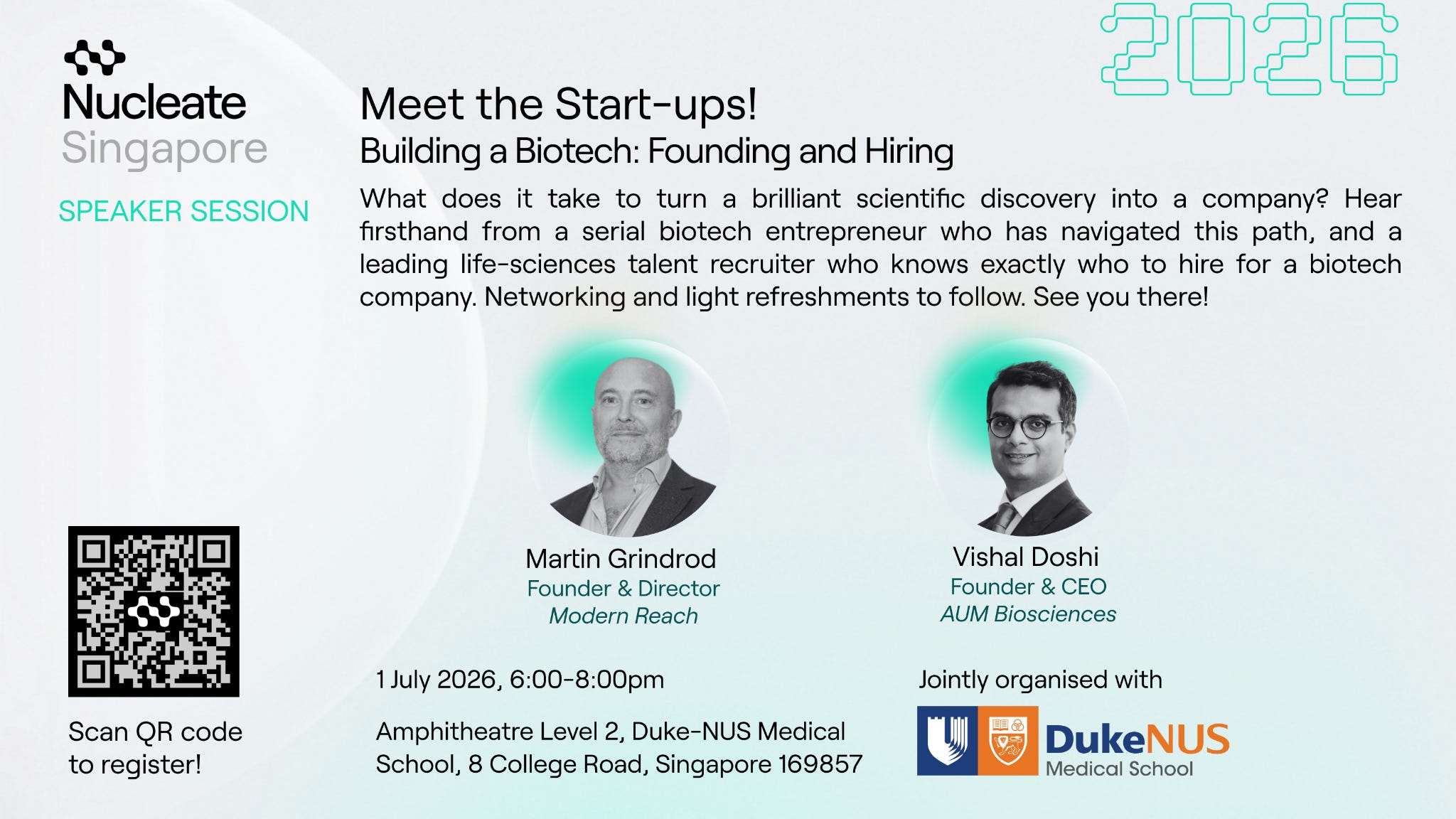
Still wondering what it takes to start or work for a biotech company? Grab a friend and come to our next Meet the Start-Ups session! Click the link here or scan the QR code below to grab your spot before they’re gone.
And now, let’s get into the rest of the article! Enjoy!
High potential SG research, hot off the press
@Senuri De Silva
TL;DR
Dry eye disease affects over 1.5 billion people worldwide and is driven by chronic inflammation and oxidative stress, with limited treatment options.
Researchers engineered a plant-inspired nanosystem called LEAF, derived from spinach photosynthetic machinery, that uses visible light to generate protective molecules inside eye cells.
In cell and mouse models, LEAF reduced oxidative stress and inflammation, boosted antioxidant defenses, and protected the cornea from damage.
Humans and plants both depend on sunlight, but in very different ways. Our eyes use light to see the world, while plants use light to generate energy through photosynthesis. For decades, photosynthesis has been considered a process unique to plants and certain microorganisms. But what if some of nature’s solar-powered machinery could be repurposed to help human cells heal? Inspired by examples in nature such as sea slugs, which can temporarily retain functional chloroplasts from algae and use them to gain metabolic benefits, researchers at NUS explored whether plant photosynthetic components could be harnessed as a new form of therapy. Their focus was on keratoconjunctivitis sicca (dry eye disease), a common condition affecting more than 1.5 billion people worldwide. Dry eye disease is driven by chronic inflammation and oxidative stress on the eye surface, causing discomfort, pain, and impaired vision.
To tackle this challenge, the team developed a tiny bioengineered system called LEAF (Light-Reaction Enriched Thylakoid NADPH-Foundry). Starting with spinach chloroplasts, they carefully isolated the light-harvesting structures responsible for photosynthesis and repackaged them into nanosized particles. Unlike whole chloroplasts, which carry out full photosynthesis to make sugars, these engineered particles focus only on capturing light to generate NADPH and ATP, molecules that help cells restore energy balance and repair oxidative damage.
When exposed to normal visible light, LEAF generates NADPH and ATP independently of the body’s own metabolism. These molecules help restore the cell’s antioxidant defenses, reduce harmful reactive oxygen species, and support tissue recovery. Importantly, the researchers found that LEAF particles could enter corneal cells and persist long enough to provide ongoing protection rather than being immediately broken down by the cell. The team tested the technology in cell systems and mouse models of dry eye disease. They found that LEAF reduced oxidative stress, enhanced the activity of natural antioxidant enzymes, suppressed inflammation, and protected the cornea from damage. In treated animals, the system helped restore a healthier eye surface and improved resistance to inflammatory injury.
This work introduces an entirely different therapeutic concept: using light itself as a source of healing energy. By adapting plant photosynthetic machinery for use in mammalian tissues, the study opens a fascinating new direction for treating diseases driven by oxidative stress and inflammation; not only in the eye, but potentially in other organs as well.
Explore how biotech companies are transforming nature’s own solutions into life-saving innovations:
deepblue uses AI-driven metabolic modelling to engineer carbon-fixing microorganisms to produce high-value chemicals.
Seres Therapeutics develops microbiome-based therapeutics and recently secured $25M from Nestlé.
@Senuri De Silva
TL;DR
Fatty liver disease affects around 25% of the global population, but how early gut dysfunction contributes to liver disease remains poorly understood.
NTU researchers identified Angptl4 as a key regulator linking gut barrier dysfunction to liver injury.
Mouse and microbiome studies showed that beneficial bacteria such as Roseburia hominis protect against disease, while Romboutsia hominis worsens gut leakiness and liver damage.
Metabolic dysfunction-associated steatotic liver disease (MASLD) affects around one in four people worldwide and is becoming increasingly common alongside obesity and diabetes. While MASLD begins as fat accumulation in the liver, it can progress to more severe forms of disease, including inflammation, liver scarring and permanent liver damage. Emerging evidence suggests that problems in the intestinal barrier; the protective lining that separates the gut from the rest of the body; may occur long before liver damage becomes apparent. When this barrier becomes “leaky,” bacterial products and dietary molecules can enter the bloodstream and trigger harmful signals that contribute to liver injury.
Researchers at NTU investigated how a protein called Angptl4, known for its role in metabolism and inflammation, influences this process. Using mouse models, they found that loss of intestinal Angptl4 strengthened the gut barrier, reduced gut permeability, and protected against the development of MASH, the more severe inflammatory form of MASLD. Their results suggest that Angptl4 acts as a key molecular link connecting diet, gut health, and liver disease.
The team also explored the role of the gut microbiome. They found that different bacterial species had markedly different effects on disease progression. The bacterium Roseburia hominis helped protect the gut barrier and reduced liver damage, while Romboutsia hominis promoted gut leakiness and worsened liver pathology. Importantly, dietary intervention with the prebiotic fiber inulin helped restore beneficial gut signaling and improve disease outcomes.
Together, these findings highlight how interactions between diet, gut microbes, and intestinal barrier function can shape the earliest stages of fatty liver disease. By identifying Angptl4 as a central regulator of this gut–liver communication pathway, the study provides new insight into how metabolic and microbial factors contribute to MASLD progression.
Learn more about biotech advances in liver disease:
GSK pledges £44.5M in near term for UK-based biotech Engitix to explore the cause of liver fibrosis regression.
Roche to acquire US-based biotech, liver drug developer 89bio for up to $3.5 billion.
BioVie plans $20M IPO for spinout tasked with developing liver disease drug.
News from the Singapore life sciences industry
A*STAR and NUS launch joint lab to accelerate translation of synthetic biology into real-world applications.
Singapore and China Sign Memorandum of Understanding to Renew Commitment in Enhancing Regulatory Collaboration on Health Products.
National University Hospital and LASALLE College of the Arts set up a Sustainable Medicine Design Lab in Singapore.
NUS Medicine launches a new translational research programme in neuroscience.
NUS Medicine and PolyU sign an MoU to advance AI-enabled musculoskeletal research.
Research team led by scientists from A*STAR Genome Institute of Singapore developed HERRO, an AI tool for high-accuracy genome mapping.
Singapore Health Sciences Authority (HSA) approves MSD’s Enflonsia for infant RSV prevention.
Asian Society of Cardiovascular Imaging signs an MoU with Philips to strengthen imaging capabilities in Asia Pacific.
Medtronic Singapore partners with the Society of Colorectal Surgeons to strengthen surgical training.
Singapore’s Ministry of Health to invest S$2.5 billion to strengthen translational and clinical research.
CapitaLand officially opens the S$1.4 billion Geneo life sciences hub.
Agilent and NATi announce 2-year partnership to advance lipid-conjugated oligonucleotide research.
QuantumTx and NUH open Mitocharge Muscle Health Centre - Singapore’s first dedicated muscle health centre.
NUS team launches CNA Visualizer- an open-access tool to decode DNA change patterns in breast cancer.
IHH Healthcare and DBS sign an SGD 250 million sustainability-linked loan to promote responsible antibiotic use.
Singapore’s premier podcast on the local biotech ecosystem.
Conference/Seminars
Health Data Science Symposium 2026
(26 June, 9:00 AM - 5:00 PM, in person)
RNA Therapeutics & Manufacturing Asia 2026
(30 June - 1 July, 8:00 AM - 6:00 PM, in person)
Cell & Gene Therapy World Asia 2026 (10th Edition)
(30 June - 1 July, in person)
Oligonucleotides & Peptides World Asia Congress 2026
(30 June - 1 July, in person)
(8 July - 10 July, full-day, in person)
SCRI Clinical Trials Symposium 2026
(30 July - 31 July, in person)
Networking
Nucleate Singapore Meet the Start-Ups
(1 July, 6:00 PM - 8:00 PM, in person)
Sat Health & Bio Brews Singapore
(Every Sat, 9:00 AM - 10:30 PM, in person)
Seminars/Panel discussion
(24 June, 2:00 pm - 5:00 pm, in person)
Wake Up to Sleep: Aligning Health Innovation with the Science of Sleep
(3 July, 2:00 pm - 4:00 pm, in person)
She Heals: From WoundCare to Aging (Fireside Chat)
(7 July, 4:00 pm - 6:00 pm, in person)
Workshop
SCRI Clinical Trials Symposium 2026 (Pre-symposium 2-day workshop)
(28 July - 29 July, in person)
(i) Health Technology Assessment (HTA) Workshop
(ii) Biostatistics Workshop on Advanced and Innovative Clinical Trial Designs
Thanks for reading The Nucleate Artery! Share this post with a friend.
Comments
Nothing yet. Say the first thing.
Sign in to join the conversation.