
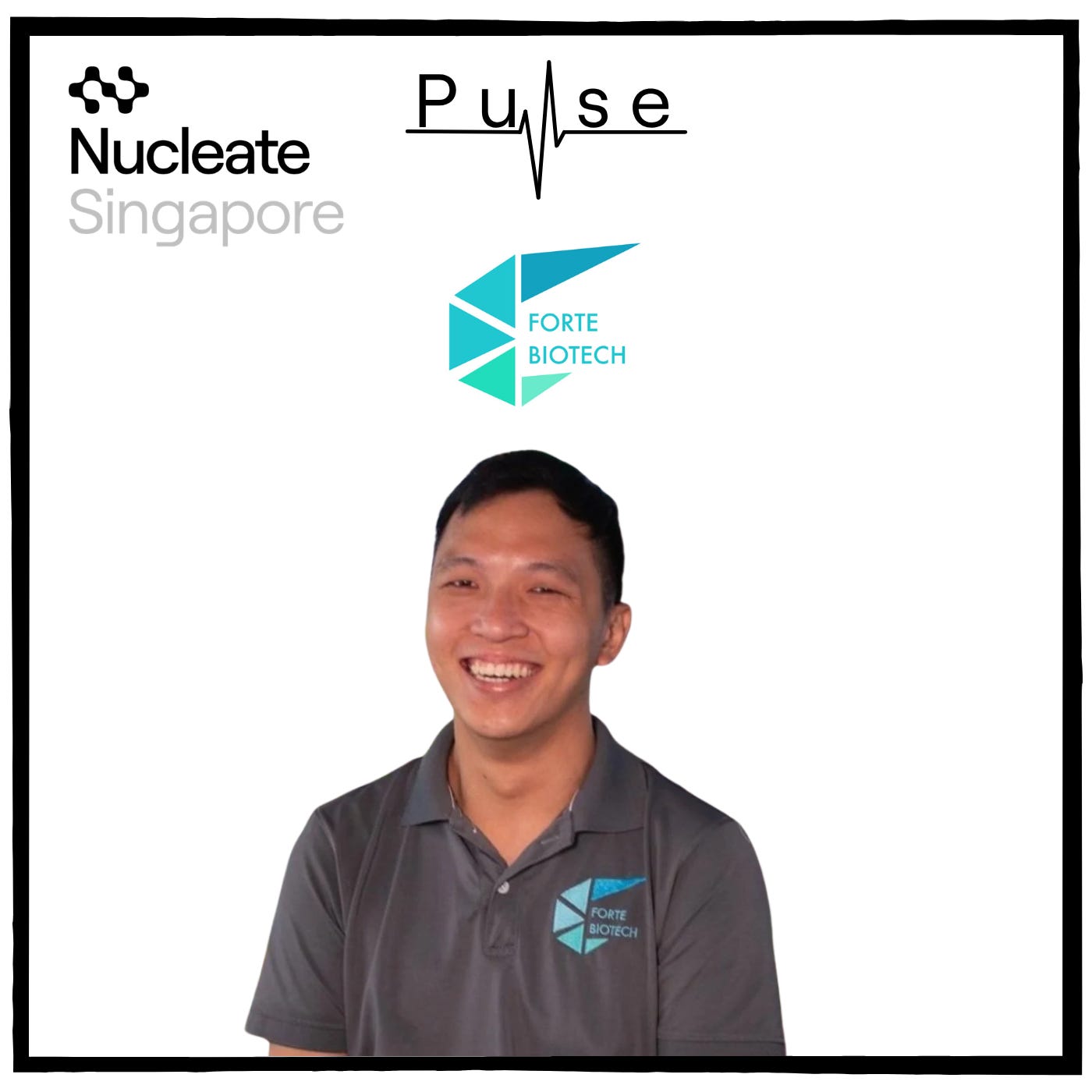
Mr. Kit Yong is the co-founder of Forte Biotech, a Singapore-based agritech startup developing rapid, point-of-care molecular diagnostics for aquaculture.
Forte Biotech was founded in 2021. The concept behind RAPID was inspired by the founders’ experiences working with farmers in Vietnam, as well as insights from their own family businesses. Having witnessed firsthand the challenges faced by farmers, their families, and their livelihoods, the team remains committed to developing solutions that can make a meaningful and lasting impact.
In this episode, Kit shares how Forte Biotech was founded to address a critical but overlooked problem in shrimp farming: catastrophic losses due to undetected disease outbreaks. He explains how the company built a portable isothermal amplification platform and proprietary DNA extraction chemistry capable of handling challenging shrimp samples, enabling farmers to conduct reliable, onsite pathogen detection without complex laboratory infrastructure.
Key Takeaways
🔬 Diagnostics are the gateway to treatment: Without accurate and timely detection, even the best therapeutics and vaccines cannot be applied effectively.
🦐 Aquaculture faces major disease risks: Early detection of pathogens is critical to preventing catastrophic losses in shrimp farming and improving farm sustainability.
⚙️ Technology must be designed for real-world users: Successful field diagnostics need to be simple, robust, and usable outside traditional laboratory environments.
🌏 Local partnerships are essential for scaling: Expanding across Southeast Asia requires trusted local connections who understand regulatory and cultural landscapes.
🧑🔬 Field insights matter as much as lab research: Scientists must engage directly with end users to understand real problems and design practical solutions.
💬 Communication is a key scientific skill: Translating complex science into language that farmers, investors, and partners understand is essential for real-world impact.
“Farmers are hardworking, smart people — at the heart of it, they are business people trying to use biology to make money. In that sense, they are already running biotech companies.”
“Diagnostics is really the gateway to treatment. You can develop vaccines and therapeutics, but if you don’t know when or how to apply them, there is no point.”
“In applied science, especially in agriculture, scientists need to go out into the field. It’s hot, it’s sweaty, it’s uncomfortable — but that’s where the real problems are.”
“In the startup world there is no clear guide. You take what you learn, internalize it, test it, refine it, and repeat the cycle again and again.”
“One of the biggest milestones for any startup is simply reaching profitability. Funding is tough — and in agritech or aquaculture, it’s even tougher.”
“Before starting a company, it’s often better to build broad experience first. When the right problem appears, it becomes much easier to build something meaningful.”
”Biotech is a lot of work and the pay can be terrible at the beginning — so you need to be very sure that the problem you’re tackling is worth it.”
00:00 Meet Kit Yong
02:33 No Manual for Startups
04:09 Why Forte Bio Started
06:53 Net Zero and Farm Impact
09:35 Rapid DNA Extraction Breakthrough
11:57 Sample Degradation and False Negatives
14:44 Major Shrimp Diseases Explained
18:26 Bridging Farmers and Scientists
20:18 Portable Hardware and Isothermal Tech
21:19 Balancing Cost Accuracy
21:55 Rapid Hardware Overview
22:52 On Farm Reliability Lessons
24:53 Scaling Across Southeast Asia Markets
25:46 Regulation And Local Partners
31:09 Building An Agile Team
33:40 Diagnostics And Food Security
35:57 Milestones Profitability Goals
36:47 Science Communication For Impact
Aakash Naresh Kumar: Today we are very glad to have with us Mr. Kit Yong. Kit is the co-founder of Forte Bio, a company that specializes in the testing of diseases in shrimp farms. Thank you so much again for joining us today, Kit.
Kit Yong: Yes, thank you for having me, Aakash.
Aakash Naresh Kumar: So Kit, you have had a very interesting journey starting from back at school, from your family business.
Your path is actually quite fascinating if begin by working in your family business to an online e-commerce, even a hospitality business in Vietnam. After that, you began your own grocery store brand during COVID. So could you share what was the motivation behind exploring so many different types of ventures?
Kit Yong: A lack of discipline and a inability to study, I think. For me, I’ve always enjoyed, I’ve enjoyed science. I like the idea that, you know, you have a hypothesis, you test your hypothesis, you see the results and then you refine it further. But I feel that this is, can be used in many ways, right? Not just whether it’s in science or you design an experiment. You can also use it for business to see what works in business. It’s a very good philosophy for life.
I realized from the very start that I’m not a very good student. I can study, but I find it very hard to memorize things. I find it very hard to work like in undergrad mods. You’ve got to memorize what are the codons, my God! I really cannot do all those, especially in the day and age when you can just Google. So I realized very early on that I probably won’t have discipline or the ability to go far. Pursuing a scientific career. So I started to look out elsewhere for other things that I could possibly do and make money.
So I’m very fortunate that my family runs a business, so I have the chance to actually work with them throughout my studies. And that also gave me opportunities to start up ventures, like the hospitality business in Vietnam, which was done with a good friend of mine. All of these are good experiences that I’ve learned how to work with people, how to further refine the own way that I think the whole scientific method thingy and, sort of, build up my experience.
And all of these are skills that I still use on a day-to-day basis. If you’re asking me about motivation, it’s more or less a motivation to survive because I’m frankly speaking quite terrible at studies.
Aakash Naresh Kumar: I think I can agree with you that I certainly do not miss studying as much as well.
How would you say, how did your experience running your family’s wholesale business or pioneering e-commerce transitions, how did it prepare you to finally found and enter the startup world and eventually founding Forte Biotech?
Kit Yong: I think a lot of times as Singaporean, we are very used to instruction manual, right?
A lot of times, let’s say you buy the furniture from IKEA, first thing you do, you look at a panel, right? And then figure out which screw is what, which screw goes where. But unfortunately I’ve never really had that discipline to do so, and I think in startup world, there’s no manual you gotta go and figure out which crew goes where, which part goes where.
I think one thing, when I got my own house and we were getting furniture, we got a lot from TaoBao. And then some of the instruction sheets just thought were not packed. So you to figure out which part goes into the way. And I feel that’s a lot of what happened when I was working in my family’s business.
Plus there is no user guide, right? There are SOPs, but some of the new things like how do you run a business? How do you do online business, if no one’s family done the online business before. What are the best strategies? Of course, all of this you need to learn and you need to go online, see what people do, study and refine and find out a method that works eventually.
So I think this whole experience of taking what we learned, internalizing it, refining it, executing it, and reiterating the whole process was very helpful. And that’s something I should do today, whether it’s with customers, how do I sell to a customer? What do a customer want? Or how do I refine my technical skills a bit more?
How do I refine my own product more? I think these are very important considerations, whether it’s from the technical, scientific side, on the commercial, the business side. This is still the same cycle pretty much.
Aakash Naresh Kumar: I think that’s a good way , if you could share about the origin story of Forte Biotech.
What inspired you and your co-founder to start a test kit for Farmers Company and what problem or unmet need were you trying to tackle?
Kit Yong: We weren’t trying to start a biotech company, to be honest. I think our main aim and motivation was to be a known shark.
Now, why do I say that? It’s because I think farmers are hardworking, smart people and at the heart of it, they are business people trying to use biology to make money. So basically they are biotechs company, if you look at it that way. Just that instead of shiny new bioreactor, they’re doing protein synthesis in a living animal.
So your bioreactor can also spoil and your living animal bioreactor will also spoil, right? And a lot of the reason why it’s spoils is because of diseases. Let’s say you have a fish, you feed protein to the fish, the fish turns it into edible protein. You sell it to a human. That’s the whole idea behind it.
But the fish could fall sick and die. The shrimp could fall sick and die. And if they fall sick and die, you don’t get any money back. So all the money that you spend on fish feed or prawn feed, for example, you throw it in, it doesn’t get converted into money that you can take back if it falls sick. So we realized that there was a lot of problems with financing these farmers because the risk is big.
My own parents, we sell a much more predictable product, so it’s easy to get financing from the bank and they use the financing quite wisely to then build up a business. Farmers don’t have the opportunity to do that, and we want to step in to be able to do that. So that was the original disease. Can I lend money to a farmer and understand what’s the risk that he faces?
Now, most of the risks and most of the losses are because of diseases. They fall sick, they die, and it’s terrible for everyone, not just the farmer, but also the distributor that sells the feed to the farmer, and the factory that sells the feed to the distributor is terrible. So you wanna find a way to find out the risk of what’s going on in the farm.
And at that time, COVID just started and then we saw the pictures of people queuing up in China and everywhere around the world queueing up for PCR tests. It takes two, three weeks for the results to come back because the labs are so overwhelmed and then you fall sick, you think you’re sick. PCR results comes back negative. All these horror stories. And we thought, “Why can’t we do the test ourselves?” And this is a problem that’s happening every day in the animal, in the livestock industry, whether it is chickens, pigs, cows, sheep, fishes, prawns. We have the same pandemics going on all the time. So I realized that it was a good thing to do.
And also the ideas evolve from there to point of care test kit.
Aakash Naresh Kumar: I guess probably will be a good time to also bring up, based on all the different challenges you’re trying to tackle, that you were the winner of the Net Zero Challenge 2023. So congratulations on that.
Kit Yong: Thank you.
Aakash Naresh Kumar: Comparing that with the outcomes that you mentioned and the types of problems you’re trying to solve, what are some of the sustainability outcomes going through this whole journey of this Net Zero Challenge that stood out to you?
Kit Yong: I think the first thing, of course, when we talk about emissions from farming. There are two. The first is the emissions that’s needed to get the feed on site and feeding it through the fish or the shrimp in our case. The second is basically the energy that you need to invest into it. Because you need to run aerators and all that. I think that’s definitely a big problem. Imagine you raise the shrimp to nearly ready for harvest. Spend 90 days of effort and all that, and suddenly you lose everything overnight because of white spot virus, it kills everything overnight. I think that’s terrible. It’s not fun. You’ve wasted all these resources you’ve put in, whether it’s financial or a toll on the environment. You throw all these sick things out without disinfection. It pollutes the environment further, so that’s one thing. The second damage, which I think is the bigger damage , more so than the emissions, is antibiotic abuse.
Antibiotics are being taken as prophylactics in farming. That is ridiculous to me. And I am terrified because I do know that farmers, some of them, they grow some of the shrimp for their own consumption, and the rest is for the market. I think it’s terrible, but I understand it from their point of view.
Why do they do this? Because they’re terrified of what diseases can do to them, and there’s no good way of detecting and managing these diseases early. So I do understand from both the business point of view as well as the scientific point of view, what works and what doesn’t work. So maybe it works for them from the business point of view.
Because antibiotics are cheap. And their objective is just to feed themselves. Today, it’s very hard to plan long term and if you’re going to go hungry tomorrow. So yeah, just do it and it’ll be someone else’s problem. But what we are seeing is they’re getting the seeds of that they’ve planted are now sprouting.
We are getting antibiotic resistant vibrio outbreaks in shrimp farms. They have diseases which they add super in front of it now because it’s a totally more infectious, more virulent strain like it used to be. Caught just EMS, early mortality syndrome. Now they got EMS as well as super EMS. So we are seeing all these challenges and I think to me, if our company can prevent one more super disease from appearing, I will be very, very satisfied.
Aakash Naresh Kumar: It is a scary thing with all the antibiotics, not just in bugs, but now I should mention from the feed as well, even among animals. But I think it’ll be a good time to transition a bit to talk more about Forte Biotech’s technology, described as the rapid system that employs a propriety chemistry to extract PCR grade DNA.
So what was the inspiration behind this propriety chemistry?
Kit Yong: Currently, when you want to do a PCR, you normally need to use column based methods or magnetic beads methods, right? The chemistry behind, it’s actually very simple, but the problem is how do we apply this? Concept into the field in an effective manner.
Recently I was at the University of Arizona to take a short course on shrimp pathology, and then it’s all PhD level students. Most of the participants are much more educated than me. We split into five groups to do a PCR test on shrimp. Of these five groups of very well educated people, much more than the general lab population in aquaculture, only two groups managed to get the answers correct for the samples. I’m glad to say my group is one of them. So it’s actually difficult because shrimp are very, very challenging samples to work with. You’ve got a high enzyme activity inside a lot of DNAs, RNAs. You’ve got a lot of lipids inside. You’ve got a lot of proteins inside because it’s basically mix of the liver and the pancreas.
I was very lucky to work with Dr. Chung-Pei of DXD hub, previously of NUS, during the NUS GRIP program. And with his experience, we came out with a product that is able to use the Boom’s method and other similar methods to then do the extraction. We wanted to make it something that was so easy to even a drunk farmer can do.
So we have to limit a lot of things so that we are able to actually use it onsite without centrifuge. And at the same time, make it suitable for ENT transportation. Because I think no insulation will be able to pack something that is needed to be stored at minus 18 all the way to the remote village in Vietnam.
No insulation’s gonna do that. So you need to make something that is able for, I would say even the most drunk farmer and the most remote villagers of Southeast Asia to use. So I think that was the inspiration behind what we did.
Aakash Naresh Kumar: It’s really good to know, though. It’s also interesting to understand that prawn samples, as you mentioned, with all this high protein content enzyme, it’s difficult to extract DNA. So could we dive a bit deeper as to how do you isolate this clean PCR grade DNA from this very hard to get samples?
Kit Yong: Yeah, it’s really quite easy, you just use sugar spice and everything nice. And then we add chemical X into it. The way that we do it is basically we look through a lot of the protocol.
And then it came a two year process of then optimizing what’s necessary. We have a very good team that did all this experimental work working through countless amounts of shrimp, whether that is the one that we grow or the ones that we buy from Sheng Siong, which credit to Sheng Siong actually has the freshest prawns.
So if you are a seafood fan, buy from Sheng Siong or Prime, they tend to have the best seafood in Singapore among supermarkets. We know this because if you test only fresh shrimp, you can detect diseases. We detect diseases, we know that a shrimp is really, really fresh. And that’s one of the challenges because a lot of farms, they will sample and send it to the lab. But because of the transport process, the shrimp is not well preserved. It’s not so fresh anymore. The diseases actually get digested. The pathogens get digested away by the enzymes in the liver or in the shrimp. So you get a false negative. It’s not a false negative because the PCR, that is a false negative because the sample is already degraded.
So that’s all the challenges that we had to go through. For our extraction chemistry, that’s basically, sort of rethinking of how can we use the various methods that literature already have to combat this along with the restraints that we have. That’s how we came up with our methods.
Aakash Naresh Kumar: So in a way, if I could repackage that it’s more of like you are trying, if there is any pathogens inside a particular group of samples, you want to find it before it gets degraded by the liver.
Kit Yong: Yes, pretty much. So basically, our license buffer has to do quite a lot of things at the same time. And one unintended ability of our lysis buffer is that we can actually store samples for quite some time in ambient temperature for further processing, whether it’s by column base or other methods. That was a very surprising finding that you have because even samples which I’ve taken from the furthest of places I live in my luggage, I forget about, one month later I take out is still working, we still can get DNA from it.
So I think that’s something that is quite surprising and something that we realized on hindsight that other people have already commercialized. So I think that’s something that we can also go down, but our main focus is still on point of care because that’s where we feel it has the biggest benefits business wise.
Aakash Naresh Kumar: It’s quite distinct. Learning is like a, something that you were not planning on finance. Somehow you found it by chance.
Kit Yong: Yeah, but I mean, we also have to be lucky if Isaac sat under a durian tree, we wouldn’t know much about gravity.
Aakash Naresh Kumar: Very well put, I think of all these diseases, what are some of the major diseases and pathogens that affect these shrimp farms?
Kit Yong: We have a lot of, so maybe we just start through the different types of living things. Viruses are a big problem, so shrimp, they do not have adaptive immunity. They only have innate immunity. So basically their immune response is to swell up, malise and die, if I were to put it that way. So they’re very prone to infections, right?
So for viral diseases, they’re basically defenseless. Because they have no way to stop viral replication inside there other than apopthosis. So that’s one issue that they have. So white spot virus is a very bad problem that they have in Southeast Asia. There are also other diseases such as Taura, for example, that was the first big disease back in the 1980s coming out from Ecuador.
Pretty much they’ve been able to bring resistance to it. By sort of taking out the receptors that make them vulnerable to the Taura virus. They’ve also other diseases in China, like DIV decapod iridescent virus, IMNV, RNA virus that basically rots half the prawn. So you have some prawns, the front half is working, the back part is rotten.
It is very interesting and I think there’s a bit of a disconnect between the lab and the farm. Because the farmer basically tell you, oh, we seem to have two IMNV types. One is the smelly type and one’s the non-smelly type. I say, what do you mean by that? Oh, smelly type is when they get infected, they smell very bad. Non-smelly is when they get infected. They just look infected, but they’re not smelly. So what does it mean for the farmer and what does it mean for the lab? Because he said in the smelly type, basically everything died overnight. Non-smelly type still worth a hundred, a few two, three days, so it’s about bridging these differences.
I feel that’s very important. So that’s one side of the virus. For bacteria, they tend to have better defenses. But now we have bacteria that have plasmid that produce toxin, so vibrio is a very commonly seen bacteria, normally quite well managed, but they have managed to take on plasmids from bacterias that infect butterflies of all things, caterpillars. And those have proven to be very toxic for shrimp for some strange reason. So God knows how the plasmids got in there, right? But you have a lot of antibiotics being used. It’s no surprise that there’ll be horizontal transmission or all this plasmids. People just transfer to each other. Bacteria just transferred to each other and all that. I’m not surprised that this infectious started. So we have one that decimated the Thai industry, AHPND. And recently we have another one that’s starting from China now. Very bad in Vietnam, the translucent post larva disease. All of these are basically plasmids that are in vibrio, so it’s very interesting to me.
Sorry, I’m nerding out here. And finally, another big problem that we have is what we call EHP Enterocytozoon hepatopenaei. It’s actually a fungi, a microsporidian that causes the shrimp to slow down in growth. It doesn’t kill the shrimp, so it’s a very big problem because your shrimp are not dying, so you cannot tell that it’s a disease.
The only way that you know is you keep feeding and they’re not growing bigger on the business side, you lose a lot of money. Because by the time you realize you have probably invested a lot of money into the feed and you realize it’s not growing and they also as a gateway for other opportunistic bacteria to come in.
So yeah, it’s a lot of diseases. And I’m sorry, I realized I. It just went on a lot. This is what happens when you get a biologist to come and do a podcast. We just start rambling about all the science that we like.
Aakash Naresh Kumar: Actually yes , we do dove into the science. So you actually at home, but there’s one interesting fact that you mentioned that I would like to just a little bit deeper in.
Would you say that the current sort of crosstalk between farmers and scientists. Do you think there’s a gap over there that needs to be bridge in terms of communication between the two?
Kit Yong: I think sometimes we all speak different languages, and I don’t mean the fact that in Southeast Asia we still speak Malay, Thai and all that.
Yes, that’s one challenge. But the bigger challenge is what does it mean? Like in the case of the virus, smelly IMNV versus normal IMNV, how do you define smelly in a scientific sense. How do you compare, oh, this one is a nine of 10 in terms of smell. This one is seven out of 10 or okay, three out of 10 means it’s the non smelly.
So some of these observations need to then be, or the business side on the field side needs to then be translated in a way that the scientists can understand. And similarly, the findings that the scientists know should also then be translated into something that the farmers can understand.
I think that’s the big difference that we have now. In this case, I was very lucky in Arizona, I met Dr. Arun Dhar, he runs the lab over there, and when I tell him about this scenario, he said, oh, okay. It’s very interesting because smelly means that it’s rotting faster. If it’s rotting faster means the cells are dying faster, and if the cells are dying faster, means there is a higher virulence. So if there’s a higher virulence, there should be a higher mortality. I went to check and yes, the smell one is actually about the higher mortality. So it does take a mix of experience and scientists who actually bought it to go into the field work.
I feel like maybe in Singapore sometimes, we are very non-field work. We like to be in the lab. Sometimes scientists, especially in this applied field, do need to go out to field. Do need to work on a fuel more, even if it’s hot, sweaty, uncomfortable.
Aakash Naresh Kumar: My next question was gonna be talking about some of the other key features of your platform, which revolves around portability.
Going on a field is definitely a very important part of any scientific work, but you’ve developed proper hardware like the rapid heater, reader, rapid plus, a rapid mix with various specs, what are some of the different parts that make up this hardware? Could you just briefly talk about what they do?
Kit Yong: A huge reason why PCR machines are very expensive is because we need to control the heating and cooling very accurately. I think that’s something that’s expensive. And you also, for the case of PCRs, you need to have very powerful lasers or rather precise lasers that can shoot good receptors, right?
We try and reduce the cost of all this hardware, so by doing so, we make two decisions. The first was to use isotherm amplification because it makes the thing a lot simpler, with one temperature, you just heat it up to, in our case, 65 degrees, 67 degrees. It just runs steady. You don’t need to worry.
The heater is cheap, right? You don’t need to precise temperature control. Save a lot money. The second thing is basically the information they need. Because basically, isothermal is very famous for non-specific amplification. It’s hard to control, but we have taken steps to design such that we spend a bit more.
So instead of Cyber base, we go a bit deeper into molecular beacon and stuff like that. Yes, it’s a bit more costly, but for us it’s important because the savings that we have from every other part can pay a little bit for this bigger part. So that’s how we balance the cost with the accuracy.
And in terms of this, the different parts of the hardware basically for Rapid. As far as Rapid Max, this are qualitative systems. I give you a yes no result at the end of the day, using my reader, which can also send the data back via email at the moment. But we are also trying to add WhatsApp, Telegram as well as our own AD Plus, and then on Rapid Plus is a development together with DXD Hub from A-STAR what we do is a semi- quantitative lab. So we are able to tell when where’s amplification, we’ve devised a sort real time ability to measure fluorescence at a very low budget. So if I’m not wrong, we are compared to equivalent machines from China, we actually can undercut them by up to 10 times because our engineering is cheap and our company boss is stupid.
He doesn’t want to raise the price. So I think that’s also a big problem.
Aakash Naresh Kumar: So in terms of on -farm operations, do you have to bridge any gaps when it comes to letting the farmers know how this whole system will work? How do you ensure that when the runs are happening is reliable?
What are some of the key engineering constraint that you have to solve? And do you have to communicate all these to the farmers on the ground?
Kit Yong: Oh, yes. Actually, it’s very interesting you mentioned this ‘cause we had a mini crisis couple of months back. Because for some reason, whenever we take our machines to Thailand, they do not work for whatever reason.
And I realize you’re so simple, so silly. Thailand, the power plugs can take either too round or too straight. Straight ones tend to sit more tightly as compared to the round ones. So we were equipping them with the round ones instead of the straight ones. The wire came loose, probably doesn’t work. Stuff like that.
So it is really the details. I think we learned a few lessons along the way, right where, as much as I was telling you earlier about we need to cut the cost, but we also need to invest in good enough quality. So, especially in these sort areas, I think robustness is very important. So we try and build things that are simple and robust. Your screen is busted. Okay, nevermind. I send you a new screen. You just put it in, or it’s not working. Never mind you just send a thing back to me. I send you a new one. I think we we need to make it cheap enough and easy enough to use so that we are able to effectively service these customers.
Because the customers, aside from Thailand, no one else ever asked for operational manual for some reason. So it is so simple, you just put it on YouTube video and you understand, right? Most of them is all okay. We need to really dumb down the operation and make it really as simple as possible for people to use it effectively. Because if people don’t use it effectively, the first person they blame is, oh, this device is not accurate, right? It’s never, oh, I didn’t know how to use it. So I think that’s a very important part.
Aakash Naresh Kumar: I think that’s probably a good time for me to also ask. You launched Forte Biotech in 2021 and it’s now expanded to at least five Southeast Asian markets.
So how have the different farming cultures or regulatory landscapes shaped your approach to your expansion to these countries?
Kit Yong: Oh, a lot, a lot. I think it’s quite interesting because the whole shrimp farming industry is very big, but we are small at the same time. So it is one of those industries where everyone knows each other, all the companies know each other. We were exhibiting in Thailand where we meet our distributor in Philippines, and our distributor in Philippines helped get us a customer in Vietnam. Who then gets another customer for us in Thailand. So it’s a very interconnected industry. Everyone seems to know each other. Everyone has tea on each other and all that. I mean, this is not Aquaculture podcast, so I can spill a tea. I’m just kidding. But it’s a very small industry. I think when it comes to regulatory landscape, we have to track carefully because unfortunately we operate in a very awkward space.
We are not a hundred percent biotech. We are not a hundred percent healthcare. We’re not a hundred percent anymore health. We occupy something in between all of this. Sometimes it’s hard for regulators to decide where we land, so we do have to be quite careful. Most of the time we find the easiest way, anything more detailed will probably get me into jail or trouble.
I’m just kidding. Nothing will get me in jail, I hope. But. We’ll have to find the most efficient way to get into a market, and if the most efficient way is also too difficult, then we have to put our focus elsewhere or need to find other ways to do so. I would say that recently I was at a APEC convention and there was actually a whole session about regulation on farming products.
In that discussion, it happened to be about CRISPR, gene editing and all that. Which level of gene editing would you need to get approval for, or which are just go ahead and do it I think it’s something that industry and regulation need to catch up to the sites because our science is evolving so quickly, right?
CRISPR is opening up so many possibilities. Not just that, we also have AI, we are just speaking ahead for this about how AI can also help us about, experimental design and the things that can do. So I think it’s very important that regulators need to update their mindset fast enough, and I’m glad that quite a few of them know that and they’re working on that.
So that’s good, I think I’m optimistic.
Aakash Naresh Kumar: Absolutely right about the fact that landscape’s changed really quickly, especially with AI now coming in. When you do enter a new market, for example, would you say that it’s important to have a local connection, someone that can push you in the right direction for regulation and all that?
Kit Yong: Yes. That is essential. Absolutely. It’s essential, I think you need someone. We are lucky we’re from Singapore. Singapore has a set brand name already, that we are reliable and trustworthy in most of the cases, so that helps as a diagnostic company, but the other part of it is the connection.
So no one’s going to talk to a random Singaporean knocking at your door. You need a connection and all that. We as a people tend to be a bit weaker. Because we are very business first, right? Normally in the rest of the world it’s friends first business later. So I think that’s something that I was quite lucky with.
Because we make good friends, we show them the video , our product, they feel like, hey, these guys are reliable. We can work with them. And then they push you into different markets, they help you with quite a fair bit of stuff. So I think that’s important. But we do need to make friends.
Yeah. It’s very hard to be just a company like that.
Aakash Naresh Kumar: Connections are very important. And the Forte Biotech also has a partnership with NUS GRIP. Speaking of connections, how would you describe your collaboration with them?
Kit Yong: I think NUS has been a very good supporter from starting being our first funder, giving us a good space to use at NUS Agritech Center and giving us the exposure.
No one’s going to believe a random guy on the street that says, hey, I can make a PCR for chip. I can make a molecular diagnostic system for chip. But having a brand name that actually helps to bring a bit of credibility and it helps us with the getting our foot into the door. But beyond that, of course we have to rely on ourselves to make sure that it’s a good product so that we can keep ourselves, our walk through the door eventually.
So yeah, I’m very grateful for the initial partnership and we make quite a lot of friends there. We get to ask people for help sometimes, or bounce ideas with people, which I think is the most important. At NUS Agritech Center, we gotta talk a lot with NUS GRIP seniors. The whole team has been super generous.
And super happy to share their information and experience. That helps us, even if we are not working on strawberries, for example. But it helps us a lot in understanding the market and thinking about ideas. That whole Kampung spirit, they have there, is very helpful.
Aakash Naresh Kumar: See, that’s also interesting to know, this is all data you mentioned with your current partnerships. What would you say are some of the other factors that you look for when exploring a potential new partnership?
Kit Yong: I feel it’s a lot of factors you look for in a wife or husband, whatever, the partner, first of all, there must be the same direction.
There must be a common goal, then must be compatibility. Maybe you just want some benefits from each other, but friends with benefit will never really last for very long. You need to really hunker down and say, okay, are we working in the same direction? Is this something that can be long term? Because I think for bio, as you mentioned earlier, it’s a very small industry, like everyone knows each other. If you play bunk, people know that you are not nice, and that harms the future chances for anyone involved in this. So I think we are very lucky, we have picked up good production partners along the way. We’ve picked up good research partners along the way, but we’ve also picked up partners who are not so good.
I think a lot of it comes down to experience and basically fights. If the guy is trustworthy, if they’ve done good work and they’re putting in a good research or production agreement. Then to qualify things like QC, things like your standards that you need to meet and all that, at least it’s clear on both sides and a good prenup must be there. It’s pretty much like getting married, I say.
Aakash Naresh Kumar: That’s a really interesting analogy to use. With a partnership, you have to make sure that the goals are aligned. It’s something that is mutually beneficial, but looking within as well. Can you share how you build and empower your multinational team across different markets you are in and also how do you keep them agile, like innovation, focus in this rapidly evolving tech space.
Kit Yong: I think we’re just very lucky to have gotten a very good team, for example, in Vietnam, my manager over there actually came from all the way back when I was doing the Airbnbs in Vietnam. So you’ve known each other for eight years, even before I started this business. I’m just very lucky to have the fit to meet good people.
I am very lucky to have had good bosses in the past, like in NUS. I strongly believe as a leader we need to empower our team to have ownership of their decisions to take ownerships of their little things. And we have to take responsibility, those decisions to not work out. So I think that’s very important to know that they can go and explore, go and learn, go and iterate, and if things screw up, we all take responsibility for it because we are building something.
I think that’s the way it is. And opening a very open chain of communications right between them. I think there are times when I need to also do better as a leader when it comes to this, but I’m just thankful that we’ve got a team that is very motivated and quite easy to manage, to be honest. We have had interns who basically with us through their school and intern out, convert to full time right afterwards.
We build a certain sort of spirit and experimental spirit, I think that is what we want to encourage. So instead of all tabletop exercises, I just gonna try. If you say you want to run an experiment, can I test oysters or can I test muscles for disease? Just go to market by a few muscles.
Do spike experiments. If our extraction works, how much would that cost? Maybe four, five hours of your time? Maybe, I don’t know, 20, $30 for the muscles, $50 for the reagents and all that. So I think that also, if they’re confident, they can then decide what they want to do and think and react fast, right?
So it’s just like an octopus with a decentralized nervous system. I just had one of those, raw octopus in Korea where they would chop it up for you and then you just have it, and then you see every arm still move for their own. I don’t want my company to be chopped out like that, but I like to think that our company functions like octopus in that sense.
It’s decentralized, but our octopus is too smart, can do a lot of things.
Aakash Naresh Kumar: It’s very interesting that team spirit, that family spirit, everyone is supporting each other. But it’s good to also transit more to the future outlook of Forte. How do you envision Rapid or even similar diagnostics impacting global food security in the future?
Are there any other livestock or disease areas that you see as something that you can target in the future?
Kit Yong: I think diagnostics is the gateway to treatment. We’re spending tons of money on making therapeutics. You’re spending tons of money making treatments, vaccines, but if you don’t know when to apply it, how to apply it, and how effective it is.
That was the point. So I feel we are being hampered by the lack of suitable onsite diagnostics for care testing. We see more diseases happening, as I mentioned earlier, a EMS, not fun. The fact that we are bringing nature and humans a lot closer together. So not take transmissions, not fun either, right? So we do see that there will be more diseases, outbreak and all that, right? They will trend out food security, but at the same time, on the optimistic side, we also do feel that, there is a lot of AI and a lot of new tools that are not available to farmers to take out the pain of the brain work screening through all the papers.
Doing all the testing, but instead a sort of brain to then suggest that, Hey, look, you could have problem A, B, C. Let’s solve it. A, you do this just to make sure it’s not a B. You do this just to make sure it’s not B, C. You do this to confirm the C, and then they can take the right decisions and the right treatment for our next plans, we are definitely looking at fish, we are looking on the ground. But I don’t want to say too much for the fear of jinxing it. So we’ll be moving through more animals because after it’s a platform, right? So that’s what we are looking at.
Aakash Naresh Kumar: And obviously we wish you all the best in that! Speaking about being the gateway to developing therapeutics in the future, would you say that the companies that do diagnostics, they have to really work well? The companies will be developing those therapies that comes out from the findings of your diagnostics.
Kit Yong: Yeah, I think that’s the goal. It needs to be a team, right? In agriculture, we need to have good animal health, we need to have good nutrition, we need to have good husbandry.
Only then you can have success. Everyone just wants, oh, I want to do this. I want to go on my own. It never works.
Aakash Naresh Kumar: That’s true. But looking ahead, what would you say are some of the key milestones or goals Forte Biotech in the next few years?
Kit Yong: The first is to reach profitability.
Funding for biotech is tough. Funding for agritech is even worse, and funding for aquaculture is the worst because of whatever happened with fraud and e- phishery. So I think that’s definitely the near term goal. We need to be able to feed ourselves, and moving forward we want to expand to these other animals, and we would hope that we have a role to play in preventing the next animal pandemic.
Whether it’s things like African swine fever, avian flu, or even strep in tilapia and all that. These are all big problems we face now. If we can play a part to soften the blow of these problems, that’d be fantastic.
Aakash Naresh Kumar: I think speaking about, solving these problems, one key factor is also having to explain scientific theories or scientific information to members of companies who may not have that subject background.
How would you say you can bridge the gap to explain in a way like, this is what we need from a business point of view and from a science point of view.
Kit Yong: I feel that with the little experience I have so far, it helps to be a good listener. Because being able to listen and actively listen. You understand what people like, what people feel, and when you’re able to get in touch with other people’s feelings.
Then you are much better able to explain. We as scientists sometimes we’re grounded in facts. It’s all about facts, facts, facts, facts, facts. We fixate onto the fact that we are telling facts, which should be the truth. But at the end of the day, if people are going to think that vaccines cause autism, and no matter how you throw the facts at them, they’re just not gonna listen.
But instead, if you say, okay, why? Why do you feel this is the case? What is the truth behind this? You can start to understand what’s the fear. We can start to understand what’s the thought process, and then we can use that to build our own arguments against this, right? For what we think is the truth, and what is proven to be the truth sometimes. I do think that’s a very important thing, which sometimes we as scientists neglect.
Aakash Naresh Kumar: So would you say that in the future there has to be more focus on scientific communication, not just between scientists, but scientists and business individuals, or even maybe the hospitals.
Kit Yong: I think it’s about making it easy to understand. It’s hard for me to go to farmer to explain difference between a digital PCR, qPCR as well as a point of care task, right on using isothermal amplification. But if I tell, okay, that one is Ferrari, this one is Mercedes, mine is a Toyota. She understands straight away, right?
I think it’s not about simplifying things, but rather understanding who the partner in this, who you’re talking to, and building a solution that works. So that they understand, they can appreciate. Because it’s like playing catch, right? If I throw a ball to you, I must throw to within no matter what, to somewhere that is near you.
Because even if you’re the best catcher in the world and I throw the ball like 40 meters away, you’re not gonna catch that. So we need to learn how to throw better, but we need to learn how to catch better so we can throw better. I think that’s what we are doing.
Aakash Naresh Kumar: Well put. I think having to be able to communicate this kind of scientific communication is really a hallmark of a good scientist and something that we all definitely do. It is important in our work. But moving on to a more personal level, what keeps you motivated in this quest to make testing accessible and accurate?
And also if you could offer any piece of advice to aspiring biotech founders tackling real world problems, what would it be?
Kit Yong: I think on a personal level, what keeps you motivated is to make money. I think it’s difficult to not make much money. I wanna make more money. I think that’s a big problem that we have in biotech for the amount of work that we do the pay is terrible. So yes, I want to pay myself more, I want to pay my team more.
So I think that’s a motivation, right? Of course, if we can help our customers do better, that’s nice. But that’s a corporate thing for me to say. That’s not a personal thing for me to say. If I could offer one piece of advice to aspiring founders, it would be don’t, because I think this climate is terrible.
Don’t do it at this time. I think there are quite a lot of problems that we like to make up ourselves. We don’t know if it’s a real problem that people care about, we don’t know if it’s the best way for us to treat things, but I would say that it would be good to take a job or a position where you get to be exposed to a multitude of things.
Build your experience from there. And I think when the climate or when the need arises, it’s much easier to build startup. I think it’s a lot easier to build now in 2025 as compared to 2021 because of Chat GPT and other large language models. I think they do help a lot with scientific work, scientific research and stuff. I think that’s good. But then that also puts the owners on you to really identify a good problem that cannot really be solved that easily. I do feel that agriculture is one of those which are basic human needs, right? So as long as you go for basic human needs, I do think that would be quite safe.
Aakash Naresh Kumar: We are all super excited for what Forte Biotech has upcoming in the future. Thank you so much for your time today.
Kit Yong: I really appreciate it and thank you very much for the time.
Aakash Naresh Kumar: Thank you.
Kit Yong: Thank you.
[1] ForteBio
[2] Kit Yong
[3] Catch & Culture Review: Is the shrimp disease AHPND spread by an airborne pathogen?
[4] NUS Enterprise | Forte Bio
Comments
Nothing yet. Say the first thing.
Sign in to join the conversation.