
The fun never stops in the nuclear corner of the stock market. These past two weeks saw Deep Fission finally start trading as both NuCube and Standard Nuclear announced intentions to join the public space. Lots of other major news to review including the DOE EDF putting $17.5 billion on the table for the AP1000 supply chain and Walmart signing the first major nuclear offtake agreement for a non-hyperscaler, non-industrial company.
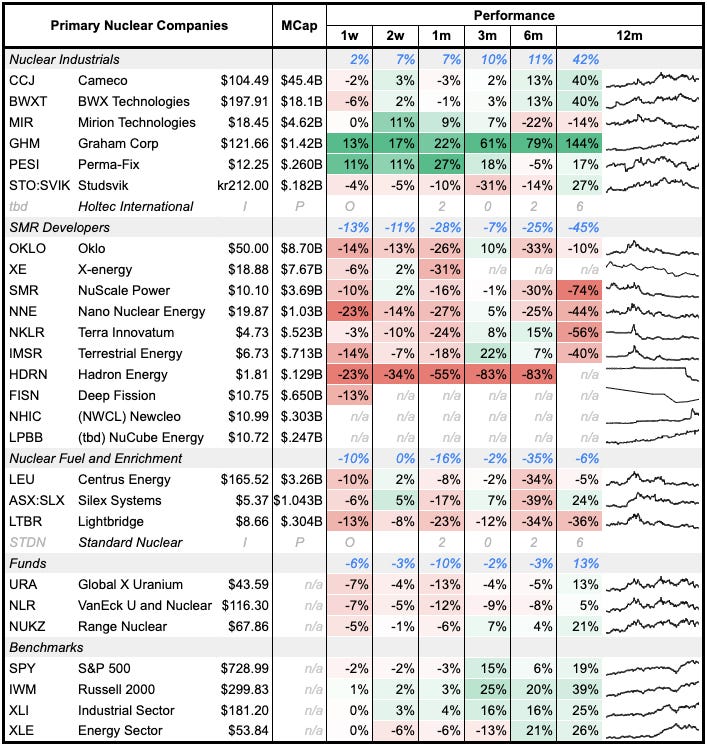
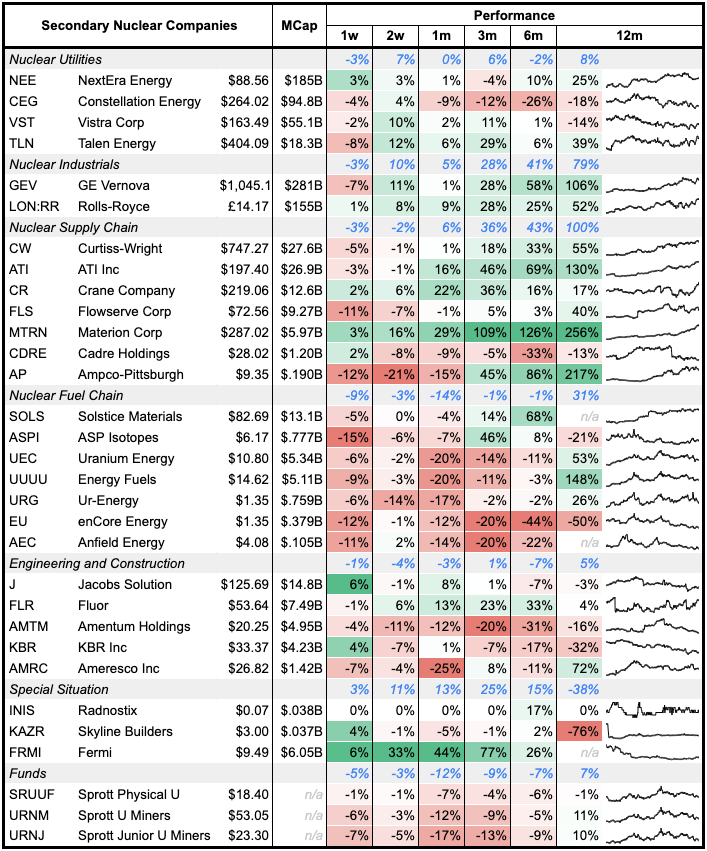

In an effort derived straight from the executive orders for reinvigorating the nuclear industrial base, the Department of Energy’s (DOE) Energy Dominance Financing (EDF) loan office has conditionally committed $17.5 billion in loans to support the construction of 10 Westinghouse AP1000 reactors. Social media saw this as a huge sign of support for other reactor developers including Oklo and NuScale, but clearly people didn’t read the announcement…
Here’s a quote from the comments made by Energy Secretary Chris Wright:
“these conditional loans will play an important role in reviving the supply chain needed for America to once again build large-scale commercial reactors. They will also help accelerate the timeline of building those large-scale reactors by up to three years”
This money is all about the supply chain for large reactors, it has nothing to do with financial support for SMR or microreactor development. Instead of supporting companies like Nano Nuclear, TerraPower, Antares, or Valar, this money is destined for companies like BWXT, Curtiss-Wright, Mirion, ATI, and multiple other Asian heavy manufacturing companies.
The $17.5 billion in loans will be used to finance five projects, each with two AP1000s. Westinghouse says they are going to partner with up to five eligible utilities or energy companies to procure long lead items for projects. The company also says they have signed letters of intent with seven potential partners with identified sites.
Remembering back to the new transatlantic nuclear partnership between the US and the UK, Holtec and EDF are working together to deploy Holtec’s SMR design in the UK. The companies are working to establish a joint venture and have submitted their proposal to the UK government for building SMR-300s at Cottam.
Alongside deployment projects being pursued by GE Vernova, TerraPower, Rolls-Royce, and X-energy, Holtec is working under the UK’s Advance Nuclear Framework, which is an accelerated nuclear technology deployment program.
Leaning into the existing grid infrastructure already located there, the planned development site is a former coal power station which will house up to four SMR-300s yielding approximately 1.3 GWe.
If you’re enjoying the content, please *like* and *restack*
Only takes about 3-5 seconds. Likes and restacks are the primary means of growing on Substack. Thanks for the help, and don’t forget to subscribe!
Paragon, a company that was recently acquired by Mirion Technologies, will be working to complete design development of their protection system for the NuScale Power Module (NPM). Three major systems will be completed by Paragon while NuScale continues procurement and manufacturing of some of the long lead items for their first 12 NPMs:
The Module Protection System (MPS) is a nuclear safety-related reactor protection system that safeguards each individual NPM
The Safety Display and Indication System (SDIS) is an augmented quality, post-accident monitoring system that provides operators with essential plant data in the event of an incident
The Plant Protection System (PPS) is a non-safety-related system responsible for control room habitability functions such as HVAC
Terra Innovatum is undergoing evaluations to increase the electrical output of their current SOLO reactor design. The company is working with Baker Hughes to potentially integrate things like advanced turbomachinery solutions such as supercritical CO2. The efficiency gains could lead to as much as 25% more electrical output per unit, increasing the capacity of their SOLO reactor from about 1 MWe to as much as 1.25 MWe.
Terrestrial has signed an agreement with Texas A&M for approximately 77 acres at the campus in Texas for developing their commercial Integral Molten Salt Reactor (IMSR) plant. The agreement follows an announcement from last year that involved the selection of multiple molten salt reactor developers for testing their designs at the school.
Some of the land at Texas A&M will also be utilized to progress the company’s TETRA and TEFLA programs under the DOE Reactor Pilot Program and DOE Fuel Line Pilot Program.
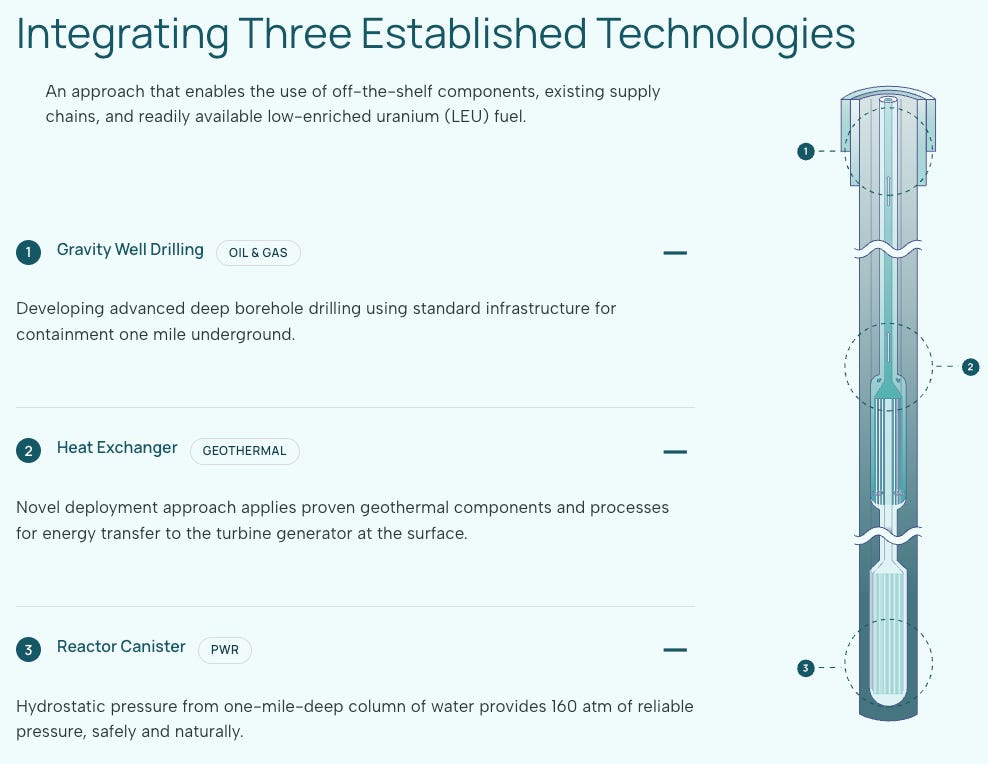
Deep Fission has announced that they have now signed letters of intent worth up to 18.5 GWe with “data centers, co-developers, industrial parks, and strategic partners”. With a reactor design rated to 15 MWe, this means they are potentially looking at the deployment of over 1200 reactors in various group sizings. CEO Liz Muller highlights this as a testament to the urgent interest in their mile-deep deployment model as the company advances its pilot project in Kansas under the DOE Reactor Pilot Program.
Side note - the company overhauled their website since going public and added some new graphics.
This headline was buried painfully deep below the news of the DOE Energy Dominance Financing loan office support plan for Westinghouse reactors. Constellation and Walmart made the announcement only an hour or two before news broke from the Wall Street Journal of the Westinghouse loan.
This is the first time a large retailer has signed a power purchase agreement from a nuclear energy facility in the US. Walmart has agreed to purchase about 176 MWe from the pair of boiling water reactors at Constellation’s Dresden Clean Energy Center in Illinois. The PPA is taking the form of two 15-year terms that begin in 2029 and 2030. The best part is the agreement will support the uprating of an additional 30 MWe from the site.
Walmart is purchasing the power to support their high-tech perishable distribution center under development in Belvidere, Illinois.
Vattenfall’s Videberg Kraft has selected Rolls-Royce over GE Vernova for deploying three reactors near the Ringhals site in Sweden. It’s a major win for both sides as Rolls-Royce has now won every technology competition that it has competed in across Europe, and Sweden will see its first new nuclear plant more than 40 years to the tune of 1500 MWe.
It can be a little confusing reading through the names that are probably new to most of our readers, so here’s a quick cheat sheet:
Videberg Kraft - Reactor development and operations company owned 20% by Vattenfall, 20% by Industrikraft, and 60% by the Swedish state. They will utilize the design from Rolls-Royce and orchestrate the construction of the three reactors.
Vattenfall - Sweden’s state-owned utility.
Industrikraft - Group of major industrial companies in Sweden that took a stake in the development of fossil-free electricity generation projects to show support for clean energy development.
Ringhals - Site on the Värö Peninsula that hosts two operating pressurized water reactors and is majority owned by Vattenfall. Adjacent to the deployment site for the Rolls-Royce reactors.
Things were starting to look a little sour for the National Energy Security theme when a few weeks ago the leading microreactor developer in the US, Antares, announced they would be purchasing enrichment services from UK facilities owned by Urenco.
While this isn’t a contract and instead just an LOI, it is good to see two American nuclear companies working towards keeping things in-house: Oklo intends to purchase enrichment services for HALEU fuel from Centrus to supply their reactors planned for deployment in Ohio. The Ohio project is part of the deal announced earlier this year between Oklo and Meta, where Oklo plans to deploy about 1.2 GWe to support data centers.
Oklo says the anticipated definitive contract will include enough HALEU for up to five Aurora reactors with deliveries beginning in 2029.
GE Vernova Hitachi Nuclear Energy (GVH) and Canadian manufacturing company Velan will be working together to expand support for the BWRX-300 in Europe. Velan supplies Reactor Integral Isolation Valves (RIIV) and Containment Isolation Valves (CIV) for the GVH reactor design. The companies are working together to expand the deployment of the BWRX-300 across Europe with the leading project in Poland, which is currently planning at least 24 of the boiling water SMRs.
Oklo and Standard Nuclear are going to be working on two major cooperation points when it comes to nuclear fuel:
Oklo’s fuel recycling facility will have a variety of byproducts, two of them being reprocessed uranium (RepU) and uranium-transuranic material (U/TRU). Standard Nuclear will look into utilizing these materials as feedstock for TRISO fuel manufacturing.
RepU is the uranium that can be separated from used nuclear fuel. It’s not as “clean” as uranium that was mined from the ground as it has extra isotopes (U-232/U-236) that make it behave differently.
U/TRU is a mix of uranium and other elements including neptunium, americium, and plutonium. This is one of the types of fuel fast reactors like Oklo’s Aurora can operate on, which cannot traditionally be used by thermal reactors like today’s commercial reactor fleet.
The second point of cooperation is the two companies working together on the DOE’s Surplus Plutonium Utilization Program. This isn’t to say that Standard Nuclear will produce plutonium fuel forms for Oklo’s Aurora reactors. This is more along the lines of the reason why Oklo is working with Lightbridge. When it comes to using plutonium, there’s going to be a lot of opportunities for synergy when it comes to the facilities that will be used to handle the material, the licensing that goes into the facility and the personnel involved, as well as the packaging and transportation of the material. The companies are looking to minimize regulatory and administrative burden.
In a very similar way that Oklo and Standard Nuclear will be working together, SHINE and newcleo have announced a partnership to recycle used nuclear fuel and fabricate it for use in fast reactors. The major difference here is SHINE and newcleo will work to close the fuel cycle and create a loop of of materials between the two companies:
newcleo will provide used nuclear fuel to SHINE
SHINE will recycle and reprocess the material and provide it back to newcleo
newcleo will then fabricate the fuel for use in its lead-cooled fast reactors.
Lightbridge completed a round of testing of their novel reactor fuel design in the Advanced Test Reactor (ATR) at Idaho National Lab (INL). A fuel material sample has been irradiated in the ATR and has been successfully removed. It’ll spend the next few months going down.
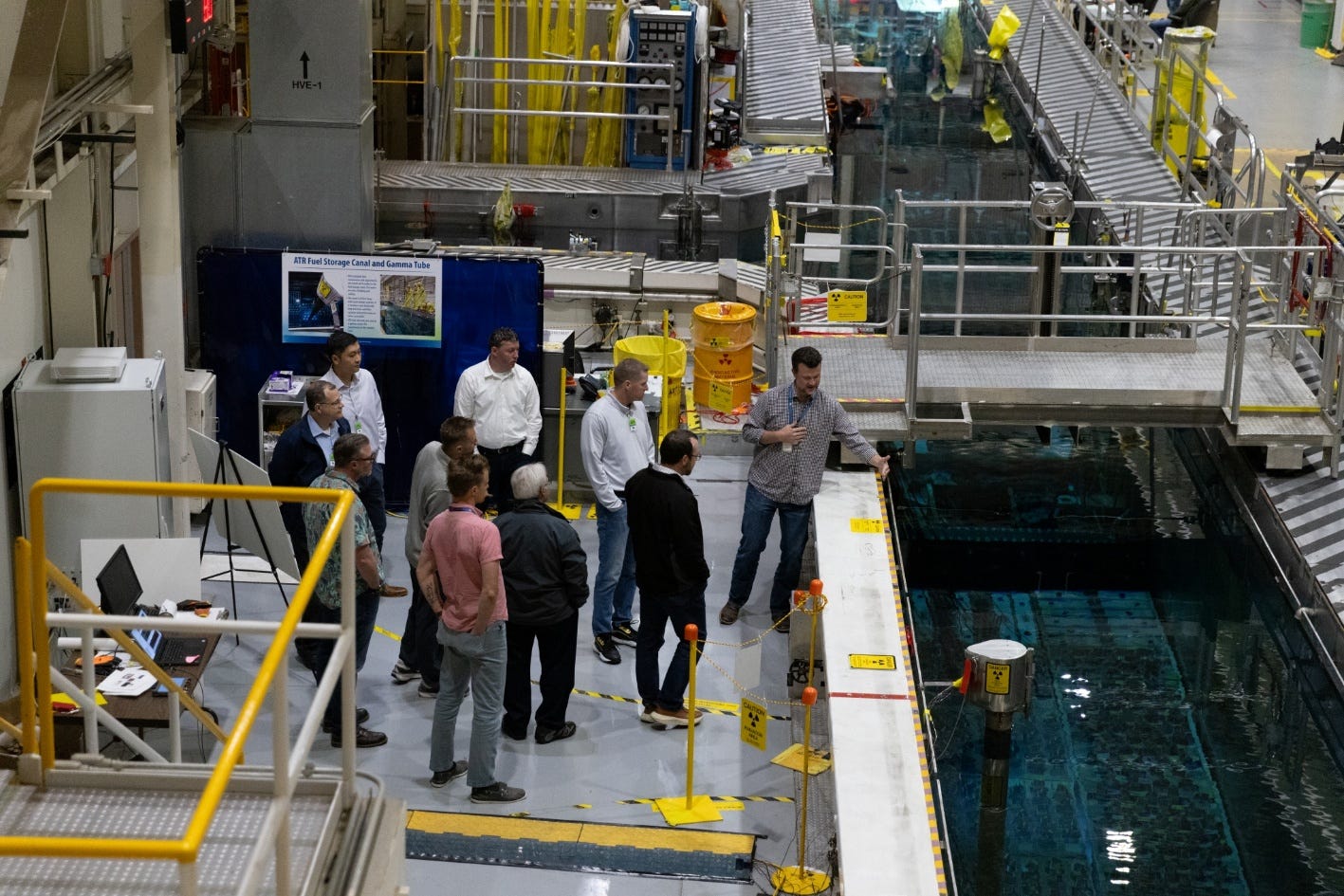
Lightbridge’s CEO notes the data that will be collected after the cooldown period will be used “to support our ongoing fuel performance modeling activities and regulatory licensing efforts for commercial deployment of Lightbridge Fuel.”
Rolls-Royce will be opening a non-nuclear facility in In the UK for establishing build processes, precision assembly, and advanced testing. The facility will support their SMR programs across the UK, Czechia, and Sweden, with an open date set for later this year.
The nuclear fuel chain is finally seeing some new representation as Standard Nuclear has announced their intention to go public via an IPO later this year.

Standard Nuclear is a reactor-agnostic producer of TRISO fuel with plans to expand into radioisotope power. The company’s roots are founded in the now-defunct UltraSafe Nuclear Co, which went bankrupt in 2024. The bankruptcy saw the reactor development assets sold to NANO Nuclear and the fuel production assets sold to Standard Nuclear.
Standard is involved in the DOE Fuel Line Pilot Program, which is a pathway to allow for rapid iteration of their manufacturing processes to expand domestic production capabilities for advanced reactor fuel. Their first notable reactor deployment support is with Radiant, which is looking to start up their first gas-cooled reactor at the INL DOME this summer. The company is also working under the recently announced plutonium utilization program and announced a partnership with Oklo to further prepare for plutonium handling operations.
Their most direct competition in the TRISO production space is BWXT, which has been producing the advanced fuel in cooperation with the DOD/DOE for years. Additional competition includes X-energy and Kairos Power.
The IPO terms are still very preliminary. Standard Nuclear publicly filed an S-1 registration statement for a proposed initial public offering of common stock, but the number of shares, price range, valuation, and expected proceeds have not yet been disclosed. The company intends to list on the NYSE under the ticker STDN.
If you’re enjoying the content, please *like* and *restack*
Only takes about 3-5 seconds. Likes and restacks are the primary means of growing on Substack. Thanks for the help, and don’t forget to subscribe!
Another player joins the fray as the public reactor development space finally hits double digits!
NuCube is one of the newest reactor developers in the industry and is working toward the commercialization of their NuSun platform, which is a heat pipe cooled, solid state reactor similar to designs being developed by Antares and Westinghouse. The reactor design comes in a couple different versions with one design at just over 1 MWe and another at 15 MWe.
The company is involved in one of the latest federal nuclear support programs, the DOE Nuclear Energy Launch Pad. Other DOE launch pad peers include Radiant, which is likely going to turn on their first reactor at INL within the next month or two, and Deployable Energy which looks to take their pilot reactor critical before July 4th.
Under the announced SPAC transaction, NuCube will combine with Launch Two Acquisition Corp which trades on Nasdaq under LPBB. The deal assigns NuCube an equity value of about $500 million. The transaction is expected to provide up to roughly $125 million of gross proceeds, consisting of an assumed $75 million plus about $50 million of SPAC trust cash after redemptions.
The title can be a little deceiving at first glance: The construction permit application (CPA) for the BWRX-300 reactor planned for construction in Tennessee has received a Safety Evaluation from the NRC staff. Since Safety Evaluation is NRC-speak for approval, this means the CPA is approved and ready for issue, right?
Not quite. This was more of an internal review stage that has reached its completion. The NRC staff, meaning the nerds in the back room, have completed the evaluation of the technical aspects of the reactor construction project - things like the reactor design and safety analyses. This was completed in addition to the independent review conducted by the Advisory Committee on Reactor Safeguards. Before the actual issuance of the construction permit there needs to be some additional steps including mandatory hearings.
Once the hearings are done and comments addressed, and the entire package with all of its interim approvals and assessments are taken in by the NRC Commission, the construction permit can actually be provided to the TVA. Final approval is still expected before the end of the year.
Hadron has received a patent for their integral reactor design. The concept features one large pressure vessel containing the reactor core, steam generator, pressurizer, and primary coolant system. The design is actually extremely similar to BWXT’s mPower reactor that was shelved years ago but brought back earlier this month for land and sea applications.
The difference between Hadron and BWXT is Hadron is working towards a significantly smaller electrical output of 10 MWe compared to BWXT’s almost 200 MWe. This does bring a concern: it’s hard to imagine the Hadron design will be able to compensate for the 95% reduction in revenue generation per reactor without a similarly high reduction in manufacturing costs.
This is also not a problem that is unique to Hadron, as it is a similar headache faced by all of the microreactor developers. The companies have all taken a similar stance that dramatic reductions in manufacturing costs will come from high volume production to compensate for the loss of economies of scale (big reactors).
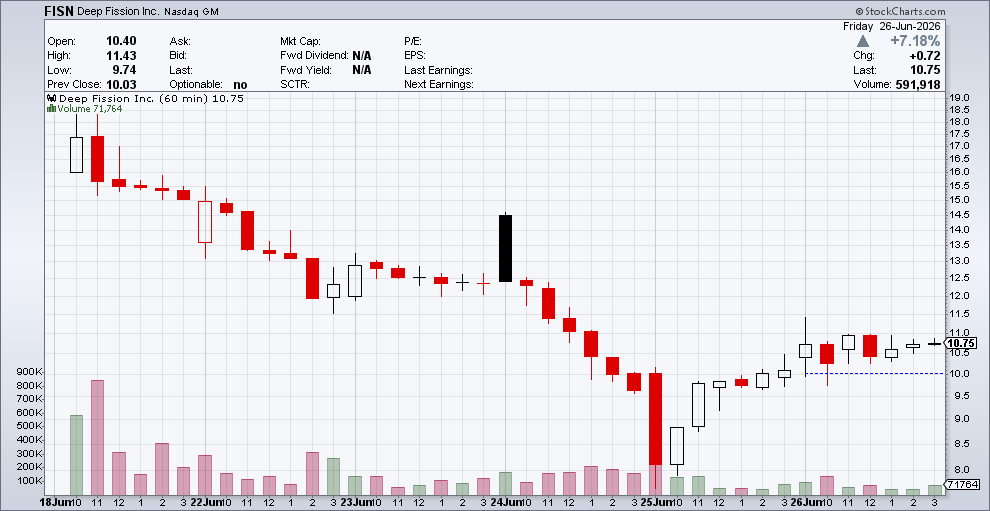
Deep Fission has finally hit the open market! The company started trading on the 18th just before the long weekend at $16 per share. Similar to the price action of most of the reactor developers, the share price quickly cratered after opening day and traded under $8 just a few days later. Price has rebounded somewhat since the announcement of the 18+ GWe customer pipeline and now trades just below $11.
Constellation is following in the footsteps of every single reactor owner in the country by requesting permission from the NRC to extend operations of their plants. The company is requesting a 20-year extension for the Ginna Clean Energy Center and Nine Mile Point Unit 1 reactors in New York. The company is posturing the move as a demonstration that “New York State's renewal of its Zero Emissions Credit (ZEC) program is working as intended.”
The company provided some pretty significant numbers to argue their case:
“Renewal of the ZEC program is projected to deliver $50 billion in ratepayer savings by 2050, contribute $38 billion to New York’s economy, secure 14,000 good-paying, local jobs for decades to come, and preserve $10 billion in tax revenue for the state.“
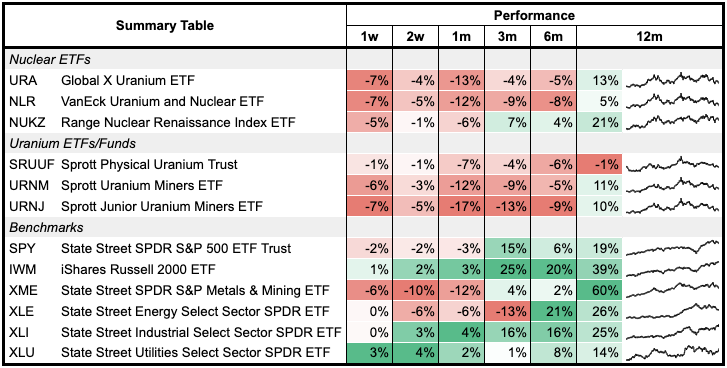
Volatility always comes for the gains in the end.
It appears recent weeks have proven the effectiveness of balancing out the extremely high-beta momentum of the nuclear and uranium mining industry with the steadier foundation provided by industrial and utility companies. The difference in the subsectors within the nuclear ETFs can be seen to some extent by the comparison of XME versus XLI and XLU.
Something to keep in mind as well is South Korean exposure within the three nuclear ETFs. URA has the highest in the low teens, followed by NUKZ around 10%, and NLR comes in at the lowest exposure in the low single digits. There has been significant turmoil in the Asian market over the past month, which has certainly affected URA and NUKZ.
NLR has noticeably lagged behind its two peers. This has to do with two factors: (1) their higher utility exposure and (2) their concentrated portfolio, which results in a “picking winners“ effect. By picking winners, we mean with their concentrated exposure in the different parts of the fuel chain and reactor operations environment, if the very few names they have picked turn out to not be involved in the various ongoing federal support programs, or experience particularly large temporary pullbacks, NLR is going to have outsized suffering compared to URA and NUKZ, which cast much wider nets.
Comments
Nothing yet. Say the first thing.
Sign in to join the conversation.