
Today’s market action suggests that the All AI, All The Time Regime is back in force, big time. In the financial markets, at least. In the Tinkerer Do It Yourself Universe there is a parallel reality unfolding: Cheap Chinese Models, Open Source Weights, Dedicated Hardware Devices and AI Self Hosting Models are all converging for a simultaneous assault on overpriced, overstaffed, and overpaid Frontier Model AI Dinosaurs along with their Suppliers and Creditors.

My personal favorite new arrival this month is a open source release on GitHub called the Colibri Inference Engine—a tiny program written in the C Programming Language that that runs massive Mixture-of-Experts (MoE) models like GLM-5.2 (744 billion parameters) on standard consumer hardware using only ~25 GB of RAM.
Needless to say, AI “Power Users” are smugly putting this inference engine down because of its Downright Glacial Performance (it takes seconds to generate each token, as opposed to the usual speed of tokens per second). What the “Power Users on Reddit and other pseudo-technical sites are missing is the fact that Colibri matches the output exactly of the larger models running on faster hardware.
The second most important rule of software (after If It’s Not Tested It’s Busted) is this: FIRST GET IT RIGHT, THEN GET IT FAST.
The Colibri Author (just one guy, not a team) nailed this very important requirement. Eyeballing the code, there are a number of optimizations that can massively improve performance in a very short period of time. Based on my brief, 15 minute code review, it appears that the author uses a smart Disk+RAM caching system to keep the most frequently used components in memory and to minimize disk thrashing. One obvious optimization would be to analyze the contiguous and non-contiguous memory blocks (in RAM and on disk) and reorder them so that most commonly used blocks lie close to each other in memory space. The data is exactly the same but the memory locations are remapped, and the optimized memory locations written to disk. This optimization burns I/O in the short term (and reduces the life of the SSD disks) but in the intermediate term the speed up should more than make up for it.
This kind of optimization does not show up in most performance profilers so it is a good place to start if you are one of our many highly technical readers.
What does this mean for options traders? If we look at the price movement of Neoclouds like CoreWeave we see a 50% bounce off the bottom in a very short period of time.
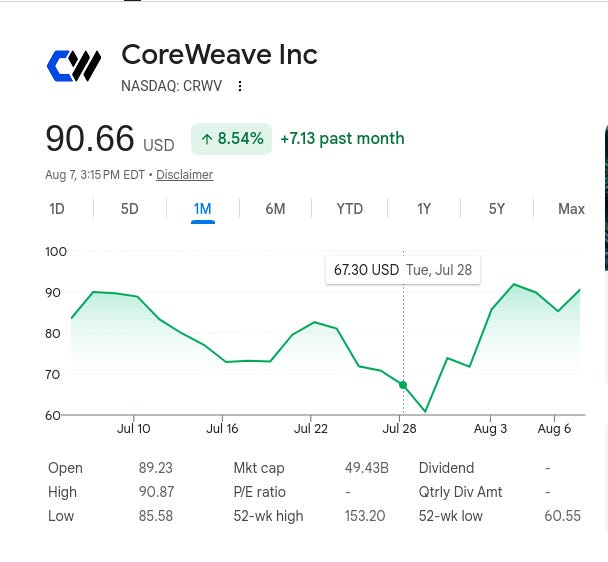
This suggests that it is too soon to trade on all the valuable information on the AI Bust we have been stockpiling. In Options Trading, Being Correct But Early Is The Same As Being Wrong. In this case, waiting for an entry point is a smart way to conserve capital for the Big Move Down.
Postscript: Several of our Nuclear Option Readers wrote in to say that they have extra servers with 512G to 1T of RAM and were contemplating selling the RAM on Ebay for much more than what they paid for the entire server back when RAM was still reasonably priced. The benchmarks for Colibri show that it runs a lot faster on these RAM heavy HFT Machines. This might be a better use of the hardware instead of selling the RAM for a quick profit.
Disclaimer : All Content on the Nuclear Option Substack is for Education and Information Purposes only. It is not a solicitation or recommendation to buy or sell any security. Before trading, consult with your Professional Financial Advisor and read the booklet Characteristics and Risks of Standardized Options Contracts, available from the Options Clearing Corporation.
No posts
Comments
Nothing yet. Say the first thing.
Sign in to join the conversation.