
Green circle = indicator has moved in a positive direction
MoM change = month-over-month change

I would much appreciate it if you could hit the like ❤️ button!
It helps more people discover Nuance Matters and is a cost-free way to let me know you appreciate the work!
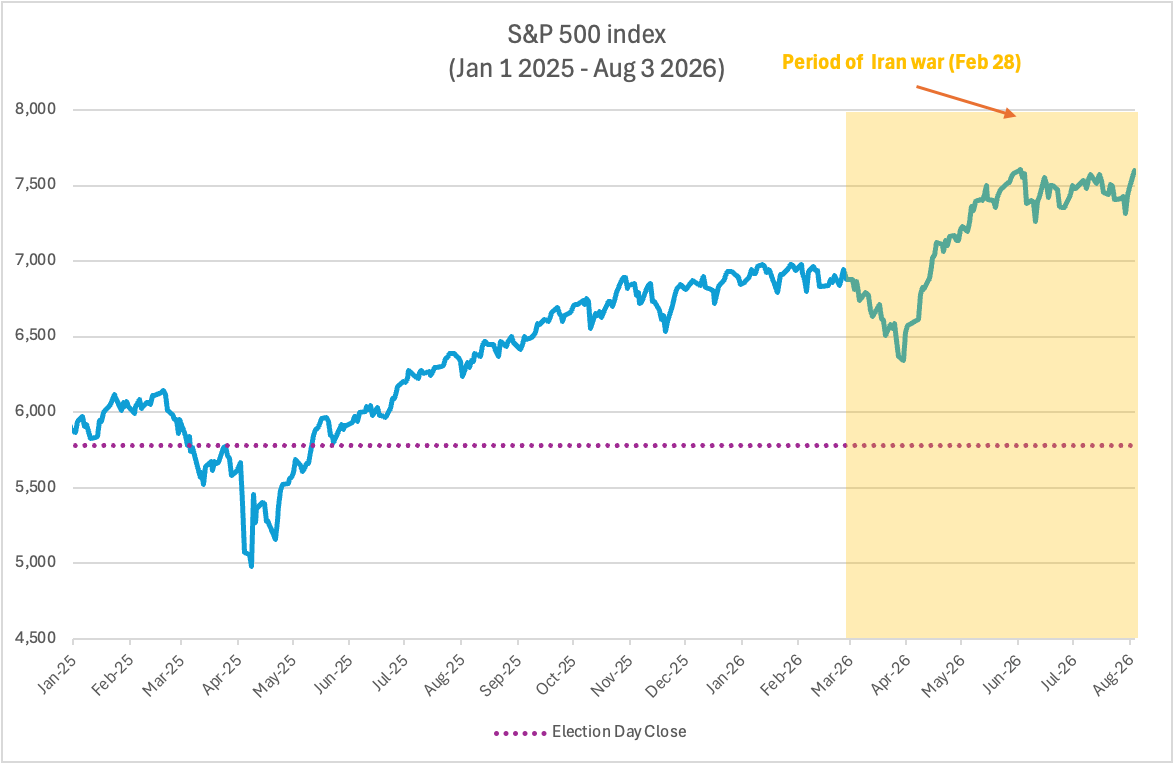
Monthly (June 1- Aug 3) return: 0.27% 🟢
2025 return: 16.39% 🟢
2026 YTD return: 11.03% 🟢
Post-election return: 31.43% 🟢
Data source for all charts herein: Marketwatch
***********************************************************************
Despite a tough June, US markets ended the first half of 2026 on a relative high. Even through the famed Magnificent Seven tech stocks lost over $2.2bn in market value in June, Q2’26 was the best quarter for the blue chip S&P 500 and the tech-heavy NASDAQ since Q2’20 when stocks were recovering from the initial pandemic blues.
Things were a bit more touch and and go in July, when a lot of companies reported earnings for Q2. We’ll touch on some of these developments below but broadly speaking, American companies are doing pretty well at the moment. Indeed, per a Financial Times analysis of data from FactSet, close to 90% of the companies listed on the S&P 500 have beat their earnings forecasts. And, despite the headwinds of the Iran War, companies are growing at the fastest rate since 2021.
Part of this is run-off from the boom in AI-related capital expenditure. One example of this is banks, have capitalized on this moment to finance the investment drive and are seeing revenue soar.
Big Oil has also done well, thanks to surging gas prices caused by the war. Even Trump seems conscious of how this looks though, telling reporters on Monday, “They’re making too much money based on a shortage…I don’t like it.”
But despite this widespread profitability, investors showed signs of trepidation, largely due to the AI-trade.
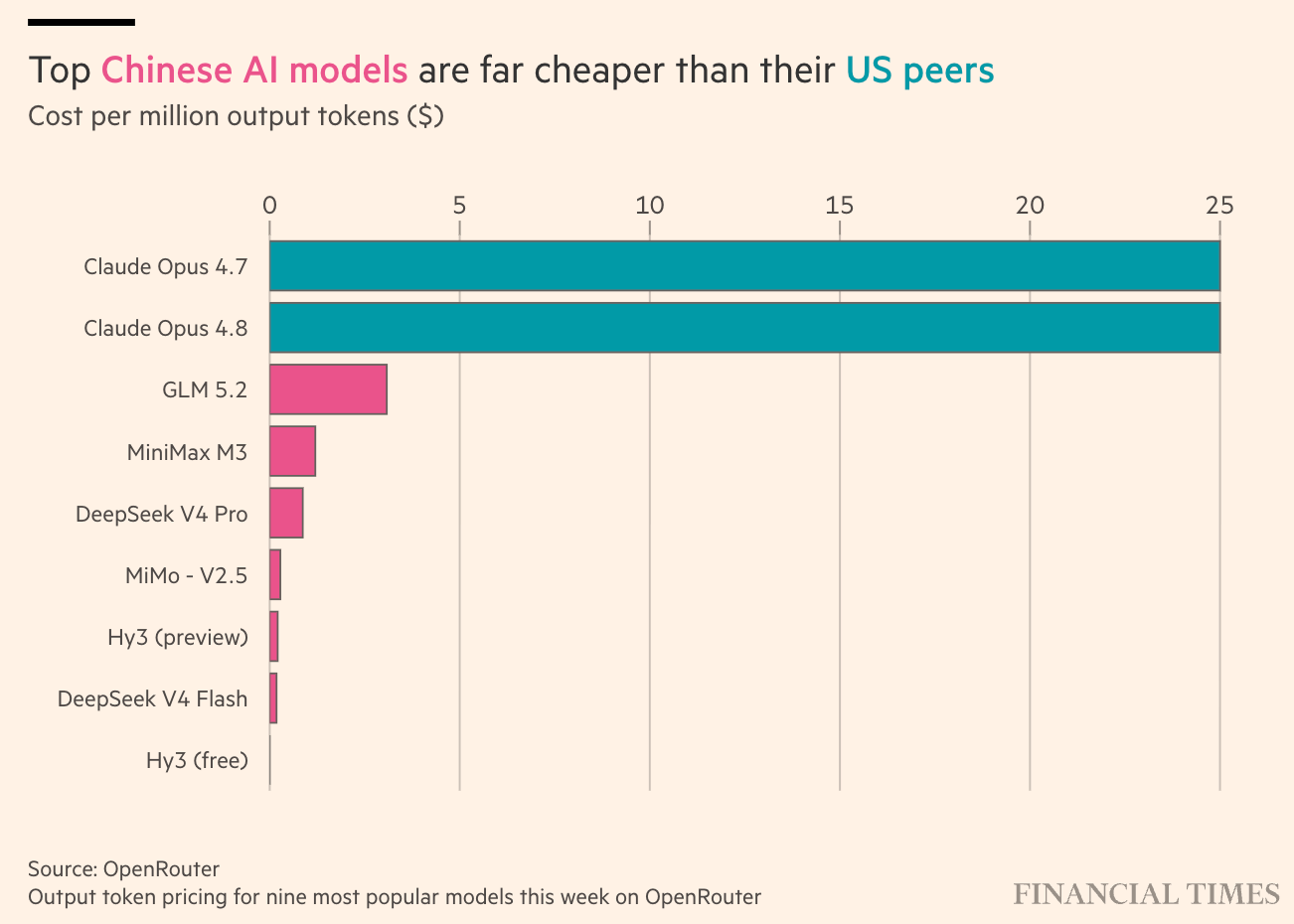
There are a few issues coming to a head here. Is AI increasing workplace productivity? It’s probably too early to tell, though displacing incumbent technologies and processes is tricky. More importantly, right now the dominant issue is the cost of using these models. It is getting more expensive to deploy AI models built by the US firms (e.g., Open AI’s ChatGPT, Anthropic’s Claude). With costs per token climbing, some businesses are asking employees to scale back their use of AI, prioritizing value-add rather than simply ‘using AI for the sake of it.’
Consequentially, Chinese AI firms have been releasing new models (Moonshot’s Kimi K3, released in mid-July, being the latest to capture the spotlight). These models might not be as good as the best available Claude or ChatGPT models, but they are inching ever closer AND cost a lot less to use.1
Think of OpenAI and Anthropic like Uber, Netflix, or any other recent tech innovation. The product was originally offered to the consumer at a relative discount, an effort to gin up interest and accrue market share. During this phase, the company or its backers eat the cost with the understanding that this is all an investment toward long-term sustainable success. Once they have enough penetration and visibility in the market, shareholders start demanding the company turn a profit, and the price goes up.
For a company like Uber, with few alternatives, or Netflix that has ‘become TV,’ they can more or less get away with it. But if there are a dozen different AI models that all perform within relative parity of each other, you are going to use the one that costs less. AI models just become another commodity.
The commoditization of AI models might be good for the user, but would be bad news for the more expensive versions, which are under pressure to start monetizing all of their vast capital outlays from the past few quarters. And for investors in the US markets, that means the Big Tech firms.
The hyperscalers (Alphabet, Amazon, Meta, and Microsoft (+ Oracle)) have already spent over a trillion dollars on data centers in recent years.2 And with all of this spend, coupled with the recent announcements about Chinese models doing well, investors have been getting a wee-bit nervous. They want to see some return on investment in the form of revenue (preferably profit, of course). Investors saw some of that in Q2 earnings, with cloud-based revenue from Microsoft (Azure) and Amazon (Amazon Web Services) soaring.
But notably, the hyperscalers’ remaining performance obligation from customers (the revenue they expect to earn from contracts with customers) is currently over $2tn, mostly from OpenAI and Anthropic. If these two AI models don’t have the customer base, they won’t be able to generate the revenue to funnel back to the hyperscalers.
Of course, the same accusation about profitability could just as easily be lobbed at the Chinese firms, which are also not yet profitable. But will the CCP care as much about profitability as shareholders in Alphabet and Amazon?
AI hyperscalers (the Big Tech firms that have invested heavily in the AI boom)
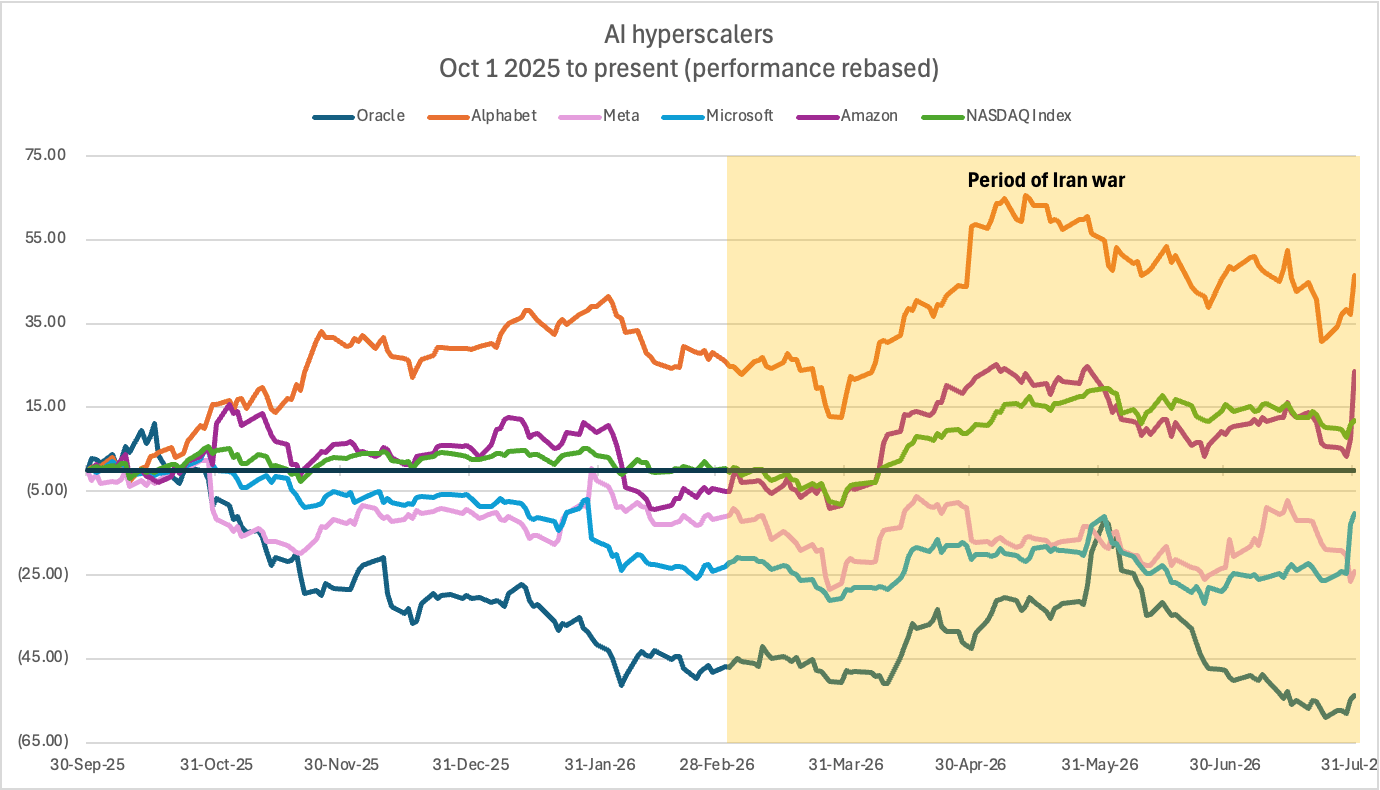
Alphabet (aka Google) (YTD ⬆️ 19%) stands as the best performing hyperscaler of the moment, at least in part because it is more easily able to monetize its AI through embedding in Google search, but it skid last month when the company announced it had negative free cash flow in Q2 (-$5.9bn). Free cash flow (FCF) is a metric used to show how much cash a company has after expenses and capital expenditures. Last quarter marked the first time Alphabet’s FCF turned negative, a clear sign its AI-heavy spending is weighing on the business.
AI adjacents (tech firms whose fortunes are directly tied to AI):
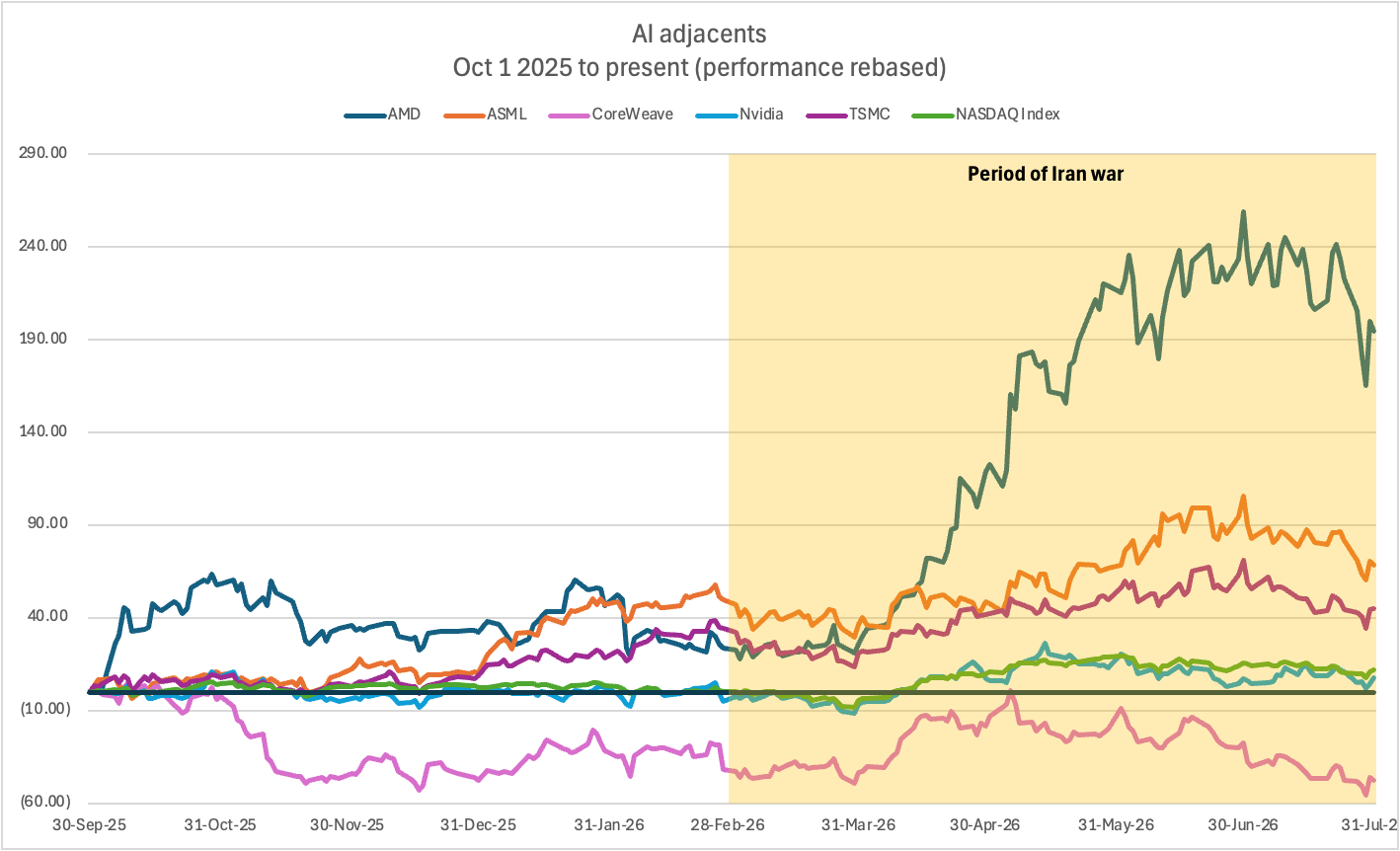
TSMC (YTD ⬆️ 27%), after it announced a 77% increase in profits, said it would invest an additional $100bn in the US to expand chip production.
Nvidia (YTD ⬆️ 11%) meanwhile continues to enter into contracts that make investors nervous about possible circular financing arrangements. The latest came last month when the GPU chip company announced it was signing contracts worth up to $50bn at a data center in Texas, which operates with hundreds of thousands of Nvidia’s chips, to lease space to customers.
Memory chip makers (companies that supply DRAM memory chips essential to the tech build-out)
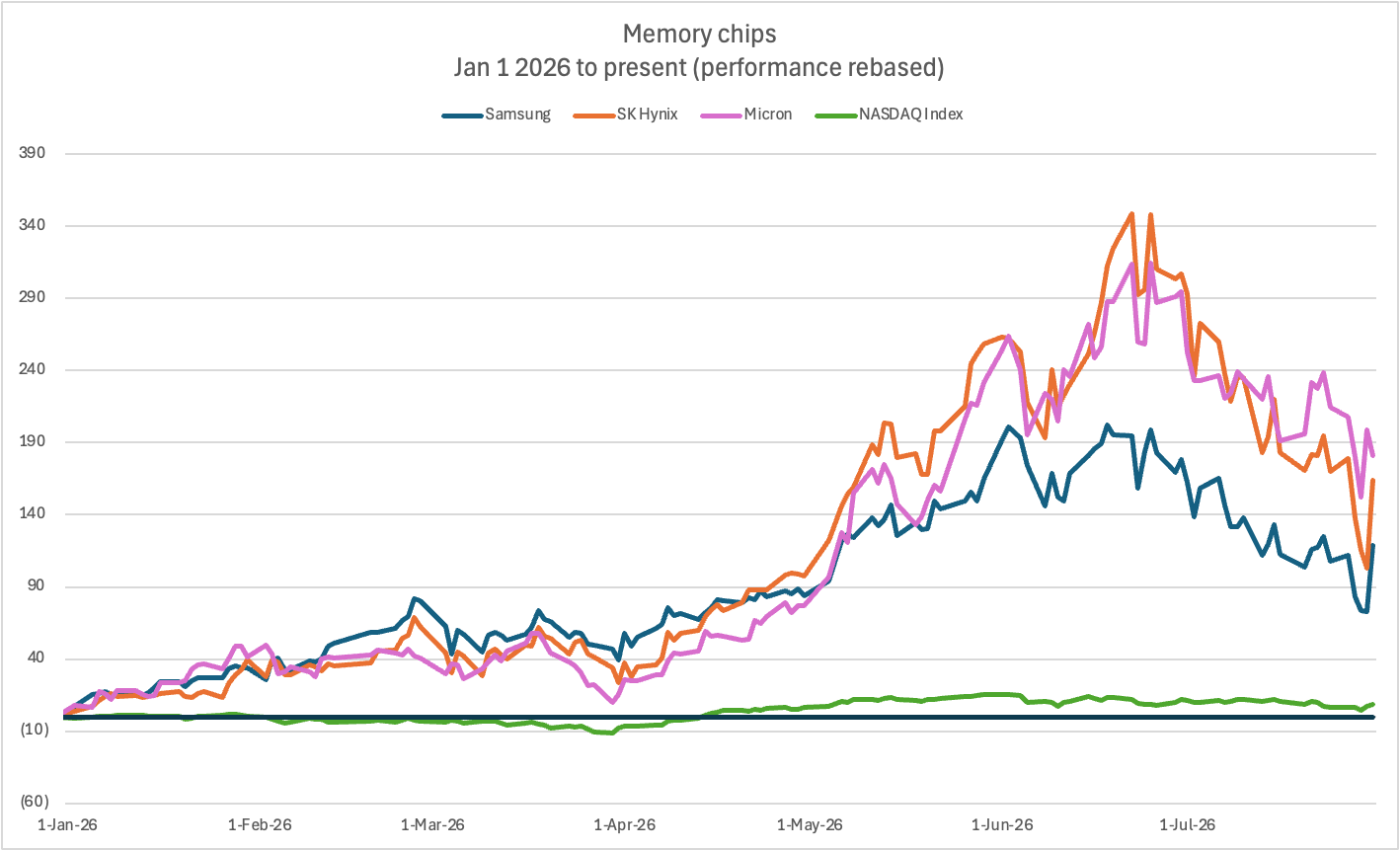
Just how ridiculous has their year been?
For the most recent quarterly earnings, fellow US firm Micron (YTD ⬆️ 191%) reported revenue of $41.5bn and net income of $28.2bn…compared to $9.3bn and $1.9bn, respectively, in the same period in 2025. Micron’s quarterly profit increased year-over-year by close to 15x! At one point in the last week of June, Micron’s share price was up over 300% in 2026.
It has not been all sunshine and rainbows though. Like the hyperscalers and AI-adjacents, the memory chip firms suffered in July over fears that the AI hype might be growing too hot.
Memory chip makers are also dealing with a more quotidian fear: supply shortages! Similar to other commodities, memory chips are known for going through boom-bust cycles. Recent reports suggest we’ll be short memory chips through at least the end of 2027.
To head this off, in June the two Korean giants (Samsung (YTD ⬆️ 99.75%) and SK Hynix (YTD ⬆️ 141%)) announced, in conjunction with the Korean government, plans to invest $600bn in additional chipmaking plants, but these will take years before they are operational. These plans will do little to address the current strains on supply, and might ultimately lead to future years of oversupply as demand slows. The oversupply/undersupply cycle will continue.
While it is clear that as the hyperscalers invest more in data centers we are in the midst of a massive run on chips, this is having a knock-on effect downstream. Consumer products that need memory chips are getting boxed out and companies (when they can get the chips) are forced to pay higher prices which feeds into the price charged to the consumer.
Case in point: Apple announced in June that it would increase the price of MacBooks and iPads by 20% to compensate for the rise in memory cost. The shortage in available DRAM memory chips has led Apple to explore linking up with China’s CXMT, much to the dismay of the Trump administration.
CXMT, China’s main producer of DRAM memory chips, went public last Monday (July 27) in Shanghai, and the market went rabid, surging over 400% in the company’s first day of trading (at one point, the company’s price-to-earnings ratio was over 1,600).
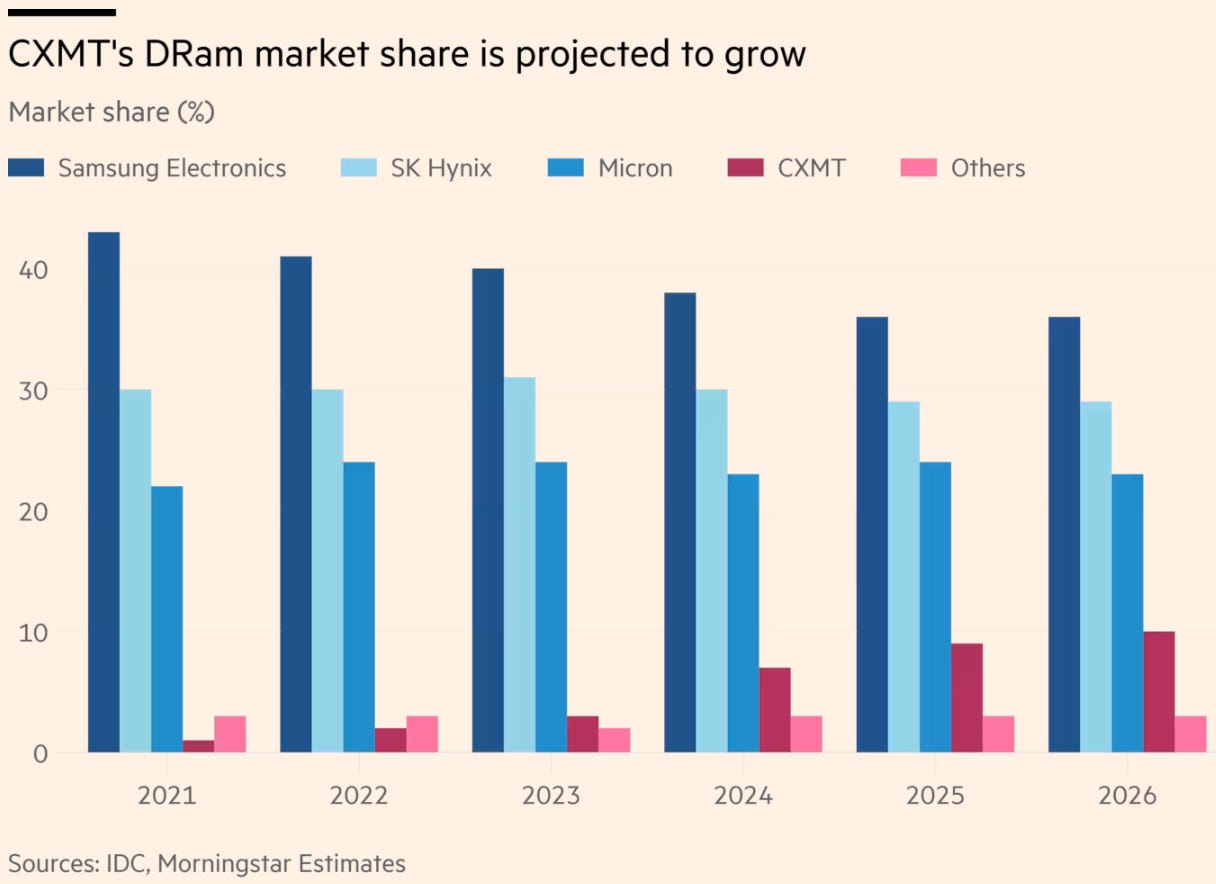
If these Korean firms lose market share and their pricing leverage to China’s CXMT, they could be stuck. It might not be an immediate problem, CXMT can’t produce at the same scale or quality as these firms (or Micron) yet, but history tells us that it may only be a matter of time before the Chinese firm catches up to the incumbent.
International markets (comparing the US’s performance to other global indices)
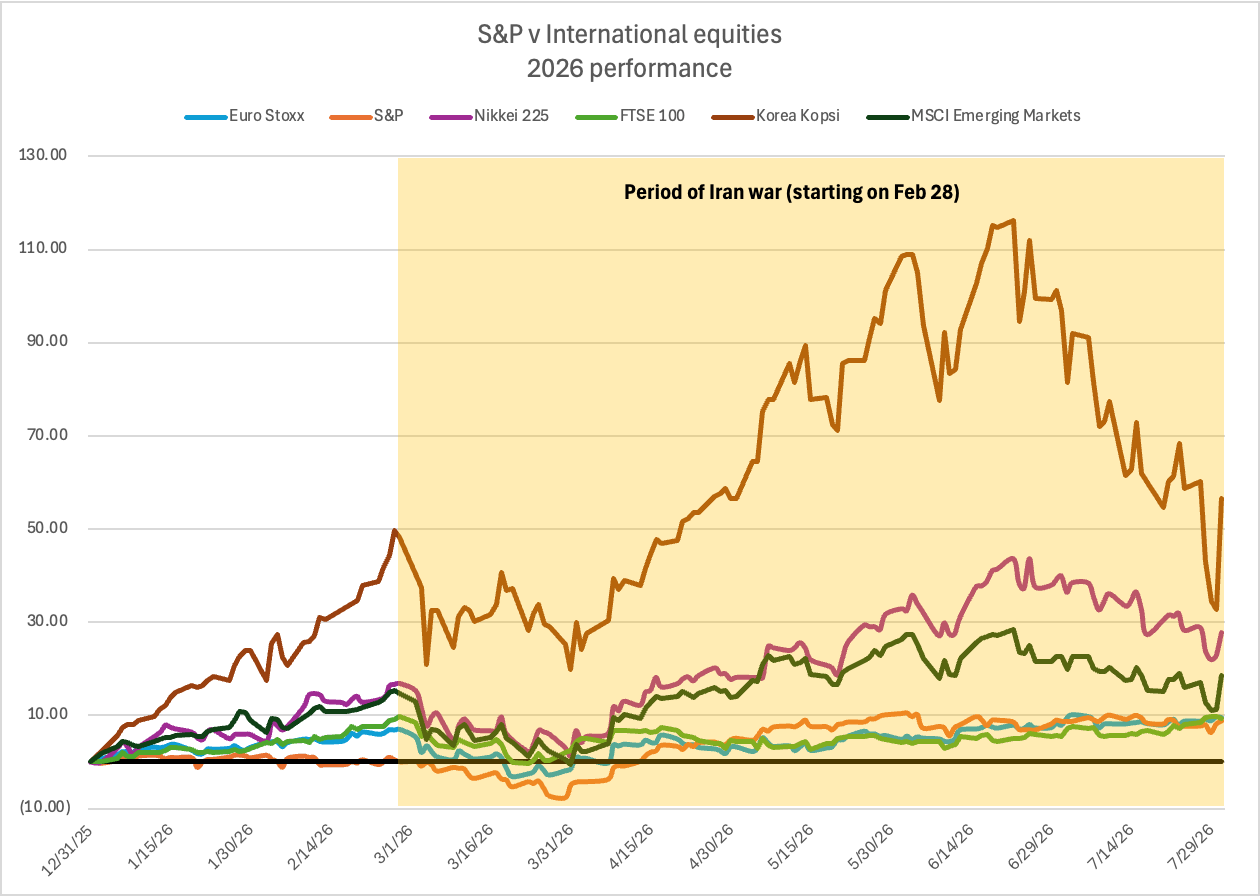
Korean 🇰🇷 Kopsi: Together, Samsung and SK Hynix, Korea’s two memory chip giants, represent over 50% of the market cap! And if you the fluctuations in US markets give you heart palpitations, the Korean Kopsi will give you a heart attack. Because the Korean market is dictated largely by investor sentiment in these two companies, investors spent June and July whipsawing through a series of ups-downs, which left some retail investors in Korea spooked.
Precious metals (gold and silver)
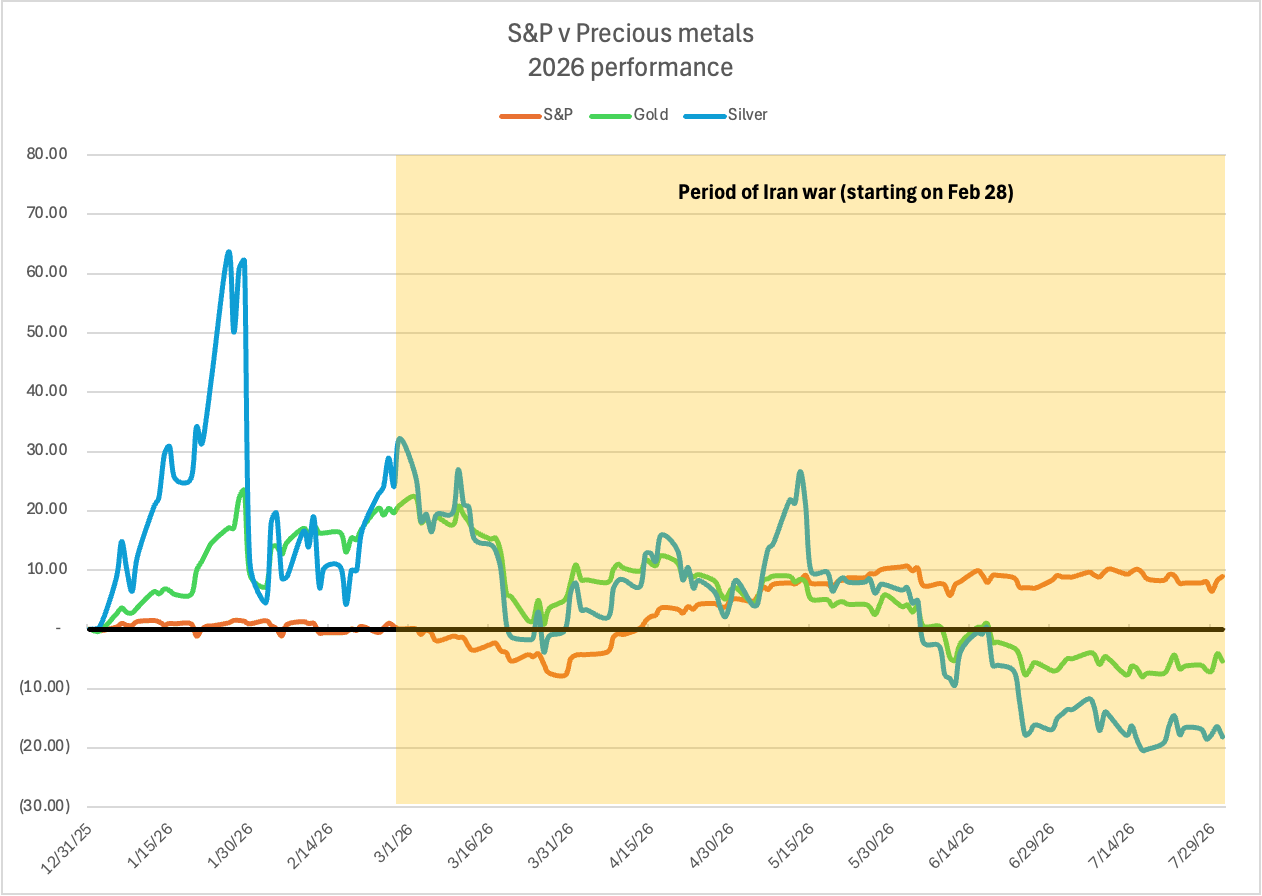
On the back of expectations for more persistent inflation, higher interest rates, and a stronger dollar (which gold is priced in), the precious medal has struggled since the war began. Indeed, Q2’26 was gold’s worst performing quarter in over a decade! It recovered a bit in July, but is still in the red for the year (and well below the S&P).
SpaceX (Elon Musk’s space exploration company that went public in June)
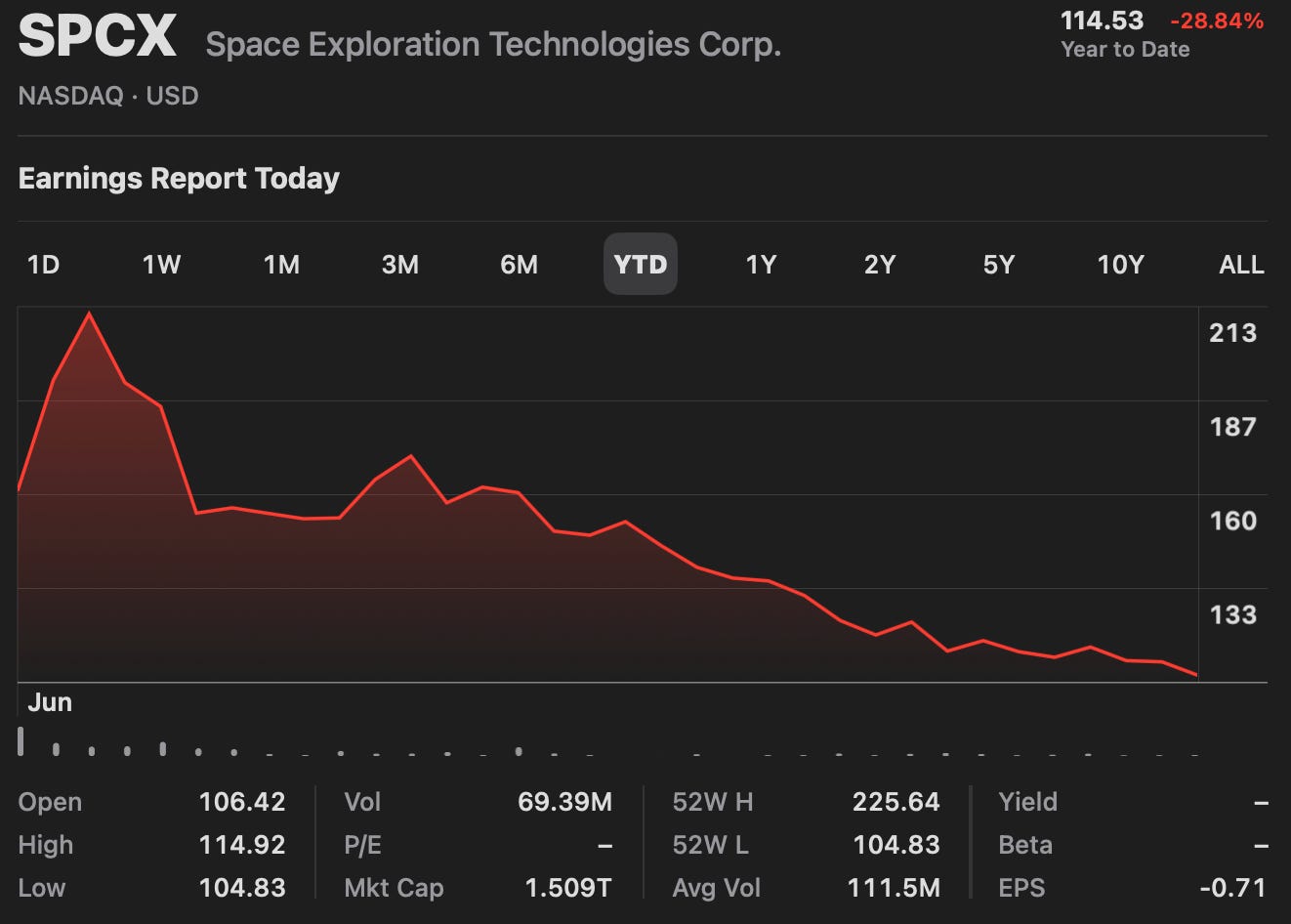
After starting out like a rocket ship headed straight for the moon, Musk’s loss-making space conglomerate has plunged back to the Earth in a major way (down 46% from its high on June 16).
If you enjoyed this edition of Nuance Matters, consider letting me know by buying me a cup of coffee!
Cheers!
Chinese models are also open-weight, which means the underlying architecture of the system is public and users can download to their local server and customize as necessary. Conversely, ChatGPT and Claude are closed models, meaning user have to use as designed.
Per Goldman Sachs, the big four hyperscalers (Alphabet, Amazon, Meta, and Microsoft) are planning to spend over $5 TRILLION through 2030.
Comments
Nothing yet. Say the first thing.
Sign in to join the conversation.