

Green circle = indicator has moved in a positive direction
Red circle = indicator has moved in a negative direction
MoM change = month-over-month change
I would much appreciate it if you could hit the like ❤️ button!
It helps more people discover Nuance Matters and is a cost-free way to let me know you appreciate the work!
Federal funds rate (Per most recent Federal Open Markets Committee meeting held on July 29): 3.63% 🟡
Consumer Price Index, all items (June 2026, released on July 14): 3.5% 🟢
CPI, less food and energy (June 2026, released on July 14): 2.6% 🟢
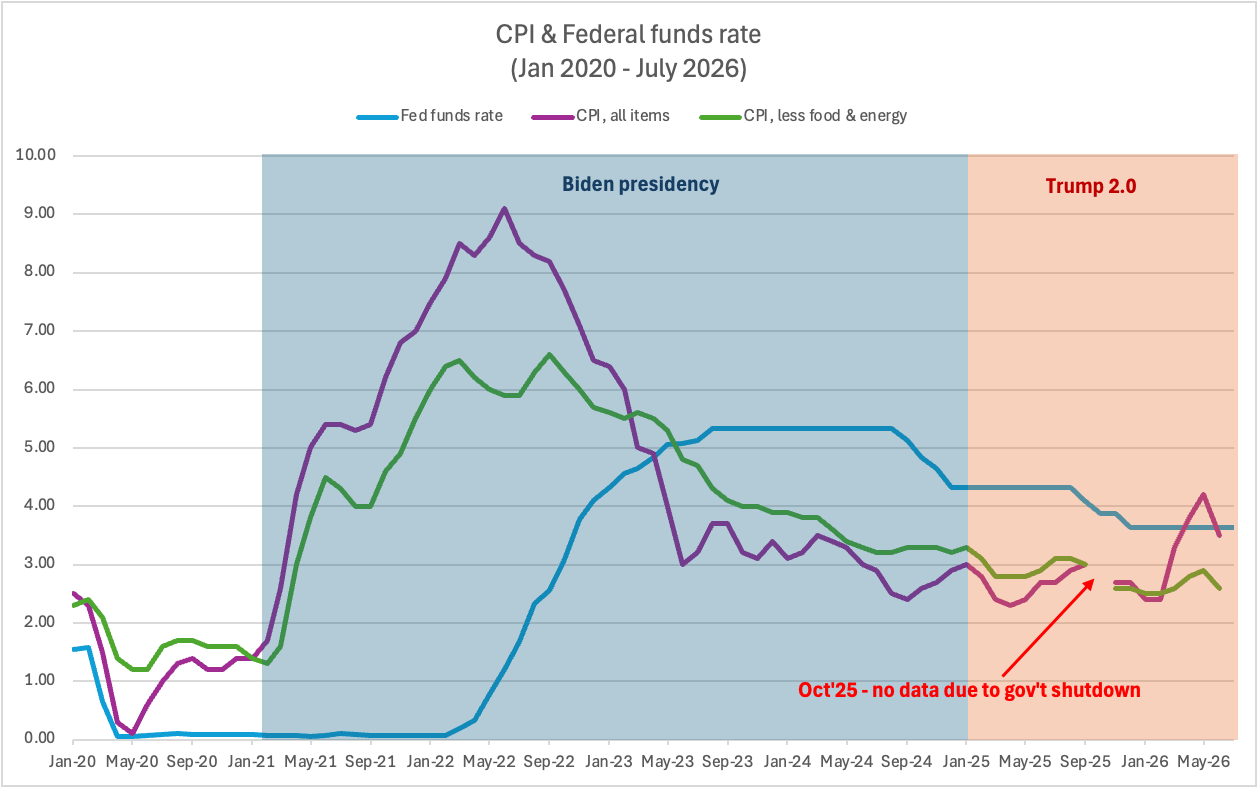
Source: Federal Reserve, St. Louis Fed & US Bureau of Labor Statistics
***********************************************************************
Inflation fell in June, at least in part because the Memorandum of Understanding had been agreed between the White House and Tehran and so the Iran war was in a bit of a holding pattern, bringing the price of oil down.1
With this in mind, the Fed met last Wed (July 29) and voted to hold rates steady, though three dissenters voted to raise interest rates (because, despite the fall, inflation remains above the Fed’s target of 2%).
This was more or less the expected outcome (investors had pegged the likelihood of a Fed rate hike at ~30%). But what really drew attention were the comments made by recently appointed Fed Chair Kevin Warsh at the subsequent press conference.
Since Trump originally nominated him as Fed Chair a few months back, Warsh has indicated he would prefer a less interventionist Fed and would no longer offer forward guidance to the markets.
And thus far, Warsh has stuck to the plan.
When he stepped up to the podium, Warsh made it clear the Fed was committed to bringing inflation down to 2%. “Where necessary and appropriate, we will not hesitate to act” to beat back inflation. But he didn’t elaborate on what conditions would elicit a Fed response, nor did he indicate how the Fed would act.
Rather, he focused his remarks on the market moves during the intervening period between Fed meetings. As Warsh explained “market attention centered on real data and real economic development” and “learning to play the ball, not the referee, and market prices will continue to respond in the direction and magnitude they see fit.”
To Fed watchers, Warsh’s implicit message was that markets should take the responsibility of controlling monetary policy from the Fed. Instead of the Fed intervening with monetary policy, Warsh sees it as an independent actor (a “referee”) above the fray that will only step in if absolutely necessary.
Per Goldman Sachs, since the previous Fed meeting in June, the combined effect of a slight increase in long-term bond yields coupled with other moves in the market (including a fall in the S&P) suggested rates had nominally hiked by 33 bps.
So in one sense, you could say markets responded to the conditions on their own without Fed intervention. Sure, but does that mean the Fed shouldn’t be responsible for actually dictating short-term monetary policy? Remember: the Fed sets the overnight lending rate, which most directly impacts short-term rates and then filters into the rest of the economy.
Warsh’s comments left investors and Fed watchers confused, uncertain about what lie ahead. As a result, the yield on short-term Treasuries (those US bonds most sensitive to monetary policy) slipped a bit as investors bet that in the near term interest rates will remain at their current level (even if inflation climbs).
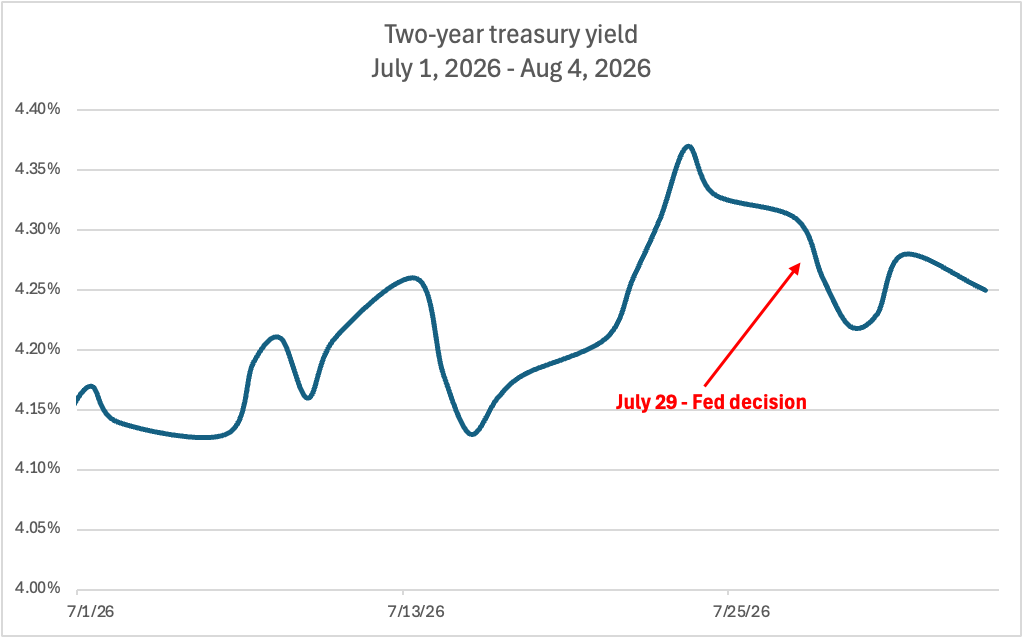
At the same time, this uncertainty spooked bond investors and led to a wider sell-off with long-term rates increasing at their fastest pace since Trump’s Liberation Day tariffs shocked the world in April 2025. The yield on long-dated Treasuries (30-year) increased to its highest level in nearly 20 years.
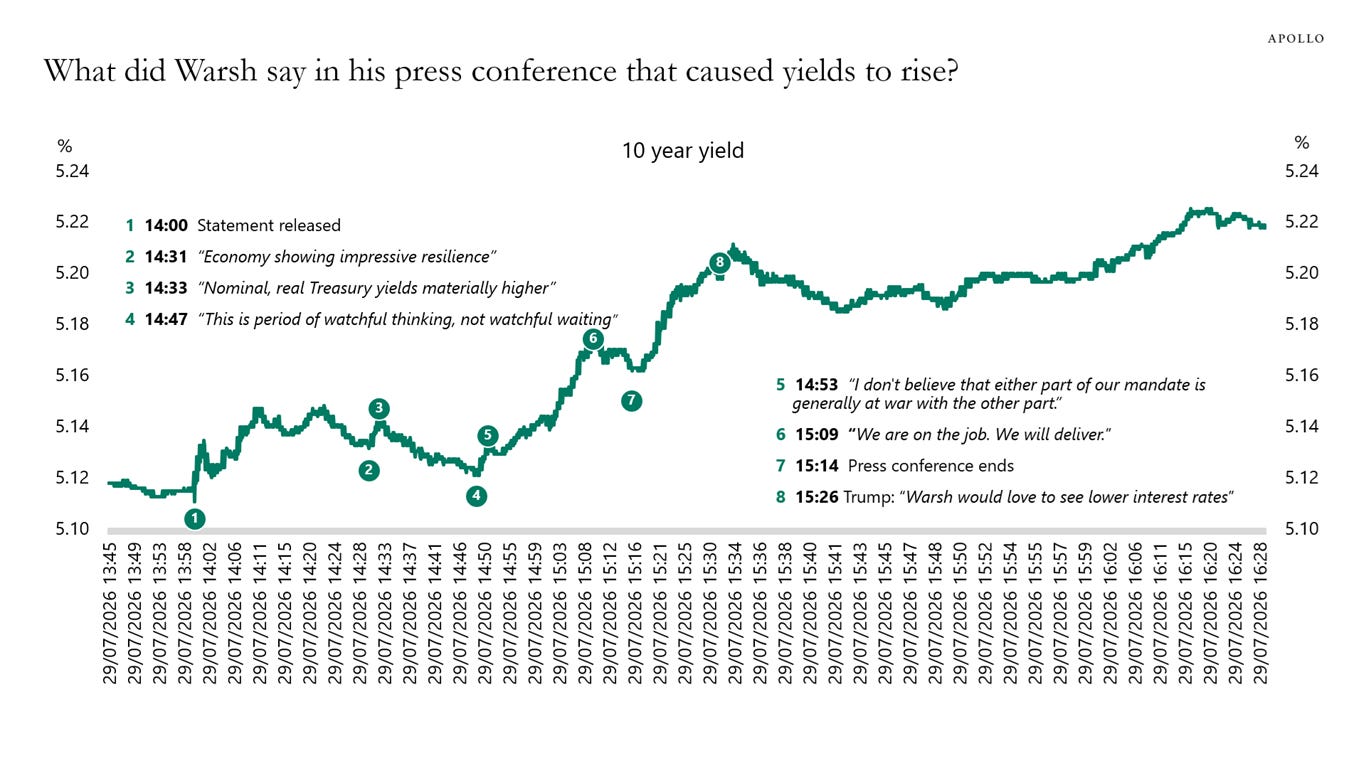
As Torsten Slok, chief economist at Apollo, noted, it wasn’t so much the decision but rather the explanation (or lack thereof) that caused the bond sell-off.
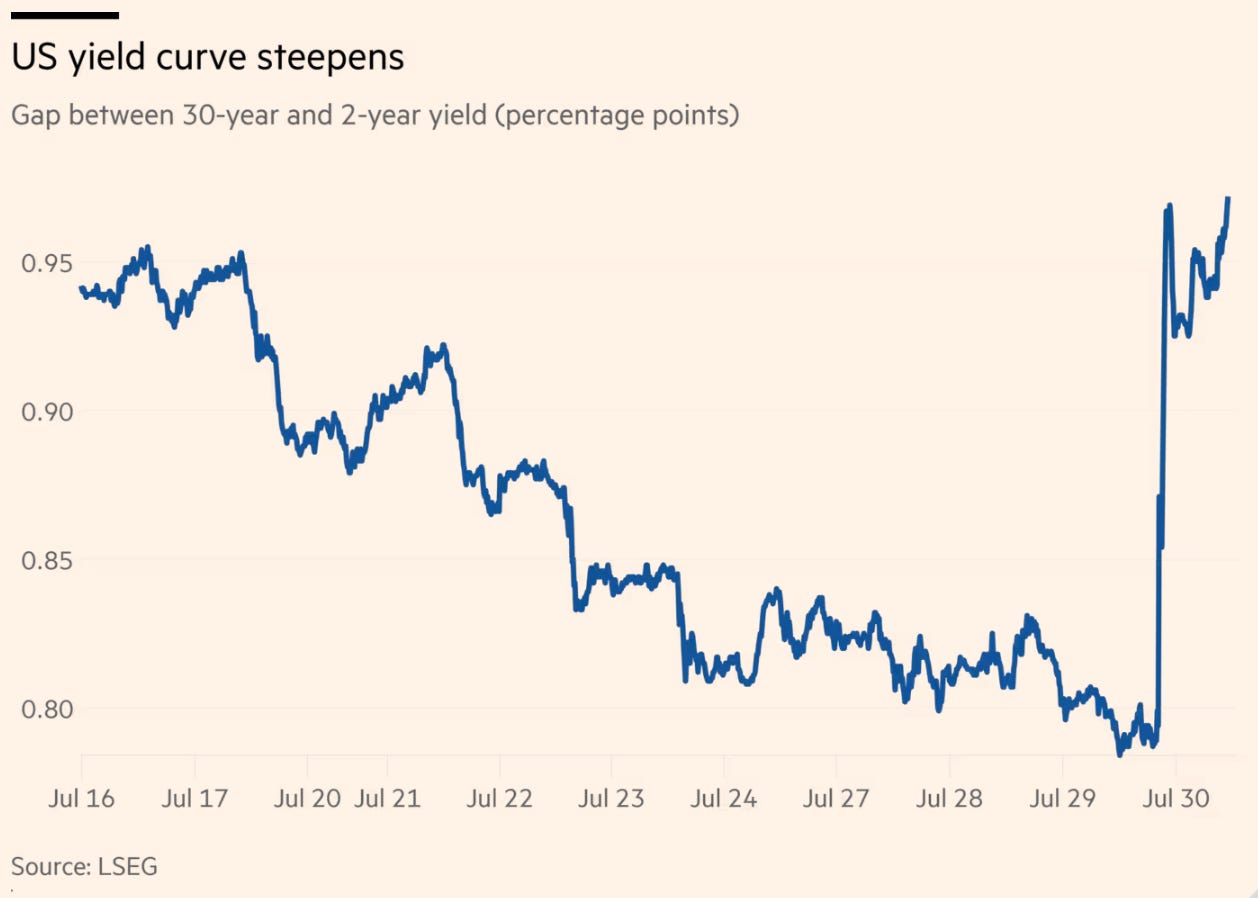
Putting the fall in short-term yields and hike in long-term yields in perspective, check out the change in the yield curve (the difference in yields between the 30-Year and two-year Treasuries). After having fallen for a couple of weeks, the curve quickly spiked after Warsh’s press conference.
Of course, it shouldn’t be forgotten that Warsh was installed in this role by Donald Trump. Trump’s primary demand since becoming President has been that the Fed lower interest rates, not hike them. Could all of this be smoke and mirrors from Warsh to justify no rate hike and appease his ultimate boss? After all, sometimes the simplest explanation is correct. In comments at the White House after the decision Trump noted, “he’s a brilliant guy. I know he’d love to see lower interest rates, but he’s got a board, and it’s a political board, and they want to keep rates up. But we fight through rates.”
Regardless, by not providing a clear road map for how the Fed plans on bringing inflation down to 2%, Warsh has injected uncertainty into the market, priming investors for more volatility. In a vacuum this isn’t horrible, but getting it right in the sweet spot will not be easy. While the argument goes that too little volatility has had investors throwing caution to the wind, too much volatility will make investors cautious.
For the moment, Warsh seems committed to the bit. However, he needs to be careful. The sort of market jolt we saw suggests traders may be concerned about Warsh’s true intentions, and risks the Fed losing credibility. In that respect, it is not too surprising that in the days since this meeting, a number of voters have publicly indicated they would be happy to raise interest rates if inflation does not come back down.
But in keeping with the theme of the Fed taking a step back and providing less insight, Warsh has reportedly been considering reducing the frequency of meetings during which the Fed votes on interest rates. The Fed currently meets eight times / year, but the Banking Act of 1935 (which created the modern Fed) mandates the committee meet “at least four times each year.”
Erin Lockwood, a political economist at UC Irvine, put together a nice chart to note that Warsh shouldn’t get too cute with this though.
Under previous Fed chairs, we were in a ‘yes x yes’ world. Warsh has already changed to a ‘yes x no’ and is suggesting a ‘no x no’ approach in which the Fed turns into a “blackbox”(…not unlike some AI models!).
Interestingly though, traders currently project a Fed rate hike at the next meeting in September.
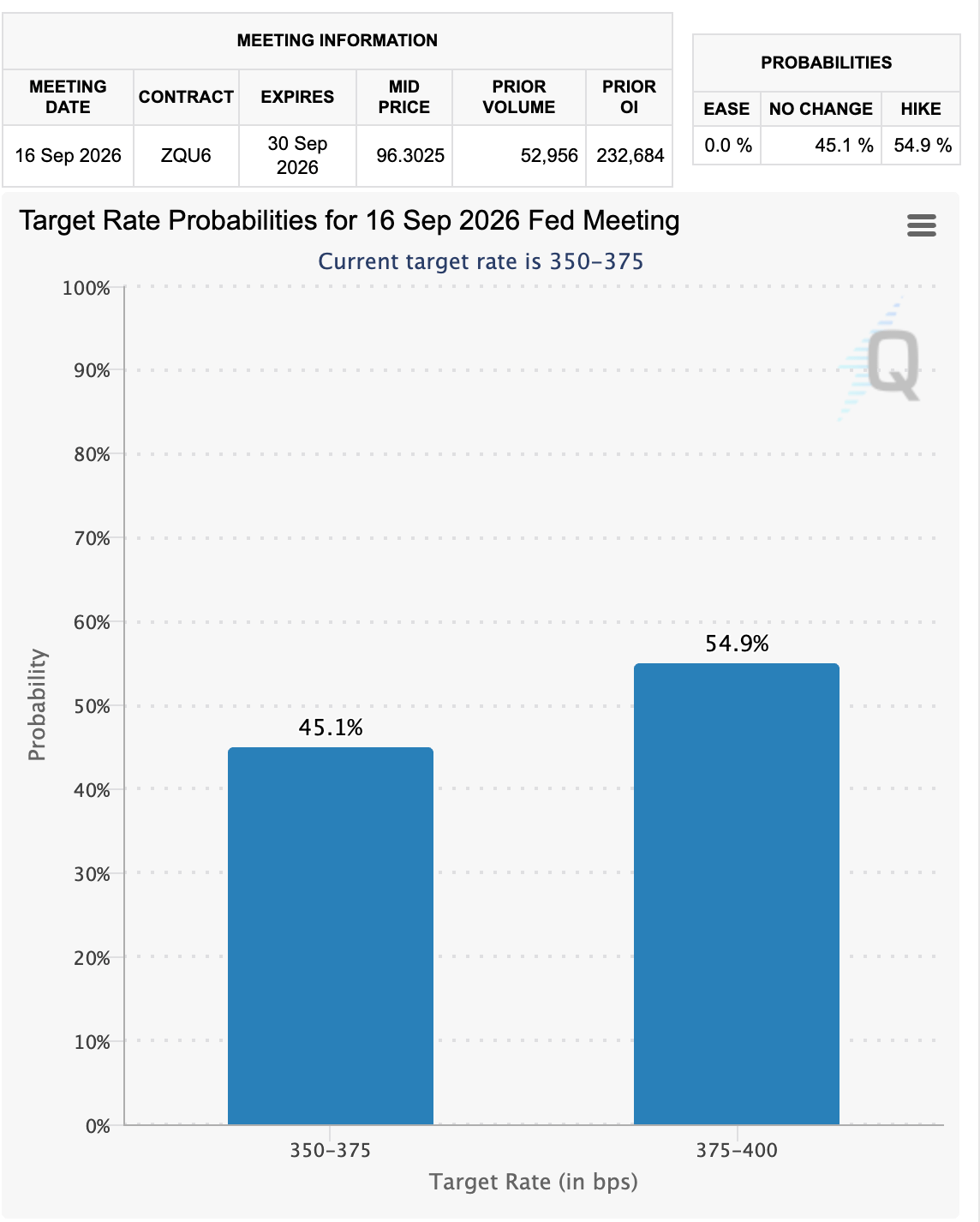
Is that simply wishful thinking? Warsh is next scheduled to talk later this month at the annual central bankers conference in Jackson Hole. Undoubtedly, investors will be parsing every word for clues as to what Warsh’s plan is going forward.
If you enjoyed this edition of Nuance Matters, consider letting me know by buying me a cup of coffee!
Cheers!
As we all know, inflation is backward looking, which might not be the best way to measure an era of constant flux. Regardless, this was the data at hand when the Fed met last week to discuss interest rates.
Comments
Nothing yet. Say the first thing.
Sign in to join the conversation.