
focus.
the ability to concentrate on one set thing while discarding distractions.
some of us may struggle with this, if not, most of us struggle with this. while others around us seemingly have insane levels of focus that seem ungodly.
why is that?
how do some people need more effort to concentrate for even an hour while others can work for more, consistently, and deeply without being thrown off?
is there maybe some secret formula we’re not getting?
maybe there’s some top secret supplement that activates 100% of our brain?
no, it’s actually none of these things.
it’s actually quite simple. and it requires an understanding of how your brain works, the connecting concepts, and the protocol necessary to develop a high level of focus.
many people and friends have asked me before on how I am able to have such an insane output for what I focus on.
“how does Don work so hard and get a lot of things done?”
and this is not by any means to put myself on a pedestal, but I’m able to put out this many articles of quality while tending to other aspects of my life after figuring out what’s really holding me back distraction wise and doubling down on a focus protocol that works for me.
this all connects in this aspect that most don’t understand the simplicity of getting into flow.
if you are someone that struggles staying on track with a task or assignment, you need to understand this:
you’re not dealing with a focus issue, you’re dealing with a distraction issue.
there’s way too many things competing for our attention, and in our modern world, this is especially amplifying this same distraction issue, we’ll dive into this later.
but there’s hope.
anyone can fix their distraction issue. yes, absolutely anyone. you included.
it may even be a struggle for you to read through this article in one go, and that’s okay.
but if you’re someone that genuinely wants to develop a level of focus from average to a high level, you might want to pay attention to everything here.
it’s 11:08 PM as I write this, one of the best times for me to maximize my output and get into flow.
deference for darkness from the Halo 3: ODST soundtrack playing on the speakers. the jazz feels like I’m roaming the dark, rainy neon city of New Mombasa myself. nonetheless, it’s dialing me in.
whiteboard full of notes, the neuroscience, the psychology, the protocols, everything imaginable on this topic dissected. gamma brain waves, three cognitive networks behind focus, transient hypofrontality, switching costs.
the information of what actually matters to focus at a high level. and you’ll get a dose of this here, so do pay attention.
so as always, do approach all of this with an open mind.
let’s get into it.

“what you focus on in your life grows.” - Robin Sharma
i mentioned at the start of this article that focus is the ability to concentrate on one thing while discarding distractions.
this is the very basis of focus itself but we can take this a step further.
we need to realize something that will change how you think about focus.
focus isn’t purely a state of mind centered around the brain, but more of an attention mechanism. understand that what we pay attention to shapes the processing of information itself.
it acts like a filter to help us make decisions.
this brings up a vital theory we need to understand, called biased competition theory.
in short, this essentially handles selective attention.
but to go deeper, there are a lot of environmental stimuli around us that are competing for our attention. sensation, visual objects, and sounds alike.
neurons in our sensory cortex are racing against each other and even suppressing each other for bandwidth when stimuli comes across your visual cortex.
attention is the needle mover here.
attending to one object boosts the neurons representing that object. they fire faster, and suppress the competition more effectively.
for other objects not getting attended to? they get degraded.
what wins the competition becomes your conscious experience, and whatever loses ceases to exist for you.
it’s the reason why you can focus directly at reading your book and not see it when you’re looking at your phone.
this is the art of focus and your conscious experience through a neurological lens.
you get the idea? good.

our attention and focus in this modern age is what we would call, “fragmented.”
broken up in bits and pieces.
really think about it yourself, the invention of the smartphone and the internet accelerated the fragmenting of the human attention span.
information is abundant and flooding us everywhere.
phone rings from a notification, making you subconsciously think about what it might be.
then boom! group chat is blowing up where your group is planning a trip.
then boom again! an email just hit your inbox and you’re getting spammed with them.
them boom once more! you’re sprinkled with calls from friends and family throughout the day.
and we’re wondering why it’s so difficult to focus on one set thing at a time.
distractions manifest themselves in unnecessary stimuli from our environment, and they’re competing for our attention which our subconscious mind is picking up on.
it’s the reason why it’s hard for me to study in my own house compared to reaching a state of deep focus in a library.
the environment in the library is quiet, you have your own clean space to study, and your brain associates such spaces with work, so you end up working more easily anyway.
compared to my house, there’s people talking outside my room, music playing in the house, and the downstairs TV can be heard upstairs.
your environment matters, and the amount of unnecessary stimuli competing for your attention is just as important.
and modern life has amplified the amount of stimuli we receive to the brim.
your phone, your TV, the internet, social media.
all are signals for distraction. no wonder our attention and focus is so fragmented.
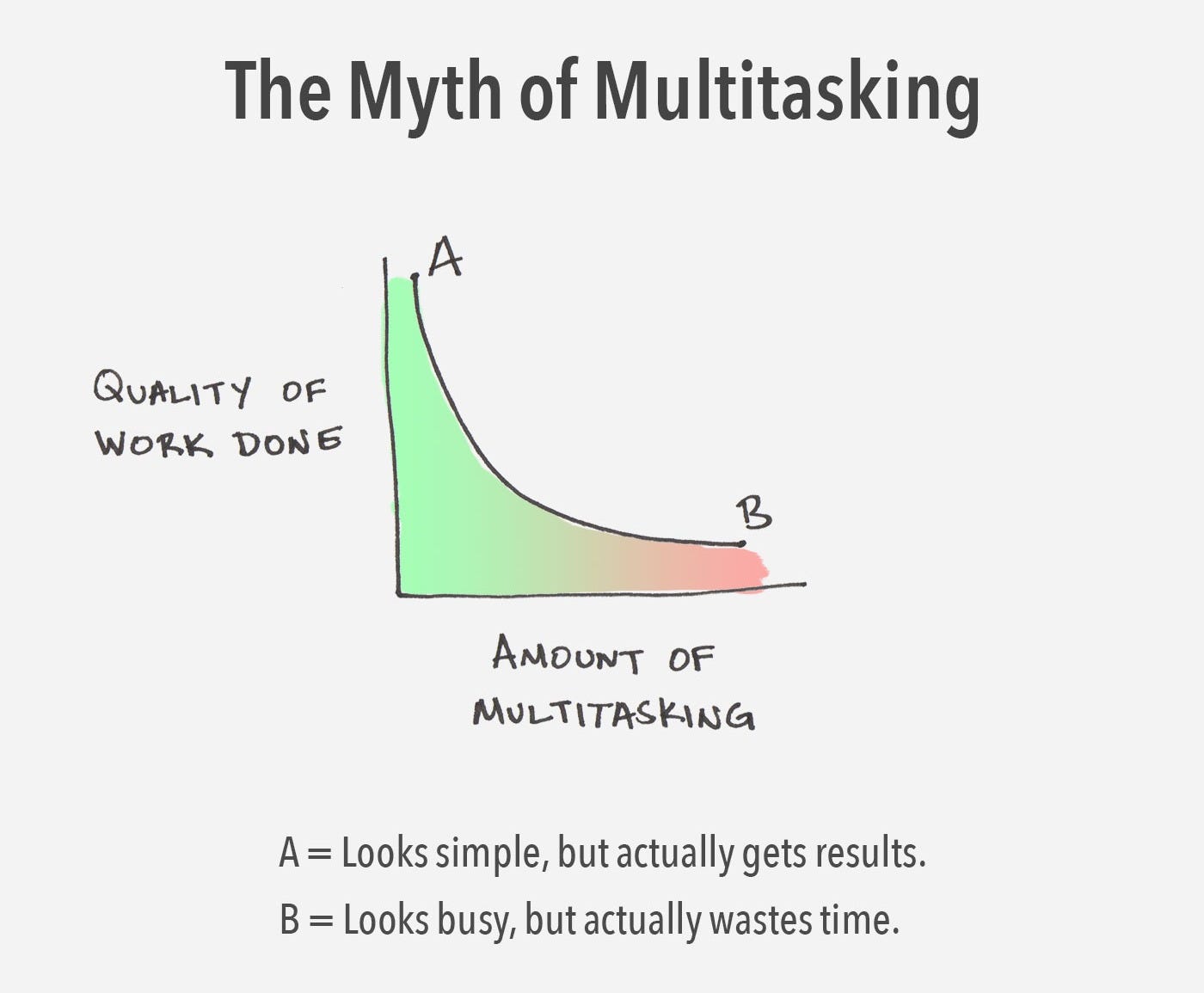
if anyone tells you they can multitask, they’re probably lying.
the thing is however, we are capable of doing two things at a time or more, but we can’t focus on two things at a time.
two things can’t be done simultaneously because our brains are naturally wired to focus on one thing at a time.
and when we do attempt to focus on two tasks simultaneously, there’s a hidden cost you don’t know about, a switching cost.
in psychology, there’s a drop in speed and accuracy that happens when your brain shifts from one task to another.
in addition you just increase your cognitive load and drain your brain’s prefrontal cortex, which can lead to burnout and mental fatigue.
your brain operates in this manner.
it either focuses on one set of rules or loads a new sets of rules while stopping old rules.
read that again because it’s truly important to understand.
it’s the reason why talking with your friend on call can go in one ear and out the other and you have to repeat yourself. maybe it’s because he or she is doing something at the same time.
it’s also the same reason for extreme life or death situations where you’re texting and driving.
the moment you’re done clicking send and look back on the road, those two-three seconds of trying to refocus on driving can change everything.
overall, doing two tasks at the same time is diminishing returns for progress. you won’t get as much done doing two things at the same time compared to one.
really visualize it like this.
our focus is designed to be like that of a ray of light from the sun.
the same ray of light from this sun is supposed to be so highly concentrated and powerful to the point of burning through a thick piece of paper.
in a multitasking lens, this ray of light ends up spreading out and becoming less powerful. and our focus ends up warming the paper instead.
it really puts things into perspective. the higher concentration, the more power and progress. the less concentration, less power and maybe even no progress.
knowing all of this, it truly cringes me to see people tell me they multitask, the downsides just heavily way the upsides.
don’t be that person.
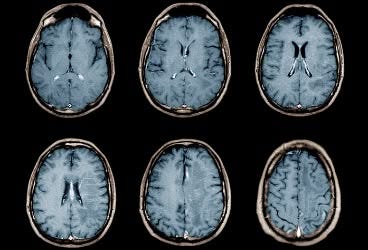
we’ve broken down the issues behind focus, but let’s get into the nuances, the neuroscience, and the mechanisms behind focus.
this is genuinely fascinating stuff, so do pay full attention on this.
there’s three main networks involved when it comes focusing and attention.
one is the alerting network.
this essentially controls your level of alertness and readiness. it’s what separates you from being drowsy versus being awake.
it’s main neurotransmitter is norepinephrine, dealing with alertness. this is secreted from a tiny brainstem structure called the locus coeruleus.
when this fires, everything gets a little more urgent.
it’s the reason why you could be half-asleep and when someone calls your name, it snaps you out of your daze.
the alerting network got a jolt.
another network we need to mention is the orienting network.
this essentially directs your attention to specific locations, objects, and features in your environment.
the main neurotransmitter here is acetylcholine, which sharpens the signal for such specific locations depending on what sensory region you’re orienting toward.
it’s the reason you turn your head involuntarily if your mom or dad calls your name.
the orienting network starts to kick in.
last but not least, there’s the executive attention network.
this deals with conflict resolution, giving you the ability to concentrate on one thing while competing stimuli are pulling you in different directions.
remember biased competition theory from before? this handles that.
the main neurotransmitter here is dopamine, which is also a hormone centered from your anterior cingulate cortex and lateral prefrontal cortex.
this network is the reason you’re here reading my article instead of checking your phone, even through notifications, which I hope is the case.
three networks, three neurotransmitters that all work together to comprise a state of focus for you.
here’s the thing however.
someone who has a tendency for behaviors of ADHD can have perfectly fine alerting and orienting networks, but a poor executive attention network.
someone who is sleep-deprived can have great executive attention but a poor alerting system.
understand that one solution for focus isn’t a constant for everyone. everything varies since each person has their own issue with attention or focus.
so it’s important to keep that in mind when it comes to these networks and focus.
if we’re dissecting focus, we can’t leave out the concept of the flow state.
some of you may know this, some of you don’t. maybe some of you have been in this state yourself without even realizing it.
whatever the case may be, it’s something you need to know.
brought about by psychologist Mihaly Csikszentmihalyi, he defined it as:
“a state in which people are so involved in an activity that nothing else seems to matter; the experience is so enjoyable that people will continue to do it even at great cost, for the sheer sake of doing it.”
this is wonderfully said.
in emphasis you essentially lose yourself in the process of creating or working on something that nothing else seems to matter, an extreme level of focus you would say.
let’s take it a step further.
flow state can be attainable when your level of skill matches the challenge of the task at hand.
if your level of skill exceeds the challenge difficulty? → boredom.
if the challenge difficulty vastly exceeds your skill level? → anxiety.
this is all theory, yes. but this is the natural tendency.
let’s take flow state a step further.
neurologically, when you enter a state of flow, you’re entering something called, transient hypofrontality.
in this state, your inner critic ceases to exist, prefrontal cortex activity is reduced, and your brain waves shift to gamma waves, dealing with deep focus at 30 - 100 HZ.
we’re gonna highlight reduced prefrontal cortex activity. this deals with long-term planning, high-level thinking, and self-control.
you might be thinking if that’s a bad thing, but it really isn’t.
it’s the reason why in flow state, the concept of time diminishes. and that you’re fully present on the task at hand, fully lost in the moment.
visualize it like this.
if you’re an artist, nothing else matters but the canvas you are painting on. hours start to feel like minutes, while you’re creating a masterpiece without even knowing it.
if you’re fighting in an MMA match, the crowd & noise outside the cage vanishes, it’s just you and your opponent now. nothing else matters and you’re deadlier than ever.
if you’re a devoted coder, nothing else matters but the screen in front of you. code is written effortlessly and you’re writing complex lines simply, you end up creating a masterclass app as a result.
this is the power of the flow state.
a study from McKinsey & Co. described that people in flow achieve up to a whopping 500% boost in productivity.
yes, 500%!
which is an insane percentage if you really think about it.
the average person operates at maybe a 35-60% level of productivity in each working day. and the flow state shows that there’s levels to this.
really understanding flow state is crucial once you rid your distraction issue.
getting into this state consistently can truly separate you from average.
“the successful warrior is the average man, with laser-like focus." - Bruce Lee
this is essentially gonna be the part that wraps everything together, so do pay attention.
you know the theory, you know the nuances, so how can we develop this “insane level of focus?”
the biggest thing I can address is to simplify your environmental stimuli as much as possible.
remember: you don’t have a focus issue, you have a distraction issue.
if you’re working online, declutter your laptop or PC. remove any unnecessary tabs and apps that are competing for your attention.
focus on what truly matters, if you have two dozen tabs open and objectively you only need two or three, close those other tabs.
if you have a bunch of books or papers in front of you, the same logic applies. cut out what’s unnecessary for the day, focus on what’s necessary now.
my setup is optimized for minimalism as a result, I don’t have a bunch of items fighting for mental bandwidth in my executive attention network.
and according to Huberman Lab, research shows that cognitive focus follows visual focus, so it all makes sense.
diving deeper into this protocol, we need to deal with your phone and social media.
go do not disturb mode (DND) to silence phone calls and notifications, maybe take it a step further and place your phone in another room.
in addition, even regular meditation practice can improve the brain’s ability to redirect focus in the midst of uncontrollable environmental distractions.
reducing time spent on social media can also improve your ability to focus over time.
even personally, ambience, instrumental, ethereal, or classical music can help a ton with focus, especially those of low BPM.
depending on what you’re listening to, they’ll influence your brain waves, shifting you from an alpha wave, to beta wave, and if you’re so focused, maybe a gamma wave for activating the flow state.
the self-explanatory part is also to block out noise as well.
this is the simple protocol, it’s a matter of optimizing your environment and simplification of stimuli.
“the six best doctors: sunshine, water, rest, air, exercise, and diet." - Wayne Fields
neuroscience research support several approaches for increasing alertness and overall focus.
the beauty is that these approaches are nearly zero cost, with exceptions to diet.
number one, get your natural sunlight.
the best times for getting sunlight yourself is either the first hour of waking up or mid-day, either before 10AM, or after 4PM respectively.
getting some sun helps you become more alert & focused, it suppresses the release of melatonin, the hormone that deals with your sleep cycle, and raises healthy cortisol & serotonin.
i do this myself personally, I feel like I’m more awake and that my batteries are recharged off of getting some sunlight on the skin.
number two, proper nutrition.
this is pretty self-explanatory but nonetheless a good reminder.
if you feed yourself sufficiently, especially complex carbs, proteins, healthy fats (omega-3s), B vitamins & minerals, and properly hydrate yourself, you prevent energy crashes & spikes that deal with brain fog.
you stabilize your blood sugar, supply your body with glucose for cognition that requires energy, and deliver vital micronutrients for neurotransmitter production.
if you don’t feed yourself accordingly, you don’t think clearly. proper nutrition is truly a pillar for focus.
number three, good sleep hygiene is a must.
this is also self-explanatory, but sleep is absolutely crucial for maintaining alertness and focus.
getting optimal amounts of hours sleeping will reset your prefrontal cortex, dealing with executive control.
waste is cleared out through your glymphatic system, you would have better mental clarity as a result.
and key neurotransmitters like dopamine, norepinephrine, and acetylcholine are rebalanced.
all of this culminates high alertness, stronger focus, and better decision making as getting enough rest restores metabolic resources for decision making.
last but not least, regular exercise helps a ton.
i’ve mentioned it throughout my articles, and the effects of mental alertness from movement is staggering.
secretion of BDNF, serotonin, endorphins, dopamine. these hormones & neurotransmitters help with plasticity but most importantly they produce an emotional high that sharpens your attention for a brief moment.
your reaction time is increased, and you think clear from a lack of brain fog.
if you can incorporate these four natural pillars as habits, you can increase your level of focus, and how fast you can get into a state of concentration.
simply eating right, sleeping right, exercising right, and getting sunlight is all you need in supplement.
nothing complicated.
this truly was information dense.
so if you were to take away anything for developing a high level of focus, it would be this:
focus is not about sheer will and concentrate on the task at hand, but a byproduct of your environment, workspace, workflow, and amount of time you spend in a focused state.
read that again. that might just be the needle mover.
with the information here, you’ve been fed theory and actionable advice on how to develop an “insane” level of focus.
remember, there is no secret formula, nor is there any secrets at all.
it’s a matter of simplification to operate at a high level. the high performers know this.
it’s not hyper-optimizing your life for productivity and efficiency, but removing what is holding you back distraction wise and focusing on what’s a priority one by one.
and you’ve just got the blueprint here.
so either build a skyscraper, or let the idea of it collect dust in the back of your mind.
do what you will.

if you loved this article, you’ll love my other articles here, give them a read:
No posts
Comments
Nothing yet. Say the first thing.
Sign in to join the conversation.