
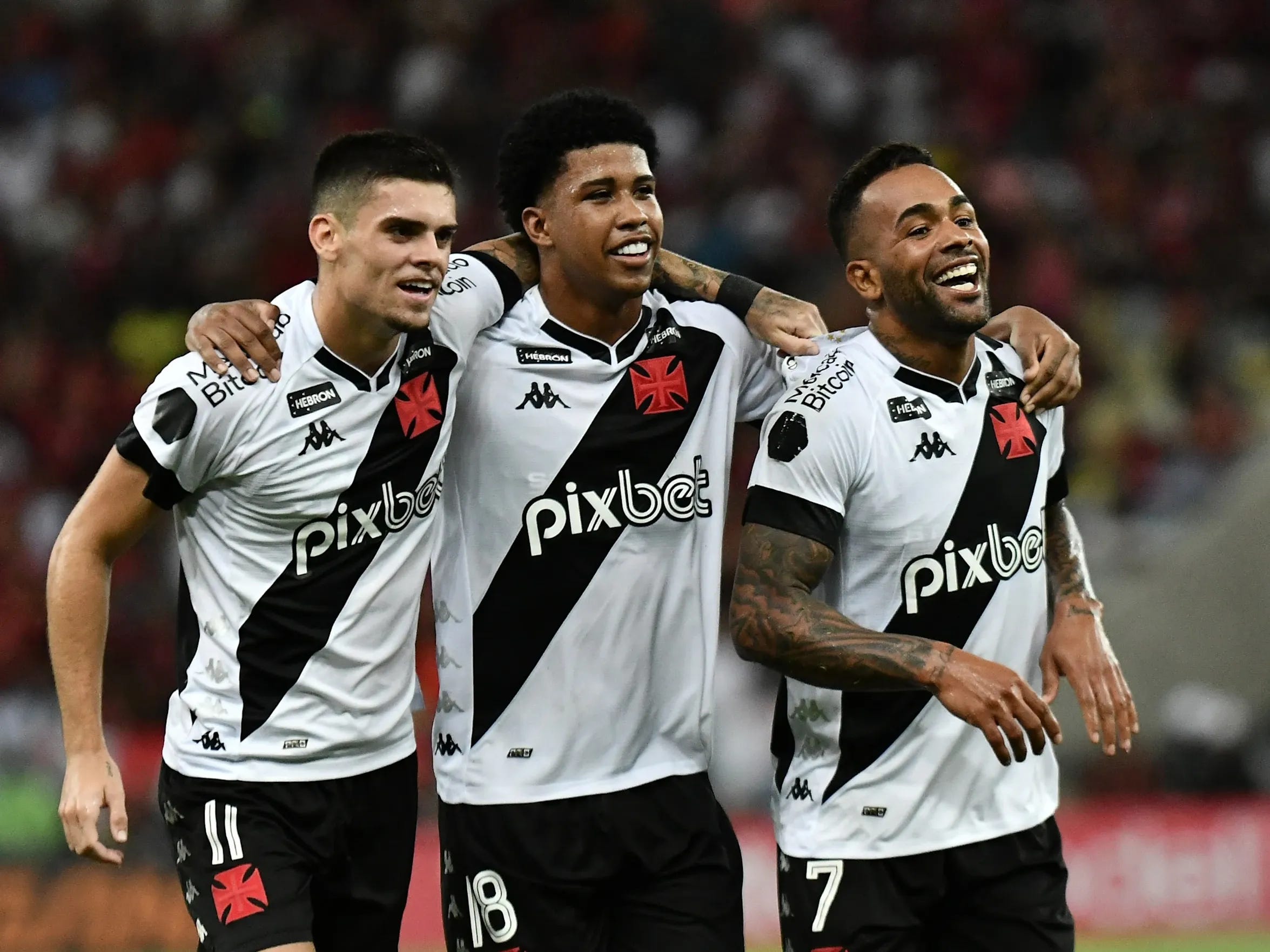
In 2021, a 17-year-old kid walked onto a pitch in the Campeonato Carioca, the championship tournament in the state of Rio de Janeiro. He became the youngest player to represent Vasco da Gama in the 21st century. Nobody really noticed the moment.
The list he topped isn’t insignificant either. Youngsters who also represented Vasco this century: Philippe Coutinho, Paulinho, Talles Magno. Names that have carried Vasco’s academy reputation forward. But a scrawny teenager from the futsal courts had got there earlier than all of them.
Lists like that are only a promise. For every youngest-to-have-achieved-something player who goes on to justify the billing, there are more who end up playing third-tier football by 25.
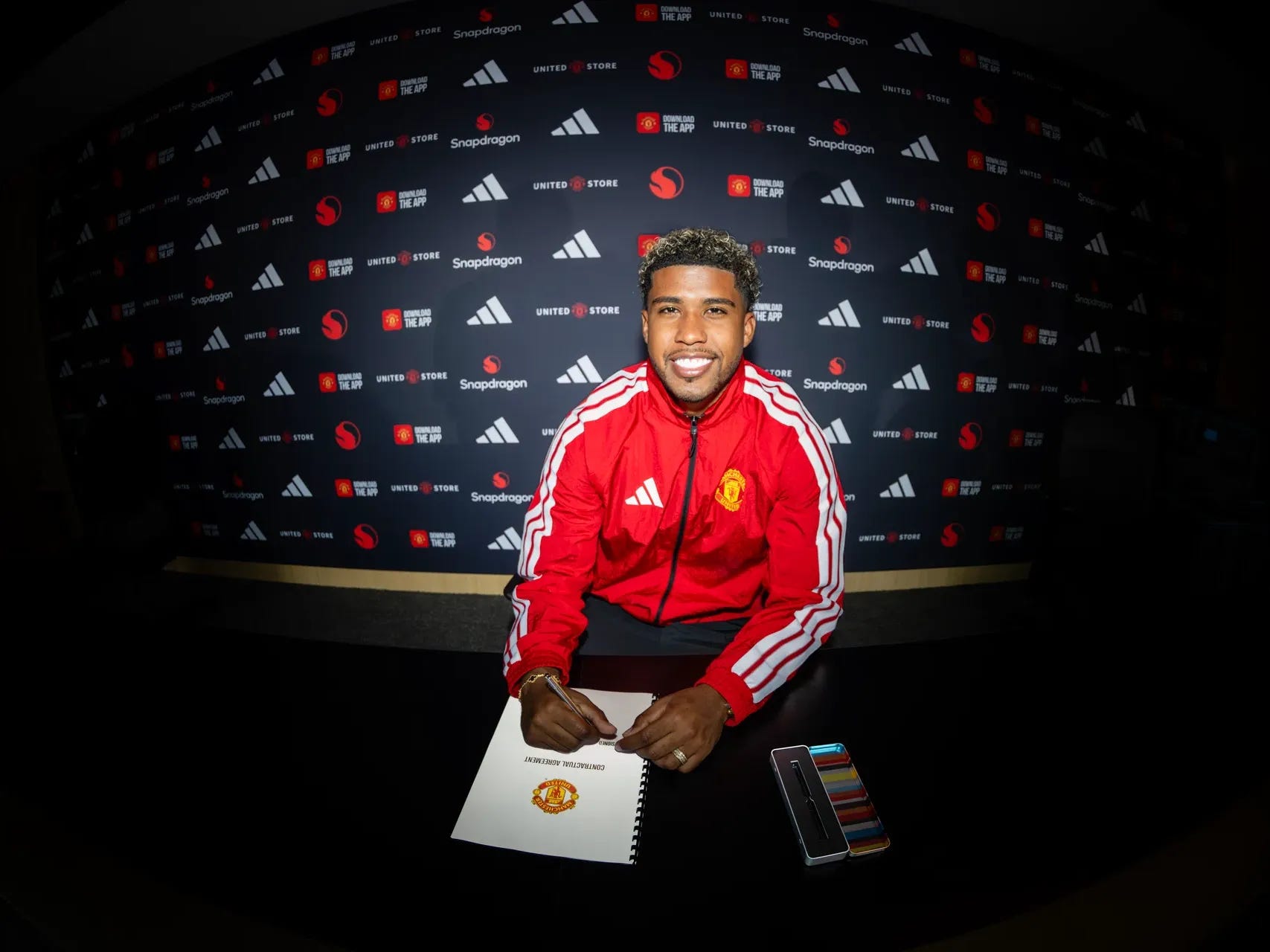
The striking thing about Andrey Santos, five years and £50 million later, is that his promise is unresolved. He’s done enough to earn a big move for a serious fee. But it’s still the promise United have invested in.
Santos joined Vasco aged seven. He started in futsal, the small-sided indoor game that produces so many Brazilian midfielders. It’s a game that rewards tight control and quick decisions in limited space. Spanish players, similarly, often grow up playing small-sided games on basketball courts. It shows.
São Januário, Vasco’s stadium, which is located about three miles north of Maracanã in Rio, has a nickname: Gigante da Colina. It’s the giant of the hill.
Santos was the best player in his 2004 generation. By 17 he was in the first team in front of big crowds at São Januário. By 18 he had 38 senior appearances under his belt. There were eight goals and a promotion from Serie B on his record too. Chelsea had seen enough to pay around £13 million for him in January 2023. Not that a transfer to Chelsea means much: there’s barely a teenager on the planet that Todd Boehly hasn’t tried to buy.
What came next is a story of frustration and near failure. The short version: a prodigy signs for a big club but doesn’t survive the chaos of its ownership. The long story? It’s more complicated than that.
Skip forward to a warm evening in Stockholm this summer. United beat Atlético Madrid 2-1 in a pre-season friendly played in front of a half-empty stadium. United had been there recently, and tickets were priced at eye-watering sums. Santos played 82 very effective minutes in the heart of United’s new midfield. It was the game that created a positive first impression.
He covers ground, though not in the way a real box-to-box engine does. We’ll come back to that. But there’s an energy to him that United’s midfield has been missing since Casemiro’s legs went somewhere in the middle of his first season at the club. Santos gets around the pitch. He makes plenty of challenges. They’re sensible ones rather than lunges, though. He’s usually in the right position. He’s a willing dueller without being a bully about it.
The thing that stands out most is what he does with the ball once he’s won it. Santos passes forward. Not the camera-friendly crossfield diagonal that gets clipped and shared. It’s the simple line-breaking ball played from deep areas that takes three opponents out of the game. Snappy, punchy. Effective balls, not Hollywood. His game is unspectacular, but that can be the hardest thing in the game to do consistently. Santos does it more often than not.
Santos’s passing is also cleaner and less scattergun than Casemiro’s, where the range was still there but the radar started to drift.
Carrick, who knows a bit about the position, has been effusive in a way he rarely is. He called Santos “a dream”, praised his maturity, and said it felt as if he’d been at the club a long time. “The way he approaches games, the way he plays for his teammates, he doesn’t play for himself,” Carrick said after the Atlético win. “He reads the game very well, is very intelligent.” Jason Wilcox went with “excellent technical qualities and the ability to impact the game at both ends”.
The technical base is really good. Santos is press-resistant, comfortable receiving under pressure and escaping on the half-turn. The instinct is to look for the forward pass, rather than something sideways.
He’s got a goal in him too. There were eight in that Vasco spell and six at the Under-20 South American Championship. He finished that tournament as both a winner and the top scorer. One strike was a solo run through the Argentinian lines that did the rounds on socials.
Ligue 1 named him their Young Player of the Month in March 2024 during a loan spell at Strasbourg. It’s a small signal but the kind of award that matters more than a manager praising his new signing.
There’s a reason United’s recruitment team, Wilcox, Vivell and the rest, moved early. In a summer when so many elite defensive-midfield targets were either unavailable or had stratospheric price tags, Santos was one they could actually land. Young, technically excellent, two-footed, and familiar with the Premier League. There should be a decade of prime years ahead.
On his passing and reading of the game, he’s already excellent. On everything else, there’s still plenty to work with.
There’s usually some complication with any prodigy’s story. Chelsea bought Santos at 18. They couldn’t register him because he fell a point short of the Premier League’s work-permit threshold. So they loaned him straight back to Vasco. Then on to Nottingham Forest in 2023-24. He barely played. Then to Strasbourg, Chelsea’s sister club, for 18 months. He finally found some playing time and some form.
He returned to Stamford Bridge in the summer of 2025, won a Club World Cup medal, and made 43 appearances across the following season. It was enough to prompt United to spend £50 million, with Chelsea keeping a 10 per cent sell-on.
Three years, four loan spells, and one permanent club where he was never truly an established player. When Chelsea signed him, Jamie Carragher’s verdict was that he was “one for the future, not ready”, a box-to-box midfielder with promise who needed time and probably a loan. The comparison drawn at the time was Douglas Luiz, another Vasco midfielder who found his way to England and moved on without playing a competitive game. City, not Chelsea. Same difference
So which is it? Did Chelsea cash in on a player who wasn’t good enough to force his way past Moises Caicedo and Enzo Fernandez? Did their absurd transfer model, buying every promising 18-year-old on earth, stockpiling, and selling the ones who don’t force their way through, simply run its course?

But Chelsea aren’t in Europe this season, which limits the minutes Santos was likely to play. The £37 million profit on a £13 million punt is easy enough to rationalise, especially with Chelsea under a UEFA financial settlement agreement.
The generous reading is that Santos is good enough for most clubs. He was simply unlucky to have landed at a club that hoards players. The less generous interpretation is that a genuinely elite midfield talent isn’t loaned out four times. Chelsea, whose coaches watched him every day for three years, priced their knowledge into a sale rather than a place in the team.
United’s bet is the former.
Despite a promising start in red, the case for caution is obvious. Santos has fewer than 30 Premier League appearances to his name. Most of his senior football has been in Ligue 1, the Brazilian league, and cup competitions. That’s an entirely different level of intensity to a 50-plus game campaign taking in Premier and Champions League nights twice a week. Not least because of the judicious weekly violence in the English top flight. After all, the step up has broken plenty of more experienced players.
The bigger tactical question is what Santos doesn’t have in his locker. Santos is a controller, not a destroyer. He’s not the space-covering monster who screens the back four on his own while everyone else pushes forward. At the time of writing, United are in negotiations with Brighton to acquire Carlos Baleba. It would certainly be high risk to ask Santos to anchor a midfield all season, possibly even in games where United could do with more physicality.
There’s also the question of whether he’s profiled correctly as a pure six. He scored goals at Strasbourg, playing higher up the pitch than he appears set to play at United. The goal threat comes with an asterisk.
Can he do all of it at once? Can he be the first passer in United’s build-up, break up play, and get forward to score? If he can do it all, week after week, against opponents now deconstructing his game, that’s a unicorn.
Plenty of midfielders can make a pass, or break up play, or score goals. The good ones can do two. The best do three. Which is Santos? We just don’t know yet.
There’s also an issue of fit with the players around him. He’ll share that midfield with some combination of Kobbie Mainoo, Youri Tielemans and Mason Mount. Perhaps Baleba will join them, if United can complete that deal this week. The former trio all do their best work with the ball. None of them is a natural ball-winner. The blend matters. A double pivot of Santos and any of the three depends heavily on Santos maintaining his position and managing transitions.
Without Santos, United are at risk of conceding too many of the same transitional goals, week after week.
Can Santos carry the load against the better sides? He might be the answer. He might expose the fact that United have three eights and one six and have decided to call that a balanced midfield.
That potential deal for Baleba really matters.
The neat throughline is that Santos replaces Casemiro for club and country. The club part is half true. The country part is a more challenging story.
Santos spent last season being talked about as part of Brazil’s post-Casemiro future. He said in the spring that he was pleased Ancelotti was counting on him. Many projected squad lists had him in as the young, versatile option behind Casemiro, Bruno Guimarães and Lucas Paquetá. Then Ancelotti named his final 26 for the World Cup, trimmed the midfield to five and took nine forwards. Ancelotti’s final squad left Santos out altogether. At least he was in esteemed company: cut alongside João Pedro, Richarlison and 41-year-old Thiago Silva. In the same summer he moved clubs, the selection decision he most wanted went against him.
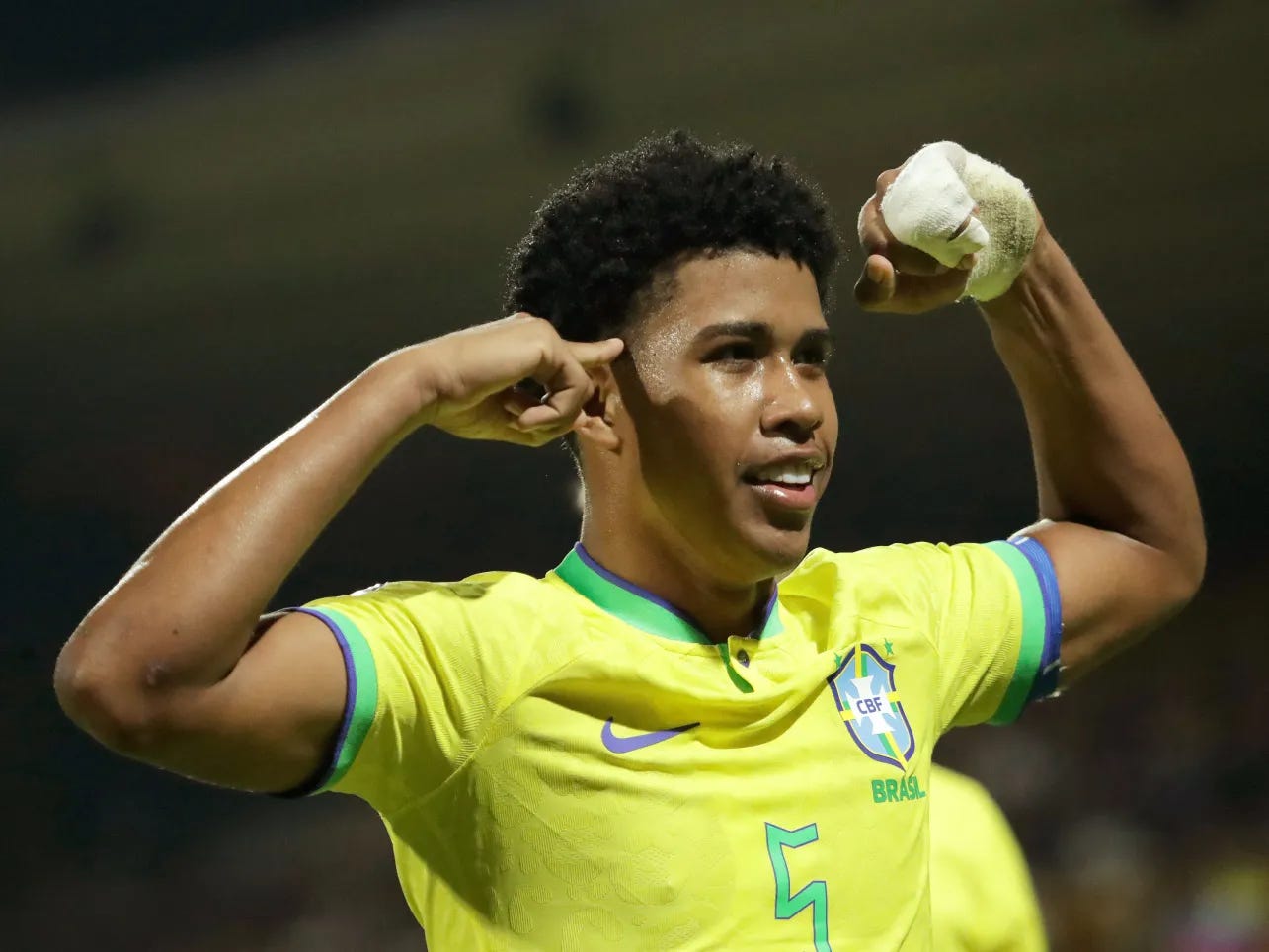
That won’t sink him, of course. Casemiro is finished with the national team after Brazil’s failed World Cup. Brazil’s midfield is going to turn over in the two years ahead of the next Copa America. Santos is among the candidates who could form the core midfield group. Candidate is the right word, though; heir is premature.
He’s competing with Bruno Guimarães and half a dozen others. Being cut from the World Cup squad is a reminder that the promise of São Januário is still, at international level, just a promise.
United open the season away at Hull City this Saturday. It’s the sort of fixture that has embarrassed the team before. It’s also the first 90 in the rest of Andrey Santos’s story.
Remember that list for a moment. Youngest Vasco player this century, beating Coutinho and Paulinho to the honour. It got him noticed in Europe. It got him a move to Chelsea. It earned him three years of being good at other clubs. The £50 million transfer to United, the red shirt on his back. Is this the moment all that promise converts into something real?
Perhaps a breakout season, with a starring role in the team built partly around him. He has the passing skills, and he reads the game well enough. There’s a maturity of temperament that should serve him well in the more pressurised environment at Old Trafford.
Let’s not get ahead of ourselves. He hasn’t made a competitive appearance for United yet. Or even really complete a full Premier League season that proves he can do it all. If United can’t get the Baleba deal done, he might not even have the option of a well-rounded midfield quartet to rely on.
The prodigy has become an excellent young footballer. Whether that excellent young footballer becomes the player his teen years promised is another question. It should be answered over the next nine months.
It starts on Humberside, in a shirt he’s worn in five friendlies. There’s everything still to prove. For the first time in his career, it’ll be at a club that isn’t planning to loan him straight out.
No posts
Comments
Nothing yet. Say the first thing.
Sign in to join the conversation.