
Welcome to the monthly No Wasted Ink Newsletter. My name is Wendy Van Camp and I’m Poet Laureate Emerita from the City of Anaheim, California. This newsletter is not affiliated with the city. All views stated here are my own.
Winter in Southern California is very short. We wear our sweaters for a scant eight weeks and then its over. The sunshine returns. For me, it was a hard winter. I wrestled with my health through much of December and January. My breathing became bad enough I considered going to urgent care, but I didn’t have the symptoms of Covid, it was simply a bad cold or the flu. The constant cough kept me up at night. My husband was extremely helpful during this issue. He handled much of the cooking and grocery shopping and brought me vapor rubs and cough syrups as I needed them.
Lately, January has become a time of applications and invitations. Requests to submit to journals come in, for which I am always grateful. Invites to apply to various venues also arrive. So although I was sick enough that I did not venture from my home, I was still busy interacting with people via Zoom or on 3D platforms. I could certainly continue to coach writers virtually from my home office.
By February, I had recovered enough to venture from the house. It was a delight to return to Gallifrey One in Los Angeles where I’ve been a dealer for at least two decades. This is the largest Dr. Who Convention in the world. It is a pleasure to see my regulars and meet new people of the fandom.
I’m proud to say that my poem “Rockets Over Anaheim” found in “Anaheim Poetry Review 3”, has been nominated for a long list Rhysling Award. Much gratitude to the members of SFPA who voted for my poem.
I will be launching my next digital edition book via Indigoskye Press on March 1st. It is a downloadable pdf version of my upcoming presentation about writing retreats at the Writers Workout Conference. If you are an attendee of the conference, you will be offered a coupon for a discounted purchase of the book along with other freebies. I hope to see you all March 16th through the 22nd!
My newest poetry collection featuring literary poems inspired by the lives of Southern California women is in its final stages. “Pages She Will Carry” still needs some formatting and art, but I’m fairly confident it will be ready for my readers by June of this year.
yours in poetry,
Wendy
Several years ago, I wrote a poem called “Cassandra.”
In the ancient story, Cassandra can see the future, but no one believes her warnings. She watches disaster unfold, powerless to stop it. The story appears in epic poetry attributed to Homer and was passed down through oral tradition long before it was written.
When I wrote my version, I placed Cassandra within a solar-powered sailing spacecraft. She fled the Earth, escaping the death she had foreseen, into the safety of outer space.
As I wrote it, I realized something important. I was not modernizing a myth. I was participating in a poetic tradition thousands of years old.
Speculative poetry is not a new invention. It is continuing mythic poetry itself.
Before There Were Novels, There Were Poets
Long before the novel, before the printing press, before silent reading, there were poets and bards. They carried history, belief, and identity in memory. They sang stories of gods, monsters, heroes, and cosmic forces.
These stories were not casual entertainment. They were sacred, communal, and instructional. To be performed aloud. Lived in rhythm and repetition.
Homer’s “Iliad” and “Odyssey” were epic poems, meant to be recited. When ancient audiences listened to these stories, they were hearing speculative work. The poets imagined conversations with gods. They envisioned underworld journeys. They described flying chariots, divine weapons, shapeshifting beings, and cosmic battles.
The difference between then and now is not the impulse. It is the vocabulary.
Gods, Fire, and Human Questions
Consider Prometheus. His story was told in poetic form by the Greek poet Hesiod in his epic poem, “Theogony and Works and Days.” Prometheus steals fire from the gods and gives it to humanity. For this act of rebellion and generosity, he is punished without end.
Fire is not just flame. It is knowledge. Technology. Power.
Ancient poets were already asking the same questions speculative poets ask today. What is the cost of progress? Who is responsible for new power? When does ambition become transgression?
Now imagine Prometheus not with a torch, but with code. Or with artificial intelligence. Or with a dangerous invention that changes the world overnight. The structure of the story holds. The poetry still works.
Speculative poets are not borrowing myths. We are continuing the conversation ancient poets began.
Monsters as Metaphor
Ancient poets also used monsters and gods to explain the unexplainable.
Thor was more than a Norse god, he was thunder itself. Lightning had a personality. Storms could be narrated. By giving natural forces names and motives, poets helped their communities live with the fear and uncertainty of natural disasters.
The story of Icarus embodied ambition. The story began as a myth among the greek people, but later it was recorded by the Roman poet Ovid, who used the story in his epic poem “Metamorphoses.” Icarus flew too close to the sun and fell. His story is poetic speculation about flight long before flight was possible. It explores risk, pride, and consequences.
These were imaginative leaps. They were poetic thought experiments.
When a contemporary speculative poet writes about space travel, bio-warfare, or altered realities, we are doing what those ancient poets did. We use metaphor, character, and narrative to explore human limits.
The setting has changed. The poetic impulse has not.
A Global Poetic Tradition
This lineage is not limited to Europe.
In Polynesian traditions, Maui slows the sun to lengthen the day so fishermen can stay on the water longer and he pulls islands from the sea to provide the people homes. These stories were preserved in chant and oral poetry.
They imagine reshaping the natural world. Altering cosmic order. They speculate about human agency in the face of vast forces.
Across continents and centuries, poets have imagined what lies beyond the visible horizon. That is speculation. That is poetry.
When we write speculative poetry now, whether about distant planets or emerging technologies, we are stepping into a global tradition of sung imagination.
Why This Matters to Writers
If you are a speculative poet, this link matters.
Your work is not niche or new, as many might believe. It is ancient. Your poetry connects you to bards who stood before fires and recited stories that shaped cultures. Modern words tie you to epic poets who imagined gods arguing in the sky.
If you write a poem about artificial intelligence, you are walking beside Prometheus. When you write about cosmic storms, you stand near Thor. Writing about failed warnings in a technological world, Cassandra speaks through you.
We sometimes treat speculative poetry as a modern subgenre. In truth, it may be the oldest form of poetry we have.
Speculative poetry is mythic poetry in contemporary language.
The Gateway
Returning to “Cassandra,” I see my poem was not a science fiction retelling of an old story. It was a continuation of epic tradition, in micro-poetry form.
Ancient poets sang of prophecy, hubris, fire, and storm. Today we write of rockets, code, and cosmic expansion. The symbols evolve. The questions remain.
We still ask: What lies ahead? What is the cost of knowledge? How far should we reach? Who will listen when we warn of danger?
Myth was never static. It was always alive in the voice of a poet.
And so is speculative poetry.
When we write it, we are not stepping away from tradition. We are stepping into it. Myth is the gateway, and poetry carries us forward.
Text within this block will maintain its original spacing when published
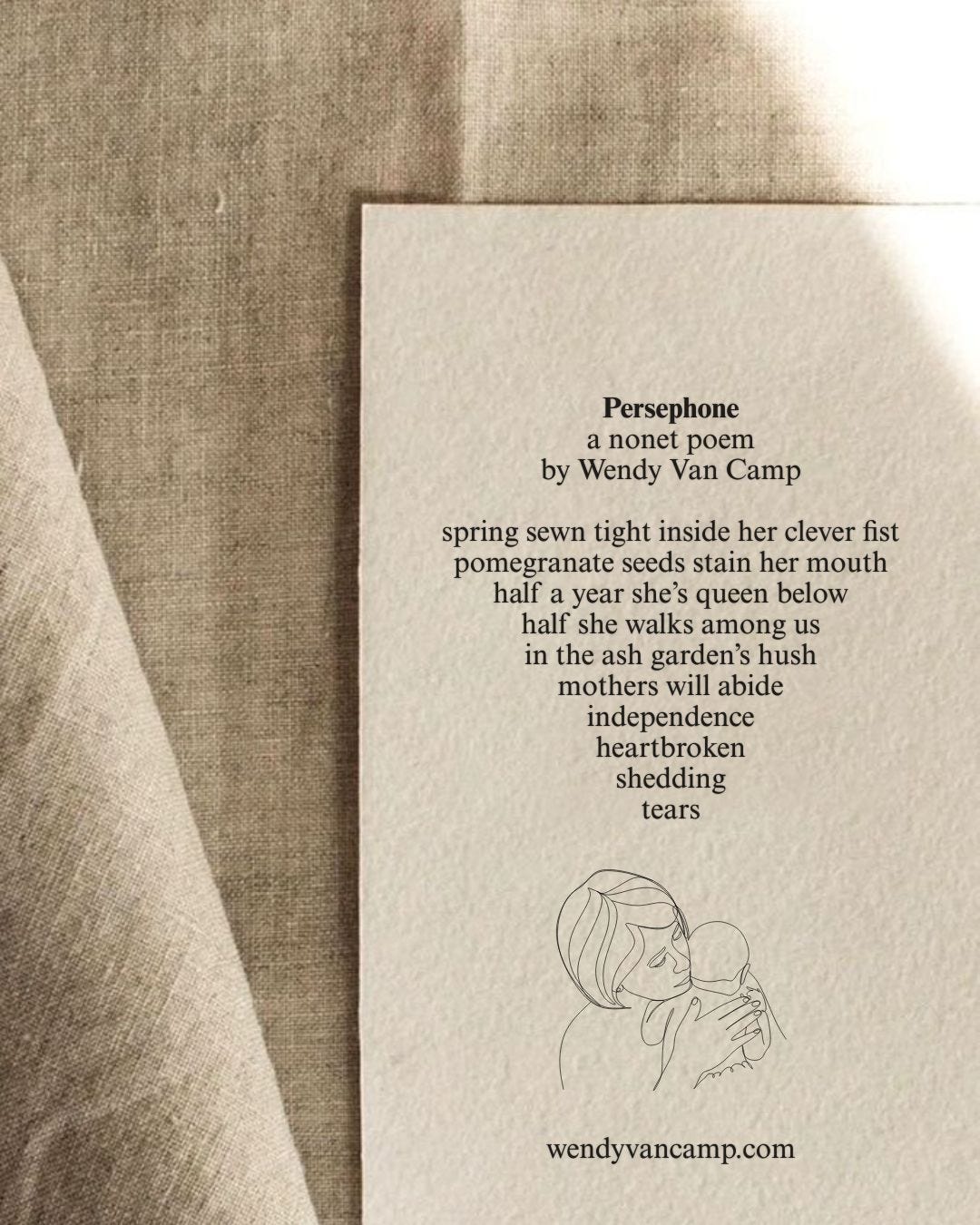
Persephone
A nonet poem
by Wendy Van Camp
spring sewn tight inside her clever fist
pomegranate seeds stain her mouth
half a year she’s queen below
half she walks among us
in the ash garden’s hush
mothers will abide
independence
heartbroken
shedding
tears
I would normally display this poem centered on the page, but unfortunately the formatting on substack does not allow for this. This poem is based on the myth of Persephone, daughter of the goddess Demeter and stolen to the underworld by Hades. It is also a poem about mothers and daughters and loneliness. One of the things I love about micropoetry is that every reader’s interpretation of my poetry is different. That is part of its magic.
Rez Magazine
January Issue 2026
One Tanka Poem
by Indigo Starling (aka Wendy Van Camp)
https://viewer.joomag.com/january-2026/0999521001767981436
This is the first of a series of tanka poems I’ve had accepted at Rez. It is free to read online and I’m honored they put my little tanka poem on a two-page spread! I hope you visit Rez and read my poem along with the offerings of the other poets, writers, and artists.
This is the second tanka poem in the series of nine Rez plans to publish this year. It is free to read online. This one features a full page spread with an image of a lovely porch swing.
Verse-Virtual: An Online Community Journal of Poetry
February Issue 2026
by Wendy Van Camp
https://verse-virtual.org/2026/February/van-camp-wendy-2026-february.asp?p=42&n=44
Three of my nonet form poems have published in the February issue. The poetry is free to read online. I’ve been a member of this community for several years and I’m honored to be included in the journal once again.
“Cat in the Slipper” , “Farmer’s Market” & “For Maestra”
SFPA Valentine’s Day Reading
published February 14th, 2026
[Synthetics First Tear]
a speculative tanka poem by Wendy Van Camp
You can hear it (and other amazing poems!) for free here:
https://sfpoetry.org/wp/publications/valentines-day-readings/
The SFPA (Speculative Fiction Poetry Association) celebrates poetry inspired by science fiction, fantasy, and the weird. Their Valentine’s Day Reading is an annual event showcasing poems of love, wonder, and imagination—perfect for hearing something new and extraordinary this Valentine’s Day.
Octavia’s Open Mic
Second Life
Open Mic at Octavia’s Coffeehouse
http://maps.secondlife.com/secondlife/Clearwing/74/101/34
February 1st, 2026
12pm - 1:00pm STL (Second Life Time = Pacific Time)
Indigo Starling (aka Wendy Van Camp) will be the featured poet at this weekly Saturday open mic. Come hear a mix of her literary and speculative poetry in a coffeehouse setting.
Octavia’s is a diverse, inclusive, eclectic coffee house & bar , in honour of the visionary science fiction author Octavia E. Butler. All welcome !
Gallifrey One
LAX Airport Marriot
Los Angeles, CA
February 6th – 8th
Ticket is required for entry
I am back in the dealer room selling and autographing my books. I should still have an assortment of my handmade jewelry available. This may be my only jewelry event for the year, so if you are a fan of my metalwork, please stop by.
with Poet Laureate Emerita Wendy Van Camp
Are you a writer who struggles with accountability? Do you write short stories or poetry and would love monthly critiques via a professional? Perhaps you need guidance in creating your writing career.
Join Poet Laureate Emerita Wendy Van Camp via her coaching service at Indigoskye Press. I offer single hour coaching via Google Meet or a discounted block of 3 sessions you would use once a month for a longer term project.
Ideas of how to use a writing coach:
Help to organize a poetry chapbook or short story collection
Help with indie publishing your novel
How to onboard as a speaker at conventions and conferences
Professional critiques of your short stories or novel chapters each month
Please visit my shop via the link at the top of my portfolio website or go there directly: https://indigoskye.com
Portfolio - http://wendyvancamp.com
Amazon - https://www.amazon.com/author/wendyvancamp
Medium - https://medium.com/@wvancamp
Indigoskye Press - https://indigoskye.com
X (Twitter) - https://x.com/wvancamp
Instagram - https://instagram.com/nowastedink
Mastodon - https://me.dm/@wvancamp
Bluesky - https://bsky.app/profile/indigoskye.bsky.social
The Planets: a scifaiku poetry collection
https://www.amazon.com/dp/B07Z8HMPF2
Letters From The Sea Series
#1 - The Curate’s Brother: A Jane Austen Variation of Persuasion
http://www.amazon.com/dp/B00OU1V45A
The Planets Companion: an astropoetry chapbook
https://www.amazon.com/dp/B0FNKMXNJD
Every Word Matters
https://indigoskye.com/index.php/product/every-word-matters/
Eccentric Orbits: An Anthology of Science Fiction Poetry 2021-2024
Volumes 2 - 5
Editor
Available for purchase: https://dimensionfold.com
Anaheim Poetry Review 2022-2023
Volumes 1 - 2
Inaugural Editor
Free to Read: https://anaheimpoetry.com
Eye To The Telescope: Quests #46 - Fall 2022
Guest Editor
Free to Read: https://eyetothetelescope.com/archives/046issue.html
Thank you for subscribing to the No Wasted Ink Free Monthly Newsletter and voiceover Ramblecast. This monthly newsletter will always remain in full and free to all subscribers. The voiceover is also available as a Spotify podcast. To subscribe via your favorite podcast player, please visit:
Comments
Nothing yet. Say the first thing.
Sign in to join the conversation.