
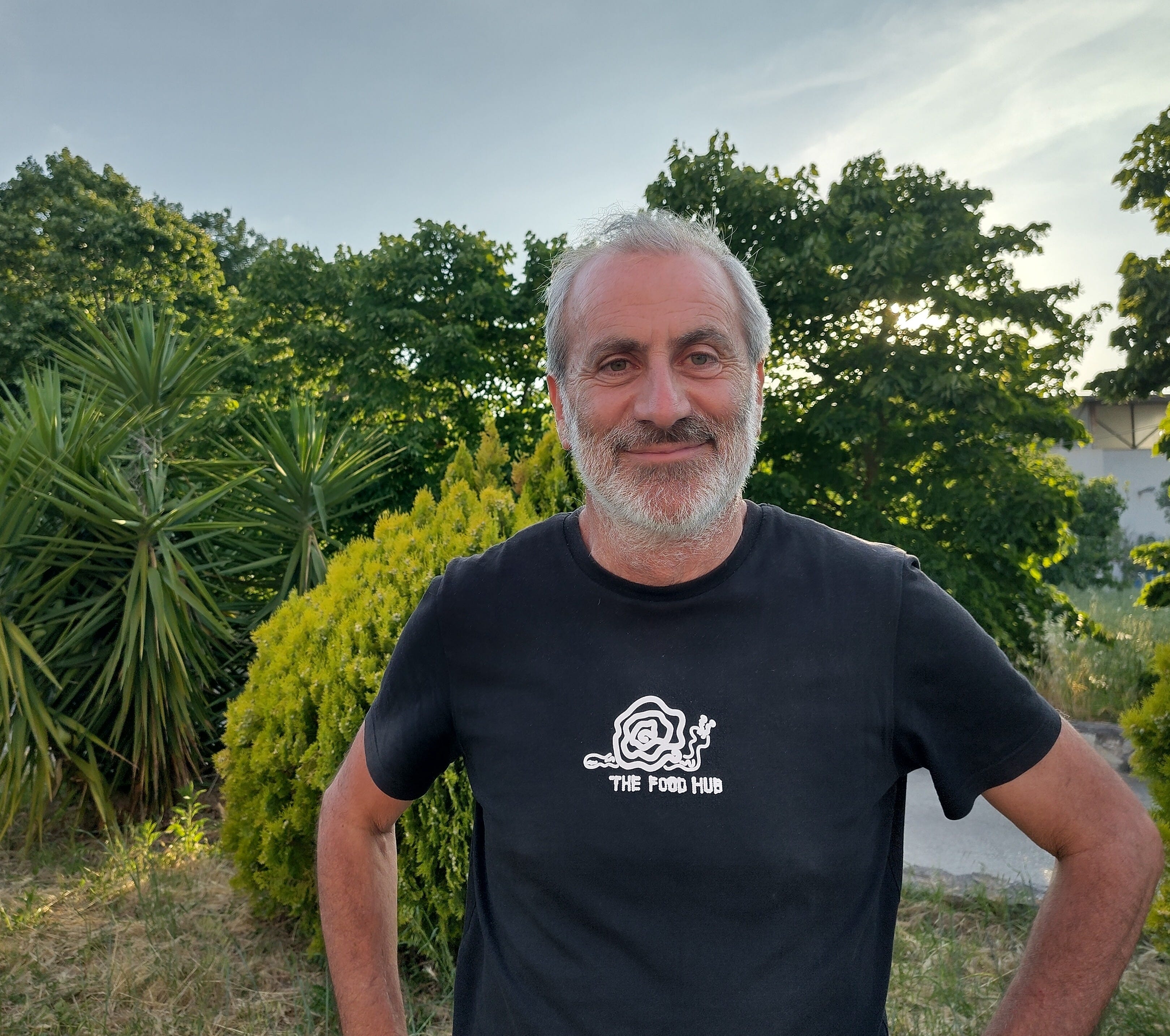
I didn’t know what Massimiliano was saying for most of the interview
.
That sounds like a confession of failure. But I am not sure it was. I sat across from him at Valdibella — outside, in the warm Sicilian afternoon, dogs moving in and out of the frame, the sound of other people somewhere nearby — and I watched a man talk about farming the way some people talk about philosophy. With his hands. With long pauses that weren’t hesitation but something more like weight. With a look that occasionally moved off me and went somewhere further away, somewhere into the past, before returning.
I understood almost none of the words in real time. And somehow I understood quite a lot.
The setup was improvised in the way that most of the best things in my life have been. I had wanted to interview Massimiliano for a long time. He is the co-founder of Valdibella, a cooperative in Camporeale in western Sicily — a territory shaped by decades of mafia control, social distrust, and an agricultural system that had made farmers invisible. In 1994 he helped start the first cooperative. In 1998, Valdibella. Today it is fifty producers, a winery, a pasta line, an oil press, a food hub with partners across Europe, and an agroecology school in its first full curriculum year. He is also a man who speaks only Italian.
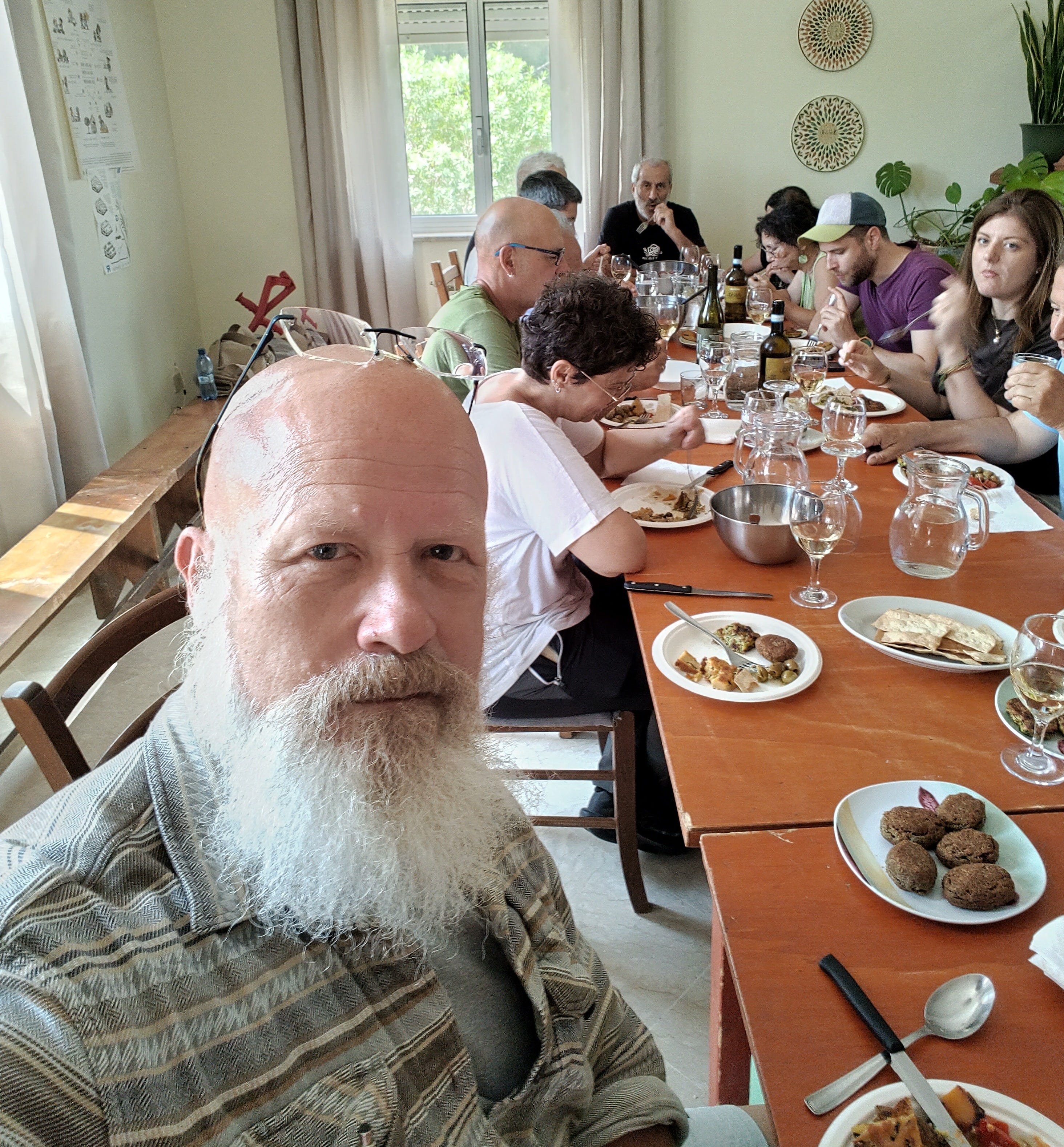
I speak Swedish and English. Between us: a translation app on a phone, two colleagues of Massimiliano who helped bridge the gaps — Eleonora, who works with the school and speaks English fluently, and others who passed words back and forth when the app couldn’t keep up — and a kind of patience that I did not know I had in me.
The process was slow. I would ask a question in English. It would be translated into Italian — sometimes by the app, sometimes by Eleonora, sometimes by a colleague nearby who leaned in and said the Italian version quietly, like a stage prompt. Massimiliano would then speak. At length. In flowing, unhurried Italian. The app would translate back, imperfectly, capturing the skeleton of what he said but losing its texture. And then I would listen, try to hold the thread, and find the next question.
What I didn’t expect was how much the slowness opened things up.
A normal interview has a rhythm — question, answer, follow-up, the conversation accelerating as it warms up, building momentum toward the moments where something unexpected is said. This interview had a different architecture. There was space between each exchange. Space in which I watched Massimiliano think, watched the expression on his face before the words came, noticed what he did with his hands when he was searching for how to say something. The translation created a gap, and in that gap there was room for attention
.
I found myself listening harder than I usually do. Not to the words — I didn’t have the words — but to something underneath them. The rhythm of a sentence. The way his voice would slow when a subject mattered to him and speed up slightly when he was building toward something he wanted me to understand. The moments when he looked at me directly, as if checking whether the idea was landing — not the idea in Italian, but the idea itself, the thing he was actually trying to say.
There is a version of this that sounds romantic, and I want to be careful not to over-romanticise it. There were also moments where I genuinely didn’t follow — where the translation came back too thin, too stripped of nuance, and I had to ask Eleonora to expand, or ask Massimiliano to say it again differently, or simply sit with the uncertainty and trust that the transcript would fill in what I had missed. There were moments of mild comedy — the app misunderstanding a word, Massimiliano correcting it with a laugh, everyone around the table briefly in agreement that technology has its limits.
But overall, something true happened in that conversation. More true, perhaps, than some interviews conducted in a shared language where fluency creates a kind of speed that skips over depth.
One moment in particular stays with me.
I asked Massimiliano what nature had taught him about running a business. It was a question I had not fully formulated before I asked it — it arrived out of what he had been saying about soil and function and the role of each entity in a living system. He paused before answering. A long pause. Not the pause of someone thinking about how to answer, but of someone deciding how much to give.
Then he spoke slowly, and even without translation I felt that what he was saying was careful and precise and personal. When the words came back through the app and through Eleonora, the core of it was this: every entity in a natural system has a function that serves the whole. Nothing in nature exists only for itself. The system works because each part fulfils its role in relationship with everything else. And that, he said, is the only honest model for agriculture — and for any business that wants to mean something.
He didn’t dress it up. He said it the way a farmer says something true: without trying to make it sound more than it is, because it is already enough.
I thought about that for the rest of the afternoon, and I am still thinking about it now.
There is also something to be said about what Massimiliano’s colleagues gave to this conversation.
Thanks for reading! This post is public so feel free to share it.
Eleonora, who co-runs the agroecology school at Valdibella, stepped in at key moments not just to translate but to expand — adding context that Massimiliano assumed I already had, filling in the shape of the school’s curriculum, explaining how the student body had grown from farmers to include city consumers who had simply started wondering where their food came from. She did this without diminishing Massimiliano, without making the conversation about her — but clearly, this is someone who has absorbed the philosophy of Valdibella deeply and carries it fluently in English in a way that allowed me to understand things I would otherwise have only half-grasped.
The other colleagues who helped — passing Italian phrases back and forth, translating a specific term, confirming whether I had understood something correctly — added something else: they made the interview feel collective. Which is, in a way, entirely appropriate for a conversation about a cooperative. There was no clean boundary between the interview and the life happening around it. Dogs appeared. Someone walked through. Maria said goodbye and left mid-conversation, which Massimiliano noted with a small wave before continuing. It was, to use a word I don’t usually reach for, alive.
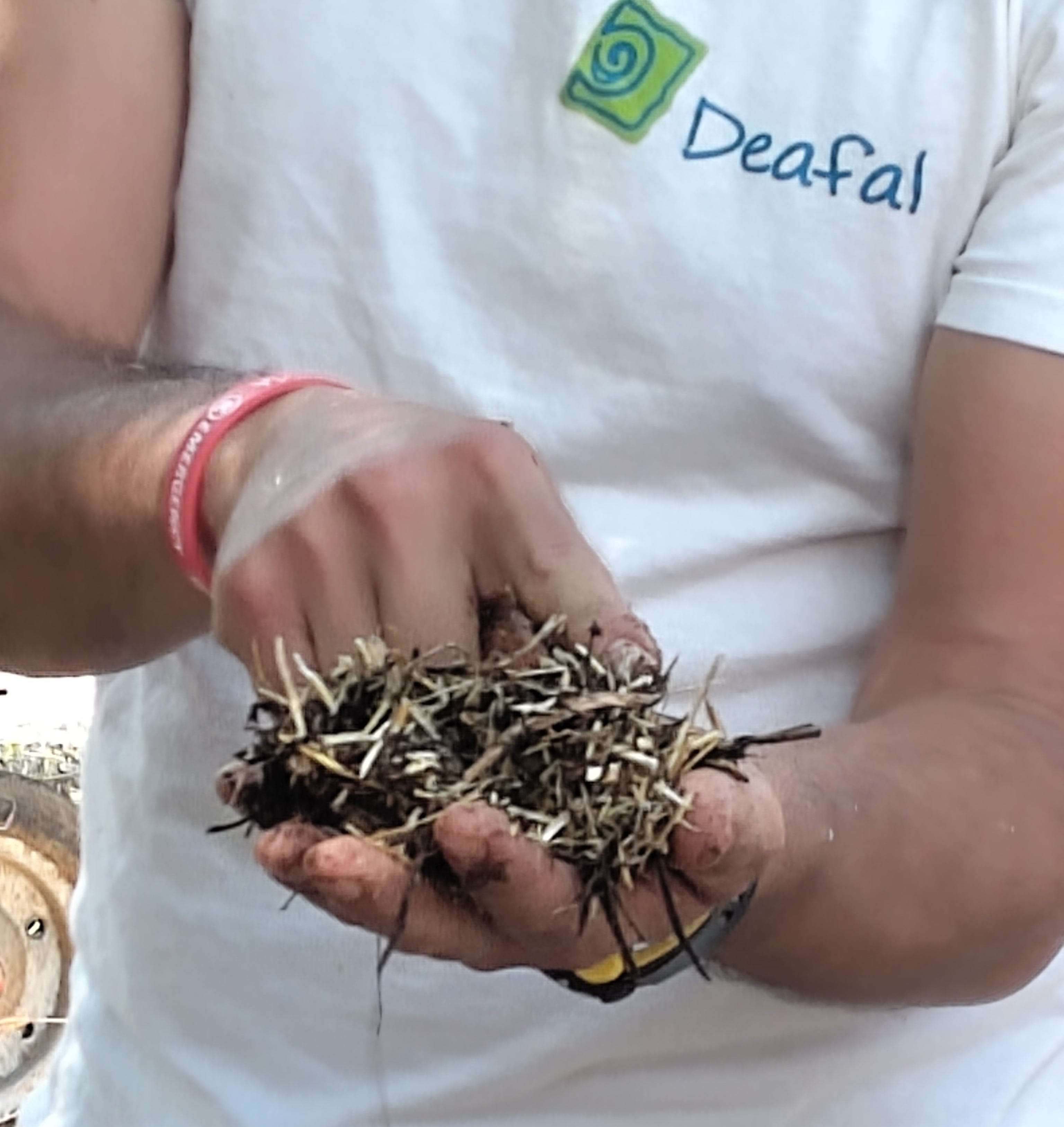
I should say that the interview was not the only thing I did at Valdibella. The day before, I had participated in the composting course that Eleonora mentions in the episode — a weekend intensive that the school was running alongside the broader curriculum. I joined it the same way I joined the conversation with Massimiliano: with a translation app, a willingness to look slightly lost, and whatever fragments of other languages I have accumulated over the years. My Italian is essentially nonexistent. My French is enough to order coffee and misread a menu. My German surfaces occasionally in the wrong situations. None of it was particularly useful in a room full of Sicilian farmers and soil scientists discussing the nitrogen cycle
.
But the composting course taught me something that the interview later confirmed: that a shared subject matter does more linguistic work than people give it credit for. When someone holds up a handful of soil and says something in Italian while pointing at it, you don’t need the words to follow a substantial part of what they mean. When a diagram goes up on a wall, or someone demonstrates how to read the temperature of a compost pile, the language becomes something closer to annotation than to meaning itself. I followed perhaps sixty percent of what was said in any technical sense. I understood, in the way you understand something when your body is in the room with it, considerably more.
This is the thing I kept coming back to during the interview the following day. The translation app, the colleagues, the patience — all of it was necessary, and I am grateful for it. But underneath the whole arrangement was something simpler: two people who cared about the same questions, in the same place, trying to talk to each other about them. That turns out to be enough of a foundation to build something on, even when the words don’t match.
A note on the two versions of this episode — because if you are reading this before or after listening, it helps to know what you are choosing between.
The original version of the episode contains the conversation largely as it happened: Massimiliano speaking in Italian, the English translations coming in as they did in real time, Eleonora’s contributions in English, my questions in English, and the ambient sound of a Sicilian farm on a working afternoon. It is not a clean recording. There are the dogs, the interruptions, the moments where the translation introduces a slight delay. But it is the conversation as it existed — and for that reason I think it is the more honest version. You hear the texture of the exchange. You hear that something real was being attempted across a distance that isn’t only linguistic.
The dubbed version is something different. I have recorded my own voice over Massimiliano’s Italian, reading the full English translation of what he said. The result is a continuous, uninterrupted English conversation that is easier to follow, faster to listen to, and loses something in the process. It loses his voice, and with it some of the person. His Italian has a quality to it — a slowness, a particular kind of seriousness — that my English reading of his words cannot fully carry. But it allows the content to come through without asking the listener to hold multiple languages at once.
I made both because I believe they are genuinely different experiences. The original is an encounter. The dubbed version is an argument — a sustained, coherent argument about food, farming, identity and power, made possible only because someone thought hard enough about these things to express them carefully in any language.
I recommend starting with the original, if you have the patience for it. Then returning to the dubbed version for the parts where you want to think more carefully about what was said.
I left Valdibella in the late afternoon. The light was doing what Sicilian light does — softening without losing intensity, turning the olive trees into something that looked like they had always been there, and always would be. Massimiliano walked me out. We shook hands. He said something in Italian that wasn’t translated, and I didn’t ask for it to be. Some things don’t need to be translated.
What I carried home was not a set of quotes or a series of facts about regenerative agriculture in Sicily — though I had those too. What I carried home was the feeling of having sat with someone who had spent thirty years building something that didn’t exist before he built it, in a place where it wasn’t supposed to be possible, without a template and without certainty, and who had arrived on the other side not bitter about the cost of it but calm about its meaning.
That came through the language barrier just fine.
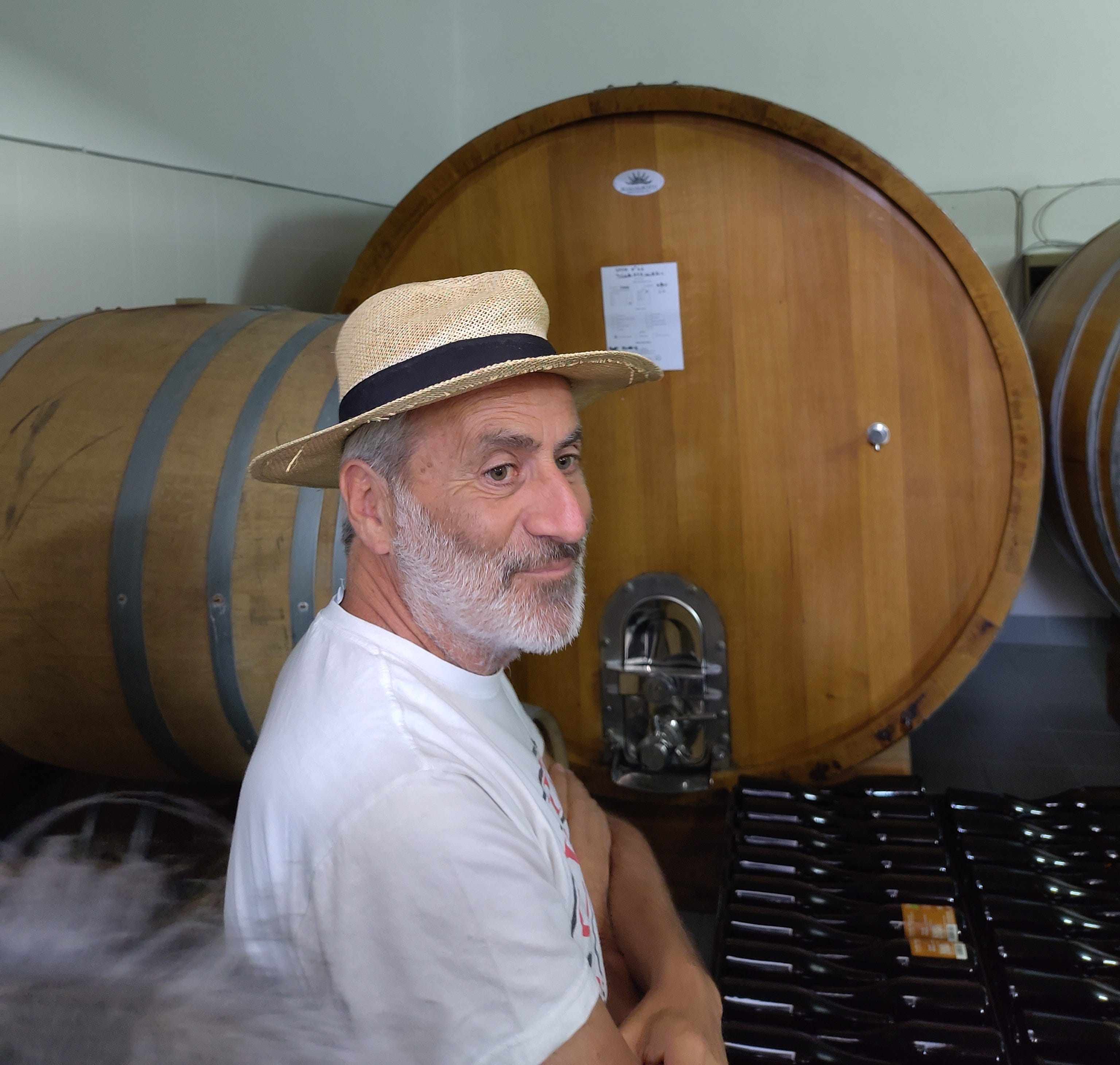
The Massimiliano Solano / Valdibella episode of Nourishing Ideas is available now in two versions — the original Italian/English recording, and a fully dubbed English version. Links in the episode notes. If this kind of work means something to you, consider supporting the podcast through the link below
.
No posts
Comments
Nothing yet. Say the first thing.
Sign in to join the conversation.