
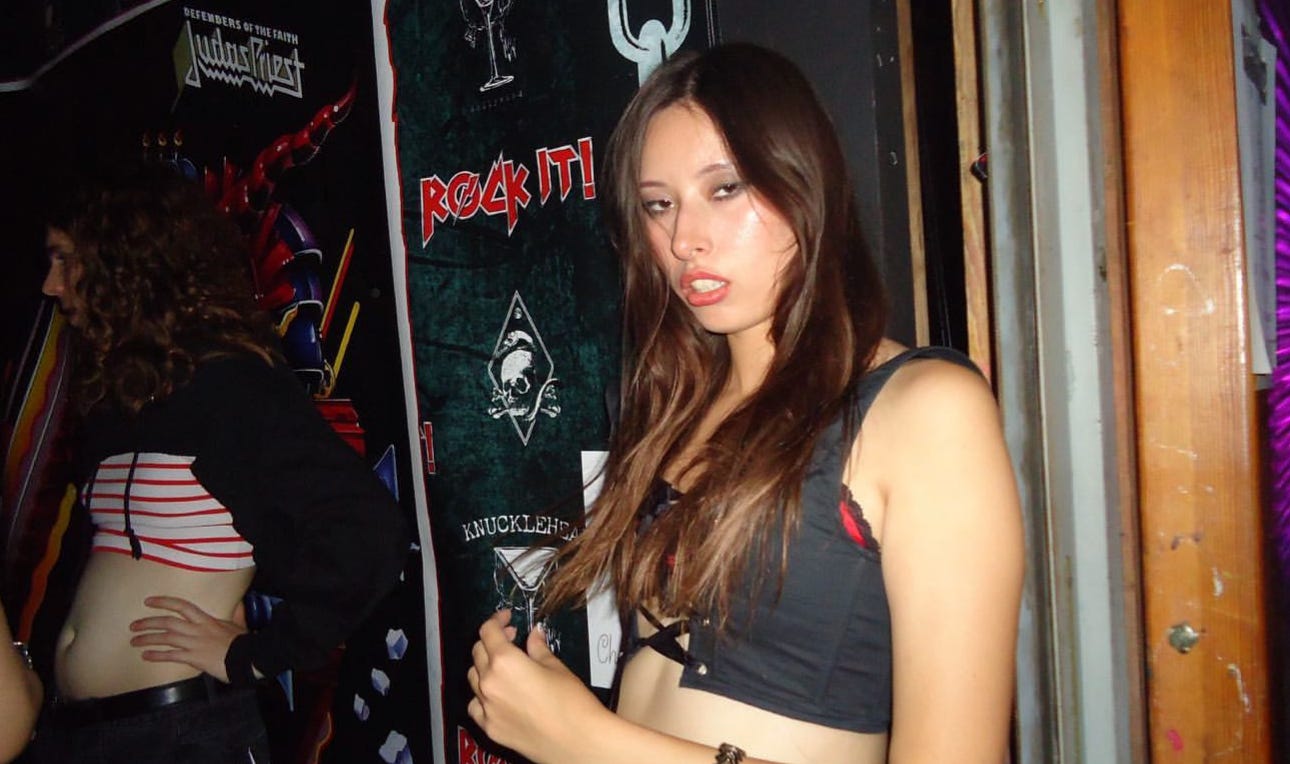
WHO IS THE HOTTEST FEMALE WRITER IN LOS ANGELES?
I scrolled through the message board, eager to find my name—or confront its glaring absence. I landed on something more entertaining.
Guest #1: Brittjivar or whatever her name is
Guest #2: Britt? Jesus no
Jesus no? Who on earth had been so moved by my appearance as to profane our Lord and Savior? I screenshotted the comment, thrilled to welcome such a passionate hater to my posse. Then I chuckled, knowing that neither of these anonymous users would ever have the opportunity to study the intimate contours of my body—although a room of total strangers in Woodland Hills would do so that very night.
I occasionally model for figure drawing workshops. That is, I strike poses for cohorts of artists, holding still so they can practice sketching the proportions of an unusually large nose or unusually adorable behind. Sometimes, these gigs feel glamorous—after all, I’m carrying on the legacy of a generations-old profession, one that has inspired countless masterpieces. Other times, they’re a test of endurance in a way that feels no different from a trip to the gym. Yet I always come home fulfilled.
If you’re reading this, though, you probably shouldn’t come to my next class.
“Sometimes, these [art modeling] gigs feel glamorous—after all, I’m carrying on the legacy of a generations-old profession, one that has inspired countless masterpieces. Other times, they’re a test of endurance in a way that feels no different from a trip to the gym. Yet I always come home fulfilled.” —Brittany Menjivar, Commodification of Self Newsletter
Why did I, a writer, start dabbling in art modeling? One “obvious” answer presents itself: so I could write about it, duh. Yet there’s another, more honest response: I’m a serial dabbler. In fact, I swear by dabbling as an artistic philosophy.
People always talk about Barbie’s supposed influence on girls’ body image. Well, here’s the influence she had on me: at the age of three, I often declared that I wanted to be “the first woman in the world to do everything.” In other words, I daydreamed about juggling a variety of professions: author, screenwriter, actress, photographer, marine biologist.
Writing is my passion; I’ve never tried to brand myself as the prototypical Hollywood multihyphenate. Yet I’ve also stayed in touch with the other creative pursuits that have interested me over the years (though marine biology, alas, has remained out of the question). I’ve acted in short films, danced in the backgrounds of music videos. I’ve modeled for small brands and shot a variety of bands. I work seasonally as a haunted house performer.
I don’t aspire to “make it big” in any of these arenas; nor do I take on these gigs solely for the cash. I earnestly believe they’re a balm for the artistic soul. Maybe, in some way, I’m similar to the proverbial high-achieving woman who likes to lean back in the bedroom—it can be a relief, restorative, even, to play without any pressure.
“I don’t aspire to ‘make it big’ in any of these arenas; nor do I take on these gigs solely for the cash. I earnestly believe they’re a balm for the artistic soul.” —Brittany Menjivar, Commodification of Self Newsletter
Trade secret: it’s easier to break into something new than you think it is. What happens once you’re “in” is typically the hard part.
One day, I noticed that an Instagram mutual had posted about modeling for a figure drawing class; I clicked on the account and sent a DM indicating my interest. Before I knew it, I was on the schedule.
The workshop organizer—let’s call him Tom—seemed amicable enough. He asked me if I could hold several brief poses (one to five minutes each) before moving into longer poses (segmented into twenty-minute breaks). As for my wardrobe (or lack thereof), he presented two options: I could do a classical pose (a.k.a. get nakey) or wear an interesting costume. (I would later discover all of this to be the industry standard.) I told him I would opt for the latter (as my period was impending and I didn’t want to create a different kind of painting on the floor). Before I knew it, it was time for my close-up.
I had blocked off the morning and afternoon to prepare. For the most part, it turns out, art modeling is something you just kind of do—but I came up with a steady rolodex of poses and rehearsed them, recalibrating myself for balance, studying the sensation of my bare feet against the cold floor.
After an “everything shower,” it was crunch time. I slipped into my bikini, grabbed my tote bag, nearly tripped down the stairs. Only at the front door did I realize I wasn’t wearing pants. I threw on the one garment within eyesight—a black trenchcoat—and hustled to my car. When the neighbors waved, I felt like a flasher about to do the dirty deed.
My GPS led me to one of those work-live artist compounds on the fringes of the city. In the parking lot, I met Tom in person. He could have been anywhere between 25 and 45. His expression teetered between a flat smile and a cold stare; I couldn’t tell whether or not he was good-looking. His lack of commitment unnerved me; for a second, I wanted him to be uglier, meaner, definitively middle-aged.
“Thank you for letting me try this,” I told him. “I’d love to hear any advice you might have for me..”
“It’s your first time?”
I nodded. “I’m sorry,” I said, in a way that was purely tactical rather than apologetic. “I really tried to make that clear over text.”
“Well, this is terrible.”
I waited for him to crack a smile. It never came. Neither did the advice.
I went to a “naked party” once—back at Yale, where they were considered an age-old tradition. My friends and I pointedly averted our eyes from each other’s private areas as we stripped to Nelly’s “Hot in Herre.” Despite the song’s spicy subtext, the event was asexual in nature; staring was forbidden, as were advances of any kind. When a classmate asked me what I thought of the experience, I told him, “It’s like I’m a baby swimming in the universe’s amniotic sac.”
Standing in that barren art studio, even in my swimsuit, I could not lay claim to that feeling.
I am a charitable person when it comes to impressions. I give everyone, dour-faced men included, the benefit of the doubt. I know that awkwardness or concentration can sometimes look like coldness. This knowledge could not protect me from the crushing weight of their silent stares.
The same five songs played on repeat as I strained my muscles in ways I had never thought possible. When I attempted particularly difficult poses, few corrective suggestions were offered.
At one point, Tom looked into my eyes and laughed. I wanted so badly to interpret this as a sign of tenderness. The devil on my shoulder chalked it up to scorn—or pity.
None of the participants offered to show me their work. Most of the men packed up quickly; I asked one straggler if he’d be willing to let me take a peek. He showed me a caricaturish image exaggerating my nose and lips; I snapped an iPhone photo.
When I showed my boyfriend the picture, eager to sanctify the evening with the totemic power of an interesting souvenir, he winced. “That doesn’t look like you. You’re so much prettier,” he said. I couldn’t help but feel cheated. Sure, Tom had paid me a stipend—but I did have an intuitive sense that I should be walking away with something more. Was the money not tangible enough? Or did I crave a more holistic reward?
“I am a charitable person when it comes to impressions. I give everyone, dour-faced men included, the benefit of the doubt.” —Brittany Menjivar
I polled my friends: Was Tom an eccentric, possibly autistic man who was too shy to tell me he had been charmed by my naivete, or did he resent me and everything I represented to him?
The results were unanimous—“I’m pretty sure he hated you.” I wasted no time in searching for another workshop.
I didn’t have to look for long. A local gallery had seen my session with Tom advertised on Instagram; the gallery owner wanted to hire me for an upcoming class. Thus, on a sunny Saturday morning, I found myself striding into a studio in Glendale, ready to strip down for real this time.
The gallery owner, a friendly Armenian woman, hugged me and thanked me as soon as I walked through the doors. She showed me to the bathroom; then she led me to a table with refreshments and cookies. Sunlight streamed through the blinds as attendees mixed and mingled. I asked if most of them knew each other; they smiled, eager to tell me about the community they had formed. I didn’t feel like an interloper; I was being welcomed into the fold.
My host showed me an array of pillows and art horses I could use to support myself. She asked me if I wanted to keep track of time on my own phone, as many students preferred to do; I said yes, already made comfortable by this recognition of my agency. Then I disrobed.
No longer concerning itself with confusing social dynamics, my mind was free to wander. It finally alighted upon the subject of my body. Now I will anticipate all your burning questions. We’ll start with a lightning round: Did anyone ogle you? Did you get cold? Were you ever overcome by a sudden urge to go to the bathroom? 1) Nope. 2) No—the organizer checked in to make sure the room temperature was a-ok with me. 3) Yes, but I held it till break time and I was fine. Moving on: Did you feel self-conscious? Hand to my heart, I did not. There was a separation of several feet between me and the artists; it’s not like everyone was looking directly into my cavities. Also, in a figure drawing setting, no one is assessing you against some elusive rubric, trying to figure out what makes you “ugly.” Yes, the artists intend to draw you honestly, but they are seeking the beauty in the distinctness of your form—and they are used to doing so with people of all body types. Also, it’s rare that everyone’s eyes will be fixed upon you at once. Artists will spend much more time looking at their canvasses than they will you. I will say, however, that being observed encouraged me to take better care of myself in the way I held my body—shoulders back, spine straight.
“Yes, the artists intend to draw you honestly, but they are seeking the beauty in the distinctness of your form—and they are used to doing so with people of all body types.” —Brittany Menjivar
Next up: Is it hard to remain in place? It sure can be. Certain stances are more difficult than others—merely standing with your arms crossed can get tiring after a few minutes. (Do it right now, I dare you.) But you find your footing eventually (pun intended). Configuring myself into different poses forced me to try mindfulness on for size. Excuse me while I hop onto my fourth-wave feminist soapbox: pushing yourself to your physical limits really does make you appreciate your body for what it can do rather than what it looks like. I can flex my legs. I can hold my head high. I can wiggle every one of my toes.
Ok, other than the imperative to maintain good posture or the concern that your leg might fall asleep for the next thirty minutes, what did you think about? I’ve never been good at meditation, so my answer is “everything.” (Yes, I want to do everything and think about everything. I’m Type A, ok?) I mostly reflected on problems I was trying to work out, both personal and artistic. Having to stay perfectly still tricked my nervous system into staying calm, so I could think things through clearly and thoroughly. The lack of distractions helped, too—when’s the last time you went hours without scrolling on your phone?
I wasn’t relying on my internal monologue the whole time. Between moments of silence, we would chat; these conversations would spill into breaks (during which I’d slip on a robe). After my final pose, the talk kept flowing. The artists told me about curating exhibitions, applying to colleges, or returning to drawing after years of estrangement; I opened up about my short stories and film scripts. There was no shame in any of our gazes. We met each other in the sacred sacrament of artistic collaboration.
~
Since that sunny daytime session, all of my art modeling experiences have been overwhelmingly positive. When the timer is ticking, I breathe deeply and rhythmically, grateful for the strength in every one of my limbs. When the alarm goes off, I stretch my arms toward the sky; I eat water crackers and talk about jazz or a recent exhibition or that movie that just came out. After class, I walk around and take pictures of everyone’s portraits. Dozens of different women stare back at me. Some of them smile ethereally, painted in pastels. Others drip with understated glamour. Still others stand in power positions, more video game character than movie star. All of them have my long hair, my winged eyeliner, my overbite. All of them are me.
During one class, an artist made an observation that stuck with me. “When I’m drawing, I find myself giving compliments I’ve never come up with before—like, ‘You have great shadows.’ Your shadows are great, for the record.” Shadows—can you believe that? Amidst our self-obsession, we tend to think we’ve looked at ourselves from every potential angle—but there are always possibilities we haven’t considered. What a blessing it is to be decontextualized, beheld without preconceptions or expectations.
It sounds trite, but it’s true: in our current, hyper-online era, the writer’s image matters more than it ever has previously. (Especially if you live in LA or New York, which are both infamously image-obsessed.) Your social media profiles serve as footnotes to any essay. You have to look good in the photos from the important reading, because you have to grid-post them when the night is through. And then there’s the trope of the “literary it girl,” which can feel like an honor or a Post-It note stuck to your back depending on who’s bestowing it upon you. Don’t get me wrong, I love attention—and I know that personal branding can be a way to send a coherent message about your work. Still, the pressure to get it right can be overwhelming, whether it’s external or internal. Sometimes you have to step out of the spotlight and… into a different spotlight. Sometimes it feels good to reveal a different side of yourself, even if that side is your backside.
Am I urging you, reader, to drop everything and start art modeling this instant? Not quite—but I am asking you to walk into a room where no one knows you and bare yourself. Even when it’s weird at first. Even when the AC’s blasting and you get goosebumps. You deserve to be appreciated as you are, not just when you’re all dressed up.
Brittany Menjivar works and plays in the City of Angels. Her short fiction collection Parasocialite has been praised by Nylon, Office, and the Los Angeles Review of Books. Her feature adaptation of Alex Kazemi’s New Millennium Boyz (co-written with the author) is forthcoming from Muse Films. She runs the bicoastal reading series Car Crash Collective with her literary partner-in-crime Erin Satterthwaite. Follow her on Instagram and Substack.
For a discount on the Commodification of Self online course, use Brittany’s code at checkout: BRITTM20
No posts
Comments
Nothing yet. Say the first thing.
Sign in to join the conversation.