
I’ve been spending a lot of time this month avoiding Instagram.
The other day I was thinking about Rush Limbaugh, and the way a lot of my friends reacted to his death, and how I finally just had to take a break from being around Discord or IG. I couldn’t get past how viscerally irritated I was by the dancing on graves, tensing up. At the time, I was having a hard time articulating to myself why.
What I concluded at the time is that I couldn’t stand the way grave-dancers present their behavior as somehow savvy, sophisticated; there’s a “by any means necessary” vibe to it all, the mocking of pearl-clutchers as naive, a posture of Machiavellian rationality.
But like, there’s not usually an argument made that there’s some Deep Truth to it being Good to Mock the Dead, Actually. It’s just seen as prissy to think we should be nice to the Bad People. So really, this stance amounts to a sort of ideological peer pressure, a weird inverted moralism which serves to say, “c’mon man, everyone’s doing it, don’t be lame.”
When pressed, the arguments actually on offer tend to be the same sad, tired rationalizations anybody offers for bad behavior: not justifications for doing something, but accusations that it’s not fair to say you shouldn’t. He encouraged violence — “He started it!” — as if killing him in any way fixes the problem of his political project. We can’t white wash him — “but he’s a big meanie!” — as if affording someone basic respect required that you like them.
This reflects an incredible lack of moral seriousness: a retreat to a toddler’s worldview, as well as a toddler’s level of awareness of what is good for oneself. Looking back at my journaling from that year:
Back home group chat celebrating (?) Limbaugh’s death by reminding themselves of the awful things he said. I thought the case for grave-dancing in cases like his was “he did a lot of bad and people are happy he’s gone.” Wouldn’t such people would move on thereafter, all the happier to forget him? They certainly wouldn’t drag up his corpse to be mad at again. Seems to me getting mad is kinda the point
This is all just wallowing in rage over the badness of the guy who no longer exists. It’s a miserable vibe. What is guzzling this Hatorade for?
Josh Barro recently wrote about the underlying belief that “[t]o have the correct political views is an important part of what it is to be a good person,” a justifiable stance with the unfortunate tendency to degrade into the belief that “people who get politics wrong are worse people, and they deserve worse treatment.”
That’s part of it, I think. What I’d stress is less the idea of defining the outgroup — though the one who does not dance is certainly seen as somehow suspicious — but more of defining the self as an especially committed, cold-blooded politico who accepts the cost of progress. So it’s extremely frustrating that this is all a LARP, one that directly undercuts the actual end goals of progressive politics — equal rights for all people, regardless of our personal feelings about the value of the people in question.
Whenever something like this happens, folks more committed to the bit get real creative trying to explain why this specific murder was actually permissible, see for example Rachel Donald’s “You don’t have to mourn Charlie Kirk.” Most of Donald’s argument is idiosyncratic to her brand of counter-colonial eco-traditionalism, and so not really worth engaging here. But her piece relies on a case study which I think is really useful, because it reflects the reasoning of a lot of progs excusing ghoulishness.
Donald draws an analogy to a tribe faced with the question of what to do with an extraordinarily violent tribesman:
After /Twa killed three other members of the tribe, the community decided to protect themselves. Every single man fired a poisoned arrow at /Twa and, after he fell to the ground, all the men and women stabbed him with spears, symbolically taking collective responsibility for his death.
The problem with this comparison is that the United States is not a small tribe, so our social dynamics are a bit different, with two main outcomes:
We are numerous and spread out enough that it is hard for one member to force existential stakes on all others, removing the protection of ourselves as a motive.
There is no shared consensus over the murder or joint responsibility.
As a result, killing is basically guaranteed to be detrimental, rather than conducive, to group harmony. You can see that even in Donald’s case, in which three murders had taken place and there is a consensus that the murderer must die, all members of the tribe were made to participate in equal measure1 — even in a society of universal kill-/Twa-ism, to let anyone off the hook would risk sowing the seeds of later conflict.
There is to be fair an analogous argument made about societies like ours. If you’ve been in progressive online spaces in the last decade, you’ve seen this meme:
Sure, we’re not a small tribe — but don’t we too have self-preservation concerns? After all, the liberal justification of the state is the need to sacrifice of some portion of our natural liberties to secure the defense of their greater part by force. Can’t one argue that suppression of intolerant politics is the cost of broader political freedom?
Given the recent Coates-Klein discussion, I want to be clear what I’m arguing against here. I am not saying you personally have to tolerate, that is to say like or hang out with, Republicans. I’m saying we cannot as a matter of policy “refuse to tolerate” them, give them the boot, refuse to let them do politics.
My first objection is that this seems like a bad idea given who is in power at the moment; in fact, it’s basically the argument used to (temporarily) get Kimmel off the air. It is not in my self-interest to accept this standard given who gets — or might get — to define what sorts of intolerance are intolerable! “Ah,” one might fancifully respond, “but I’m talking about the objectively intolerable. Their standard is obviously wrong.” Well, put a pin in it, but let’s accept that for the sake of argument. Why shouldn’t we suppress them, aside from concerns of reciprocity?
Well, Jeremiah Johnson’s “What is the purpose of liberalism?” points out that this sort of intolerance is what led to the cycles of bloodshed in the Old World liberalism was created to avoid. I think this tends not to convince because it’s not immediately obvious how being ok with one guy’s death gets us to the Thirty Year’s War. The thing is that this argument does not imply we should “prune” the tree of liberty with the occasional, regrettable assassination. The beliefs of Charlie Kirk that are being considered anathema and thus too disruptive to allow are held by something like just over a fourth of the U.S. population.2 If we are to cast that many people out of polite society, we are going to need a civil war, at least enough terror to cow a significant portion of the population.
What are we really doing here? Why are we pretending there’s any cold-blooded consequentialist argument for killing a man when his death has, very predictably, made everything worse?
In his recent appearance on Ross Douthat’s podcast Interesting Times, Ezra Klein said that in spending so much time “try[ing] to define people out of the community,” “I just think in many ways we were not practicing politics. We were doing something else.”
These aren’t political arguments from hard-nosed Machiavellian realists. This is cope. This is people saying, “I am really sick of having to deal with these people.” I’m sick of dealing with them, too! Unfortunately, we just have to — we are not going to be able to shovel them all into the Gulf of Mexico. I am sorry to say it but we are going to have to live with each other.
It’s beyond ludicrous to say otherwise and dress it up as if you’re some defender of social harmony, and sick to advocate for violence you’re not going to commit. Encouraging sick people to pick up a gun and pointlessly ruin their own life and the lives of others or the sake of looking 2edgy4u online is contemptible. To my mind, that’s the sort of rhetoric and behavior befitting a comparison to /Twa.
The irritating thing about that meme is that it’s not even quoting Karl Popper. This is pointed out by Lasse Jacobsen, writing for Unreasonable Doubt in “The Paradoxes of the Tolerant.” The Paradox of Tolerance wasn’t some deeply worked out principle of Popper’s, but a topic briefly addressed in the fourth footnote to chapter 7 of The Open Society and Its Enemies, in the midst of an extended critique of Plato’s Republic. The context is Plato’s “paradox of freedom:” “‘Does not the excess’ (of liberty) ‘bring men to such a state that they badly want a tyranny?’”
In other words, this is being raised as an argument against the possibility of democratic society, one which Popper rejects! “All these paradoxes can easily be avoided.” But first, he adds to Plato’s two other so-called paradoxes, one of majority rule and another of tolerance: that the majority may abuse the rights of the minority, and that “if we are not prepared to defend a tolerant society against the onslaught of the intolerant, then the tolerant will be destroyed, and tolerance with them.” The very next line reads (emphasis mine):
In this formulation, I do not imply, for instance, that we should always suppress the utterance of intolerant philosophies; as long as we can counter them by rational argument and keep them in check by public opinion, suppression would certainly be most unwise. But we should claim the right to suppress them if necessary even by force; for it may easily turn out that they are not prepared to meet us on the level of rational argument, but begin by denouncing all argument; they may forbid their followers to listen to rational argument, because it is deceptive, and teach them to answer arguments by the use of their fists or pistols.
There’s an op-ed hosted by the libertarian R Street which argues Popper can be read as advocating for more expansive limits on speech than we currently have in the U.S. — but what’s plain is his belief that, when we establish a democratic republic, we have already created the tools necessary to overcome the threat of autocracy. Why do any progs online disagree — why have so little faith in the democratic society that they believe we must contradict its precepts to save them?
When it comes to the tired and the poor, progressives are rightly quick defend the inherent rights and worthiness of every human being. Why else would we defend the felon’s right to vote, or prisoners’ rights in general? Why else protest homeless camp clearances, or deportations of the undocumented? Why care what students can read in school? If, as the right cynically believes, this is all an effort to get votes, it’s a really inefficient one — these are the people least likely to get to (and most likely barred from) the ballot box. The truth is that “Bleeding hearts” are so named because they care about the un-cared for. We believe that an egalitarian, dispassionate respect for the dignity and freedoms of others, treating others as something like ends in themselves, is foundational to any idea of a humane and egalitarian society.
It’s obvious why someone who believes those things would have an immense distaste for Charlie Kirk’s politics — but the whole point is that even those we hate are people with inalienable rights. It’s obvious why Democrats see Kirk’s project as dangerous, a threat to American democracy — but the whole point is that democracy is good and worth defending. You just can’t say that it’s cool and fun for Kirk to be shot in the neck and say that this is your worldview! It is anti-progressive to be for violent censorship!
Above, I’ve mostly given the classic reciprocal case for respecting the rights of Charlie Kirk: I give the Devil the benefit of the law for my own safety’s sake.
But I feel like we’ve become so worried about what those who disagree with us want to take away that we’ve forgotten why we fundamentally believe a free society is better than the alternatives, and “it can be worse” won’t cut it in getting folks to remember. We do not just tolerate but value the rights of those with whom we disagree. If you’ve forgotten, return to J.S. Mill’s On Liberty.
When we’re faced with speech we consider so wrong to be anathema, worthy of suppression, Mill reminds us that there are always three possibilities: we are either wrong, partially wrong, or right. In the first case, opposition to censorship is obvious. Because we are not infallible, we should try to encourage a norm of protecting political freedoms, lest we enforce error. The second case is the danger of most censorship, because it’s when the worst person you know has a good point that you’re most tempted to shut them up. Predictably, this leads to bad outcomes. It’s the third case we most often have trouble remembering — why should we suffer the completely incorrect opinions of proven morons? Forget Kirk, what about literal Nazis?
What is testified to in Scripture is attested in life: even the sinner is good, and he can be good for others in some ways that a righteous man cannot be.3
The most obvious danger is that we very often mistake examples of the second case as belonging to the third; we overestimate how right we are, and how wrong are others. It is ancient wisdom that we are more disposed to see the speck in the eye of our neighbor than the log in our own. But it’s not just that we might be wrong; we might be made more correct. Henry Farrell, “In praise of negativity,” writes that our ability to reason evolved more to convince/rebut others than to discern absolute truth. This happily means that “[o]ur ability to see the motes in others’ eyes while ignoring the beams in our own can be put to good work, when we criticize others and force them to improve their arguments.”
We benefit from this dynamic, Mill argues, even when we are totally in the right. If we never test our belief, even if it is God’s revealed truth, we really only believe it on faith — we only happen to be correct. Such “dead dogmas,” he reminds us, are fragile. Any thinking person is liable to abandon them, knowing that “[h]e who knows only his own side of the case knows little of that,” and ultimately “has no ground for preferring either opinion.” And only through testing arguments do we actually understand the implications and limits of what we believe, such that we can rationally implement the belief, aware of its function and proper use.
We are made better by the fact that we force ourselves to live with, to defend, the speech of those who are in the wrong. We know that the only alternative is pig-headed tribalism and willful ignorance. There is a reason that the people most defensive of their right to celebrate the death of Charlie Kirk are so often morons!
I’m haunted by the face of that guy in the Mehdi Hassan Jubilee fiasco, the one who cops to being a fascist. Every time Mehdi points out a contradiction in his thinking, evincing confusion, he gets this weird glint in his eye. When reminded of the obvious fact that his politics would justify his death at the government, he responds, basically, “no u.” “It’s Schmidt’s friend-enemy distinction,” he says. Aren’t I clever.
They know that their remarks are frivolous, open to challenge. But they are amusing themselves, for it is their adversary who is obliged to use words responsibly, since he believes in words. The anti-Semites have the right to play.
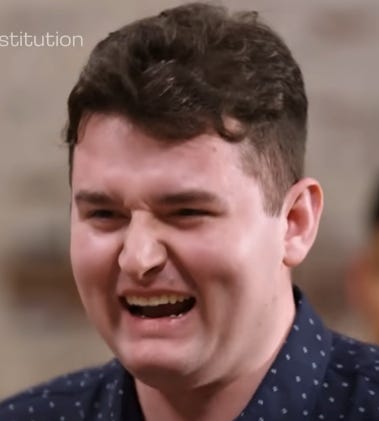
I cannot express the depth of my disgust watching this idiot manchild snort and bounce like a diaper-wearing baboon. It is perverse. It physically angers me that someone so stupid feels so much pride over a willful disregard for logical consistency.
This is the alternative to the humane society. This is what I see when I listen to people give such bad arguments in defense of being unable to bring themselves to just say “people should not be silenced by execution for bad politics.” It debases you to act as if this makes you some cool thinker when it only reflects a total lack of ability to put aside your own emotions in the face of something this existentially serious. This violent pig idiocy can only lead in one direction. We are trying — should be trying more desperately — to save ourselves from that fate, not accelerate the collapse.
You know better than this! Act like it!
nitpicking but your involvement is not merely symbolic if you’re stabbing the guy
J.M. Gustafson, introduction to H.R. Neibuhr’s The Responsible Self.
No posts
Comments
Nothing yet. Say the first thing.
Sign in to join the conversation.