
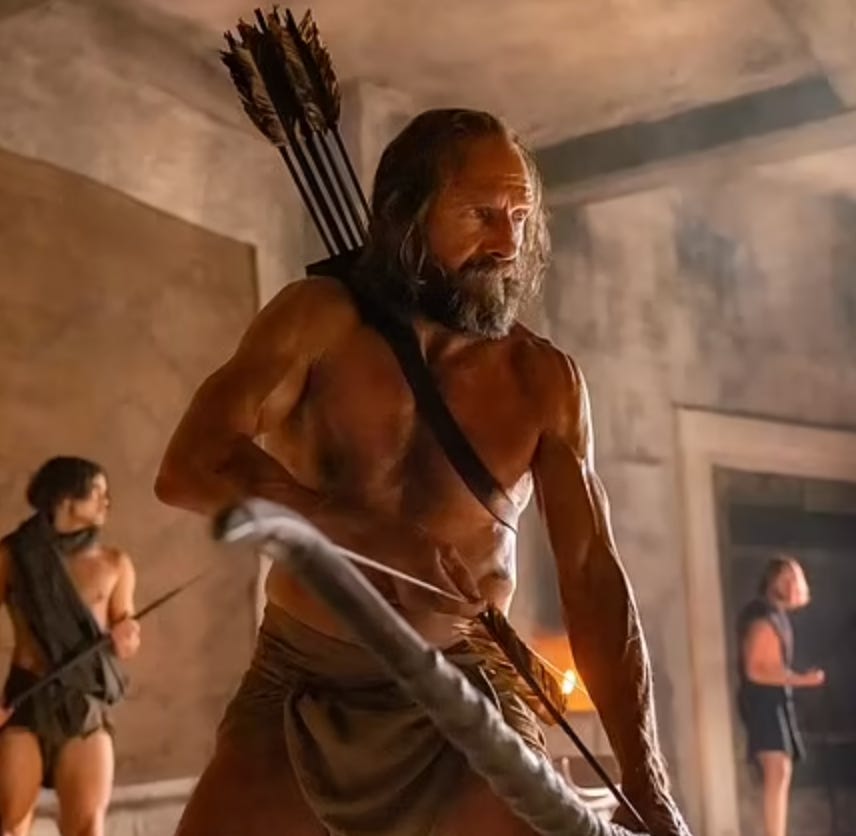
I have not seen Christopher Nolan’s The Odyssey yet. I have seen The Return, a whole film only about the climax of The Odyssey, and I’ve reread The Odyssey very recently, Emily Wilson’s verse translation.
Many may not agree, but I find Homer’s writing in The Odyssey to verge on the cinematic. I mean, if cinema had existed 2800 years ago, I’d simply call his writing cinematic. It’s contemporary in its visual vocabulary, as are many national epics. El Cantar del Cid comes to mind.
But, as someone who has written for the big screen and experienced the kind of notes one gets on a screenplay, I have one major issue with Homer’s epic.
The scene with Odysseus’ bow is both the story’s climactic strength and, ironically in a narrative populated by gods, witches, giants, and monsters, its least plausible element, maybe because it isn’t overtly supernatural.
Why would Odysseus leave his sentimental favorite bow at home instead of taking it with him as his personal weapon to use in the Trojan War? Is this an important question? No. Is it an entertainment question? I would say so.
A minor issue in this vein touches on the eyes of the axe blades (or axe handle holes, which is how the word στειλειή has come to be translated) through which Odysseus shoots the first arrow. Why does Odysseus have such a multitude of axes, of both iron and bronze, in storage? As my mother used to say, “You can only use one at a time.” Why so many axes in the closet in your house, Odysseus? Don’t you have an official armorer?
He has at least two store rooms in the narrative: one he hides the suitors’ weapons in, and another his wife hasn’t open since he left for Troy. Both are only called “the store room” or whatever, but we know they have to be two different rooms because the one Penelope opens to get his bow is opened after the one in which he hides the suitors’ arms and shields. And Homer makes a big deal out of that.
To distract from questions about the bow, Homer makes a big production of Penelope’s opening of the keepsake store room.
To illustrate what I mean, let me first paraphrase a demonstrative tidbit my dear late theater collaborator and friend Danny Thompson of Theater Oobleck once imparted to demonstrate the over-theatricality of an action. He was quoting a critic or perhaps a Stanislawski-like acting mentor, and he portrayed the actor as he narrated: “The actor dusted his chair off before sitting down, sweeping his coattails out of the way of his heinie with a flourish. He crossed one leg over the other, with a flourish. He reached into his inner breast pocket, with a flourish, and produced a two-foot-long match. He struck the match on the bottom of the shoe on the foot of the crossed-over leg, with a flourish of course, and with still another flourish he lit the cigarette in its foot-long holder, “and let me tell you,” said the critic, “that cigarette was lit.”
Homer tells us:
“The queen had reached the storeroom, and she stepped across the threshold of polished oak; a skillful carpenter had set it level, fixed the frame, and built the dazzling double doors. She quickly loosed the door-thong from its hook, pushed in the key and with true aim, thrust back the fastenings. The fine doors, as the key struck home, began to bellow as a bull at pasture bellows.”
And let me tell you, them storeroom doors was open!
Odysseus’ bow, unbendable by any lesser man than himself, hangs in there. Homer takes great pains to explain why Odysseus hasn’t brought it with him to the war, an attempt only serving to highlight the improbability and thereby the convenience of having the unbendable bow appear at this point in the story.
Why did he not bring this bow to the Trojan War? Well, Homer explains, his friend gave it to him, and his friend died. And it was an heirloom handed down among the male sires of that friend’s lineage. So, obviously, it was too precious to bring to a war.
Of course, that is exactly the kind of weapon one would bring to the war. A sword with great lineage is just the kind of sword one wears to every battle, because it’s battle tested. And if your friend who gave it to you died, what better way to honor your friend than to bring it to the most important war of your lifetime? It is literally and literarily absurd for Odysseus not to have brought this bow with him. The only reason he didn’t is because Homer wanted it to appear at this climactic moment in the story.
Homer’s problem is that it couldn’t be a second-rate bow. It had to be an important bow. One doesn’t use secondhand items in a climax. “The reason Odysseus didn’t take this bow, which only he could bend and string, was that he already had a better bow, which also no one but he could bend and string. Yeah, there were two bows, a really great one to use in battle, and a not-as-good one to leave at home for Penelope to lock away. Yeah, that’s the ticket.”
He’s a good archer, too. People have known that about him since he was a boy. He’s an all-around great strategist, especially in The Iliad, and fighter. No reason not to bring a bow to the war, and even less reason for him not to bring this special bow.
It’s very likely Homer heard about a similar scene in another story and thought, “Ooo, that would be a great climactic moment for when the raggedy-ass Stranger reveals himself to be none other than the King of Ithaca. There’s just one thing,” Homer says to himself: “why would Odysseus not bring his super-special bow with him to the Trojan War? Eh, I’ll just make something up.”
In the Ramayana there are two great bow scenes. One is when Rama is competing for the hand in marriage of Sita. No one can bend the bow. Only Rama can bend the bow, but it’s so inflexible that it breaks. In another scene he’s proving his battle prowess to the Monkey King and shoots an arrow right through a tree and out the other side. Actually, through seven trees and out the other side and into a big rock that shatters.
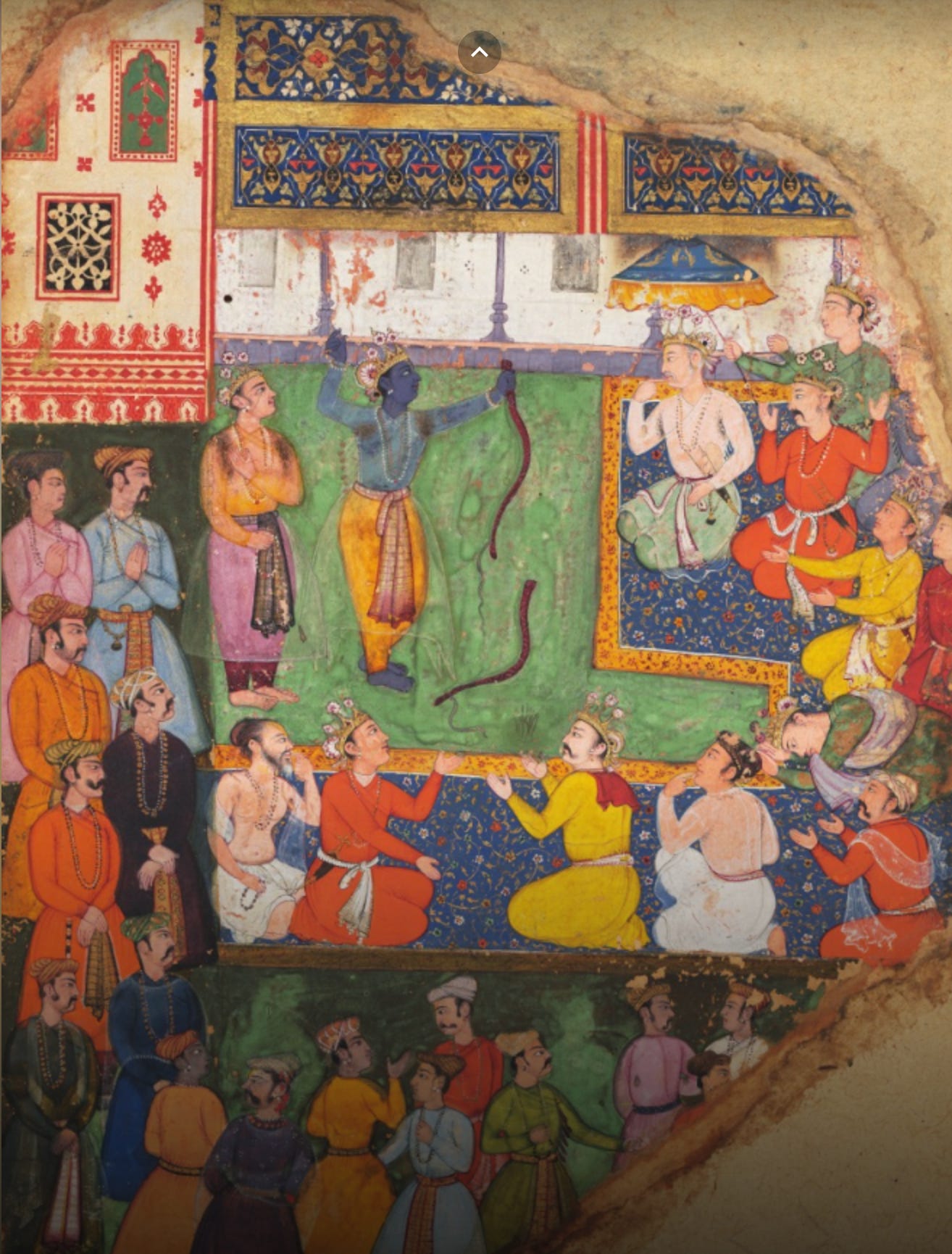
In the Mahabharata, Arjuna and his archery instructor Drona both accomplish great feats of aim with arrows. Also, Arjuna’s arrow shot is so powerful that it sends the chariot from which he lets it fly rolling backwards, an early prefiguration of Newton’s third law of motion.
Neither of those Indian sources, and there are many others, had the problem of requiring that a special bow only appear at a specific moment. Homer’s story requires special pleading.
Even 3000 years ago, Greek storytelling carried the seeds of what we call western modernity. Whereas Rama’s breaking of Lord Shiva’s bow takes place at the winning of his bride, Homer’s telling takes place in the late stage of Odysseus and Penelope’s relationship in a household in which their marriage has undergone a great deal of stress due to distance. It’s a far more quotidian, personally identifiable environment. I could go on and on, as many have, about western modernity1 and its self-congratulations over focusing on mundane domesticity.
Many have also pointed out the resemblance of bow-and-arrow scenes in various foundational myths. So, I claim no originality in what I’ve argued here. I’ll close by repeating another thing other writers have asserted: audiences don’t care about plot holes. As long as the story and its constituent scenes work in the moment, there’s no harm done by contriving a convenient story element.
But I do want to assure the spirit of Homer, you can’t bullshit a bullshitter.
Sorry, I mean “modernism”… kind of. Or, the “modern aesthetic.”
Comments
Nothing yet. Say the first thing.
Sign in to join the conversation.