
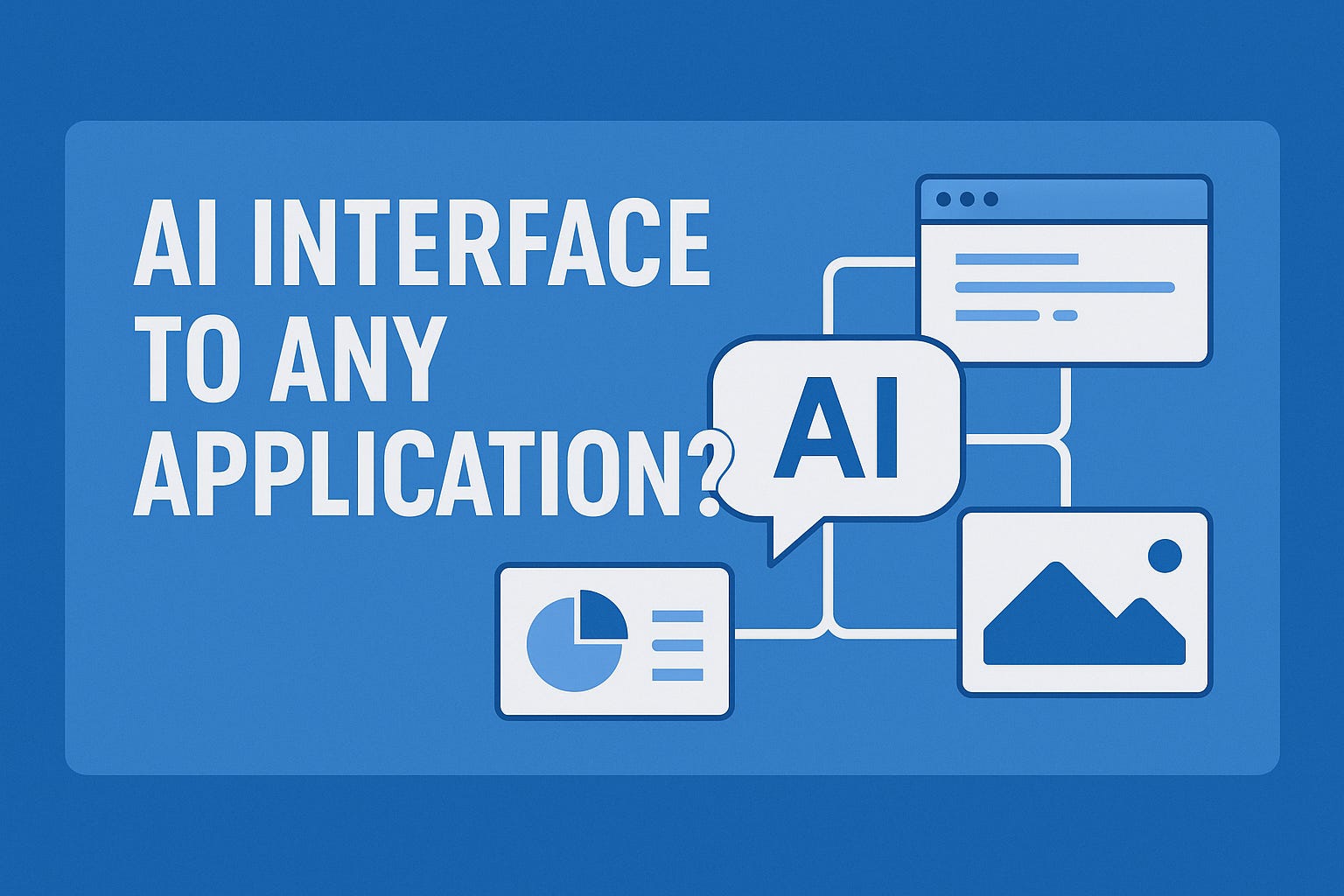
With the hype around AI continuing to grow, does it make business sense to use it as a universal interface—especially now with the emergence of the Model-Process Protocol (MCP)?
Until now, AI has mostly been used as a support tool—essentially acting as a smart assistant. Common use cases include text-based help like proofreading, translation, summarization, and brainstorming. In ERP systems, AI can assist users with such support tasks but typically does not interact directly with core system processes.
The Model-Process Protocol (MCP) changes the game. It acts as a kind of "interface glue" that allows software systems—browsers, design tools, ERP systems, etc.—to be accessed and operated through AI.
With MCP, AI can do much more than just read or interpret data. It can request, update, and even operate across multiple systems. For example, you could instruct AI to pull data from one system and insert it into another—without needing a traditional UI or integration layer in between.
Essentially, AI becomes the new user interface for any system that has an MCP server installed.
There are already several MCP servers available today. Just search for “MCP servers” to explore what's out there.
Curious about the possibilities, I decided to create an MCP server for GrowERP. Since GrowERP has an OpenAPI interface, building a server seemed relatively straightforward.
Given that AI is at the core of this innovation, I thought—why not let AI help build the MCP server itself?
I used Claude AI from Anthropic (the creators of the MCP protocol), integrated into VS Code. You can get started with just $5; API keys are available at [https://console.anthropic.com/](https://console.anthropic.com/).
**My prompt:**
_“Create an MCP server for GrowERP using the OpenAPI interface at https://backend.growerp.org/rest/service.swagger/growerp/100.”_
Claude eventually generated a basic MCP server. However, the first result was a mocked-up version—a template not intended for production use.
After some iterations, I ran out of tokens, bought another $10 worth, and asked for a production-ready version. Claude made many improvements, and the server eventually built successfully. But even then, it wasn't quite right—it bypassed MCP by connecting directly to the OpenAPI, defeating the point of using the protocol in the first place.
This experiment shows that we are indeed at the beginning of a major shift. MCP has the potential to allow AI to act as a natural interface between systems—a powerful concept. However, don’t expect end-users to interact with your ERP system purely through AI prompts just yet.
Instead, AI could evolve into a behind-the-scenes mediator, helping users get what they need by guiding them or handling cross-system tasks.
One caveat: performance. AI is extremely flexible and capable of understanding intent, but that flexibility comes at the cost of speed. Complex queries or system operations may take longer than traditional methods.
Still, this is a fascinating step forward—and the journey is just getting started.
No posts
Comments
Nothing yet. Say the first thing.
Sign in to join the conversation.