
If you are one of the millions* of people who watched the 2025 College Football Playoff National Championship on January 20th, you likely saw the video recorded message from President Trump that played at halftime. In my personal social media feeds, the reaction was instantaneous, centering on the notion of “That was a choice.” My immediate thought was about the '‘Keep politics out of sports” crowd and if they would show up with an opinion**.
On January 21, this article from the Guardian*** made the rounds in my social media feeds: “Donald Trump’s return to power lays bare the lie that sports don’t matter.” The TL;DR version centers around the Trump campaign took advantage of what sport has to offer, and that sports matter.
“Sports create space where people create collective meaning. Fandom isn’t random. It is rooted in social relations that can bend toward the political.”Sports and politics are inherently intertwined. Always have been, always will be. Do you like community sport leagues, and changes in street direction and traffic control in and out of stadiums and arenas on game days? That’s your local government at work. Do you love the spectacle of the Olympics and the FIFA World Cups? There are absolutely politics at the global level.
I talked, in an earlier post, about the intersection of politics and sports, and how we have begun to treat sports like politics. It’s hard to separate the two out when we treat them the same.
One of the 8 motivations sports fans have for watching sports is the idea of escape. We use sport as an escape from every day life; to forget, even temporarily, stressors, problems, or difficulties. One of the most common refrains I hear from people who argue to keep politics out of sports is that they are watching sport to NOT have to think about political (or social) issues.
Laura Ingraham told LeBron James to “Shut Up and Dribble” in 2018, saying it was “unwise to seek political advice from someone who gets paid a hundred million dollars to bounce a ball.” In November of 2024, Ingraham once again talked about athletes merging politics … except this time, while doing an interview with former WWE superstar Hulk Hogan, she praised San Francisco 49ers defensive end Nick Bosa, Las Vegas Raiders tight end Brock Bowers, and Detroit Lions defenders Za’Darius Smith for doing the ‘Trump Dance’ . Apparently these athletes are ‘sending a message of hope’ that ‘Trump can end racism.’
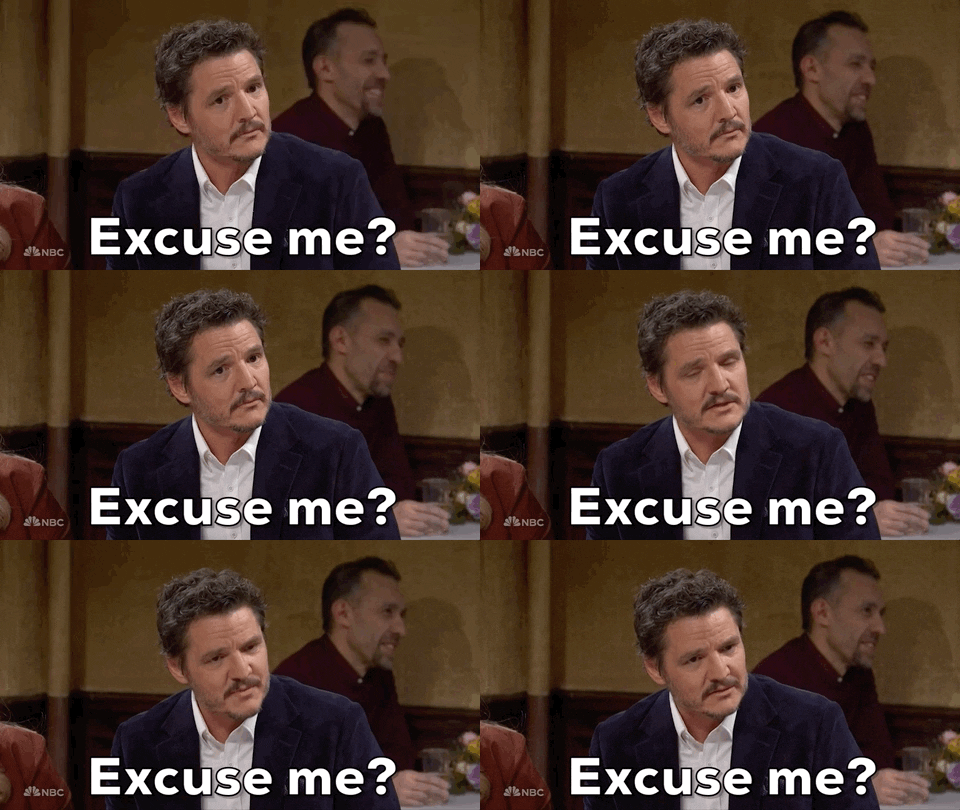
If you have whiplash from that 180, you’re likely not alone. It shouldn’t be too hard to figure out what is different about these two instances.
Using sport as a political tool is not a new concept. In the political arena, sport has been weaponized to further agendas and stoke nationalistic ideals, with recent examples including the notion of sportswashing and the fight to exclude transgender athletes from participating in sports. People are more than willing to gleefully use sport when it props up their own agenda, and dismiss it when it does not.
Circling back to the motivation to escape, perhaps it’s time to stop catering to the idea to ‘keep politics out of sport’ and admit that what is wanted is to not have beliefs, values, and ideologies challenged. In a world of extreme media fragmentation, it is easy to curate a media feed that reflects only one point of view. The more that feed echos, the louder the messages become, and the attachment becomes even stronger. These are your people! They understand you! To put this in terms of sports, this is your team.
Perhaps this is the point where sports are one of the few things that can pull us out of our respective echo chambers and force us to confront different worldviews, even those with which we profoundly disagree. This is not limited to one side of the political spectrum. I’m sure many people were thrilled to see Trump’s message during the national championship game, while many were not. People embrace messages of social justice, equality, and inclusion while others oppose what those ideas mean.
As we move forward, it is ignorant to think that politics and sports will never meet. The value of what sport can bring, and how it touches people, are exceptionally powerful tools. We will see sport used to further ideologies and agendas. This will be done both for the betterment of humanity, but also will (continue to) be used as a weapon against humanity.
Let’s just be honest and say that if you want politics kept out of sports, you’re not really talking about politics. Rather, you don’t want sports to pull you out of your echo chamber and force you to confront something that makes you uncomfortable.
But this, friends, is the place we shouldn’t shy away from. I tell my students that being confronted with a different worldview often will make you uncomfortable, and you should take the time to figure out why. There is also a line that you must be willing to draw. There’s a difference between a viewpoint making you uncomfortable, and a viewpoint that seeks to reduce the humanity of another human being - racism, sexism, homophobia, transphobia, xenophobia, and you should NEVER be forced to ‘tolerate’ or listen to those types of viewpoints.
Being uncomfortable is how we grow and move forward. Rather than demand that it never happen, perhaps it’s time to actually listen to what is being said.
*Final viewing numbers have not been released at the time of this writing.
**Though I have not seen much in my feeds, I acknowledge it may be out there and I just haven’t seen it.
***In an effort to stay transparent about sources, I will note The Guardian is a left-leaning outlet.
No posts
Comments
Nothing yet. Say the first thing.
Sign in to join the conversation.