
(originally published at Avant Music News)
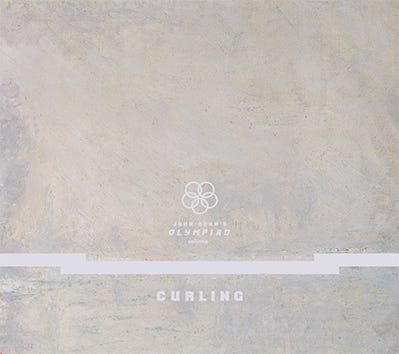
Has Tzadik ever timed a release so perfectly? Right on cue for the Milan-Cortina Olympics, we get the latest installment of John Zorn’s Olympiad: two versions of the composer’s 1978 game piece, Curling.
Curling is unlike any other Olympic sport, so it’s no surprise that Curling is like no other game piece. It is also among the least well-known. The first recordings came only in 2015, when the guitar quartet Dither grouped three versions of the piece with variations on Hockey and Fencing. The contrasts on that record hint at how Zorn represented the sport itself. Curling is only a contact sport in the gentlest possible way, and the piece has none of the violence of Hockey or the somewhat later, more famous Cobra.
The new release offers two takes on Curling, one each from the Rova Saxophone Quartet and the William Winant Percussion Group. Combined with the guitars of Dither, we now have a staggering range of approaches to Zorn’s most minimalist game piece.
Curling is built on long tones. As with all of the game pieces, the “rules” are unpublished, so outsiders won’t know the parameters for the improvisation. Still, we can work out some of the principles. The interactions between musicians seem to operate a bit like old-school screensavers: One long tone bumping into another (like a curling stone, natch), then another, and so on. The collisions can gain in complexity, but only so much so. Unlike most group free improv, the aim isn’t to explore a full range of dynamics or colors.
The Rovas, in particular, embrace those limitations. They bring out all sorts of gritty and scratchy saxophone sounds, but they rarely rise above about mezzo piano. The rules seem to give players the option to replace long tones with repeated short notes, like those of notated minimalism. Yet over the course of 25 minutes, the Rovas only occasionally take advantage. The promo copy for the new release offers the adjective “meditative,” and while I would hesitate to use the word, the saxophone quartet probably brings the listener as close as possible while still following the rules of a Zorn game piece.
A percussion quartet is an intriguing choice for a piece centered on sustained tones. The transition from the Rovas to the Winants is surprisingly smooth, as the percussionists begin with bows and cymbals: the sounds aren’t that different from alto and soprano saxes. In a span of 20 minutes, the group also deploys drums, maracas, and the occasional mallet instrument. The fact that they are often hitting things--and thus playing lots of short notes in place of literal long tones--gives the percussion version more variety than the saxophones.
Both the Rovas and the Winants offer a completely different vision than the guitarists of Dither. The mostly-electric quartet--in all three variations, even the one with acoustic axes--seems to want to push the piece as hard as they can, jostling against each other, gesturing toward dynamic and emotional peaks. Dither’s takes on Curling are more subdued than their Fencing or Hockey but still considerably more frenetic than either group on the new recording.
There will never be a definitive version of any of Zorn’s game pieces, so we are lucky to now have three interpretations of Curling with such diversity among them. The long tones, even if they aren’t really meditative, make the piece more accessible than the likes of Cobra or Xu Feng. Even if you don’t tune in for the curling competition in Cortina, the latest Olympiad from Tzadik demands your attention.
No posts
Comments
Nothing yet. Say the first thing.
Sign in to join the conversation.