
(Note: this post was originally written in 2019 and reflects archiving and image use as it existed then)
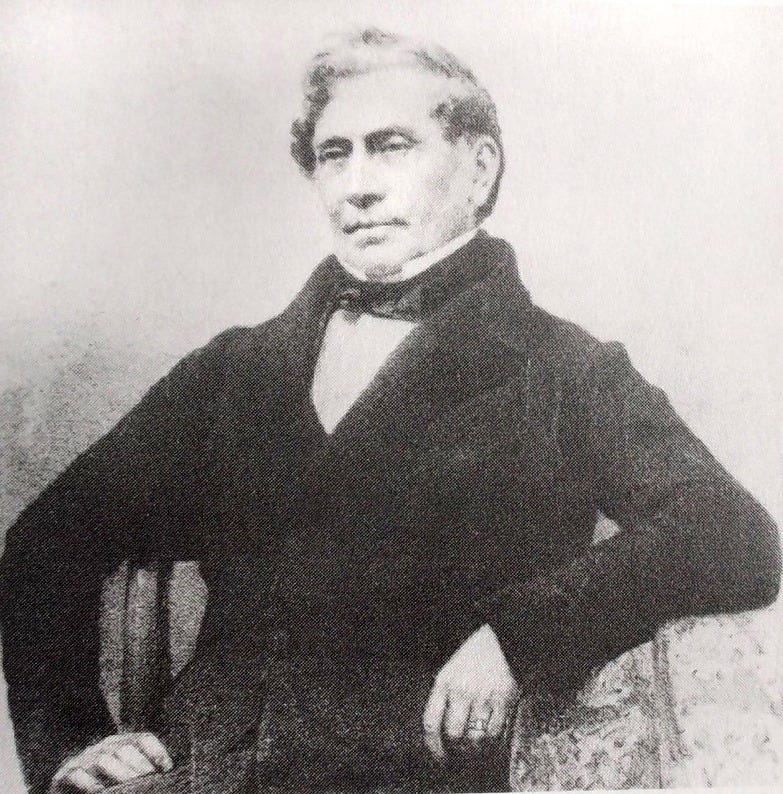
In the image, a man sits in a respectable dark suit of the 1840s. He is a man, probably in his forties, comfortably secure and confident in the middle of his life. His pose is easy, face a little serious but relaxed. He is very much a gentleman at ease.
I will admit I always liked this image. Of the images and paintings supposedly of Dr. James Barry, most are either from when he was a very young man or well into his old age. In all of them, there is a certain tenseness about him, a little bit unhappy, a little bit guarded.
I liked the idea of this image being of Barry in the middle of his life. By his forties, he’d reached a little bit more balance than he’d had when he’d been younger. He’d learned to be a bit more political and about how to rein in his temper. He was a seasoned medical administrator, army officer, and civil servant, no longer having to be undermined by older men who thought he was too young for the positions he held. He was also published and respected in the medical field. Although he still ran afoul of military bureaucracy and societal norms, it was no longer with the willful arrogance he’d displayed in his youth.
In his forties and fifties, Dr. James Barry would have been a solid man, confident in a position and reputation built on decades of experience, which he had very much earned.
The only problem is that the above image is not of Dr. James Barry.
I first came across the image labeled as being of Dr. James Barry in Scanty Particulars by Rachel Holmes. Although in the book the image is labeled as being of Dr. James Barry, Holmes does not cite where she originally found the image, nor is there a citation for the institutional repository that holds the original copy. Wikipedia also uses the image in the page on Dr. James Barry and reproduces it as a public domain image. Their citation is Scanty Particulars by Rachel Holmes as well, and they do not list the original institutional repository either.
For a long time, I just assumed this was good enough, even though I couldn’t trace the image back to its original location; I assumed Holmes must have compelling evidence that it was of Dr. James Barry. The thing about Barry, though, is that the more I research him, the more I discover just how much misinformation about him there truly is out there. Over time, the image bothered me.
Jeremy Dronfield claimed on social media that the image was not of Barry at all, but didn’t follow this claim up with a citation or the name of the institutional repository where the original was held.
Finally, I decided I was going to get to the bottom of this image and who it actually was. I knew the Royal College of Physicians museum had included Dr. James Barry in their recent exhibit entitled ‘This vexed question’: 500 years of women in medicine, and I knew they’d used that particular image of Barry. I assumed that since they had a full staff of professional curators, they must have citations to go with all of the images they had on display, at the very least for legal reasons. When I reached out to them, however, I was told by the curator I emailed that the image had been sourced from Wikipedia, and they didn’t have any more information about its province than I did.
Finally, in desperation, I went searching for a reproduction of the image used in such a way that a citation, of something other than Wikipedia, absolutely had to be included. That was how I actually found it. Neo-/Victorian Biographilia and James Miranda Barry by Ann Heilmann uses this particular image as its cover art, and because of copyright law, doing so required the publisher to provide a full citation for the original image.
That was how I learned the original image was held by the Western Cape Archives and Record Services in Cape Town, South Africa, archival reference number M774.
That was more than enough information to go to the Western Cape Archives website and use their catalog to track down the entry for the item in question.
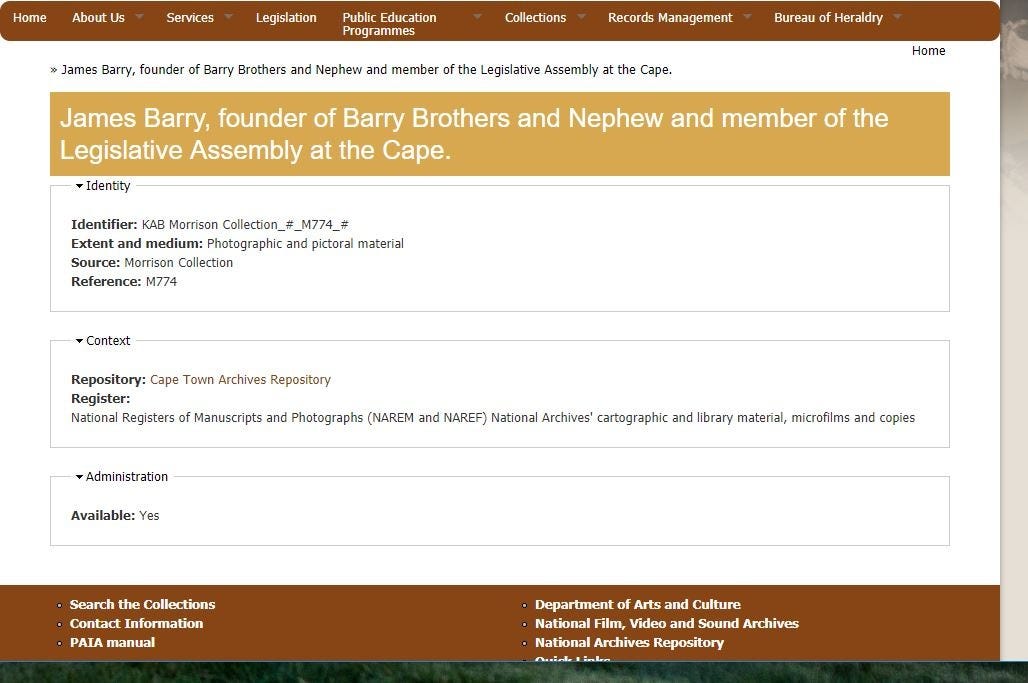
As you can see, the item is clearly described as not being Dr. James Barry.
It turns out there was another James Barry of note in Cape Town.
The Barry family was wealthy merchants in the Cape Colony who owned a chain of counting houses. The business was started by Joseph Barry, who, although originally from England, immigrated from France to South Africa. He was joined in the business by his brother and, later, his nephew, James Charles Barry, who is most likely the man in the above image.
What I think happened is that at some point, this image was mislabeled in a catalog as belonging to Dr. James Barry. I could be wrong, though; there could still be more twists to this story.
As of now, though, unless there has been a significant case of mislabeling at the archive that holds the original artifact I am saying this is, sadly, not Dr. James Barry.
No posts
Comments
Nothing yet. Say the first thing.
Sign in to join the conversation.