
One of the themes I love to explore in my Notes of a Wildflower is living more — or wanting to live more — in tune with the seasons.
Following the rhythm of light and darkness, of growth and rest.
Over the course of a year, the sun moves through winter, spring, summer and autumn. The moon does this in her own way, in roughly 29 days.
In this series of Wildflower shorts, I take you along the full moons of this year.
This time: the full moon of August 28th — the Late Summermoon.
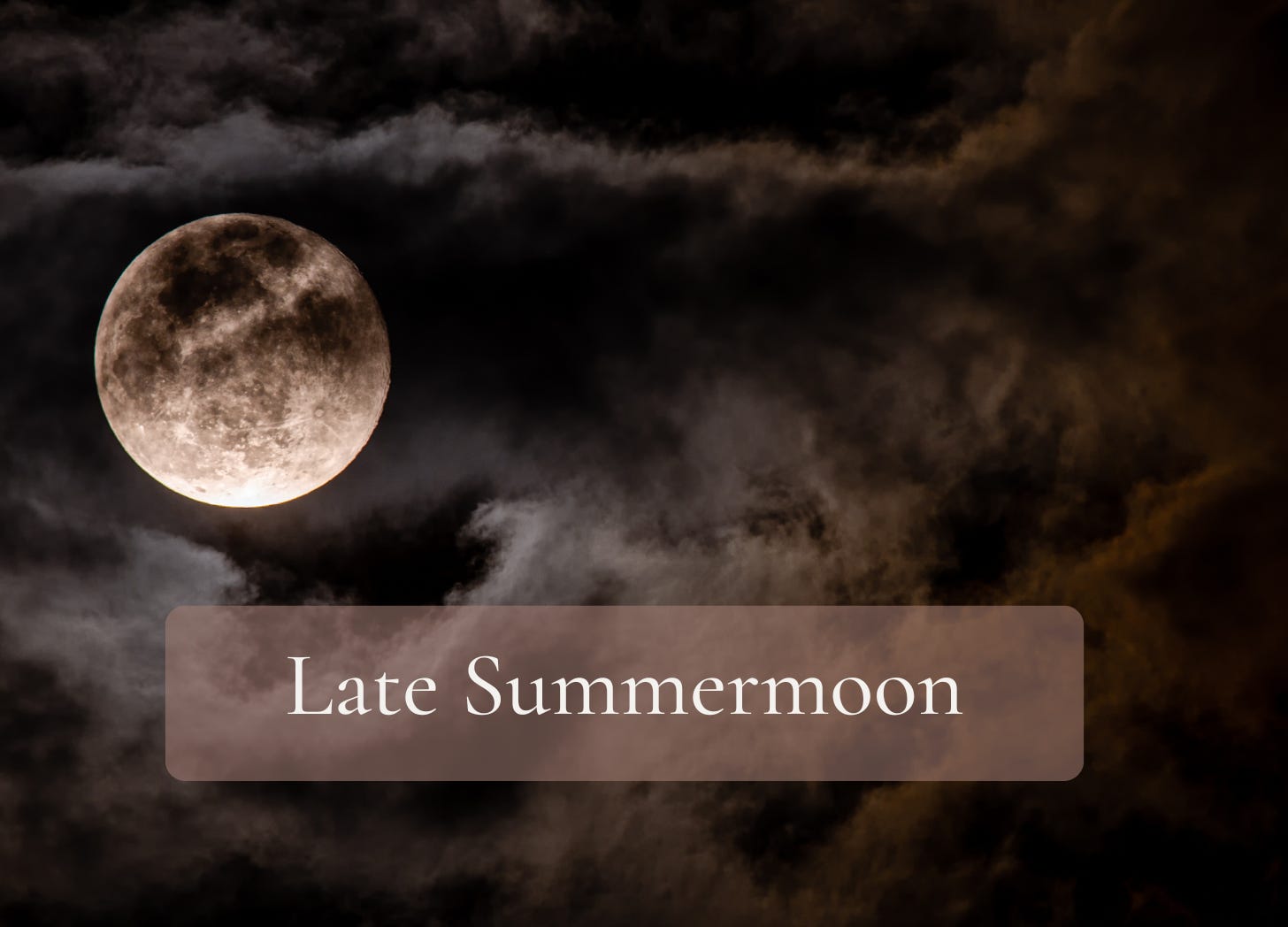
The nineth full moon of 2026, the full moon of August, falls on August 28.
Below I’ll tell you more about the background of several names given to this full moon, as well as some other special events between this full moon and the next one.
Here you can find the Introduction of Wildflowers Year of the Moon:
Don’t forget, a full moon is a time to celebrate and being grateful. 😊
The seasonal name of this Full Moon is the Late Summer Moon. This name refers to the transition from summer to the beginning of autumn. The energy of summer is still very much present, but you can feel it shifting towards autumn — the season of ripening and harvest.
The Late Summer Moon symbolises transition, ripening, completion and gratitude. The Late Summer Moon invites you to pause and reflect on what in your life has come fully into bloom and what may be beginning to change. It is not only about what you want to grow, but also about what is ready to be harvested.
The name Sturgeon Moon refers to the sturgeon, a large freshwater fish that could traditionally be caught in abundance during this season. This Moon is associated with food and abundance.
Spiritually, the Sturgeon Moon represents abundance, perseverance and depth. The sturgeon is a fish that can live for a very long time. For this reason, this Moon also represents longevity and wisdom.
Normally, this is where I mention the name the Celts gave to this Full Moon. There is no single, universally agreed-upon Celtic name for the August Full Moon. I have chosen to include the name Grain Moon here.
The Grain Moon refers to the ripening and harvesting of grain in late summer. What began as a tiny seed has now grown into a beautiful crop. This Moon is therefore also about ripening, patience, harvesting what has been sown and abundance.

Other names for this full moon that I came across include:
The Lightning Moon refers to the summer thunderstorms that often occur during this period, much like the Thunder Moon of July.
The Corn Moon refers to corn ripening and being harvested during this period. You can also find this name used for the Full Moon in July or even September.
The Fruit Moon refers to the harvest of summer fruit: plums, peaches, apples and pears. Such a beautiful time! 😊 Along these lines, I also came across Plum Moon and Moon of the Ripening, or Moon When All Things Ripen.
This Full Moon, on 28 August, will be partially eclipsed by the Earth’s shadow in the early morning. The eclipse will reach its maximum at 6:00 a.m. The Full Moon will temporarily turn red, creating what is sometimes called a Blood Moon.
During the week of 6–14 September, the Moon will pass by the planets Mars, Jupiter, Mercury and Venus, one by one, on 6, 8, 12 and 14 September.
On 1 September, the small Aurigid meteor shower will be visible, with around five to six shooting stars per hour.
In September, the Summer Triangle can still be seen. It is not a constellation, but is formed by the three bright stars Vega, in the constellation Lyra; Deneb, in Cygnus; and Altair, in Aquila.
During this period, the constellations Capricornus, Cassiopeia, Ursa Major and Pegasus are also clearly visible. Early in the evening, Capricornus can be found low in the southern sky, with the bright star Deneb Algedi. Cassiopeia is recognisable by its ‘W’ shape. Ursa Major can be seen in the northwest. Pegasus is in the east and is recognisable by its Great Square.
On 23 September, the autumnal equinox takes place. The day and night are then exactly the same length.
Helpful tools for observing stars and planets include apps such as SkyMap, Sky Tonight, or Night Sky.
The different phases of the moon can be seen on the following dates:
Last Quarter: September 4
Autumn: relaxation and self-care.New Moon: September 11
Winter: reflection and setting intentions.First Quarter: September 18
Spring: taking action and making decisions.
I have come up with a number of reflection questions for you to think about when you want to consciously pause and reflect during this Late Summer Moon:
What is ripening, and may I soon be ready to harvest?
What change is beginning to reveal itself?
What wisdom have I gained so far this year?
Where could I trust my own experience and inner wisdom more?
What am I grateful for?
What do I want to preserve and carry with me into the next phase?
Perhaps you could spend ten minutes (or longer) writing with the prompt:
The Late Summermoon tells me…

The next full moon will be on September 26: the Autumn moon! 🍂🌕

Finally, read this post if you want to learn more about the new moon.
No posts
Comments
Nothing yet. Say the first thing.
Sign in to join the conversation.