
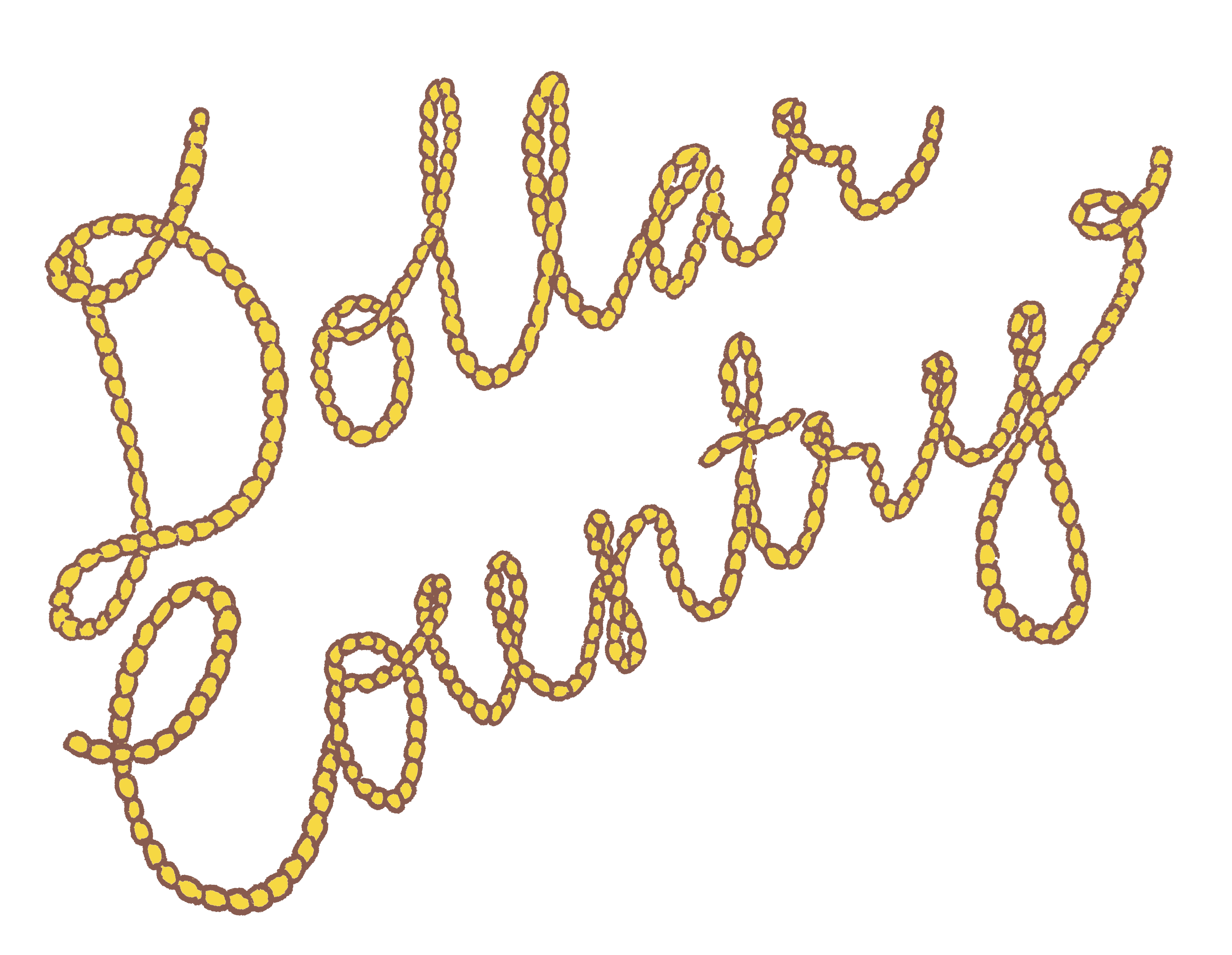
A couple of years ago I took a short roadtrip to interview Franklin Fantini, who runs the podcast and newsletter Dollar Country from his Cleveland home. I think what Franklin is doing is as important as ever, and well worth your time. Check out his website, where you can find episodes of the show and some really neat merch. You can also follow him here on Substack where posts newly released episodes of the show as well as monthly updates on cool stuff he finds.
In the late 60’s, an aspiring singer named Jim Mansell recorded a slew of singles for the Kansas City label Throne Records. One song, 1968’s “Fool’n,” opens with a charmingly crude fiddle line interspersed with jazzy honky-tonk piano flourishes. With a soft but commanding croon, Mansell delivers a haunting, twangy show tune about a lover who’d played him for a fool. “Fool’n” is a country song through and through, part of a rich musical tradition, which, over the course of the 20th century, grew into a massive corporate industry. But Mansell’s music can’t be heard on country radio stations or streaming services, and you’re not likely to find it in record stores outside of the Kansas City area either. Because, like most of the artists you’ll hear on Dollar Country, Jim Mansell never hit it big.
Dollar Country, a podcast disguised as a radio show, deals almost exclusively in records like Mansell’s — songs by musicians who never had their time in the limelight. Eight years and nearly 250 episodes in, host Franklin Fantini, or “Frank the Drifter” as he introduces himself on air, has played thousands of virtually unknown country records to his listeners. The show, which Fantini sees as a way of discovering and sharing the history of country music in America, also reevaluates the way we ascribe value to music and art. “I think a lot of this country stuff is undervalued and will forever be undervalued,” he says.
Fantini feels that nowadays, as far as some collectors are concerned, the monetary value of a record determines its quality. Since the average consumer doesn’t have time to listen to records all day long and determine which songs are good and which ones aren’t, they often must rely on other signifiers of quality and value. For many, that signifier ends up being a record’s price tag. “When I’m selling, people will see a $20 record and they’ll think it’s better than the $5 record,” he tells me. But the market price of a record is determined largely by rarity and demand, not quality, which, of course, is ultimately subjective. But Fantini listens to and collects music not just for its sonic, aesthetic or monetary value, but its historical value as well.
Musical and artistic movements are often defined by their most famous practitioners, who are honored in museums, award shows and magazine listicles. And while many of these influential artists are fully deserving of inclusion in their respective canons, there’s more to the story than just the superstars. Before the advent of recording technology helped turn it into a commercial industry rather than a personal and communal activity, country music was part of the folklore of rural America, particularly in the South. “For a lot of people, ‘music’ meant ‘country music,’” Fantini says. “If someone picked up a guitar, they were playing what we would call country music. As a genre, the well is so deep.” Even in the context of the modern recording industry, the well is as deep as it’s always been if you look past the iconized figures at the surface.
To Fantini, country music contains the history of America, or at least an important part of it. He feels that country records tell the story of (mostly) white, rural working-class people, much like blues records do for working-class black people. The music of country’s biggest stars tells this story too, but, in a purely quantitative sense, they tell a very small percentage of it. The bulk of country records that exist are songs we’ve never heard, created by artists whose names we’ve never seen. By zooming in and taking a closer look at some of these unheard songs, we can actually widen our lens and paint a broader picture of the story country music tells.
Record companies and producers are doing this around the world. In the last decade-and-a-half, as vinyl has seen a rise in popularity, so too have reissue labels who release music that wasn’t commercially successful in its time, but that they believe has value. There are various artist compilations documenting the City Pop era of 1980’s Japan, the 70’s rock scenes in Zambia and Nigeria, and studio album reissues by bands and artists whose records were once thought lost forever. Labels like Light in the Attic, Numero Group and Mississippi Records make it their goal to disseminate these forgotten gems to modern listeners who may appreciate them. Fantini considers himself to be “on the same team” as these labels, but he runs his operation in a fundamentally different way, which he believes creates a different kind of value in the music.
“I’m going to play a bunch of stuff, and the listener is smart enough to figure out what they like, whereas Numero Group is picking out these very special diamonds in the rough.” The primary difference in these two approaches is in who is ultimately doing the curation. Most labels curate their outputs themselves and decide what is worth releasing to the public. Fantini on the other hand plays everything and lets his listeners determine which tracks are diamonds. Nonetheless, he still considers himself to be a curator, albeit a less exclusive one. To his weekly listeners, twenty or so tracks per episode seems like an endless supply. But the number of tracks he’s played since he began the show pales in comparison to his full collection. In over eight years of regular broadcasting, he’s played only a fraction of what he owns. In that sense, he sees himself as what he calls a gatekeeper of independent and private press country music. “The people who listen to my show don’t get to hear the stuff I don’t play.” But they may eventually, as Fantini shows no signs of stopping.
While Dollar Country focuses on its own niche, the variety found on his show exists in other areas as well, and, like Jim Mansell’s “Fool’n,” it isn’t always available to hear on Spotify or Apple Music. How many small-time doo-wop vocal groups and soul singers made records in the 50’s and 60's? How many punk bands in the 70’s and 80's? Countless genres and scenes have equally deep wells of history just like country music does. The undervalued contents of those wells are ripe for the taking, and you can probably find some in the unmined dollar bins of your local record store.
No posts
Comments
Nothing yet. Say the first thing.
Sign in to join the conversation.