
Imagine Sherlock Holmes in hot pursuit of Professor Moriarty, the “Napoleon of crime,” a bona fide mastermind who orchestrates a criminal empire from behind the scenes through layers of agents and institutions. In “The Final Problem,” Holmes deduces the grand design by relentlessly returning to first principles, peeling back every assumption until the hidden architecture stands exposed. That same elementary habit defines the work of Ludwig von Mises and F.A. Hayek—the Holmes figures of first-principles thinking in economic thinking—while, to run with the analogy, Henry Hazlitt and Thomas Sowell serve as their steadfast Dr. Watsons, translating those insights into clear, everyday language that ordinary people can wield. Moriarty, in our time, is the composite figure of central planners, credentialed intellectuals, bureaucratic administrators, and the conformity machinery they maintain. “Moriarty” does not reward payment in first principles; he demands payment in compliance, credentials, and practical utility suited to his status quo.
Elementary thinking is easy if you think about it. Just start with space and time, geography and history; or, perhaps you’re more of a critical realist and believe in ontological stratification, emergence, and epiphenomenon:

One problem with this line of reasoning is the chicken-and-egg dilemma between individuals and society (and between agency and structure). However, when it comes to us humans, each of us, everyone we know, and all our measurable genealogies were and are born into an always-already historically situated social structure, and then we are socialized within and into it, largely reproducing it throughout our lives. Emile Durkheim called the persistent presence and irresistible, inescapable influence of the social world on individuals “social facts,” known today as social forces. Social facts are all those aspects of social reality that exist independently of individuals—they were here before we were born and will largely remain after we die, and they are influential if not coercive to us—we either accept and abide by their legitimacy or there are subtle, not-so-subtle, and inescapable consequences if we do not.
Elementary thinking requires us to examine Durkheim’s concept of “social facts” through the same first-principles lens we have used throughout this series—I believe I just did, but I reproduced, at least in part, Durkheim’s own proposition. For Ludwig von Mises, Durkheim’s claim that social facts are external, coercive realities—existing sui generis, independent of individual consciousness and constraining human action—represented the clearest example of the holistic sociology he rejected outright. In Human Action and his epistemological writings, Mises insisted that all social phenomena must be traced back to purposeful individual action; there is no “society” as an objective entity with its own laws.
Durkheim’s positivist approach, like Marx’s dialectical historical materialism, treated the social as primary and individual thought as derivative. This was, for Mises, epistemologically untenable and ontologically mistaken. It is the same error that produces the economic calculation problem: planners (or sociologists) who hypostatize collective facts ignore the subjective meanings and dispersed knowledge that alone make rational coordination possible. As I argued in my own chapter, “Austrian Sociology,” this Durkheimian view stands in direct opposition to the methodological individualism that links von Mises to Max Weber’s interpretivist verstehen—both begin with actors’ subjective orientations rather than with reified “social facts.”
I believe this, too, can be scrutinized using first-principles thinking, as it should be. The fact of the matter is, as I stated, humans are born into a world not of our own making or choosing. We have inborn genetic contributions that shape our anatomy and physiology, which is why children bear a family resemblance to their parents and share similar personalities, too. Numerous twin studies demonstrate this. Of course, a well-trained sociologist would say this is all the result of nurture (never mind the physiological similarities), that socialization (and culture) is the main explanatory factor. Twin studies disprove this. If you, as an infant, were adopted and raised by a family in a society on the opposite side of the world, you would very much more than likely speak their language, practice their customs, and likely sing their national anthem to boot. Social facts are facts, but only individuals act. Both can be, and are true at the same time. Education is a prime example.
Education, as an institution, is intentionally used to shape individuals, as well as whole cohorts and populations; individual students differ in their aptitudes, abilities, and dispositions toward the setting, of course, but the institution of education and organizations that school children attend are, in fact, designed to mold minds and shape behaviors collectively. Durkheim knew this, which is why he proposed using education as a means of moral manipulation of the masses; Marx and Engels knew this, too, which is why their 10th plank in the plan for (global) communism was for the state to provide “free” “public” education—I believe this is one reason why generations accept as a fact of life “the need” of central banking. One outcome, I believe, of government schooling, institutionalized for over a century, has been a growing acceptance and support for socialism and communism and the declining popularity of capitalism with each successive generation. It’s not supernatural, a coincidence, or a random chance. The Marxists took their long march through the institutions.
The social fact of the matter is that institutions and organizations exist in their own right: Family members come and go, and whole families can be wiped out in genocides, yet The Family persists; Prophets, popes, and parishioners die while Religion lives on; students graduate, teachers retire (and are fired), and schools close down, yet Education remains, like a metastasized tumor or an oak tree in a tornado, depending on your perspective; even under heavy regulation, central planning, criminalization of trade, markets materialize (or metastasize, depending on your view) wherever and whenever people continue to trade; and finally, the State has taken many forms over the eons, from strong-man domination by warlords and despotic tyrants, to empires and kingdoms, to religious orders, to governments, and possibly in the future, to corporations (think Walazon or X-Meta, should they gain the legitimate use of force and coercion).
Reducing all social phenomena to human action is a conceptual error, ontologically incoherent, and an existential mistake. Methodological individualism has its analytic utility, at the very least—it’s actually indispensable if and when actual, real-life living human beings with names and birthdates are part of the analysis, but macro-level analyses are, too. One can analyze the institutional inertia behind the transformations of all of the above social institutions and the slow growth in the size and power of governments, to the point of a return to the systemic corruption of myriad historical totalitarian autarkies, without studying Pharaoh, King George, Leopold, Napoleon, Lincoln, Hitler, the Bushes, Clintons, or any of their lieutenants—of course, it wouldn’t hurt to do so, but it’s not necessary for a macro analysis.
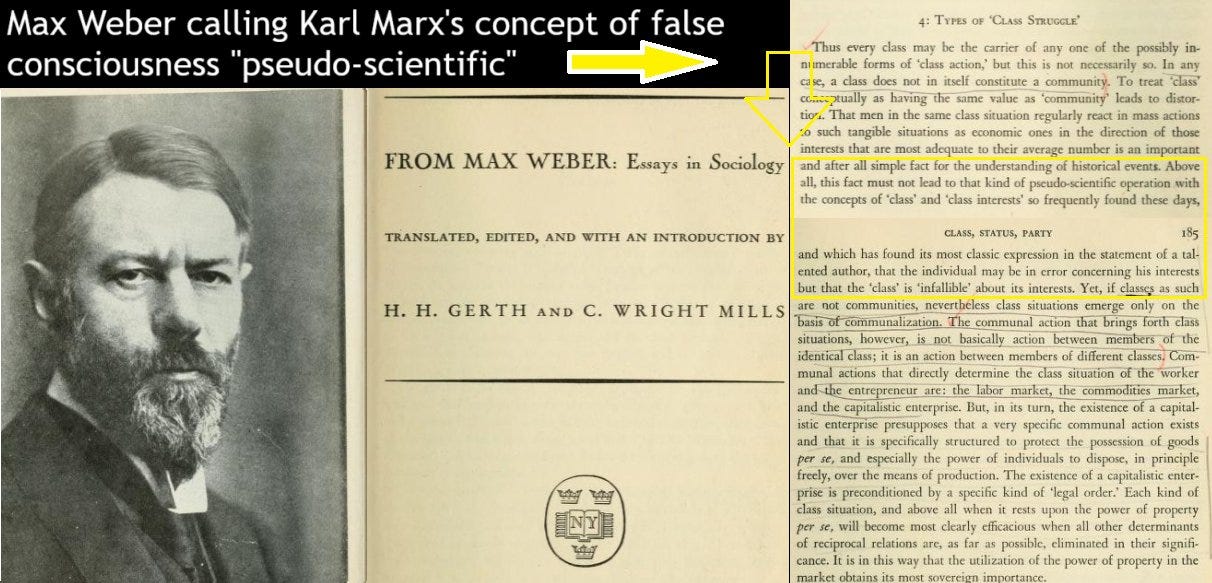
The persistent return to the undeniable fact that individuals act purposefully in a world of scarce means and dispersed knowledge is the one currency the piper will not accept. Macro-analysis all too easily slides into the kind of metanarrative upon which postmodernists founded their religion. One need not slide into the 2+2=5 insanity of strong relativism to critique metanarratives; just look above at how Max Weber surgically dismembered Marx and Engels’ cornerstone logic of “false consciousness” with the scalpel of methodological individualism. But what happens when millions of people are educated throughout their psycho-social development with pretty much the same content, delivered with pretty much the same interpretations? You get one generation (or two) who believed Columbus had to convince people the Earth was a sphere, and another generation (or two) who believe Columbus was on a mission to wipe out indigenous peoples of the West.
This is likely why education was targeted for infiltration and occupation, and it explains why classical liberalism, Austrian economics, libertarianism, and conservatism are so often demonized or ignored altogether. Speaking from experience, I have tried engaging thousands of college students in the most basic form of elementary thinking, starting with time and space, and it’s as if not being able to read an analog clock or paper map translates to the refusal to acknowledge that we do not at first have to ask detailed, specific questions (not that they, I, or most people have the knowledge to do so). When and where are often good enough starting points, followed by who, what, how, then why—never mind should! Austrians start with the fact that humans must act and that we act intentionally. One outcome of schooling is that many people postulate from conjectures instilled in them from mutually reinforcing institutional narratives, Left and Right. I believe this has been the point of institutional capture by (neo)Marxist and other radical social theorists.
This social fact, which is that education has been, can, and is used to condition the minds of populations, cannot, and should not be ignored. This is why the series title itself is more than a (somewhat) clever phrase—it is the practical solution we have been building toward across the previous parts, and it continues in the tradition of Mises, Hayek, Hazlitt, Sowell, and many other first-principle scholars. One game I like to play with my students is called Richbucks. It’s an in-class activity in which points are awarded based on how many Richbucks my students can pay me at the end of class. They each start with one, on loan at 10% interest. As the activity goes on, they learn that few, if any, will actually be able to accumulate any “wealth” due to my debt-based fiat monetary system. I then explain that this is much more in line with Marxism than free market economics, showing them the 5th plank of communism. This leads them to first-principles thinking: How can you pay back what you owe if you must continue borrowing from your lender to repay them in the lender’s own currency, which is loaned at interest? They tend to understand, often realizing why I ask them if they know what mitochondria are, followed by fiat currency.
Simple math is first principle thinking: 1+2= 3, always; 1-2= -1, always; and 3 > -1, and it is typically better to have three of something than to owe one. In economics, the “double thank you moment” negates this math: When I win, and you win, we both win; therefore, there are three wins. You can focus on the individuals in the interaction, but the production of value requires the interaction, which is a thing in itself that can be studied, and routinely is by symbolic interactionists. The mistake in the Austrian school is failing to take the leap from Mises to Weber, from human action to social action. Both men, polymath geniuses in their own right, fully understood the importance of considering others’ perspectives, and both provided critical insights into how and why bureaucracies are beloved organizations for central planners. Anyone who has ever served on a committee within a bureaucracy knows that bureaucracies do not function from individual actions alone.
Enter F.A. Hayek: Hayek deepened the critique of the managerial mindset of social scientists and philosophers in The Counter-Revolution of Science, where he identified Durkheim’s sociology as a prime case of scientistic hubris, which it is. Durkheim’s attempt to model sociology on the natural sciences—treating observable “social facts” as objective data analogous to physical facts—ignored the subjective meanings, tacit knowledge, and spontaneous order that emerge from millions of individual plans. That said, Durkheim was onto something: There are nested layers of social reality that exist above the level of individuals, one of which is social interactions (cash transaction), another is groups (fans at a sporting event and the teams on the court), then there are organizations (the team franchise), communities (all fans of the team), networks (fantasy sports leagues, professional sports leagues, corporate partnerships), social institutions (economics, sports, media), culture, civilizations, and globalization.
Hayek’s knowledge problem shows why such facts of social life cannot be centralized or treated as coercive constraints: what Durkheim called external social forces are often the unintended outcomes of human action coordinated through prices, norms, and institutions (formal and informal rules and expectations)—outcomes no central authority or sociological observer can fully grasp or control. This is obviously false, and probably just my bad reading of Hayek. Of course, Hayek would have had to understand that patterns of social behavior persist long after individuals die or leave an organization or group. Of course, Hayek would have had to understand that, for example, large-scale economic factors, such as the manipulation of central bank interest rates, lie far beyond the control or influence of entry-level workers, yet affect their lives intimately and profoundly. And, of course, Hayek would have understood that infants have no influence over the conditions they are born into, that children largely accept the world around as a matter of fact (hello, Santa Claus, the Tooth Fairy, going to school, being tested on information in textbooks, asking to use the restroom), and that many adults are only nominally incredulous toward the monetary and banking system, two-party system, corporate news, or why government should, in any way, set educational policies for their own children.
For both Mises and Hayek, Durkheim’s framework is not neutral social science—it was not; it is a philosophical prelude to the fatal conceit of central planning itself—it was. It subordinates elementary thinking (the persistent “why” that begins with individual purpose) to a collective ontology that serves the status quo of bureaucratic and intellectual authority. The early macro-level social theorists, save for Max Weber, were obsessed with managing social order by manipulating its institutions, primarily education and the economy. None of this means we can’t or shouldn’t engage in macro-level analysis. In fact, if we don’t, we risk missing the forest for the trees, as they say, and in some cases that risk entails losing sight of the fact that controlled burns are routinely used to manage forests. Now, I don’t want to sound like a conspiracy theorist—yes, I do, but the fact that Marx and Engels’ Communist Manifesto has been one of the top 10 most commonly assigned texts in Western colleges and universities for decades, that it states abolition or state control of every major social institution, that plank 5 in the communist agenda is nationalization of banks, that the tenth of 10 planks is “free public education,” that they call for the forcible overthrow of all existing social structures, and that they theorized this as an early form of globalization resulting in a world-wide communist system, indicates that it is possible, maybe even likely, that the communists have engineered social facts to reach or very nearly reach most of their goals. Just take a look around since 2020 (hello, the Great Reset, ring a bell?).
It is an undeniable, indisputable social fact that cannot be ignored or argued away that schools are used to indoctrinate children—yes, “indoctrinate” is a strong word, but it does not mean “brainwash,” though that might happen, too. And, considering that it is much more difficult to unlearn than to learn, which has certain implications for the deeply embedded moral lessons of the bureaucracy of government schools, not to mention the increasingly overt lessons of radical activists in classrooms mistakenly called educators, how can we say that this is all reducible to spontaneous order, emergence, or epiphenomena of social reality? The genealogy of these ideological indoctrinators can be traced to Education departments in higher education, namely Columbia University, which in turn can be traced to influences from the neo-Marxist “Frankfurt school” critical theorists. This is why, after all, Hayek and Sowell took concern with the role and influence of intellectuals in society.
The generation that cut its teeth on Marxism, postmodernism, and other radical social theories and philosophies in Introductory courses in the social sciences and humanities when those texts first began appearing in the late 1970s-80s has been making hiring, promotion, and firing decisions in higher education for two and three generations now. This is why we’ve seen the steeper lean toward left-wing ideologies throughout Western Civilization over the past 10 to 20 years. In this regard, I am the piper that won’t take payment in Austrian first principles if those principles must always be reducible to particular individuals. The collective patterns, emanating as they do from the individual brushstrokes necessary for the painting, make up the total picture. As Durkheim is famous for saying, there is a sui generis social reality, and as his and other lunatics’ pursuits make clear, it can and has been managed.
Opponents of Mises, Hayek, Hazlitt, and Sowell took long strides to reach the point where those names are all but nonexistent in educational materials across most of higher education—this is called agnotology. We are at the point where, in the process of epistemicide, their philosophies and economic theories can be called, in black and white ink with no uncertain equivocations, “evil,” said to “threaten to destroy society” by those unchecked “evils,” and that the laissez-faire free market system was created by the state and can operate only through state intervention. This comes from Chapter 2 in a major section titled “Neoliberalism,” authored by popular textbook author, social theorist, and Sociology Professor George Ritzer. His book is now in its 2nd edition, and I could spend an entire essay alone showing you how he and many others like him spin a web of guilt by association that links Hayek to the assassination of Salvador Allende and the coup of the Chilean government (just ask Naomi Klein, and then ask Johan Norberg about Naomi Klein). Folks, “they” are engineering pro-communist, anti-capitalist, and statist ideologies into the kids, and “they” have been doing this for decades!
Elementary thinking forces us to confront how the axiological narrowing of curiosity has turned the natural drive to ask “why” into a truncated habit of asking only “how,” and it’s not “how can this possibly be,” but “how do I pass the test to get my degree?” After saying everything I’ve said above, I’ll ask the question: how can this possibly be? In short, parents, teachers, and media figures, all of whom matriculated through the type of educational systems I’ve described, self-selected and were selected to constitute those positions in organizations that made this possible. “They” channel multiple intelligences into narrow, measurable pathways that sustain existing hierarchies rather than cultivating the stamina for foundational questioning. The world doesn’t need more philosophers, as the saying goes, unless those philosophers are the intellectuals who find justifications for how to transition the prevailing social order into the next global order. The result is a public that defers to polished expertise while the actual masters of any field—coaches, scientists, economists—privately “go back to the basics” when reality diverges from expectation, but publicly go along with the program lest they sacrifice their careers.
We see this survivor bias everywhere: standardized testing and “because that’s why” parenting produce adults who accept debt-based money, demographic engineering, and bureaucratic solutions as inevitable rather than as deliberate designs. When we apply Mises’ praxeology and Weber’s social action, we understand that these institutions do not emerge spontaneously; they are the visible outcomes of individual actors pursuing their own ends within rule structures that discourage elementary renewal. We could call this social engineering. We could call this institutionalization. But we should not call this “spontaneous order.” We should not reduce these phenomena to the cascading latent functions of purposive social action. For every unintended, unanticipated, or unrecognized consequence, we can ask the very basic question, cui bono? And my first principle is that if there are people benefiting financially, occupationally, socially, or in terms of maintaining their freedom to continue to act in ways that allow them to continue accruing resources, mistake after alleged “mistake,” then at what point do we ask ourselves if our first principles have failed us, if they lead back to the assumption that only individuals act?
As a callback to the first three parts of this series, and to ground this in historical and consequential facts, we should apply a first-principles lens; the monetary system reveals the nature of this beast at its core. Nixon’s 1971 decoupling of the dollar from gold, paired with the 1970s rise of fiat credit and central-bank monopoly, created a debt-based money that must expand perpetually to service prior debt obligations. Untold generations of unnamed humans will be born into debt bondage, just as happened for decades prior. Children are still told “money doesn’t grow on trees,” yet the monetary and banking system itself conjures credit by decree and rents it back at interest. Hazlitt’s one lesson—trace every policy to its longer-term effects on all groups—makes the unseen costs obvious: perpetual growth imperatives treat future human time and planetary resources as collateral. How is this not slavery?
The same era that birthed this monetary regime also gave us the Club of Rome, Ehrlich’s failed predictions, and the environmentalist push for population control. Elementary thinking exposes the obvious contradiction masked by the blame-it-on-capitalism meme (not the Internet kind, the cultural kind engineered via education and entertainment media): while one set of institutions engineered limitless credit, another insisted planetary limits required one-child policies and sex-selective practices. The lopsided demographic pyramids now visible in China and India, along with the permanent loss of millions of potential minds, illustrate Sowell’s constrained vision—human nature and individual differences guarantee that one-size-fits-all interventions produce trade-offs far worse than the problems they claimed to solve. In this case, it’s human lives that will have never existed, and millions of men who cannot establish a family of their own within their ethnic communities, should that be what they would choose.
The erasure of fundamentals in mass institutions follows the same logic. Public education and media present only the highlight reels of expertise while hiding the iterative failures and discarded hypotheses that genuine mastery requires. Go to the websites of Project Censored and Propaganda in Focus to read about all the stories buried behind sensationalist headlines, if they were ever published at all. Strategic communications, consumer marketing, political science, and public opinion professionals curate narratives designed to “memory hole” the past, blur and obfuscate the present, and set course for a new bright future, if only the right people are steering the ship. Steady progress means discouraging the public from noticing how Prussian-model schooling and digital echo chambers channel curiosity into conformity. Hayek’s knowledge problem shows why this cannot be otherwise: dispersed, tacit knowledge cannot be centralized, yet planners and intellectuals act as if it could, and their actions indicate that they believe human social behavior can be engineered.
Bureaucracy, as Mises demonstrated in his classic work, is necessary for limited governmental functions but becomes parasitic when extended into production and civil society; it cannot calculate rationally without market prices. Weber’s insights on social action reinforce the point: when individuals’ subjective meanings and purposes are subordinated to rule-bound procedure, spontaneous order gives way to calculational chaos. This is the environment the long march through the institutions was designed to create, and that long march was and still is real, having engineered many of the social facts of our current situation. Social facts are a first principle.
This brings us directly to the Law of Individual Differences—the reason unintended consequences are not accidents but structural features. Mises’ methodological individualism, married to Weber’s verstehen, insists that social phenomena must be traced to unique biographies, preferences, and plans. Central planners, whether in education, health care, or economic management, operate on the fiction that people are interchangeable or easily replaceable. Sowell’s distinction between constrained and unconstrained visions makes the mechanism plain: the unconstrained vision favored by intellectuals imagines malleable humans who can be engineered into ideal outcomes, while the constrained vision sees trade-offs and the irreplaceable role of competition and spontaneous order.
Hazlitt and Bylund extend this by showing how interventions destroy not only the seen benefits but the unseen and unrealized opportunities that would have emerged in a free market. The result is intervention cascades—each new control spawned by the side effects of the last—while fewer people retain the elementary habit of spotting the full chessboard. When we ask why central planners tolerate these outcomes, elementary thinking reveals the strategic logic. By remediating to the lowest common denominator and discouraging persistent foundational questioning, the system reduces the number of individuals capable of perceiving, articulating, and resisting the exploitative dimensions of policy. Kant’s categorical imperative is routinely violated because the game is not about mutual respect but about maintaining control.
Predictive programming, feedback loops, and algorithmic nudges—now amplified by artificial intelligence—further shrink the “unexplained variance” produced by free will and stochastic human action. Yet as Sowell’s own journey from early Marxism to first-principles scrutiny demonstrates, and as Mises’ calculation argument proves, economies cannot be managed, and societies cannot be engineered without destroying the very knowledge and incentives that make prosperity and human flourishing possible. What we should want is a situation in which children born into this world have the maximum possibility of freely choosing and working toward a destiny they set rather than a fate chosen for them. And, again, at a certain level of analysis, individuals all look like ants, and boots don’t ask ants permission.
The piper does not take payment in first principles. First principles expose the entire design of the engineering of social facts. Returning to elementary thinking—persistent, uncomfortable, Socratic questioning that begins with the undeniable fact that something exists and that individuals act purposefully—is not an academic luxury; it is the birthright that was systematically stripped away and the only reliable safeguard against the Moriarty-like structures that have grown around us. Mises, Hayek, Hazlitt, and Sowell did not invent this habit; they simply refused to abandon it. When enough of us reclaim it, the grand design loses its power. It really is that elementary.
No posts
Comments
Nothing yet. Say the first thing.
Sign in to join the conversation.