
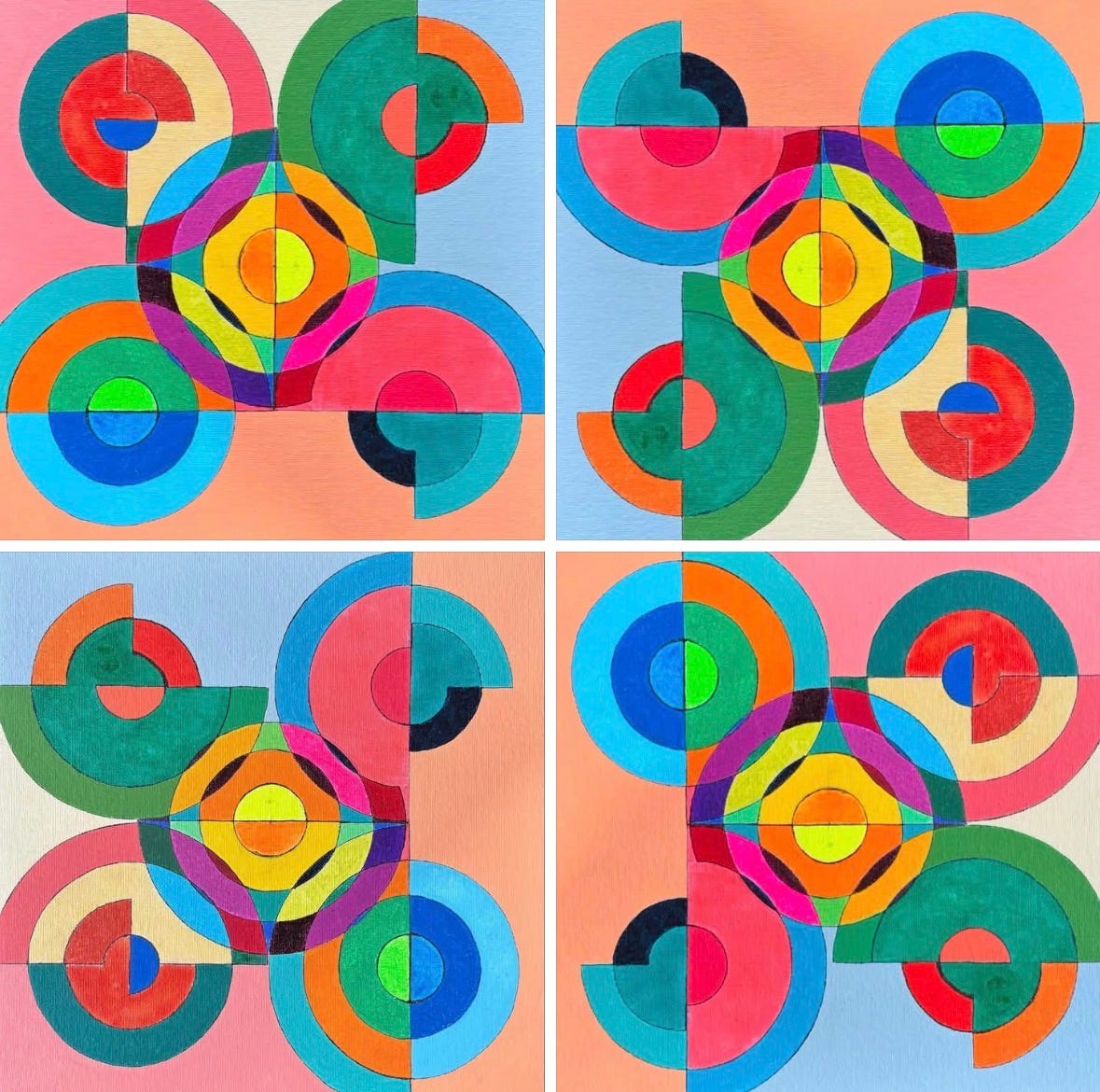
Painting: Higher Vibrational Cosmology (Intro). Matt Lavelle
Back when I was studying with Ornette, I took pictures of his library and started tracking down some of the books he had, seeking more insight into harmolodics. He let me borrow a few. One day I left a bunch of comic books I had at his place which was pretty ridiculous. One of Ornette’s books stood out above all others: Does God Play Dice? The Mathematics of Chaos by Ian Stewart. Here I thought must be a window into where OC was coming from. Einstein was the source of the question with his metaphor that God does not play dice. He had deep skepticism toward quantum mechanics. He believed the universe was deterministic. Niels Bohr flipped it on Einstein telling him “Stop telling God what to do.”
In a literal scientific sense, the universe does roll dice at the atomic scale. The universe appears to operate on probability rather than strict certainty.
Does God play dice?
The No’s: Some follow the law of Karma. Every event is a direct reaction to a past action. Others believe that God possesses Omniscience and Providence. Everything follows a divine plan.
The Yes people: Free will means God allows us to make choices.
We are the dice..
I still feel that there is always a right decision, we just have the option to go the wrong way, get lost, and yes, go through it. Others believe that life is a playground with rules but God lets the game unfold unpredictably for the sheer joy of experience. Others believe that God is not an all-controlling dictator, but a participant who adapts to a changing, evolving universe. If that’s true then not only do we have far more power than we understand, but we are also the biggest embarrassment in existence in 2026.
There are others who believe in Quantum Mysticism, blending quantum physics with mysticism. Quantum randomness can be viewed as the universe thinking or creating in real-time. God provides infinite possibilities (the dice roll), and human consciousness collapses those possibilities into reality.
God is the roll and the game. God is all that is.
In my experience doing channeled Sacred Geometry paintings I’ve discovered that divine design absolutely exists, but chaos is an inherent part of it and part of the process. I’ve been experimenting with adding mathematical chaos that has opened doors to a next level of higher vibrational cosmology.
Getting back to OC, for him the question was more important than the answer in my opinion. His music could go through everything thing I’ve just written in 30 seconds. He practiced order to a degree with melody and idea resolution, but at the same same brought the beloved chaos, not resolving ideas, challenging form, challenging musical role play and responsibilities, and leaving voice leading on the side of the road.
Just like all the different answers to the question does God play dice, all artists must learn what their personal relationship is with chaos. In looking at some of the most profound artistic accomplishments that I know of, their artistic journey's are largely based on what they discovered within themselves and within the universe when they walked the line, and sometimes, jumped off the cliff. Miles Davis, John Coltrane, Pablo Picasso, and James Joyce all went through what I see as the seasons. Like James Joyce though, they didn’t always start in spring and end in winter.
Duke Ellington called Miles the Picasso of Jazz. Like Picasso, MD kept it moving in search of personal artistic discovery. When Bop first started up, it must have been seen as chaos to the mainstream swing players. Complexity was turned up on every level. If you look closely at Bird solos, he thrived in this environment like no other. There was always logic and order, but there was always a wrinkle and inspired abandon within it. It was always just the right amount of chaos to me. Bird was attracted to order, and wanted to compose more. He said his favorite work was with his strings. Miles was right there with Bird at the start of his own journey. Miles also sought order when he produced Birth of the Cool. Miles modal period was a whole other season as he reduced harmonic complexity. The simpler harmonic structure actually opened the door to chaos. While Miles ventured into deeper levels of expression in response, Coltrane went through this door to open his own. With his 60’s quintet Miles went much further into chaos, right in fact to what may have been his limit at the time. With that band he could walk the line on his own terms, leading, but being pushed at the same time. Later in the 70’s Miles went even further with chaos but in a different direction, going full on rhythm. I will posit that even Miles last period was chaotic by it’s very nature as he was very successful playing music that so many people didn’t want him to. I cant get over people shouting “Kind of Blue!” during his 80’s concerts.
Coltrane of course had his truncated, extreme journey through music. I can’t look away from the fact that Bird, Miles, and Trane battled drug addiction. You cannot get to a higher level of chaos in your life then serving that before everything else, when you know music is the most important thing, That kind of chaos is a weapon. Even in his earliest days Coltrane seemed to seek musical order but walk with chaos to a degree. He mastered order and lyricism within all of his complex ideas and then went full on into musical cosmic law with Giant Steps. (Cherokee is Giant Steps for trumpet players, fight me). Coltrane boxed himself into a corner, and then he found Ornette who showed him the way out through that beloved chaos. With his spirituality becoming his total focus, Trane pushed into even his own limits of chaos. Still, there was always some sense of order present. Check out those Interstellar Space transcriptions.
Now I’ll take this chaotic stack further adding in the 8 seasons of Picasso. I really like that his phases rarely replaced each other completely. Rather, they coexisted and occasionally re-emerged, often in surprising forms. The famous Blue period is well known, and possibly related to the fall of his close friend and artistic ally Carles Casagemas as they lived on the edge of life together. Some suggest that his piece The Old Guitarist is similar to Miles modal kind of blue period.
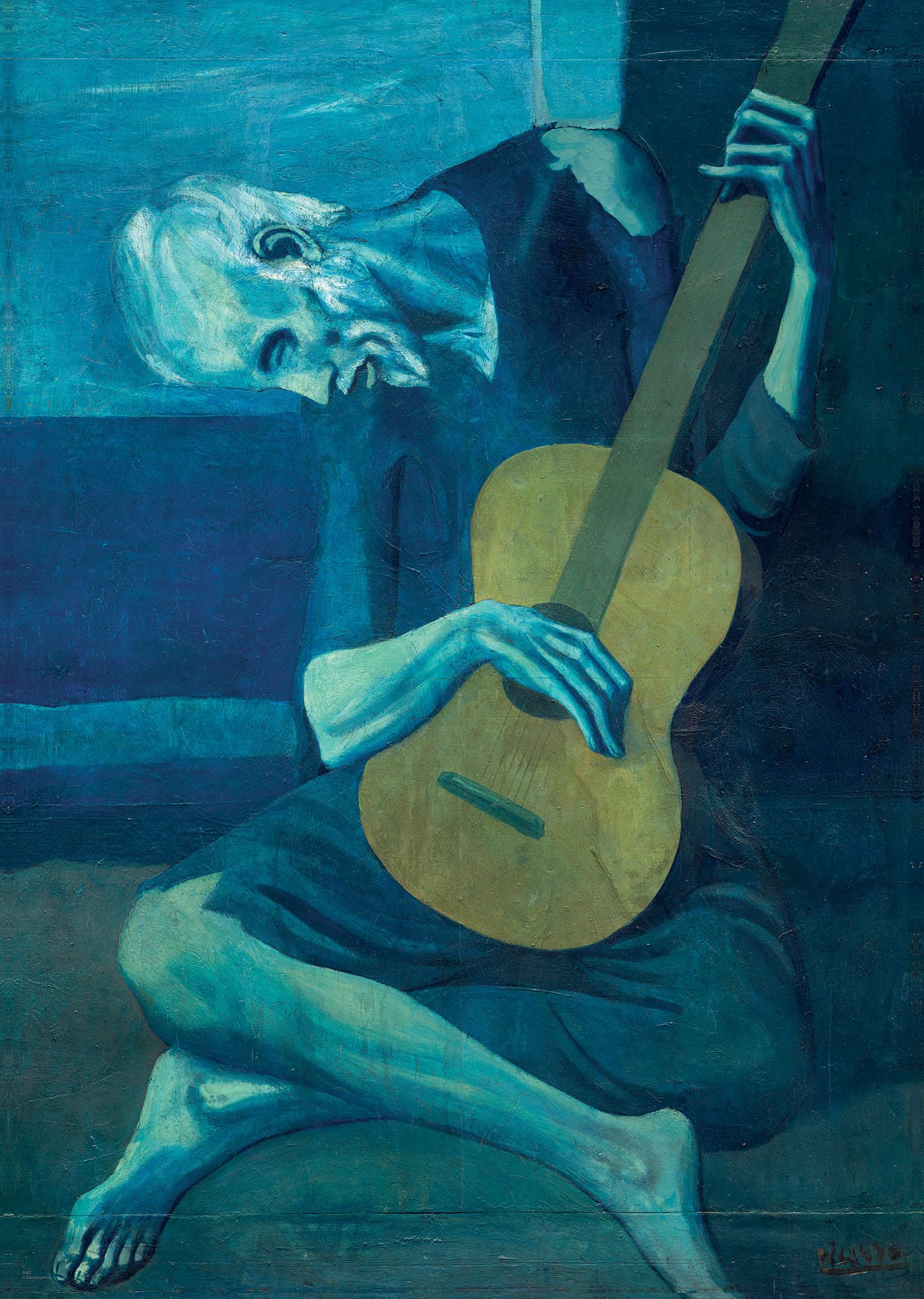
The melody here is not choked by extensive harmony and can breathe. All of the attention is brought to the body language of the guitarist. These lines go deep and are not intruded upon by the need to prove you played the turnaround correctly. There’s space and somehow the silence of a moment frozen in time. It feels like it just stopped raining and that cold damp vibe is in the air. The guitarist is not just feeling it, he is the feeling, as was Miles on My Funny Valentine.
Some have compared Picasso’s Three Musicians to Giant Steps.
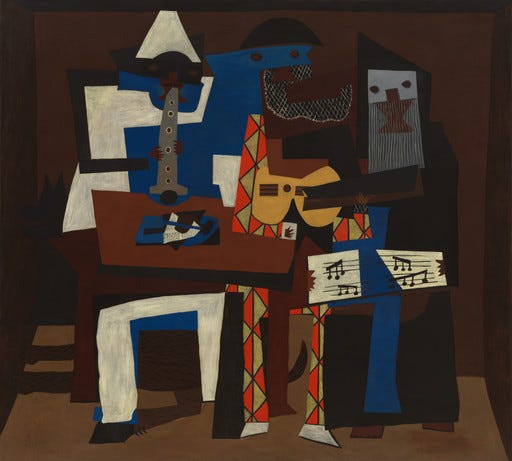
Sharp contrast and those angles are kind of like looking at Giant Steps on the page. People have different relationships with Giant Steps in general, it’s a crossroads in jazz to a degree. Anybody have an idea of who in jazz might play angles like these? The 3 different stand out colors is more like 3 of Duke’s colors to me. It could be Hodges, Lawrence Brown, and Harry Carney. I wish I could have been present for Picasso revealing his new work. He must have thrived in chaos to a degree.
For me, It’s all about Les Demoiselles d'Avignon.
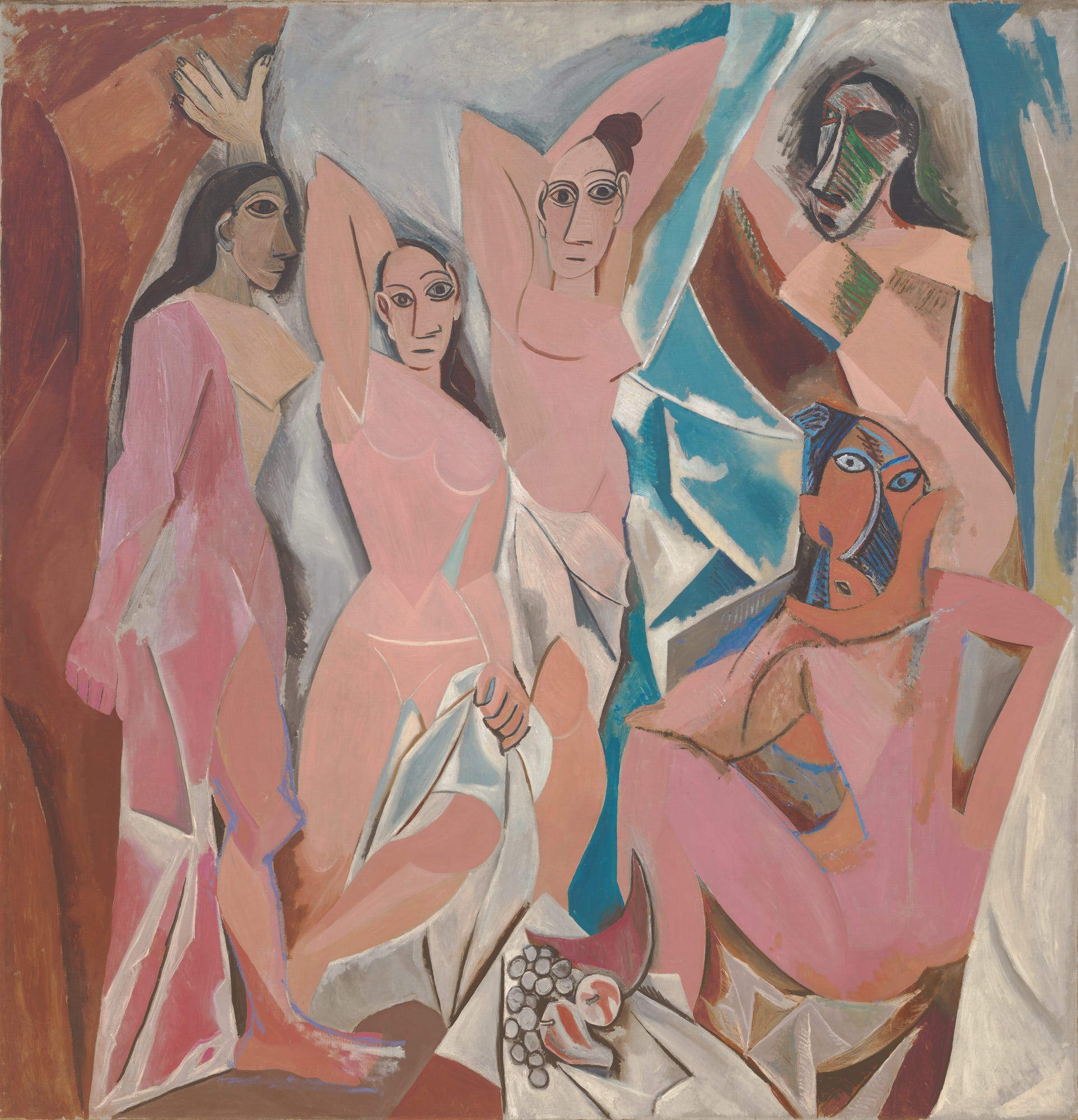
This one says Ornette to me, and even connects to Miles paintings. Picasso was only 25, but the raw humanity here got people in their feelings. He changed the game with this piece, the same way OC did. Both of them were just being themselves and not trying to turn the cart over.
Look, this is me..
Artistic chaos can be a weapon.
I’m not a heavy student of art or writing, but perhaps James Joyce is the grandmaster of using chaos in the writing world. Perhaps books are seasons to a writer. He moved from clear stories in Dubliners to the dense style of Ulysses. Then, he jumped into the dream language of Finnegans Wake.
From The Penelope Chapter in Ulysses:
yes and his heart went like mad and i said yes i will Yes
That right there feels more natural than most of the calculated writing I read. While it could be considered chaos, it’s genuine human expression.
The 10 Thunder Words from Finnegans Wake.
Let em’ have it Mr. Joyce! His work makes me feel less fear in my own writing, and challenges me to go much harder in the paint.
Miles, John Coltrane, Ornette, Cecil Taylor, Picasso, and James Joyce all used chaos in different ways to push that damn envelope. Changing music, changing art, changing writing. Shocking critics who spin out and never recover. Challenging fans and at times splitting audiences. Giving us all many years of reaction and growth that they set up for us. Leaving art that will be here teaching others until the last sunset.
I’ll never forget seeing Cecil Taylor in one of his late concerts in a big room. I was standing in the back and watched an audience member storm out in anger saying “bullshit!”
Really? CT had been being him for decades at that point. His music pushed a button like he was new on the scene back in the day.
So what is our collective relationship with chaos in 2026? Chaos is on the verge of ending us. Somehow we have to hold on to the idea that chaos is required now as the only way to break everything up and move on. I watch a channel called Gaia and if the aliens really do land, then all of our childishness is a wrap. Imagine a human like being walking up to you and making eye contact and then in your mind you can communicate. A being from another planet.
That’s the kind of chaos I’m talking about. LFG.
In my music, art, and writing, I like order within chaos, but not all one way or the other. I like to merge the purest forms of both. Some musicians find their safe spot and will spend their lives there. I was thinking the other day, just how many times can you play free looking for something. How many times can anyone play free looking for something until it’s not about what you discover but the search itself? Do you want to build an audience of people listening to you search or show people what you’ve found instead? I need something to work towards and against. I’m trying to be a better trumpet player, trying to integrate a difficult horn, trying to learn and grow from the reality of channeled sacred geometry art from my higher self, and trying to figure out who I am as a writer by writing this blog all at the same time.
All three of my artistic personalities roll the cosmic dice.
Every solo and recording that Miles, Trane, and Ornette did was a roll of the dice.
Every painting by Picasso was a roll of the dice.
Every book, sentence, every word, every punctuation mark was a roll of the dice by James Joyce.
This stack is a roll of the dice.
The cover photo is a piece I did recently, and a roll of the dice.
Every time we roll the cosmic dice, we get a little closer to the truth.
I feel we’re closer than we have ever been.
Artists of the world, let’s keep rolling and keep leading the way..
ML
Peace
Reading thanks this week for
Sub script ions are need ed and app teach re acted
TBC in the combined liner note music experience here.
No posts
Comments
Nothing yet. Say the first thing.
Sign in to join the conversation.