
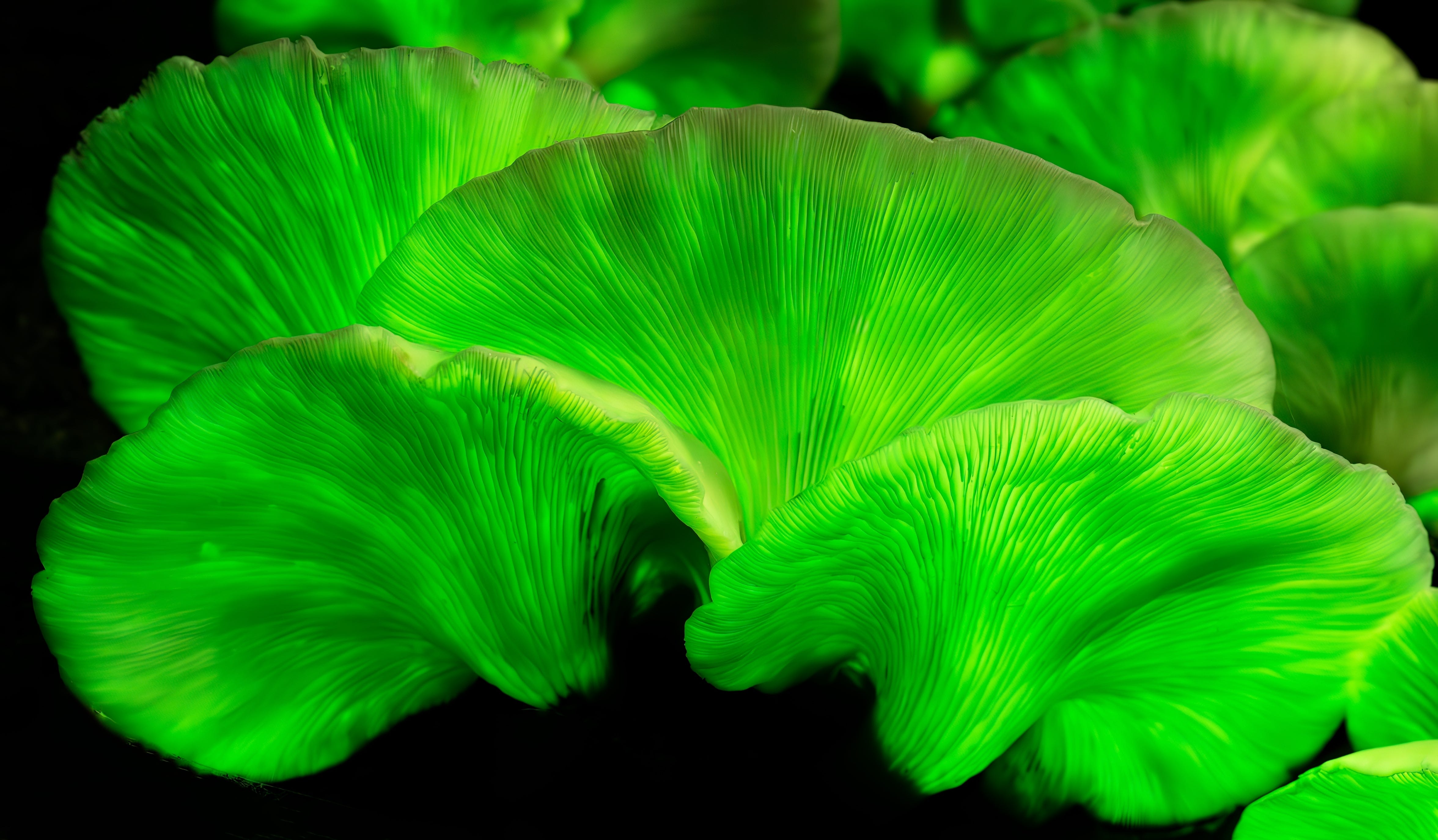
I’ve never personally stumbled across a glowing mushroom in the wild but always been fascinated by the idea of them. A mushroom that glows in the dark may sound something out of a fantasy novel, but it’s real biochemistry—and a new paper in The FEBS Journal just filled in a missing piece of how it actually works.
The species highlighted here is Neonothopanus gardneri, one of the biggest and brightest of the known glowing fungi. It was first collected back in 1839 by an English botanist named George Gardner, who stumbled across kids in a small Brazilian town playing with glowing debris in the street and initially assumed it was fireflies. It turned out to be this mushroom, which locals already knew well and called “flor de coco.” Then, strangely, nobody formally documented it again for over 170 years. It wasn’t until a 2011 genetic study co-authored by mycologist Dennis Desjardin that the species was properly reclassified and given the name it carries today. It’s known to grow at the base of palm species like babaçu and piaçava in a handful of Brazilian states, feeding on their decaying fronds, and its green glow is thought to attract beetles, flies, and ants that help spread its spores.
Researchers have known for a while that fungi like this run on a four-enzyme pathway (the fungal bioluminescence pathway, or FBP) that produces a light-emitting molecule, lets it glow, and then has to deal with what’s left over. That leftover molecule is called oxyluciferin, and until now, nobody had definitively nailed down the enzyme responsible for breaking it back down.
This new 2026 study is the product of eight years of work by researchers in Russia, Brazil, and Japan, and it finally identifies and characterizes that enzyme: caffeylpyruvate hydrolase, or CPH. The team cloned the gene, expressed the protein, purified it, and confirmed exactly what it does: it splits oxyluciferin into two pieces, caffeic acid and pyruvic acid. The caffeic acid gets fed right back into the pathway to make more of the light-producing molecule. The pyruvic acid, meanwhile, can be shuttled into the fungus’s central metabolism—the same system it uses to generate everyday cellular energy.
Fungal luciferase systems are already being used in medicine and research as living light sources: tools that let scientists literally watch things happen inside living tissue, like tumor growth or inflammation, in real time. Every piece of this pathway that gets fully mapped is a piece that bioengineers can borrow, tune, and drop into other organisms. Understanding the recycling step specifically means future bioluminescent tools could be built to sustain themselves longer and more efficiently, with less outside intervention.
If this has you more curious than just mildly impressed, you can watch this biochemistry for yourself. We sell a live plate culture of Panellus stipticus, a different glowing species than the one in this study, but one confirmed to run the exact same four-enzyme cycle, CPH step included—every known luminescent fungus traces back to a single common ancestor that evolved this trick once, roughly 160 million years ago, and passed it down. You'll want some basic sterile-technique chops to work off a plate culture. But if you're a student, a hobbyist mycologist, or just someone who wants an actual glowing organism on your own bench, it's about as hands-on as you can get with the exact chemistry we just spent this whole post talking about.
No posts
Comments
Nothing yet. Say the first thing.
Sign in to join the conversation.