
Anjali Pathiyath on building a scaffolded research skills curriculum from Year 7 to Sixth Form, and why sitting with uncertainty is one of the most important things we can teach
Daniella Mardell and Trish Henderson on redesigning the Careers Convention around AI and workplace futures, and what students and parents actually want from careers education
Surge 2 and our new Year 13 Applied AI pilot: entrepreneurship and data science as extensions of academic rigour
How Year 10 electives are evolving to offer applied, varied, and genuinely stretching experiences beyond examination syllabuses
What connects all of this: the shared principles emerging across our curriculum development work
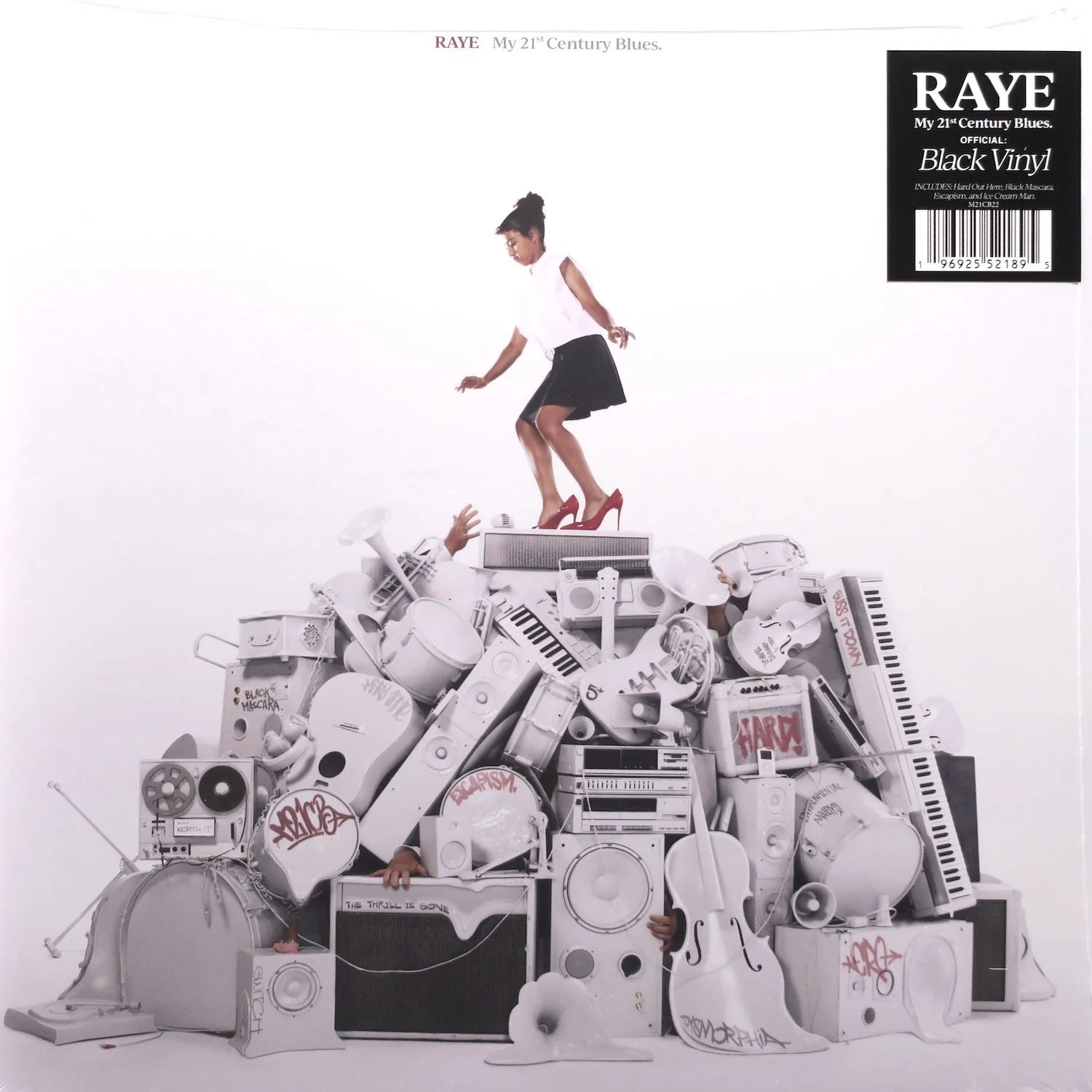
Much to the ridicule of a group of Year 11 students, I like to suggest that Raye’s international musical success is down to me. In my first assembly at NLCS two years ago, I played “Worth It” to the school as an example of an original, new approach to music underpinned by a traditional orchestra and jazz motifs stretching back 100 years. For some in the assembly, it was indeed the first time they had heard Raye, though the fact that she had sold out the O2 three times over that year did rather undermine any argument that I had contributed to her success.
That principle, something new layered over foundations stretching back a century, continues to underpin how we are approaching innovation at NLCS and the Ideas Hub. For this edition we focus on our work across the curriculum.
This is our thirteenth Substack, and this edition focuses on exactly that question: what happens when you build outward from existing academic strength rather than starting from scratch? What follows brings together four strands of curriculum development, research skills, careers education, entrepreneurship, and electives, told in part by the colleagues leading them.
Anjali Pathiyath, our Head Librarian and Head of Student Research, has been developing the research skills framework embedded across Key Stage 3 and extending into the Sixth Form. Here, she explains the thinking behind it: (click here to read her full blog)
We are living through a moment in which information has become radically abundant, instant, and mediated by algorithms. Artificial intelligence can generate essays, arguments, images, and interpretations in seconds. Yet amid this acceleration, a deeper educational question emerges with renewed force: what does it actually mean to know something?
This question has sat at the centre of my work since joining North London Collegiate School as Head Librarian and Archivist, and subsequently as Head of Student Research. Much of my focus over the past couple of years has involved designing and embedding a cohesive, scaffolded research skills curriculum across Key Stage 3. The intention is for students to realise that the act of “researching” goes beyond simply looking up a question on Google or an AI platform.
Each day, as I spend time recommending books to students in the library or giving feedback on EPQ drafts, my goal is to get students to enjoy the process of foraging and evaluating, and not merely be focused on their end result. The aim is to teach students that it is entirely normal, sometimes even better, to sit with uncertainty for a little longer. Yes, these skills help them develop confidence and rigour, but they also build patience and resilience when they are forced to revisit earlier assumptions, especially when answers don’t come easily.
The challenge facing education today is not merely whether students can access information but whether they can develop the discernment necessary to transform information into understanding, and understanding into insight.
Our Key Stage 3 Research Skills Framework is deliberately scaffolded to build confidence, rigour, interdisciplinary thinking, and intellectual independence over time.
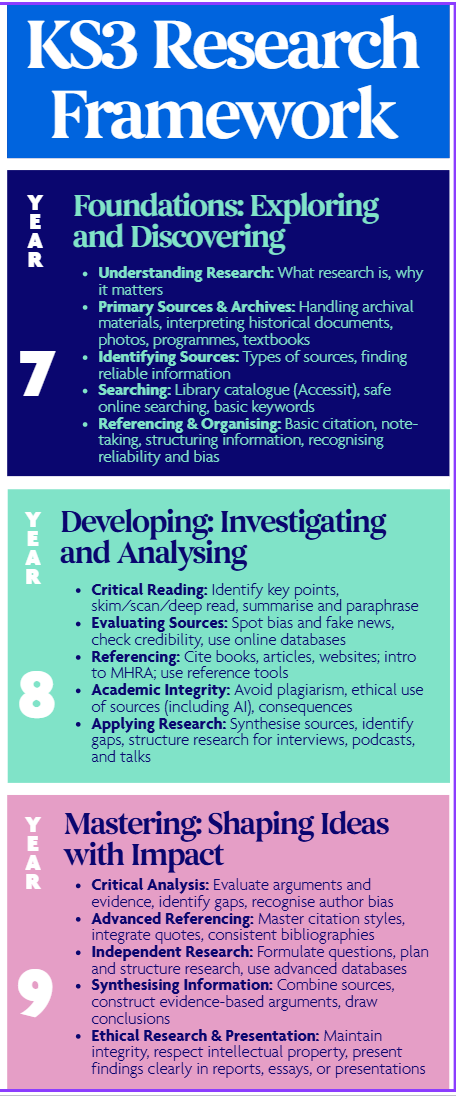
In Year 7, students begin with the foundations: understanding what research actually is, how knowledge is constructed, and how sources function differently. They encounter archives and primary sources, handle historical materials, learn about provenance, and begin distinguishing reliable information from misinformation. In the summer term, this culminates in a poster presentation evening where students present narratives about NLCS history using primary source material from our school archives.
By Year 8, students move into deeper analytical territory: critically reading texts, identifying bias, evaluating credibility, and recognising the blurred boundaries between authority and visibility. Academic integrity and oracy become central, including source evaluation, attribution, and inference. The summer term culminates in an Ethics Symposium where students showcase their ability to reflect meaningfully on ethics-based case studies and engage in thoughtful dialogue.
By Year 9, the goal is intellectual autonomy. Students formulate independent research questions, engage with advanced databases and referencing systems, evaluate competing arguments, and develop evidence-based conclusions. The Year 9 project culminates in a 2,000-word Independent Research Project, designed to prepare students for the extended academic essays they will undertake in the Sixth Form.
What I value most in this framework is its emphasis on cultivating a critical habit of mind alongside the technical competencies necessary for strong academic work. A student who understands how to question a source is also learning how to question assumptions. A student who learns to synthesise perspectives is learning intellectual humility.
Importantly, at NLCS, we do not view these skills as discrete competencies confined to an annual project or isolated within the library. They form a continuum extending into the far more independent scholarly work students undertake in the Sixth Form through the EPQ, the McCabe Project (our school’s extended independent research programme), or IB Extended Essay. Research skills are taught alongside their journey, supported by library provision encompassing curated physical resources, digital subscriptions, and open-access databases, alongside regular one-to-one research consultations.
In an age where information is increasingly automated, the capacity to evaluate evidence, recognise assumptions, synthesise perspectives, formulate meaningful questions, and handle ambiguity may become one of the most profoundly human forms of education we can offer.
If research skills teach students how to think, our careers education work helps them understand why these capabilities matter. Daniella Mardell, our Assistant Head: University Guidance and Careers , working alongside Trish Henderson our Head of Careers and Employability, led the design of our February 2026 Careers Convention. Here, they share the thinking behind it:
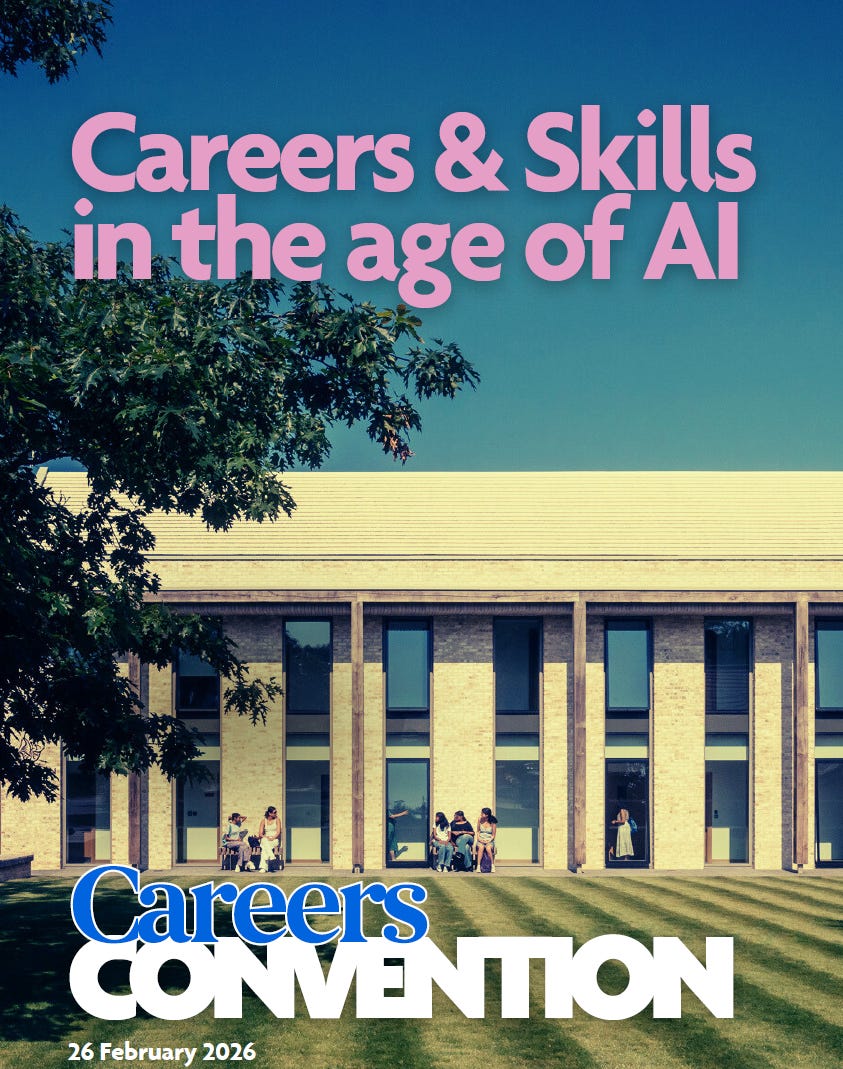
This is an event we run biennially, but the decision to completely change the theme and structure for this year was deliberate. I’ve been monitoring the arrival and impact of AI on the workplace for some time now. Both Trish and I receive occasional emails from students and parents asking about AI, and I know the Heads have had conversations with parents about this, so it’s clearly on everybody’s minds.
I wanted to create a space where we could work with it and discuss it properly. Not in an abstract, hypothetical way, but through genuine engagement with professionals navigating these changes right now.
The event started with a session on degree apprenticeships, brilliantly delivered by Brooke Connell. This was important: we wanted to open up conversations about different pathways beyond traditional university routes, especially as the workplace continues to evolve. Then we had our keynote speech from Tanvi Ghokale, an Old North Londoner who now leads Everyday Banking and Consumer Lending divisions at NatWest. She provided concrete insight into how senior leaders think about technological change while keeping human judgement and relationships at the centre.
The panel discussion was chaired by Richard Kaufman, a sports journalist who hosts professionally. Having someone of that calibre made an enormous difference: he knew how to draw out genuine insights rather than prepared statements. We had two panels, one on the impact of AI in the workplace, another on skills needed for the future workplace. Panellists included professionals working across law, technology consulting, AI and data for financial services, and entrepreneurship.
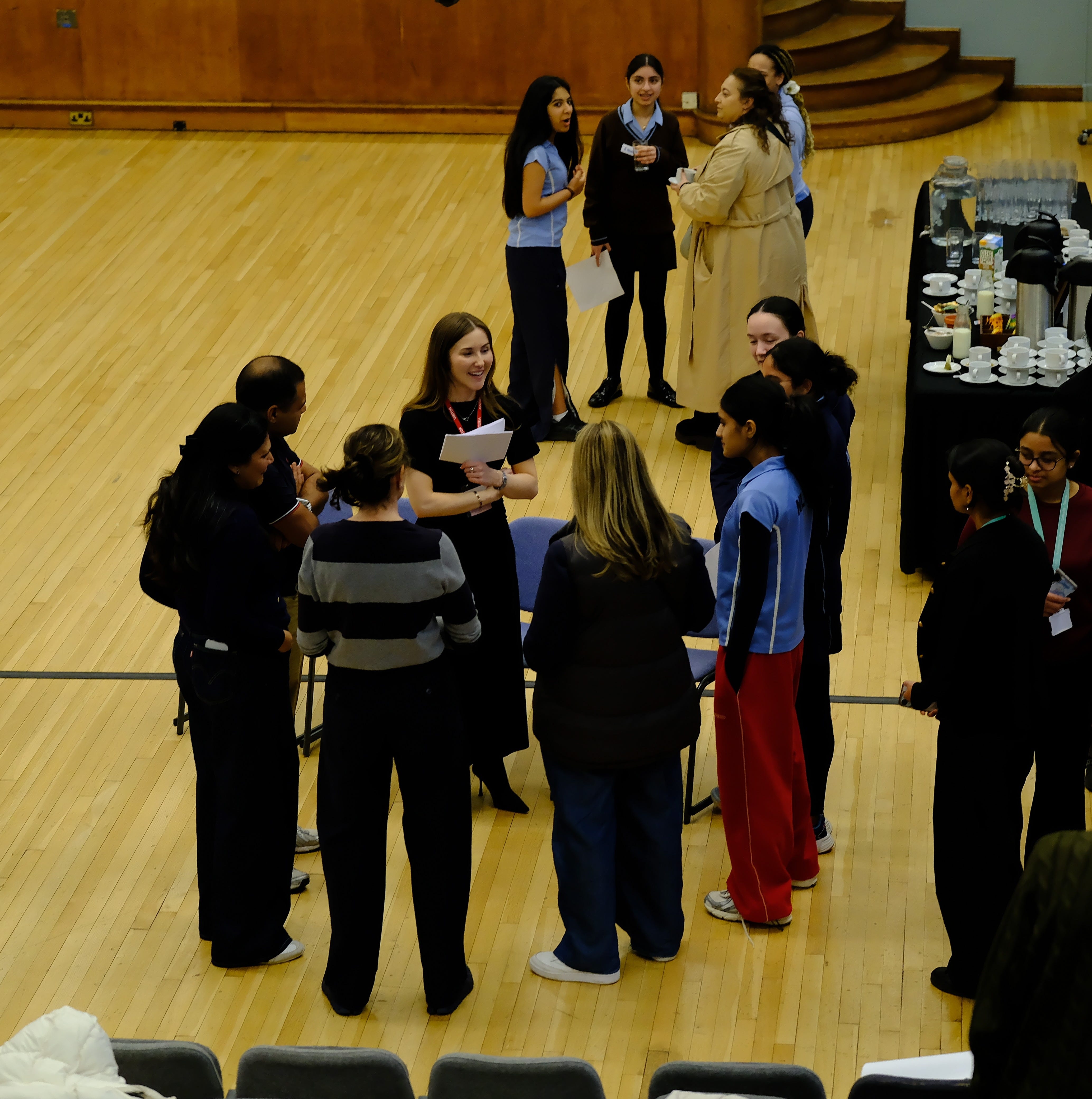
Then everybody moved across to the Ideas Hub for refreshments and individual consultations. I had placed professionals in fields rather than specific jobs, clustering them so students could move between conversations and begin understanding how different sectors were responding to similar pressures.
Running alongside all of this, Nishi Shah Gadani from Happy Little Humans delivered workshops on “Human Skills in an AI-Driven World.” These were interactive sessions exploring what technology can and cannot replace: creativity, emotional intelligence, adaptability, communication. Students reflected on capabilities that give them a lasting edge.
The feedback has been remarkable. One professional described it as “a pleasure to engage with thoughtful and curious and insightful young minds.” A Year 10 parent commented: “I thought it was a thoroughly engaging evening. From the keynote speakers to the knowledge and insights of the invited panellists through to the opportunity of having individual discussions with the wide range of experts later on in the Ideas Hub.”
But beyond the event itself, this is part of a broader strategy. Careers is coming into the curriculum more intentionally. We’re opening Unifrog to younger year groups much earlier. Year 10 activities that Samy is launching have a careers focus. And higher up in the school, we now have Surge (our student entrepreneurship programme), the Applied AI pilot, and this kind of sustained engagement with what capabilities actually matter in the world students will enter.
We’re making the convention biennial rather than annual so we don’t exhaust topics and so it aligns with the medics and dentists conference, which is also biennial. Next year we have Careers Week rather than the convention, with smaller events across the spring term.
What I’m taking away from this is that students and parents want genuine engagement with these questions. Not reassurance, not speculation, but honest conversation about how the world of work is changing and what that means for the capabilities young people need to develop.
Surge 2025 was a great success, but in isolation it is just something that happened once. Surge aims to be ‘the castle on the hill’ of our approach to developing entrepreneurial skills for every student; and with a new applied AI course in the pipeline, we are excited about what happens next. Robin Street, our Director of Innovation, explains a little more.
Surge II launches this term following significant uptake last year, with 90% of eligible students signing up again. The core remains: industry mentorship, business skills development, and pitch events. What has evolved is how we sequence content and structure external partnerships based on what we learned from the first iteration.
The genuinely new development is our Year 13 Applied AI pilot. This extends Surge’s problem-solving mindset into data science and applied technology. Students will work with real datasets, develop analytical capabilities, and apply AI tools to practical problems. The emphasis is application: using these tools to solve problems, test hypotheses, and create value, not theoretical computer science.
Both programmes reflect a conviction that entrepreneurship and applied technology aren’t extras but extensions of academic rigour. Constructing a viable business model or cleaning and analysing a dataset properly demands the same critical thinking and evidence-based reasoning as any serious academic work.

Year 10 electives have protected curriculum time outside examination syllabuses. We are evolving them to be more applied, more varied, and to offer genuine choice: not a miscellaneous collection but curated experiences that stretch students across boundaries.
This doesn’t mean every elective must be about AI or entrepreneurship. Debating, financial literacy, architectural studies and forensic science can embody these principles just as powerfully. The test is whether an elective develops capabilities students wouldn’t get elsewhere in their timetable and connects to questions that matter beyond the classroom.
This is careful curation rather than redesign. The electives work well. We are making their purpose more explicit and ensuring they collectively offer the breadth students deserve.
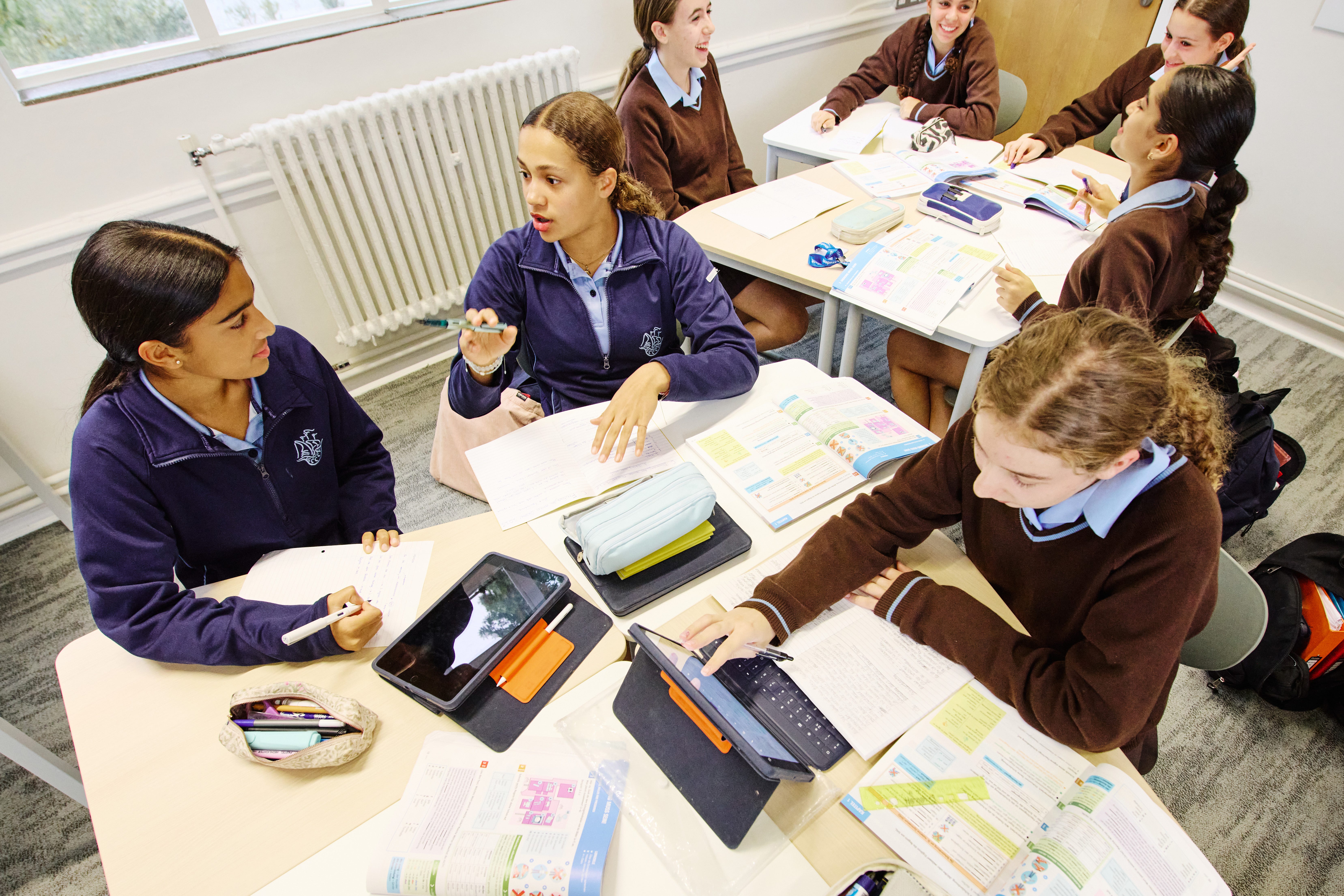
These initiatives aren’t isolated developments. They represent a curriculum asking similar questions across different contexts: what should students be learning to do that extends beyond content acquisition?
The answer emerging isn’t a single framework but a set of shared principles, each visible in the work described above.
Curiosity sustained over time. The patience Anjali describes in Year 7 archive work, sitting with uncertainty rather than reaching for the first answer, is the same quality that carries a Year 12 student through a SURGE pitch when their first business model fails.
Application alongside understanding. Surge, Applied AI, and the evolving electives all emphasise using knowledge, not just acquiring it. Daniella’s Careers Convention made the same point from the employer’s perspective: understanding matters, but so does the ability to do something with it.
Working across boundaries. Research synthesises across sources, entrepreneurship combines business and technology, electives stretch beyond single subjects. The planned Year 8 Ethics Symposium will ask students to think across disciplinary lines in exactly the way Surge demands of its participants two years later.
Real-world engagement. The Careers Convention brings professionals into school, Surge connects to industry mentors, the research skills framework prepares for university-level work. In each case, the classroom connects outward.
Skills that transfer. The ability to evaluate evidence, construct arguments, work with ambiguity, communicate clearly, and lead. These matter across everything else, and they appear in every strand described here.
Our Quick Ideas for students recently completed its run supporting exam preparation with research-backed revision strategies, while Quick Ideas for staff covered the evidence on handwriting versus typing for learning and practical strategies for retrieval practice. Both series bridge the gap between educational research and daily practice without requiring Sunday night reading sessions.
We have appointed a Roboteer in Residence to support our expanding VEX Robotics programme from Year 5 through to Sixth Form. The role will work directly with students, develop partnership school training programmes, and support curriculum integration in Computer Studies and Design Technology.
The next Ideas Hub Substack will focus on the Teaching and Learning Excellence Framework, the pedagogical architecture within which all this curriculum development sits. We will share how the framework has evolved, what we have learned from embedding it, and how it connects to the values that define teaching and learning at NLCS.
Thanks for reading the NLCS Ideas Hub Substack! Subscribe for free to receive new posts and support our work.
This is our thirteenth Substack exploring innovation in education. Previous editions have covered learning spaces, teaching excellence frameworks, academic partnerships, research on student wellbeing, and the role of student voice in educational development. As we continue into our second year of Ideas Hub operations, we remain committed to sharing insights and fostering dialogue about the future of education.
No posts
Comments
Nothing yet. Say the first thing.
Sign in to join the conversation.