
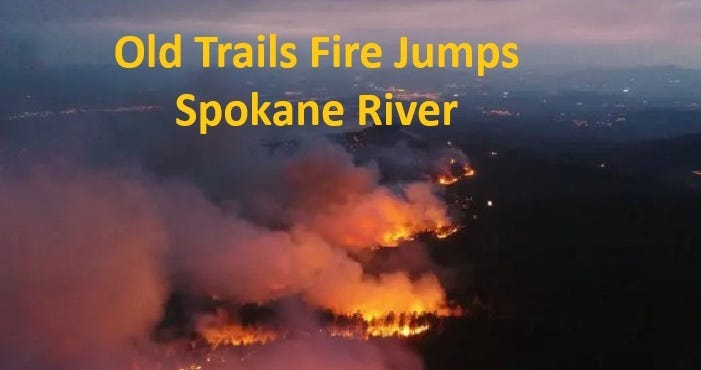
You can’t say they didn’t warn us. The night before an unusually gusty Saturday in early August, the National Weather Service warned of “unprecedented fire-danger.”
Although few residents noticed, the summer was slightly drier than usual, and the month of July was two degrees warmer than usual. But fire officials knew that high winds were expected and that Spokane county residents were facing a particularly dangerous situation, so Spokane County residents were warned they needed to be ready to evacuate on a moment’s notice.
It was prescient of the National Weather Service to foresee the problem. Because while warm, dry summers are very common in Spokane, (five rain-free Julys in the last 25 years), and summer windstorms are not unusual—this PARTICULAR combination of a somewhat dry, somewhat hot, and very windy day was considered “particularly dangerous”. So dangerous, in fact, that residents should not be surprised to see a forest fire that started near Airway Heights “jump the Spokane River” and spread to destroy neighborhoods on the other side.
Yep, you heard that right. Cinders from a forest fire crossed a 200 foot river-bed in several places, ignited trees on the other side of the river, and then burned up the side of a 180 foot cliff to reach and incinerate several residential neighborhoods in Northwest Spokane.
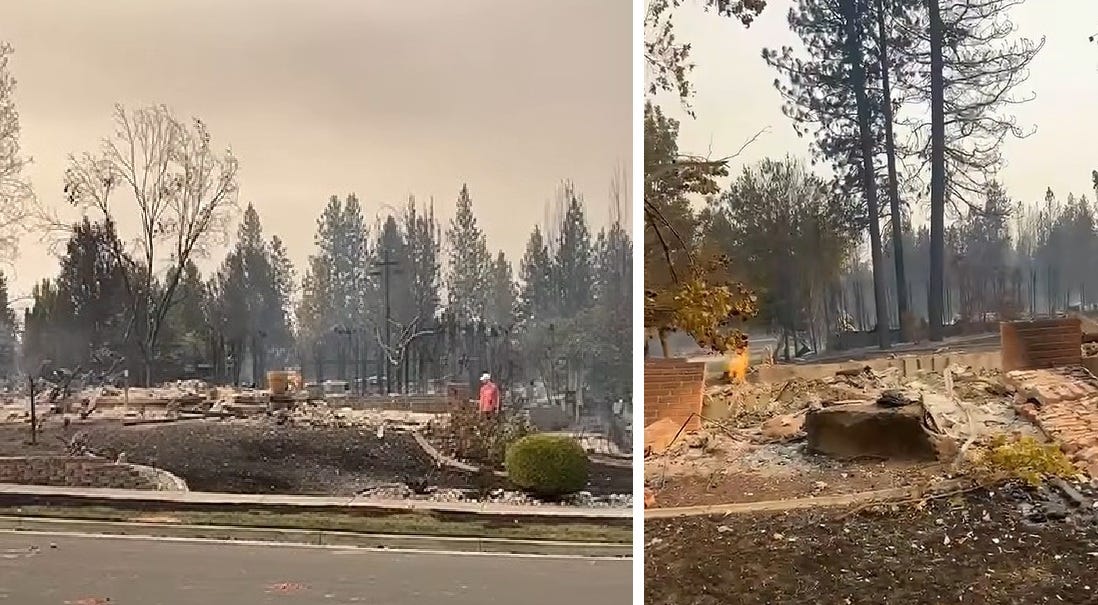
The devastation done to several neighborhoods in West Spokane overlooking the river was quite severe. Fortunately, some of the trees behind the incinerated houses survived the fires survived intact, so there is still a nice forest-like feel to the burned-out piles of rubble.
It may seem strange that a “wild-fire” that engulf a forest across the river would burn all the houses in the neighborhood, while leaving trees unscathed, but fire experts explain that this is perfectly normal. It seems that trees are naturally fire resistant, and people’s homes are highly inflammable—once cinders get beyond their fire-retardant roofs and siding. So yes, fast moving fires can incinerates structures, but leave neighboring trees intact. All this is completely normal!!!
Morning after wreckage video #1
Morning after wreckage video #2
Now that we have expressed appreciation for the Rare emergency alert issued for eastern Washington due to wildfire risk, we’d like to express wonder at the amazing prescience of the National Weather Service. Long-time residents of the Spokane area, untrained in meteorology, were suprised by the conflagration, but the experts were not. Weather service officials forsaw the disaster and issued proactive warnings. So why weren’t regular residents, who’ve lived in the area for decades able to see the signs?
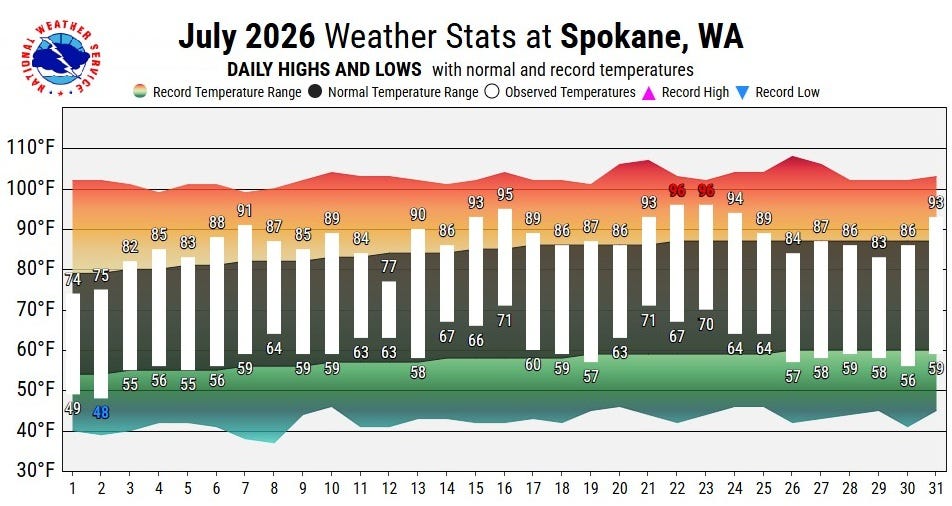
Most summers in Spokane are warm and dry, so its hard for locals to recognize a suspiciously “hot, dry summer” unless there are numerous scorching days over 95 degrees over a sustained period. And as this chart shows, were only two particularly hot days the entire summer, and none over 100 degrees. This is what a sunny, warm July looks like to most people—nothing out of the ordinary. To a Spokane native, this looks like normally warm weather—not Dante’s Inferno.
But what about precipitation? That is even harder to judge. A warm, dry July is not necessarily a problem if there was a wet spring and a good snowpack. But there is no county-wide concept of “normal” precipitation. Spokane county includes both wet mountains and dry plains, and even towns close to each other have significantly different rain and snow patterns.
For example, the amount of precipitation reported between March 21st and June 21st of 2026 at five weather stations in Spokane County varied between 2.8 and 5.6 inches, and this is measured against an “average” spring rainfall in Spokane County of about 3.8 inches. But what does this mean when more mountainous areas of the county get more than double the rainfall of the dry, grassy, western plains? Yes, July was dry, but overall, but 2026 was not a particularly arid year:
Spokane County weather station readings for spring 2026: Mead—4.5 inches, Cheney—3.14 inches, Newman Lake—5.6 inches, Liberty Lake—4.6 inches, Spokane Airport—2.8 inches.
The following chart nicely illustrates how most Spokane residents perceived of spring and early summer of 2026. Warm and pleasant. Not particularly hot. Not particularly dry. Not a monstrously dangerous fire-year.
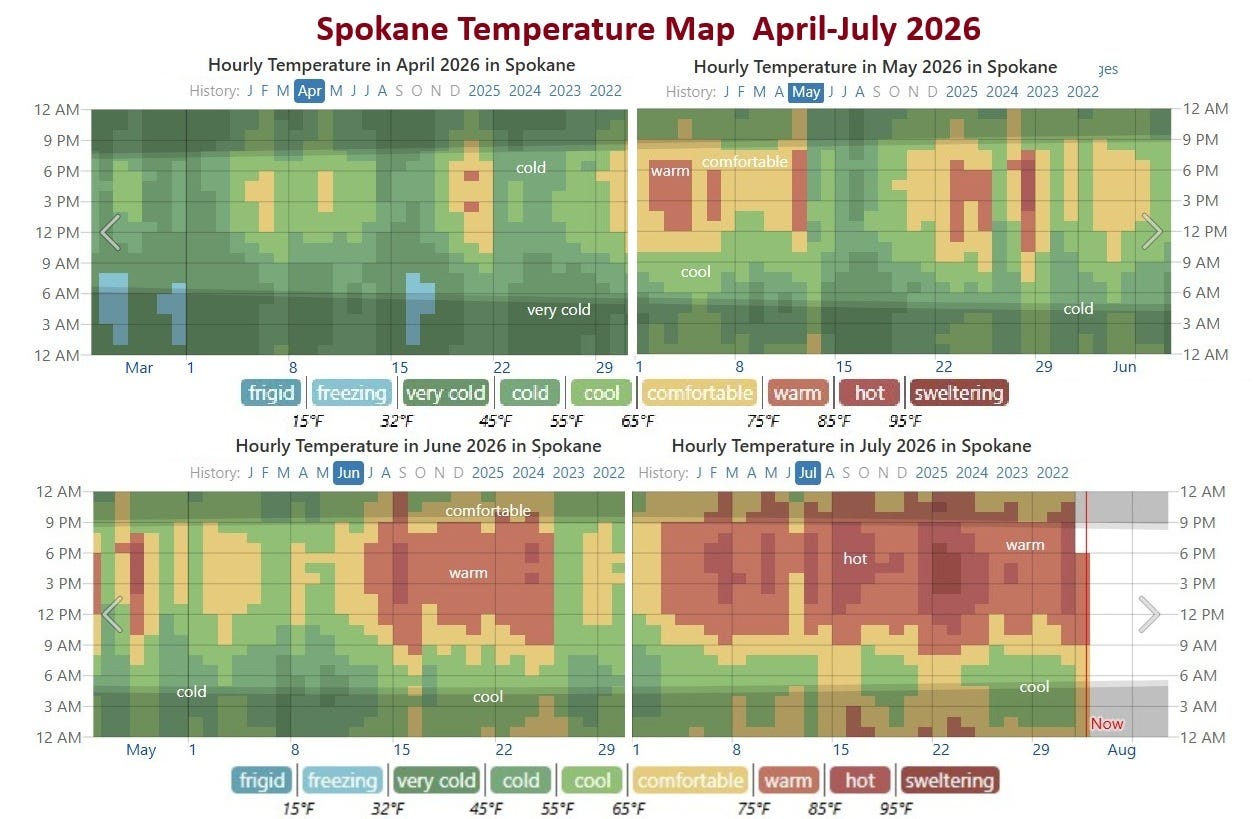
When Spokane has exceedingly hot summers—which it frequently does—residents take notice. We noticed in 2015, and 2024, which were both record-breaking, intensely hot, dry summers. We don'’t need to be warned of high fire dangers when a heat wave is obvious to all. But we didn’t perceive of 2026 as impending Armageddon. Only the “experts” were able to foresee this.
It seems that high winds can turn even a relatively mild “dry” summer into an inferno. And the forecast of high winds is exactly what triggered the emergency alert issued for wildfire risk. But how windy was it really?
Surprisingly, the winds recorded at Spokane Airport were only about 30 mph, and only for two hours. For most of the day, recorded winds were no more than 20 mph. Gales could have been higher in other locations, but these are the wind speeds, as recorded at the Spokane Airport on the day of the disaster.
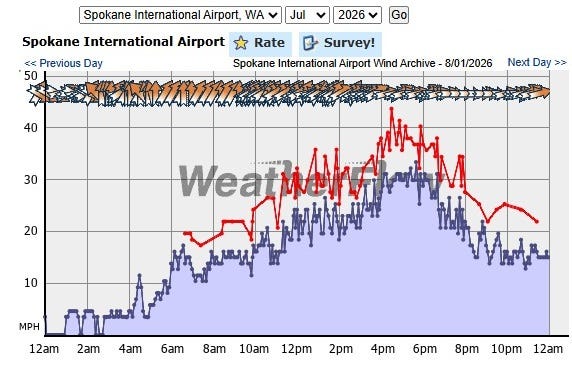
The truth is, these wind speeds are what most surprised me. I expected them to be higher. 30 mph is a significant hazard. Such winds will certainly spread wildfires. But what a 30 mph wind cannot do is knock down trees and power lines. You need about 50 mph winds for that, and the dangers of a windstorm that knocks down power lines in forested areas are very serious.
Wind can be a major factor in spreading wildfires. But a 30 mph windstorm should not be a cataclysmic event. The wind gusts during the Pacific Palisades fire were MUCH higher—they reached “sustained speeds of 40-60 mph with recorded gusts of 60-90 mph.” And during the famous October 1991 Spokane Firestorm, hot dry winds were reported between 50-60 mph.days.
One of several significant differences between the 1991 Spokane Firestorm and the Old Trails Fire Disaster is that the winds themselves sparked many of the fires, by causing trees to fall on electrical wires. Hot dry timber, electrical sparks, and high winds were a fatal combination. But we have yet to see evidence that the “particularly dangerous” winds brought down trees or initiated fires. So what did cause the fires, and why were they impossible to stop? We don’t have good answers.
So far we’ve covered temperatures, precipitation, and wind and found that none, explains the devastation of the Spokane fires. But what is upsetting about both the river-crossing 2026 Old Trails Fire, and the extremely destructive 2023 Gray Fire near Medical Lake (that jumped the I-90 Freeway), is that they both started in extremely close proximity to Fairchild Airforce base, one of the regions primary bases for fighting fires in the Northern Rockies.
How is it possible that the two most destructive fires in Spokane history,—in terms of loss of structures—occurred in the back yard of a specialized, generously equipped wild-fire fighting facility? The communities that benefit the most from Fairchild’s state-of-the-art wildfire fighting equipment, should be those in closest proximity. Yet those are the communities hit hardest in recent years by “unprecedented” wildfire damage. This makes no sense.
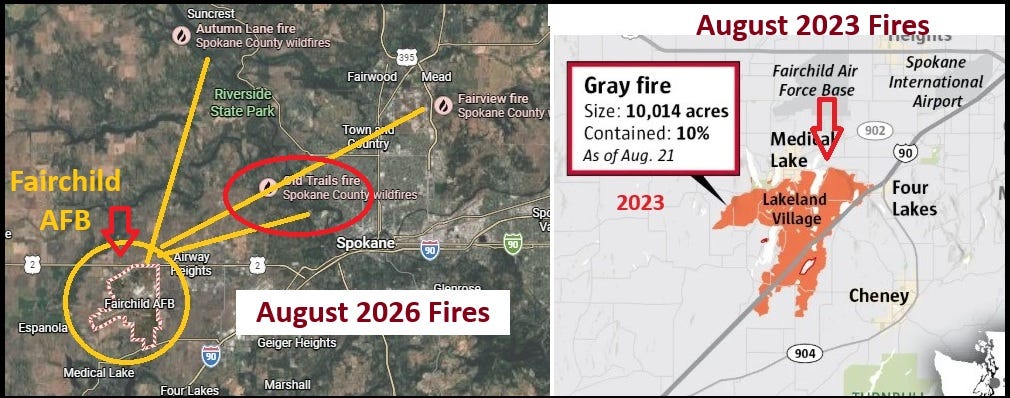
So what is Fairchild AFB doing to prevent and mitigate fire dangers—especially in cases like this where the fire danger was clearly predictable? We don’t know the details of modern fire-fighting technology, but this is what AI has to say about Fairchild’s capabilities.
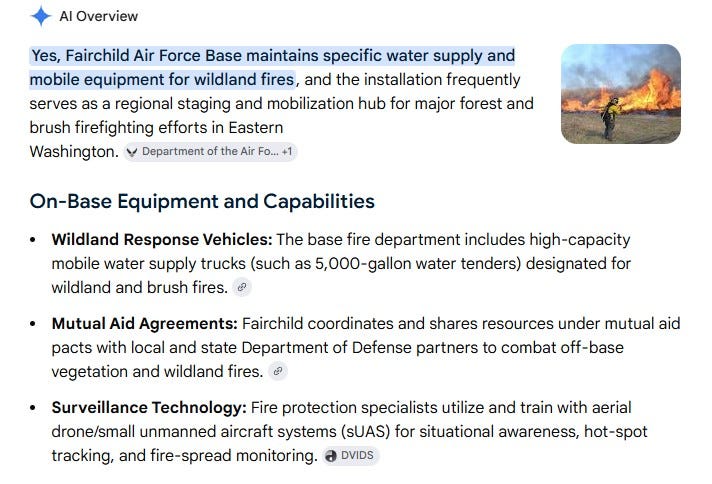
So why is it that with the best fire-fighting surveillance drones and response equipment in the inland Northwest, and with extremely clear warnings, Fairchild AFB was unable to help squash a fire in its own back yard, or prevent it from crossing a river and torching a major population center? We don’t even want to hear the excuses. They cannot possibly be credible. The only possibilities are incomprehensible incompetence, or criminal intent.
We’re willing to give Fairchild AFB the benefit of the doubt and declare them blundering nincompoops, but others are not so inclined. It is exactly this type of mind-boggling, inexcusable failure of mission that fuels conspiracy theories, such as: 1) Government clearing the way for data centers.
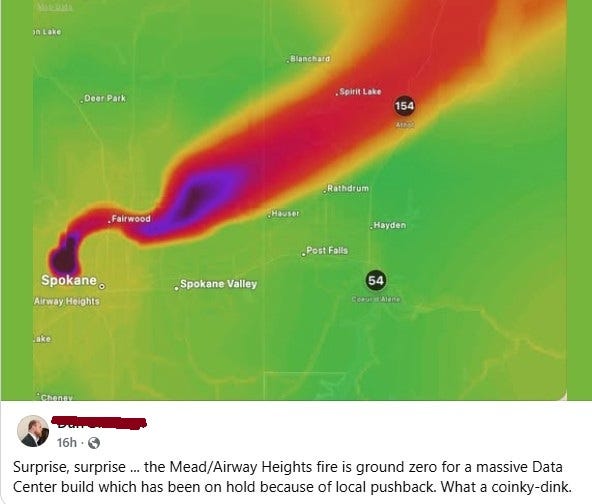
We are not condoning these conspiracy theories. There seems to be no proof at this time. But we are pointing out that the disgraceful failure of “Emergency Responders” to protect Spokane area residents from catastrophic losses, feeds into such conspiracies, and tends to make them appear credible.
This is especially true, given the fact that modern drone technology is so advance it not only provides for aerial surveillance of wild fires, it allows for drone based aerial ignition systems. And of course, to the conspiratorial mind, the idea of wild fires crossing rivers due to unfathomable incompetence, seems less plausible than aerial ignition drones in the hands of criminal sociopaths.
It is unfortunate that trust in our government institutions is now so low that such theories are seriously entertained by educated people.
In any case there is no plausible excuse for the wild-fire fighting commanders at Fairchild AFB to have failed so miserably to protect local citizens, first in 2023 and now. Even if no criminal intent was involved, the Inland Northwest needs competent, responsible, accountable persons in charge of the most advance equipment available for combatting wild-fires on urban wildfire boundaries.
Whatever the leaders of Fairchild AFB are doing to fight wildfires near populated areas is grossly ineffective, and it needs to change.
Having called out the appalling negligence of Fairchild AFB in this recent disaster, and acknowledged the uncanny insight of experts in their ability to predict fire disasters, I’m afraid I have a significantly different POV regarding the value and expedience of evacuation orders.
This may be controversial, but large scale evacuation of able bodied men, as precautionary measures may do more harm than good.
Obviously, people need to be informed if a wildfire is headed their way. And children, elderly persons, and caretakers should be evacuated from endangered areas as quickly as possible. But it would be a good thing if more householders could rely on themselves and their neighbors in a disaster instead of a “fire department” that cannot possibly prioritize saving their homes in the face of a large scale disaster. As long as it is possible to keep escape routes open, homeowners should have some other recourse than having to watch their homes burn from afar.
These insights are based on both common sense and our impressions of neighbors who actually lived through the 1991 Spokane Firestorm. We moved into one of the neighborhoods most severely affected by the Firestorm just a few years after the disaster. Most of our neighbors had lived through the experience and it was impressed deeply on their minds.
And what many of our able-bodied neighbors did NOT do during the disaster, was to evacuate to “safety”. They stayed around to save their houses, and in many cases they saved them!
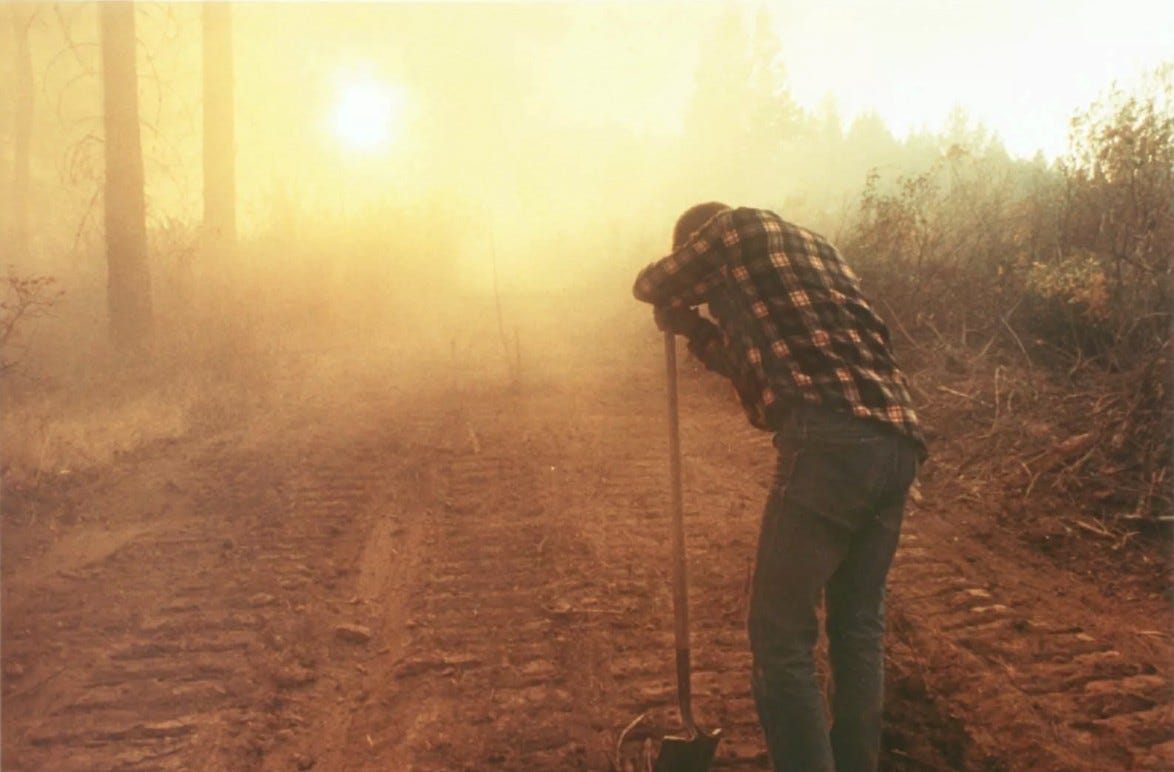
There was no “warning” given ahead of time,. The severe windstorms started numerous fires in many different neighborhoods, and many people didn’t recognize the risk to their property until the fires were at hand. But when they understood what was at risk, most of the able-bodied men in the community chose to remain in their neighborhoods and help each other. The houses at most risk were those nearest the treed areas and grasslands. Anyone who could clear brush, shovel, or wield a hose did what they could.
I wasn’t there, so I cannot speak authoritatively. But from what I could tell from the post-fire neighborhood, it appeared that many houses had been saved—even those right next to a home or forest that was badly burned. And I did not see any case where fires had crossed a major roadway. Even 50 mph winds didn’t seem to be able to cross a road and burn a house that had men with shovels and hoses protecting it.
I can’t give a first-hand account. But what the residents did to save their neighborhood seemed to “work”, and nobody died. And that was with 50-60 MPH winds, not 30 MPH. Please correct me if I’m wrong. That was my second-hand impression of a heroic neighborhood effort that could be a better model of disaster management than anything offered up by our professional disaster class.
What can the average person do to protect themselves or their belongings in the case of a disaster, where “Emergency Response” officials cannot be trusted, or are too busy with other priorities to protect your property?
We all appreciate professional emergency responders. In the case of car crashes, or individual fires, or small scale emergencies, it is wonderful to be able to “call 911” and know that trained responders are only a few minutes away. But large scale disasters are an entirely different matter. There will never be enough “first responders” to address area wide disasters of any kind. Your property and loved ones will never be anyone’s top priority—other than your own.
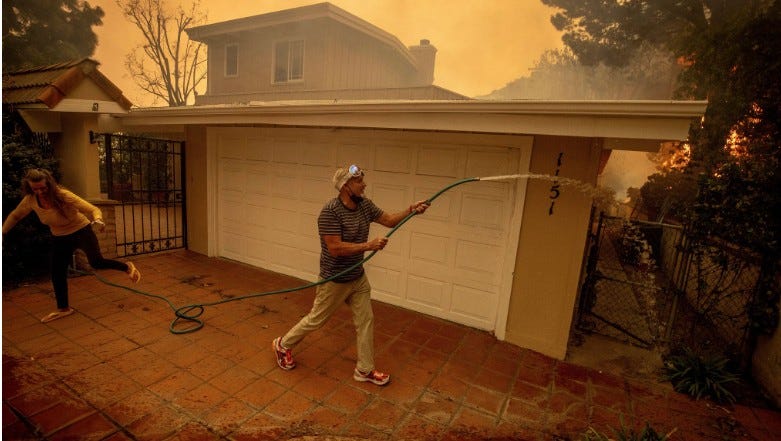
So there is something fundamentally wrong with the idea that the ONLY rational response to wildfires is to “get to safety” while everything you’ve lived and worked for goes up in flames. Yet the only message our “professional” disaster responders seem to have for disaster victims is: Get ready, Get Set, GO!!
Obviously, evactuation is the right solution for anyone but able-bodied adults, with escape routes available. And community action is needed—one man cannot stand alone against a disaster. But why is it that 35 years ago, no one in any of the threatened neighborhoods during the 1991 Firestorm needed to be told to stand together, and help each other, and save their community. No one planned for this. It’s just what people did.
Now, thanks to 24/7 news, electronic entertainment, and social media, many householders don’t even know their neighbors by name, and others have no concept of how to handle an emergency other than “calling 911”. We have been collectively lobotomized by digital distractions, and our modern class of “public safety” officials would rather have us “out of the way” than helping to save our own property.
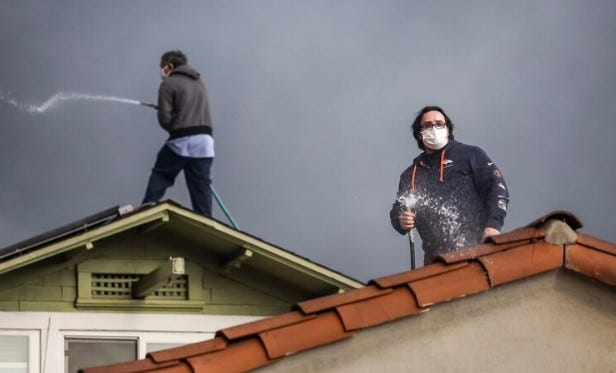
We don’t need more “professional” disaster responders. We need many, many more amateur, disaster responders. And it starts by going next door and learning your neighbor’s name and starting to build trust in a network of “amateur” disaster responders that are actually worthy of your trust.
No posts
Comments
Nothing yet. Say the first thing.
Sign in to join the conversation.