
The city has had the legal option to default on the Archer TIF agreement since the end of 2025. It hasn’t used it. City Council voted Aug. 3 to keep negotiating instead.
The project has changed. The 2024 plan mixed 23 apartments with 19 hotel units. The current plan drops housing entirely: 57 hotel units (9 suites, 48 traditional), plus restaurants and event space.
If the project stalls, the city can require the owner to demolish the site and backfill it. If the owner doesn’t, the city can do the work itself and bill the owner through a property tax assessment.
Target timeline: groundbreaking mid-November 2026, opening winter 2027 or 2028.
Parking, a longstanding worry downtown, gets addressed with a mix of underground spaces, street parking, and agreements with Carleton and a nearby lot, plus a longer-term plan to redevelop the city block at 304 Washington.
Whether local contractors get hiring protections in the new agreement is still unresolved, with council split on the question.
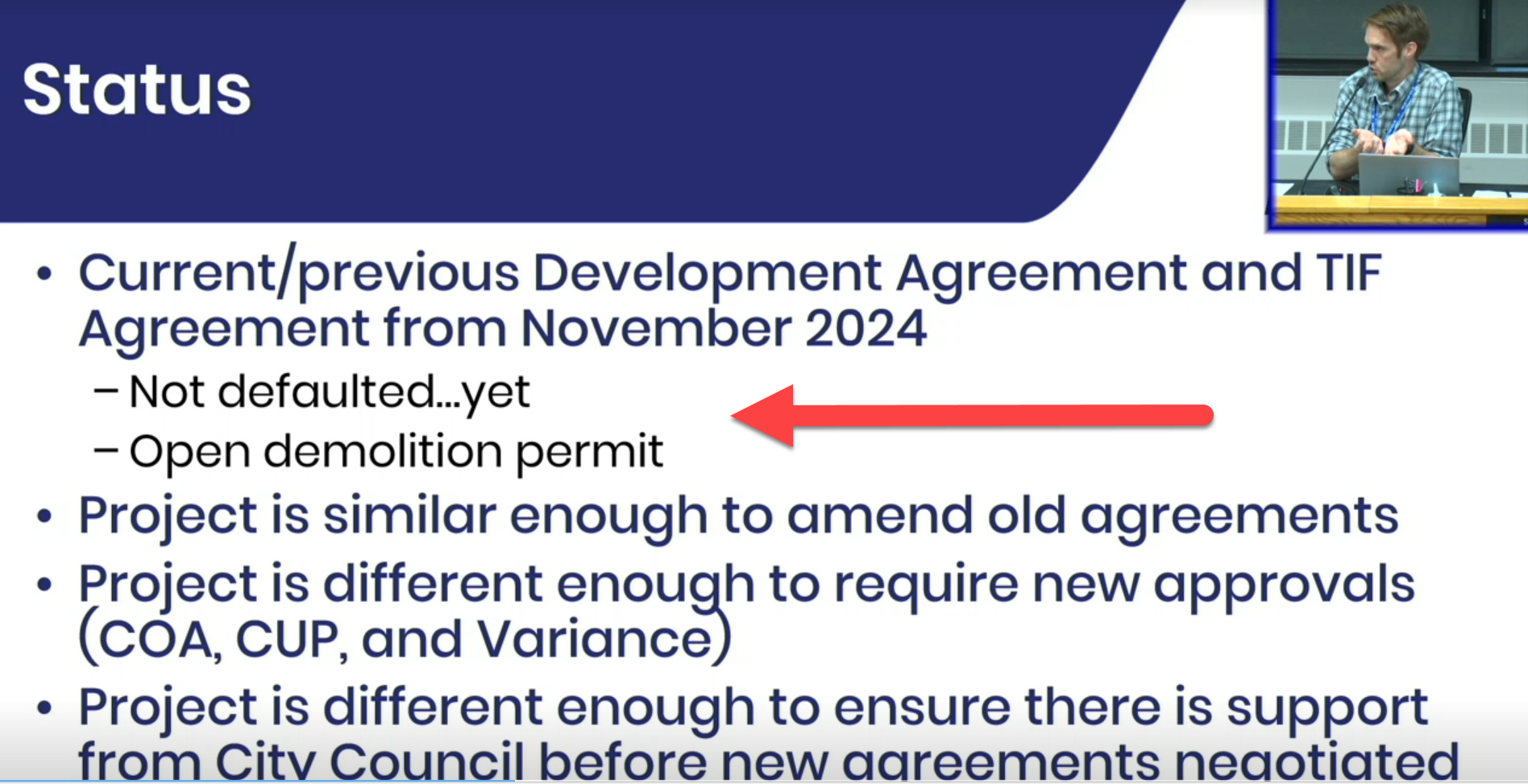
Northfield’s City Council spent close to an hour on Aug. 3 talking through the revised Archer House redevelopment plan, and the most important thing that happened wasn’t the vote. It was what Community Development Director Scott Wopata told them before the vote: the city has had the option to declare the developer in default since the end of 2025, when the original construction deadline passed. The city hasn’t used it. Missing the deadline didn't trigger automatic default. The agreement gives the developer a 30-day cure period, extendable to 180 days with good-faith progress, before the city can act.
“Not defaulted…yet,” reads a slide from Wopata’s own presentation that night (PDF). Screenshot with my red arrow:
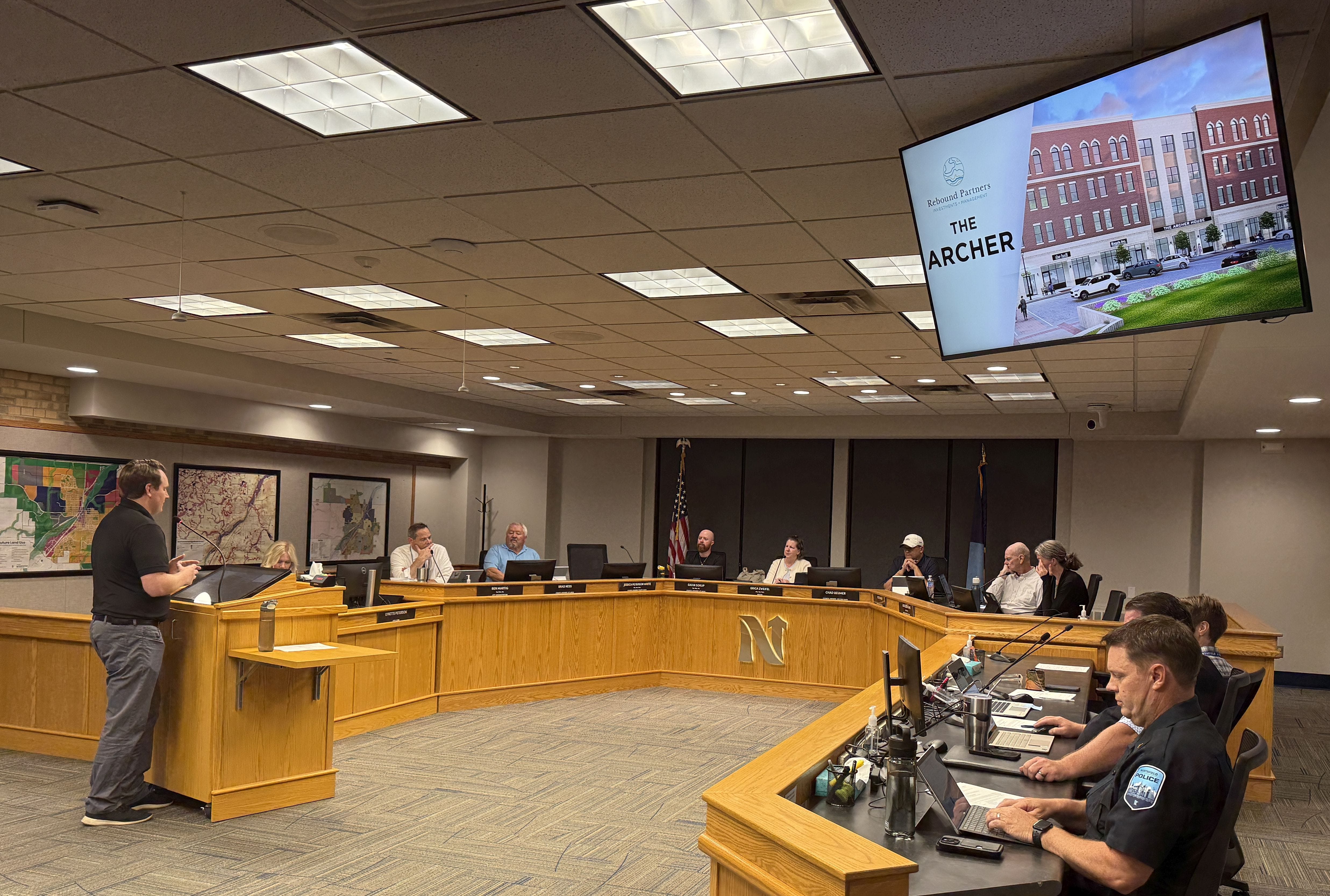
Council ultimately voted, unanimously and without public comment, to direct staff to keep negotiating a revised development and TIF agreement with the developer, Rebound Partners, doing business through Manawa LLC. That’s not final approval of a new deal. It’s permission to keep working toward one.
The original 2024 agreement was built around a very different building: 23 apartments plus 19 hotel units, ground-floor retail, and structured parking, according to the TIF plan the city adopted that November. That project stalled. City staff say the developer determined it wasn’t financially feasible and spent much of 2025 reworking the concept.
The plan on the table now drops housing entirely. It’s an all-hotel building: 9 extended-stay suites with full kitchens and washer-dryers, aimed partly at visiting faculty who might need a place to stay for a week or a month, and 48 traditional hotel rooms, for 57 units total. (Some coverage back in May, including mine, reported 54 units. Both the Aug. 3 meeting transcript and the developer’s own presentation deck confirm 57.)
Restaurants and retail return too. A classic diner is planned for the largest ground-floor space, still unnamed. The bagel shop has a name and a signed letter of intent as of Aug. 3: DoughCo, founded by Carleton alumni brothers Josh Small (’20) and Jacob Small (’22). An earlier rendering shown to the city labels that same storefront “Bagels Inc.,” an older placeholder from before the DoughCo lease was finalized.
A smaller event space, capacity around 100, rounds out the ground floor, along with public restrooms accessible from both Division Street and the riverside. East and west concept renderings:
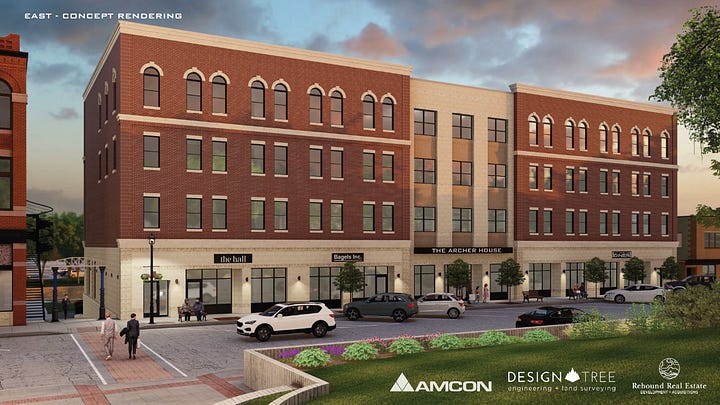
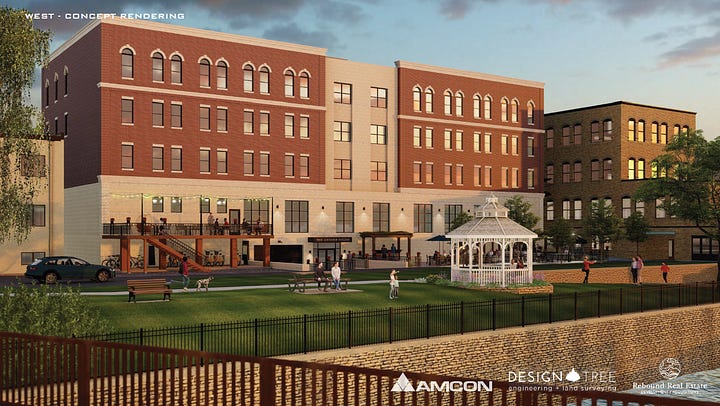
See the complete post-meeting August 2026 Archer Developer Presentation (PDF).
I asked Wopata directly, in writing, what happens to that demolition and backfill cost he mentioned at the meeting, and who pays it. His answer:
“If there isn’t significant progress on that site, the City would require the owner to complete the demolition of the site, which would include removing much of the concrete walls, floor, and then backfilling the site, and seeding it for grass or some type of finish. For any enforcement of this nature, the City requires the property owner to do the work. If the owner doesn’t complete the work in a timely fashion, then the City may perform the work and assess the costs back to the owner through a property tax assessment.
This is the same process for any enforcement by the City regardless of the property. The challenge for the Archer site would be the compounding cost of all of the backfill and then undoing/removing that backfill when it was ready to develop. Any outstanding property taxes or assessments would be the responsibility of the property owner and are not eligible for TIF funding.”
In short: the owner pays, either directly or through an assessment on their property taxes. The city bills the owner rather than paying out of TIF revenue. Wopata’s added point about “compounding cost” is worth sitting with too: backfilling the site now, only to dig it back out later if construction eventually happens, would waste money on both ends. That’s part of why the city has an incentive to keep negotiating rather than pull the plug.
At the meeting, Wopata put a rough number on the cost if the city ever has to step in: $300,000 to $400,000. He later confirmed that figure covers the full cycle, both the cost of the initial demolition and backfill, and the developer’s later cost to undo it whenever the site is ready for construction, not just the first step alone.
The developer’s own schedule, presented Aug. 3:
August: Complete 60% construction drawings. Send out bids to contractors. Finalize leases and underwriting.
September: Select construction and management teams.
October: Complete equity raise and bank financing. Finalize the TIF and development agreement. Close.
November: Break ground, if the pieces above land on schedule.
Winter 2027/2028: Open, after 12 to 14 months of construction.
Developer Matt Ganter of Rebound Partners was candid with council that the November date isn’t locked in. It depends on how quickly the city and developer can finalize the TIF agreement, a process he said could take one month or two.
Parking comes up every time this project does, so here’s the current plan in full.
The building itself will have 19 underground spaces, primarily for overnight guest use. Beyond that, the developer is counting on roughly 30 on-street spaces along Division Street and about 100 total within a two-block walk. For the slower 90 percent of the year, the developer says they don't expect that to be a problem.
For busier stretches, two backup arrangements are in the works: a proposed agreement with Carleton for overnight use of a lot just north of the site, and continued use of the old Byzantine site across the river, about 40 spots, for peak weekends in the first couple of years, with valet service if needed.
Longer term, Rebound Partners owns the building and surface lot at 304 Washington, currently an 8-unit house. Screenshot:

Their stated plan is to eventually redevelop that block into an apartment building with a parking structure meant to serve the Archer site indefinitely. That’s a second, separate redevelopment project, still years out, worth watching on its own. The future parking structure isn't part of the current negotiation.
The 2024 agreement (PDF) set the terms that a revised deal would amend, not replace. Under that plan (PDF): a 26-year tax increment financing term (2027 through 2052), with an estimated $6.23 million in total tax increment generated over that span. The city keeps 100 percent of the increase in property tax revenue the redevelopment generates to repay the public costs of the project, rather than splitting it with the county or school district as property taxes normally would be.
That last point matters, because it’s easy to misread the plan’s other numbers as describing a split. A separate disclosure required by state law shows what those taxes would have been divided among jurisdictions, roughly 51 percent city, 29 percent county, 17 percent school district, 3 percent other, if there were no TIF district and the property were taxed the ordinary way. That’s a hypothetical comparison, not what actually happens. For 26 years, the increment goes entirely to the city to pay down the project’s public costs. Only after the district expires in 2052 does the added tax revenue start flowing to the county and school district in the normal way.
Mayor Erica Zweifel used the Aug. 3 meeting to lay out what she wants to see change in the amended agreement: keeping the existing default and deadline language, adding city sign-off on public bathroom signage, and, most substantively, exploring ways to shorten the TIF term below 26 years, reduce the total assistance amount, or build in a clawback that would accelerate repayment to the city if the project performs better than projected. She pointed to the city’s Harvest Hills TIF deal as a precedent for shortening terms this way.
None of that is settled. Council’s Aug. 3 vote didn’t approve TIF terms, only direction to negotiate them. The actual amended agreement will come back to council for a separate vote.
Councilmember Chad Beumer raised a pointed question early in the meeting: would local contractors get a shot at bidding on the project, or would the work go entirely to outside firms?
Ganter said no subcontractors have been selected yet. The team will go through a standard bidding process once general contractor selection begins. Beumer pressed further, asking specifically about local subcontractors who have “upwards of tens of thousands of dollars” tied up in engineering and planning costs from the original, failed 2024 version of the project, and whether they’d get a fair chance to bid on the new one. Ganter said yes.
Beumer returned to the point later in the meeting, after the motion had already passed. He said he wasn’t asking for a requirement that the developer hire local contractors, only that Rebound and its architect, Amcon, make a good-faith effort to give those same local subcontractors, the ones already out real money from the original 2024 project, a chance to bid and potentially recoup some of it.
Councilmember Kathleen Holmes pushed back on the idea of building any local-hire requirement into the TIF agreement itself. She said that isn’t consistent with the city’s TIF policy and would unfairly constrain the developer’s ability to choose the best bid. She said the city can encourage local contractors to submit competitive bids without mandating their use.
Neither position made it into Monday’s motion. The vote was only to direct staff to negotiate a revised agreement, so whether local-hiring language shows up in that agreement, in any form, is still an open question.
This piece draws in part on an AI-generated text transcript of the Archer segment of the Aug. 3 council meeting video, city staff’s own presentation slides, the developer’s presentation deck, KYMN Radio’s Aug. 5 interview with Wopata and City Administrator Ben Martig, and a written email statement from Wopata obtained directly for this piece.
Thanks for reading Northfield.org! This post is public. Please share it with others who might be interested.
Prefer a one-time gift instead?
See the latest Northfield.org posts in the archive.
See the recent Quick Take posts here.
See posts tagged #accountabilityreporting, a mix of accountability reporting and shorter explainers on the same topics.
Comments
Nothing yet. Say the first thing.
Sign in to join the conversation.