
I have spent the better part of three years arguing that the USMCA review is not just a trade negotiation. It is the most consequential reframing of the North American relationship in a generation, across every agenda simultaneously. Last week, the White House confirmed it with a federal indictment.
On April 29, Sinaloa Governor Rubén Rocha Moya and nine other current and former Mexican officials were charged by the U.S. Department of Justice with conspiring to assist the Sinaloa Cartel in exchange for bribes and political support. This is the kind of moment my co-author Diana Paz García and I have been tracking since January 2025. What follows is our analysis, adapted from a piece we are publishing simultaneously at CSIS.
On April 29, Sinaloa Governor Rubén Rocha Moya and nine other current and former Mexican officials were indicted by the U.S. Department of Justice on charges of conspiring to assist the Sinaloa Cartel in trafficking drugs into the United States in exchange for bribes and political support. The move was not a surprise, but a culmination. For eighteen months, the White House had been turning the screws on the Sheinbaum administration, demanding deeper security cooperation and tangible outcomes, while holding a series of escalating threats in reserve, among them the specter of unilateral U.S. military action on Mexican soil. Mexico responded at nearly every turn, and at nearly every turn the goalposts moved.
The indictment of sitting officials from Morena, President Sheinbaum’s party, represents one of the most consequential of those threats, one the White House had kept in reserve but never fired. Its timing is not incidental. It comes at a moment of acute bilateral tension, and just weeks before the formal review of the USMCA, currently scheduled to launch, without Canada, on May 26.
This moment reflects a deeper structural shift in bilateral relations. For decades, the different agendas of U.S.-Mexico cooperation operated under independent silos: trade and security were negotiated separately, through distinct bureaucratic channels, and according to different political logics and calendars. Security performance has become a condition for economic integration, and the events of the past week provide the clearest evidence yet that the architecture of the old relationship has collapsed. From its earliest days, the current U.S. administration moved to dismantle the status quo, linking tariffs to results in fentanyl enforcement and the fight against organized crime. The indictment of a sitting governor is where that project has arrived.
Since January 2025, the Sheinbaum administration has been engaged in a delicate and exhausting balancing act: offering enough security cooperation to forestall the worst U.S. threats, while avoiding the appearance of capitulation to Washington, and managing ongoing USMCA extension talks. For over a year, that strategy held, imperfectly, but well enough. Mexico’s willingness to cooperate paid dividends: its tariff exposure under the April 2025 global tariff measures remained lower than that of most U.S. trading partners.
The pattern was consistent. Each time Mexico met a U.S. demand, the White House moved the goalposts. When the United States imposed 25 percent tariffs in February 2025 related to fentanyl, Sheinbaum responded by deploying 10,000 National Guard troops to the northern border. When six Mexican cartels were designated as Foreign Terrorist Organizations, Mexico carried out one of the largest single transfers in bilateral history, sending 29 cartel figures to U.S. custody. By January 2026, the total number of alleged cartel figures transferred to U.S. custody had reached 92 since Sheinbaum took office. Each concession was met not with reciprocal relief, but with a new demand.
Even this month, amid acute tensions, Mexico continued to act. On April 19, two CIA officers died in a vehicle crash in Chihuahua after accompanying state police in the decommissioning of a clandestine drug laboratory. Mexico’s security cabinet confirmed that neither officer had formal accreditation to participate in operational activities within national territory, sparking a sovereignty dispute that reverberated through both capitals. Then, on April 27, the Mexican Navy arrested Audias Flores Silva, known as “El Jardinero,” one of the CJNG’s most senior remaining commanders and a rumored successor to “El Mencho,” himself a long-sought U.S. government target whose death in February marked the first time Mexican forces under President Sheinbaum eliminated a sitting cartel leader of that stature. The arrest was both a genuine security strike and a political signal: Mexico could manage its own territory without Washington doing it for her. That both operations were supported by U.S. intelligence was further proof that the model Sheinbaum had been offering, deep cooperation without intervention, could deliver results.
Yet none of this addressed the White House’s central and growing concern: the resilience of the criminal-political nexus. Since the outset of the Trump administration, the White House had been pushing that Mexico dismantle what it described as an “intolerable alliance“ between transnational criminal organizations and the political structures that shelter them. By April 2026, the White House had crossed the Rubicon: a U.S. agency was now formally seeking to apprehend a sitting governor on Mexican soil.
The Rocha Moya indictment makes this shift explicit. The Trump administration has moved beyond targeting drug flows, the primary focus of prior U.S. administrations, and is now targeting the political infrastructure that enables them. Disrupting fentanyl precursor supply chains or arresting TCO leaders, however consequential, does not address what the U.S. government argues is a structural reality: that a number of elected officials in Mexico allegedly protect, fund, and depend on the organizations producing those flows. That is the argument embedded in the Southern District of New York’s indictment, and it represents a fundamental expansion of the scope of U.S. security demands on Mexico.
On April 23, Ambassador Ronald Johnson traveled to Los Mochis, Sinaloa, for the groundbreaking of the Pacífico Mexinol project, a USD 3.3 billion methanol facility. He used the occasion to deliver a pointed message: without legal certainty and a crackdown on corruption, private investment would not prosper, and USMCA already obliges all three governments to criminalize bribery and enforce codes of conduct for public officials. The choice of venue was not incidental. An event designed to celebrate U.S.-Mexico commercial integration became the stage for a warning about its limits. The deaths of the CIA officers in Chihuahua appear to have accelerated the White House’s decision to act against the criminal-political nexus at a level it had not previously attempted. The Rocha Moya indictment was Washington’s answer to Chihuahua.
The Sheinbaum administration has not been passive on corruption at the local level. Operation Enjambre has arrested more than 60 public officials, including mayors and municipal security directors, across Mexico, and the government has pursued corruption networks related to oil theft and tax fraud. But at the upper levels of the political class, Sheinbaum largely chose to shield figures facing serious accusations from prosecution rather than pursue them, and resisted sustained U.S. pressure throughout 2025 to move against high-level politicians with alleged cartel links. Faced with Mexico’s response, the White House concluded it would have to act on its own.
The institutional body now responsible for Mexico’s response is the Fiscalía General de la República (FGR), led since December 2025 by Ernestina Godoy Ramos, a founding Morena figure and former Mexico City prosecutor closely aligned with Sheinbaum. She is now being asked to prosecute the movement she helped build.
The upcoming USMCA review looms over this evolving dynamic. The agreement entered into force in 2020, replacing NAFTA after 26 years, and its first formal six-year review is set to launch on May 26, currently without Canada’s participation. July 1, 2026 is the pivotal decision node, when parties must signal whether to extend, renegotiate, or trigger withdrawal procedures. It is the most consequential moment in North American commercial relations in a generation, and it is now arriving in conditions its architects never anticipated.
Security cooperation has become the gatekeeper for economic certainty. Market access, investment flows, and supply chain integration are no longer insulated from security considerations; they are the terrain on which those considerations are now enforced. The Rocha Moya indictment is the most unambiguous signal yet that the White House intends to use security compliance as a condition for progress at the USMCA table.
For thirty years, first NAFTA and then USMCA structured the bilateral relationship, managing trade and keeping its other agendas at arm’s length. The silos that sustained that arrangement are gone, and the price of admission to the trade table is now security cooperation. The Rocha Moya indictment and its aftermath are the opening act of a more volatile, more conditional, and more uncertain U.S.-Mexico relationship. Canada should take note: Washington has just shown it will leverage any agenda and dependency to get what it wants. Mexico was first. It will not be last. Here are some scenarios moving forward:
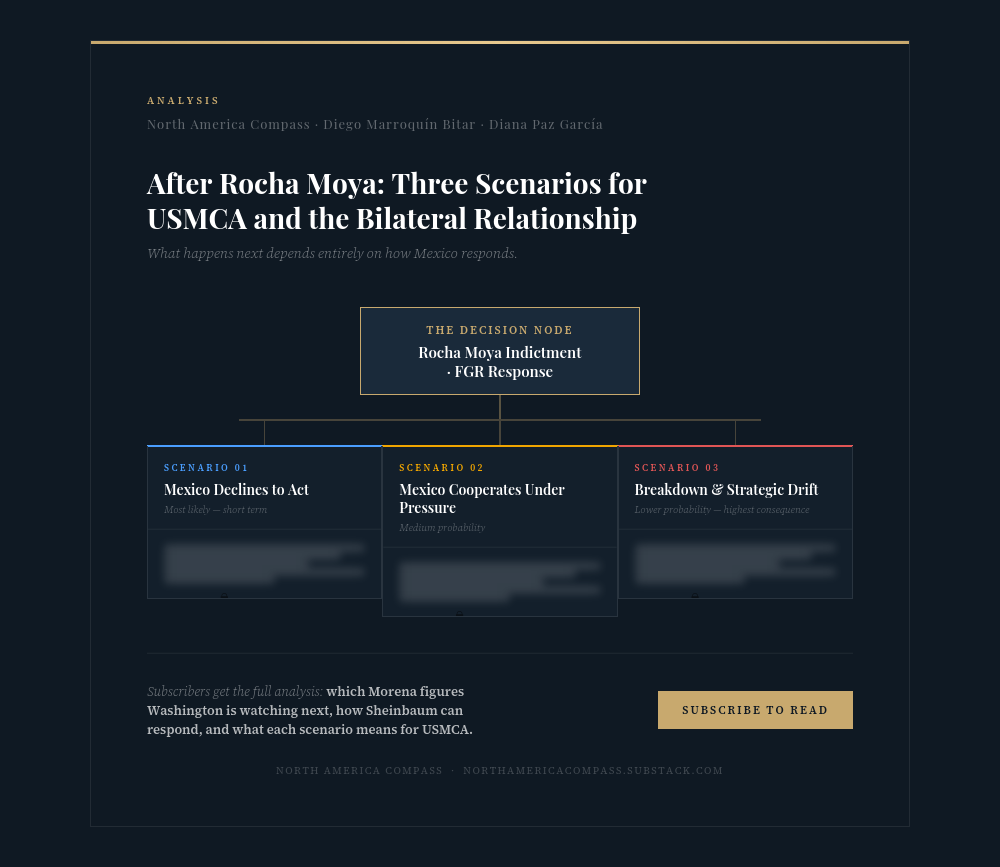
Paid subscribers get the full picture: which Morena figures Washington is watching next, how Sheinbaum can respond, and the three scenarios that will determine whether USMCA survives
Comments
Nothing yet. Say the first thing.
Sign in to join the conversation.