
With President Trump once again raising the possibility of exiting the USMCA, it is worth stepping back from the headlines and focusing on what actually matters.
The rhetoric is loud. The structural realities are quieter… and more important.
Here are six takeaways.
The July 2026 review is not a binary moment when the agreement lives or dies overnight. It is a decision node in a broader political and economic process that will likely extend through 2026 and beyond.
The USMCA contains mechanisms that allow the agreement to remain in force even if extension is not immediately agreed upon. Markets understand this. What really matters is the direction and pace of negotiations, as well as the credibility of the institutional process surrounding them.
Both Mexico and Canada have made measurable progress addressing U.S. concerns. Cooperation has intensified on fentanyl interdiction, migration management, defense coordination, and broader economic security alignment.
As a result, their trade-weighted tariff exposure remains lower than most other geographies. Mexico sits at around 5 percent. Canada is closer to 10 percent. The rest of the world faces roughly 19 percent exposure, and China remains near 36 percent.
However, this relative insulation should not be confused with immunity. I estimate that roughly 32 percent of Mexican USMCA-compliant goods and 37 percent of Canadian goods remain subject to Section 232 tariffs.
This positioning is favorable in comparative terms. But it risks becoming a Pyrrhic victory if prolonged uncertainty continues to delay capital formation and long-term investment decisions across North America.
The trilateral agenda is now fully decompartmentalized. Security, migration, defense cooperation, industrial policy, and trade are no longer siloed tracks. Progress or stagnation in one domain now spills directly into the others.
For Mexico, the main risk lies in unilateral U.S. actions on Mexican soil (boots on the ground). For Canada, it is the reimposition of tariffs on key exports and renewed threats to its economic or political sovereignty.
The original intent of the parties was to initiate structured working groups early in the year in preparation for the review. That sequencing has not materialized.
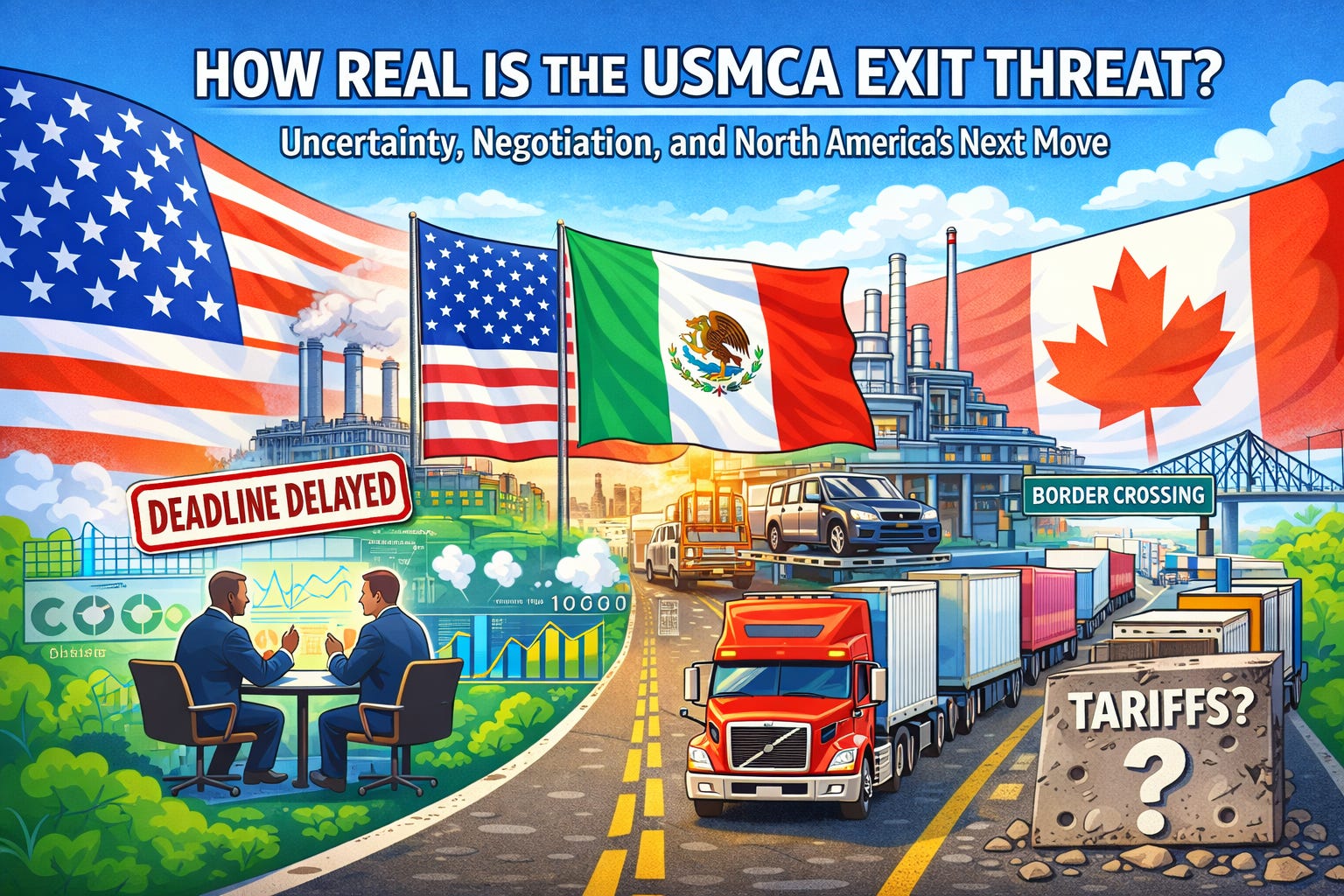
As of mid-February, formal review consultations remain limited, while unsuccessful bilateral tariff negotiations under Section 232 continue to absorb bandwidth. Renewed tensions, including threats to block the opening a U.S.–Canada bridge and slow parallel tariff discussions, have further slowed momentum.
What was initially envisioned as an orderly early-year framework may now be pushed into mid-March or even April.
The probability of a clean, early extension has thus diminished. A compressed timeline makes a prolonged negotiation more likely. Don’t expect a result on July 1, 2026.
My base scenario has not changed.
Given the economic, political, and logistical costs of a full withdrawal, I continue to interpret Trump’s renewed exit threats primarily as negotiation tactics.
North America’s production platform is deeply integrated. Energy flows, automotive supply chains, industrial inputs, and cross-border capital commitments are not easily reversed without substantial domestic disruption.
The structural cost of rupture is extremely high. That raises the threshold for actual withdrawal.
If managed carefully, North America’s trade architecture will likely extend beyond 2026. But it will not remain unchanged.
A more restrictive and politically recalibrated version of the USMCA is the most plausible outcome. Rules may tighten. Enforcement may intensify. Economic security provisions may expand. Sectoral concessions may emerge.
The process will be contentious. It will be politically costly. It will generate volatility. USMCA may well survive but will likely be transformed in the process.
The key question is no longer whether the USMCA survives. It is what kind of agreement survives — and at what political and economic cost.
North America’s integration is too advanced to unwind casually. But it is not immune to recalibration.
The coming months will determine whether the review strengthens regional competitiveness or simply injects more uncertainty into a platform that depends on long-term confidence.
🧭 North America Compass is reader-funded. In addition to all the free content, premium subscribers get exclusive deep dives on USMCA, trade policy, and North America’s economic future, plus powerful data visualizations that simplify complex issues. Every subscription makes a difference.
🔹 Stay ahead on all things North America and the 2026 USMCA review—subscribe today!
No posts
Comments
Nothing yet. Say the first thing.
Sign in to join the conversation.