
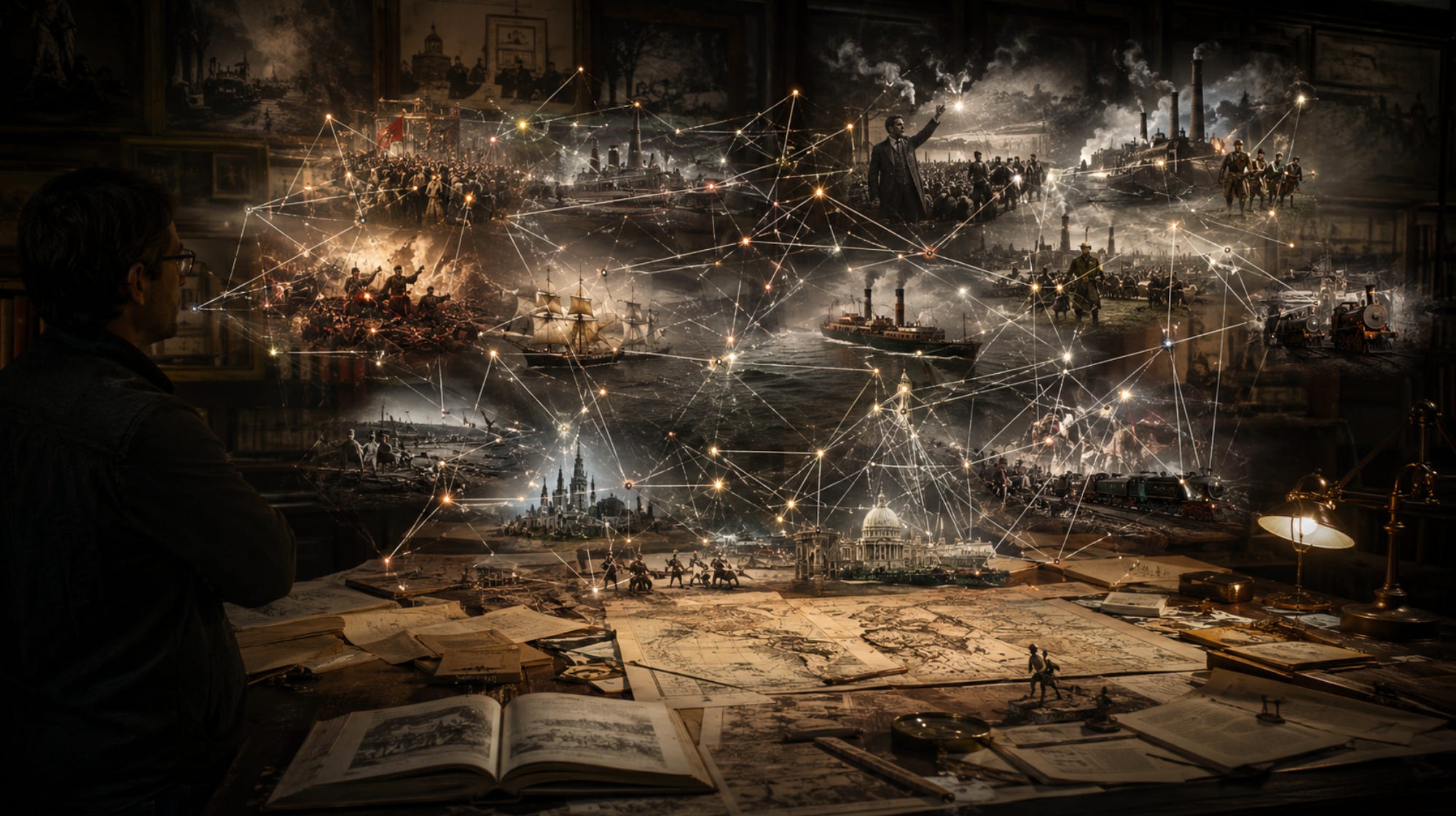
Causation is one of the most persistent problems in the study of history, and we’ve dealt with it several times on this Substack. Historians do not merely ask what happened. They ask why it happened, why it happened when it did, why it happened in one place rather than another, and why events took one course among the many that appear, in retrospect, to have been possible. Yet the closer historians come to major events—the collapse of empires, the outbreak of wars, revolutions, economic crises, migrations, religious transformations, or technological upheavals—the more elusive their causes seem to become. Every explanation appears to open onto further explanations. Political decisions depend on economic conditions; economic conditions are shaped by institutions; institutions emerge from earlier conflicts; conflicts are interpreted through cultures; cultures are transmitted through networks of people whose actions are influenced by emotion, memory, expectation, and chance. And it’s often been difficult to quantify causal factors when dealing with human events. Historical causation seems to retreat as it is approached.
It would be an exaggeration to say that historians have simply abandoned the search for causes. Historical scholarship is full of causal arguments. Historians routinely identify pressures, incentives, constraints, decisions, traditions, accidents, and structural conditions that contributed to particular outcomes. Nevertheless, many historians have become understandably suspicious of explanations that claim to isolate a single decisive cause. The older ambition to discover clear historical laws has largely fallen out of favor. Grand theories that attribute social change primarily to class struggle, geography, technology, religion, national character, or the actions of exceptional individuals tend to appear inadequate when confronted by the density of the historical record.
The fundamental difficulty could be described with one word: complexity. Human societies contain too many actors, too many variables, too many overlapping processes, and too many unpredictable interactions for simple causal analysis. Yet complexity need not be merely a declaration of defeat. It can become the beginning of a method. Over the past several decades, researchers in physics, biology, ecology, mathematics, computer science, economics, and other fields have developed a body of concepts for understanding systems whose behavior arises from large numbers of interacting components. This interdisciplinary field is commonly called complex-systems science.
The central contention of this essay is that the study of complex systems offers historians a useful framework for approaching causation. It does not provide a formula capable of predicting historical events, nor does it transform history into a branch of physics. Human beings possess consciousness, language, memory, moral judgment, and the ability to interpret the very systems in which they act. These qualities distinguish historical inquiry from the study of many natural systems. Nevertheless, human events display the defining features of complex systems: numerous interacting agents, nonlinear relationships, feedback loops, adaptation, emergence, path dependence, network effects, sensitivity to initial conditions, and interaction across multiple scales.
To understand history as a complex system is to replace the search for a single chain of causes with the study of dynamic causal configurations. Historical outcomes are not usually produced by one force acting independently. They emerge from interactions among forces. This shift preserves the historian’s concern with human meaning and particularity while adding a more rigorous vocabulary for explaining why the past is simultaneously structured and unpredictable.
The Problem of Causation in History
In ordinary speech, the word “cause” often suggests a straightforward relationship between two events. One event occurs, and another follows because of it. A spark causes an explosion. A collision causes a window to break. A switch causes a light to turn on. Such examples encourage us to imagine causation as a linear sequence: A produces B.
Historical explanations don’t possess this simplicity. Consider the outbreak of a war. A declaration of war may immediately precede the beginning of hostilities, but it is not, by itself, an adequate explanation. The declaration may have resulted from military planning, diplomatic commitments, domestic political pressures, imperial rivalries, nationalist movements, fears about an opponent’s intentions, misread communications, technological changes, and the decisions of particular leaders. Even these factors require further explanation. Why did the alliances exist? Why were military leaders influential? Why did nationalism take the form it did? Why were some warnings believed and others dismissed? Why did similar tensions at an earlier moment fail to produce war?
The difficulty is partly one of causal depth. Every cause has causes of its own. If historians explain a revolution by pointing to a financial crisis, they must explain why the government’s finances were fragile. If they appeal to an unjust tax system, they must explain how that system arose and why it could not be reformed. If they emphasize revolutionary ideas, they must explain how those ideas spread, why they became persuasive, and why they translated into collective action at a particular moment. Historical explanation can move backward almost indefinitely.
There is also the problem of causal multiplicity. Major events have many contributing causes. Some are long-term and structural, such as demographic growth, state formation, environmental constraints, or patterns of land ownership. Others are medium-term conditions, such as inflation, factional competition, institutional paralysis, or a decline in governmental legitimacy. Still others are immediate triggers: an assassination, a failed harvest, a disputed election, a military mutiny, or a rumor. These causes do not operate on the same timescale, and they do not all have the same kind of influence. A trigger may determine when a crisis begins without explaining why the society was vulnerable to crisis.
Historical causation also involves the problem of agency and structure. Explanations that emphasize individuals risk neglecting the institutions, cultures, and material conditions that constrain action. Explanations that emphasize structures risk treating people as passive instruments of impersonal forces. Historical actors make choices, but they do not choose under conditions of their own making. They inherit languages, laws, economic systems, technologies, social hierarchies, political borders, and collective memories. At the same time, those structures exist only because people reproduce, reinterpret, or challenge them through action.
Another difficulty is that historical actors respond not merely to objective circumstances but to their interpretations of those circumstances. A government may act on the basis of a threat that does not exist. Investors may cause a financial panic because they expect other investors to panic. A population may rebel not when conditions are at their worst but when rising expectations make continued deprivation appear intolerable. Ideas about the future can therefore become causes in the present. Human beings are anticipatory agents: they imagine possibilities and alter their behavior accordingly.
The historian also confronts the problem of contingency. Some events seem to depend heavily on accidents, timing, personality, weather, illness, misunderstanding, or coincidence. A message arrives late. A leader dies unexpectedly. A protest is handled violently instead of peacefully. A storm destroys a fleet. Such events may redirect developments that have been building for decades. Yet to explain history entirely through accident is as unsatisfactory as explaining it entirely through necessity. The challenge is to determine how contingent events interact with underlying conditions.
Finally, historians cannot rerun the past. Experimental scientists can sometimes alter one variable while holding others constant. Historians possess only the sequence that actually occurred. Counterfactual reasoning (asking what might have happened under different circumstances) can help clarify causal claims, but counterfactuals cannot be directly observed. The historian must infer causal importance from comparisons, patterns, documents, sequences, and judgments about plausible alternatives.
These problems explain why historical causation resists reduction to simple laws.
They do not, however, make causal knowledge impossible.
They suggest that historians require a model suited to systems in which causes are multiple, interactive, recursive, scale-dependent, and partly contingent. Complex-systems science provides precisely such a model.
Simple and Complex Systems
The distinction between a simple system and a complex system does not depend only on the number of parts it contains. A system may contain many components and still behave in a relatively simple manner if the relationships among those components are regular, stable, and predictable. Conversely, a system with comparatively few components may behave in a complex fashion if those components interact nonlinearly and adapt to one another.
A simple system is one in which the behavior of the whole can largely be understood by examining its parts separately and identifying stable relationships among them. Its causal structure is approximately linear. Small inputs usually produce proportionally small outputs, while large inputs produce proportionally large outputs. The system’s behavior can often be predicted if its initial conditions and governing rules are known.
A mechanical clock is a useful example. It may contain numerous gears and springs, but each component performs a specialized function. The gears do not interpret one another, alter their goals, or invent new relationships. The behavior of the clock is decomposable: a researcher can understand the whole by studying how its parts connect. If one gear is moved by a given amount, the resulting movement elsewhere in the mechanism is ordinarily regular and predictable.
A complex system is different. It consists of multiple interacting components, often called agents, whose local actions collectively generate patterns at the level of the whole. These patterns cannot always be deduced by studying each component in isolation. The interactions are frequently nonlinear, meaning that the magnitude of an outcome is not proportional to the magnitude of the initiating event. Small disturbances can sometimes produce enormous consequences, while large interventions may be absorbed with little visible effect.
An ecosystem is a familiar example. The population of one species depends not only on its own biological characteristics but also on predators, prey, competitors, parasites, climate, vegetation, disease, migration, and human activity. A change in one population may alter several others, which then feed back into the original population. The result is not a single causal chain but a web of reciprocal influence.
Complexity should not be confused with randomness. A complex system is neither perfectly ordered nor wholly chaotic. It often displays recognizable patterns, regularities, and constraints, but its precise behavior remains difficult to predict. Weather systems obey physical laws, yet long-range weather prediction is limited because atmospheric variables interact in nonlinear ways. Similarly, societies exhibit durable institutions and recurring patterns without following a predetermined script.
Several features are especially important for defining complex systems.
First, complex systems contain many interacting agents. The behavior of each agent depends partly on the behavior of others. In human systems, agents may include individuals, families, firms, armies, religious organizations, political parties, states, classes, or informal networks.
Second, complex systems exhibit emergence. Emergence occurs when large-scale patterns arise from local interactions without being centrally designed. No single person creates a language, a market price, a fashion trend, or a traffic jam. These phenomena emerge from the combined behavior of many participants.
Third, complex systems contain feedback loops. Positive feedback amplifies change. A bank run accelerates when withdrawals encourage further withdrawals. A political movement gains credibility as visible support attracts additional supporters. Negative feedback restrains change. Institutions may absorb dissent, markets may correct shortages through price changes, or political systems may distribute power in ways that prevent any faction from becoming dominant.
Fourth, complex systems are adaptive. Their agents learn and alter their strategies. Predators change their behavior in response to prey; businesses react to competitors; governments respond to opposition; protest movements adjust their tactics when authorities change theirs. Adaptation means that the system’s rules are not always fixed. The agents are continually modifying the environment to which they themselves must adapt.
Fifth, complex systems are path-dependent. Their future possibilities are shaped by their previous development. Early events may establish institutions, expectations, technologies, or boundaries that become costly to reverse. Once a particular path has been taken, alternatives that were once possible may disappear.
Sixth, complex systems operate across multiple scales. Events at the individual level can influence institutions, while institutions shape individual behavior. Local disturbances may spread through regional or global networks. Long-term transformations may emerge from short-term actions repeated across generations.
Finally, complex systems often possess thresholds. Pressure may accumulate without producing visible change until a critical point is reached. A final disturbance then appears to cause a sudden transformation, although the system’s vulnerability was created by earlier developments.
These concepts provide a more precise meaning for the complexity of history. They allow the historian to move beyond saying merely that “many things were happening.” The relevant question becomes: What kinds of interactions connected those things, and how did their combined behavior produce the outcome?
Human events as complex systems
Human societies satisfy the basic criteria of complex systems with unusual clarity. They are composed of vast numbers of interacting agents. Those agents communicate, imitate, compete, cooperate, remember, and anticipate. They belong simultaneously to multiple networks: families, workplaces, religious communities, classes, political organizations, cities, nations, and digital communities. Their behavior is shaped by formal rules, informal norms, material incentives, emotions, and interpretations.
No central authority controls the totality of social life. Even powerful states cannot fully determine prices, beliefs, loyalties, demographic patterns, technological innovation, or cultural change. Large-scale outcomes emerge from interactions that no participant completely understands. An emperor may issue a decree, but its effects depend on administrators, local elites, transportation systems, popular expectations, economic conditions, and resistance. A revolutionary leader may call for an uprising, but whether people respond depends on networks of trust, perceptions of risk, previous grievances, and beliefs about what others are likely to do.
One of the strongest arguments for treating human events as complex systems is the prevalence of emergent phenomena. Markets emerge from transactions among buyers and sellers. Political legitimacy emerges from countless acts of obedience, belief, habit, ritual, and enforcement. Public opinion emerges through conversations, media systems, institutions, and social pressures. National identities emerge through education, warfare, migration, storytelling, administration, and shared symbols. None of these phenomena is reducible to a single individual, yet none exists independently of human action.
Consider a crowd. A crowd is made up of individuals, but its behavior cannot always be predicted from isolated knowledge of each person. People watch one another, fear spreads, courage spreads, a rumor changes perceptions, few individuals begin to move, causing others to interpret the movement as evidence of danger or opportunity. The crowd can acquire a direction and emotional intensity that no single member intended. The same basic principle applies, on a larger scale, to financial panics, revolutionary mobilizations, religious revivals, consumer trends, and nationalist movements.
Human societies also display nonlinearity. A minor event can have consequences far beyond its apparent importance when it occurs at a vulnerable point in the system. The assassination of a political figure may remain a limited tragedy in one context but initiate a continental war in another. A modest protest may disperse harmlessly under ordinary conditions but ignite a revolution when state legitimacy is weak, elite factions are divided, communication networks are dense, and the public believes that mass participation can succeed.
This does not mean that small events possess magical causal power. Their importance depends on the system through which their effects travel. A spark starts a forest fire only when combustible material, dry conditions, oxygen, and sufficient continuity of fuel are present. Similarly, a historical trigger produces a major transformation only when political, social, economic, and cultural conditions allow its consequences to propagate.
This distinction helps historians separate triggering causes from enabling conditions. The trigger explains the timing and immediate form of the event. Enabling conditions explain why the trigger had such extensive effects. Neither explanation is sufficient alone. Without the trigger, the crisis may not have occurred when it did. Without the enabling conditions, the trigger would have remained local and limited.
The outbreak of the First World War illustrates this structure. The assassination of Archduke Franz Ferdinand in June 1914 was an immediate catalyst, but assassinations do not ordinarily generate world wars. Its consequences spread through a European system shaped by alliance commitments, imperial competition, nationalist conflict, military timetables, arms races, domestic instability, fears of strategic decline, and assumptions about offensive warfare. Governments reacted not only to the assassination but also to one another’s reactions. Mobilization by one state altered the calculations of others. Military preparations intended as defensive measures appeared threatening to rival governments. The crisis therefore developed through feedback loops.
The event cannot be explained satisfactorily by identifying one guilty nation, one ideology, or one diplomatic failure. Nor does complexity eliminate responsibility. Particular leaders made choices, and some choices were more reckless than others. A complex-systems approach distinguishes moral responsibility from causal sufficiency. An actor may bear significant responsibility for a decision without being the sole cause of the larger outcome.
Revolutions also reveal the complex character of historical causation. They are rarely produced by misery alone. Many populations endure severe hardship without overthrowing their governments. Revolutionary situations emerge when multiple processes reinforce one another: fiscal crisis weakens the state; elite divisions reduce its capacity to respond; new ideas undermine traditional authority; communication networks spread grievances; food shortages intensify anger; demonstrations reveal the regime’s vulnerability; and successful defiance lowers the perceived risks of further participation.
Positive feedback can then accelerate the process. A small protest draws a larger crowd. The larger crowd signals that resistance may be safer than previously believed. Security forces hesitate, encouraging further mobilization. Each visible act of opposition makes additional opposition appear possible. A regime that seemed permanent can lose authority with astonishing speed because authority depended partly on the expectation that others would continue to obey.
This process contains a paradox. The state may be strongest before a revolution in terms of soldiers, weapons, and formal institutions, yet weakest in terms of shared belief. Once officials, soldiers, and citizens begin to doubt that others will defend the government, the appearance of power can collapse. Political order is therefore an emergent condition supported by recursive expectations. People obey partly because they believe others will obey. When that belief changes, the system may cross a threshold.
Economic crises exhibit similar dynamics. Prices do not result from the decision of a single actor. They emerge from networks of production, consumption, credit, expectation, and regulation. Financial systems are especially dependent on confidence. A lender extends credit because repayment is expected. An investor buys an asset partly because others are expected to value it. Rising prices may attract buyers, causing further price increases. This positive feedback can create bubbles. When confidence reverses, selling produces more selling, and falling prices weaken the institutions holding the assets. A disturbance that might have remained manageable becomes systemic because institutions are interconnected.
The global financial crisis of 2008, for example, cannot be reduced to a single type of mortgage, a single bank, or a single regulatory decision. It arose from interactions among housing markets, financial innovations, leverage, credit-rating practices, monetary conditions, institutional incentives, international capital flows, regulatory gaps, and widely shared assumptions about risk. These elements did not merely add together. They changed one another. Financial products altered lending behavior; rising housing prices appeared to validate optimistic models; optimistic models justified further lending; expanding credit drove prices higher. The system generated information that seemed to confirm the behavior destabilizing it.
Complexity also clarifies the spread of ideas. Ideas do not move through society as identical objects passed intact from one mind to another. People reinterpret them according to local circumstances. A political doctrine may be adopted by workers, intellectuals, soldiers, religious leaders, and state officials for different reasons. As the idea travels, it changes. Its spread depends on social networks, prestige, censorship, literacy, technology, emotional resonance, and existing cultural categories.
This process resembles adaptation in other complex systems. Individuals alter ideas as they use them, while the altered ideas reshape later behavior. Human culture is recursively produced. People inherit symbolic systems, but they also modify those systems through speech, ritual, art, conflict, and institutional practice.
Because human agents interpret their world, social systems possess a reflexive quality. A scientific description of a hurricane does not alter the hurricane’s behavior. A description of an economy, political movement, or social class can alter the behavior of the people described. Economic forecasts may influence investment. Predictions of electoral collapse may discourage supporters. The claim that a bank is unstable may make it unstable. Historical agents act in response to theories about history, including nationalist destinies, revolutionary prophecies, religious expectations, and narratives of decline.
Human complex systems are therefore not merely adaptive. They are interpretive and self-aware. This characteristic limits any attempt to transfer scientific models mechanically into history. It also makes complexity theory especially valuable, because it directs attention to recursive interaction rather than assuming that causes operate only from the outside.
From linear causes to causal configurations
A complex-systems approach requires a change in the form of historical explanation. Instead of asking, “What was the cause?” historians should often ask, “What configuration of conditions made this outcome possible, and what interactions transformed possibility into actuality?”
This shift does not imply that every cause is equally important. Some variables exert greater influence because of their position in the system. A highly connected institution, for example, may transmit disturbances across multiple sectors. A central bank, military command, transportation hub, or communication platform may function as a network node whose failure has disproportionate consequences. Complexity analysis can therefore strengthen causal discrimination rather than weaken it.
Historical causes can be organized into several categories. Structural causes establish the system’s broad constraints and opportunities. These may include geography, demography, class relations, institutions, and technological capacities. Conjunctural causes arise from the temporary combination of conditions, such as an economic downturn coinciding with political division. Catalytic events initiate rapid change. Feedback mechanisms amplify or contain that change. Individual decisions direct the process at critical moments. Contingent events alter timing or close off alternatives.
Such categories should not be treated as isolated boxes. Their value lies in showing how different kinds of causes interact. A structural weakness may remain dormant until activated by a crisis. A crisis may remain manageable unless a leader responds poorly. A poor decision may be corrected unless communication failures or institutional rivalries amplify it. The final outcome belongs to the configuration as a whole.
This perspective also helps explain why similar causes can produce different effects. Economic inequality may contribute to revolution in one society, reform in another, authoritarian reaction in a third, and political apathy in a fourth. The difference lies in the surrounding system: state capacity, social networks, political culture, elite cohesion, international pressure, institutional flexibility, and collective expectations.
In complexity science, this phenomenon is related to context dependence. The effect of one variable depends on the state of other variables. Historical causes do not possess fixed strength under all conditions. Their power is relational.
The reverse is also true: different causal configurations can produce similar outcomes. Empires may collapse through invasion, fiscal exhaustion, succession crises, ecological pressure, civil war, administrative fragmentation, or some combination of these. Democracies may emerge through revolution, negotiated transition, foreign occupation, elite compromise, or gradual institutional reform. This principle, sometimes called equifinality, warns historians against assuming that similar outcomes must share the same path.
A complexity framework can therefore reconcile comparison with particularity. Historians may identify recurring mechanisms, feedback, network diffusion, threshold effects, path dependence, without claiming that all revolutions, wars, or collapses follow an identical law. The same mechanism can operate differently depending on its historical setting.
Path dependence and the weight of the past
Few concepts are more relevant to history than path dependence. Historical systems carry their past within them. Earlier choices create institutions, infrastructures, loyalties, legal precedents, borders, and habits that shape later choices. The result is not absolute determinism. Rather, past developments alter the cost and plausibility of future alternatives.
A familiar technological example is the persistence of established standards. Once a technology becomes widely adopted, complementary systems develop around it. Users learn it, firms invest in it, and institutions regulate it. Even if a superior alternative appears, the cost of transition may preserve the older system. Political institutions behave similarly. Administrative divisions, electoral rules, property arrangements, and constitutional procedures can outlive the circumstances that created them because groups adapt their expectations and interests to the existing structure.
Path dependence helps explain why historical change often occurs through layers rather than clean replacement. New institutions are built upon old ones. Revolutionary governments inherit bureaucracies from the regimes they overthrow. Postcolonial states inherit borders and administrative practices from imperial rule. Modern cities grow around roads, ports, and property lines established generations earlier. The past constrains the present not because people are incapable of innovation but because innovation begins from inherited conditions.
This principle also changes how historians understand “turning points.” A turning point is not necessarily a moment when history could have moved equally easily in any direction. Some alternatives were more available than others because of previous development. At the same time, a turning point may establish new feedback mechanisms that make one path increasingly difficult to reverse.
A temporary emergency law, for instance, may create agencies and interests that favor its continuation. A wartime mobilization may expand state capacity, which then enables new forms of taxation or welfare provision. A local act of segregation may shape settlement patterns, school systems, transportation networks, and property values for decades. The causal influence of the original decision grows because later developments accumulate around it.
Contingency without chaos
One of the greatest strengths of complex-systems thinking is its ability to accommodate contingency without reducing history to randomness. The alternatives to strict determinism are not limited to chaos or meaninglessness. A system can be constrained and still remain sensitive to small variations.
Sensitivity to initial conditions is often summarized by the metaphor of a butterfly whose movement contributes to a distant storm. The metaphor is easily misunderstood. It does not mean that any trivial event can cause anything whatsoever. It means that in some nonlinear systems, small differences can be amplified over time, making long-term outcomes difficult to predict even when the system follows intelligible rules.
Historical systems can display similar sensitivity. A close election, a delayed order, a misunderstood conversation, or a narrow military victory may place institutions on a different path. The consequences expand not because the initial event contained them in miniature but because later actors react to the changed situation. Each reaction creates new conditions for subsequent action.
Contingency is therefore cumulative. A chance event matters when the system preserves and amplifies its effects. Other accidents disappear without consequence because negative feedback absorbs them. The historian’s task is not merely to list accidents but to explain why some became historically consequential.
This approach avoids two extremes. The first is retrospective determinism: the belief that because an event occurred, it had to occur. The second is radical contingency: the belief that history is merely a succession of accidents. Complex systems suggest a middle position. Historical outcomes are constrained by structures and previous development, but they are not fully determined. Multiple futures may be possible, though not all are equally probable.
Implications for historical method
Applying complex-systems science to history does not require historians to abandon archives, narrative, interpretation, or close attention to context. On the contrary, these traditional methods are necessary for identifying the agents, connections, meanings, and mechanisms that constitute historical systems. Complexity should function as an organizing framework rather than a substitute for evidence.
The first methodological implication is that historians should map interactions rather than merely compile causes. A conventional explanation may list nationalism, militarism, economic pressure, and political rivalry. A complex explanation asks how nationalism affected military planning, how military planning altered diplomacy, how diplomacy influenced public expectations, and how those expectations constrained leaders. The explanatory power lies in the connections.
Second, historians should pay greater attention to feedback. Many historical narratives proceed chronologically but implicitly treat causation as moving in one direction. Complex systems often involve reciprocal causation. State policy changes social behavior, which then changes state policy. Technology transforms culture, while cultural expectations shape which technologies are developed and adopted. War builds state capacity, while state capacity changes the scale and form of war.
Third, historians should distinguish levels of analysis while showing how they interact. Individual psychology, local networks, national institutions, and international systems may all be causally relevant. Explanations fail when they assume that one level can completely replace another. A leader’s personality may matter, but its consequences depend on institutional authority and external conditions. Economic structures may constrain policy, but officials still choose among imperfect options.
Fourth, historians should identify thresholds and phase changes. Periods of apparent stability may conceal accumulating tension. Slow developments can culminate in rapid transformation once a threshold is crossed. This pattern helps explain why contemporaries are often surprised by revolutions, collapses, and panics. The visible event is sudden, but the system’s vulnerability developed gradually.
Fifth, counterfactual analysis can be made more disciplined by focusing on system mechanisms. Rather than imagining unlimited alternative histories, the historian can ask what would likely have occurred if a particular feedback loop had been interrupted, if a central network node had remained functional, or if a threshold had not been crossed. Counterfactuals become tests of causal structure rather than exercises in fantasy.
Sixth, computational tools may supplement traditional methods. Network analysis can reveal patterns of communication, trade, kinship, political affiliation, or intellectual exchange. Agent-based models can explore how simple local rules might generate large-scale outcomes. Statistical analysis can identify recurring associations across cases. Digital mapping can show the movement of people, goods, disease, or information.
These tools must be used cautiously. A model is not the past. It simplifies reality by selecting certain variables and excluding others. Human meanings cannot always be represented numerically. Archival survival is uneven, categories may be historically unstable, and measurable data may receive more attention than unmeasurable but important experiences. Nevertheless, formal models can clarify assumptions. They compel historians to state how they believe interactions occurred and can reveal consequences that intuition alone might overlook.
Narrative remains essential because historical causation unfolds through time. Sequence matters. An action changes the setting in which the next action occurs. Historical narratives are uniquely capable of representing adaptation, perception, and changing possibilities. Complexity theory should not displace narrative history; it should make narrative causally sharper.
The limits of the analogy
The transfer of concepts from science to history carries risks. Scientific language can create an appearance of rigor without genuine explanation. Terms such as “emergence,” “nonlinearity,” and “tipping point” become empty if they are used only as sophisticated synonyms for uncertainty or sudden change. Historians must identify the actual mechanisms involved.
There is also a danger of treating people as particles. Human agents possess intentions, identities, moral commitments, and interpretive capacities. They do not simply react mechanically to external forces. Two individuals in similar circumstances may act differently because they understand those circumstances differently. A historical explanation must therefore include meaning as a causal factor.
Nor does complexity guarantee predictive power. Complex-systems science often explains why precise prediction is difficult. A model may identify vulnerabilities, likely mechanisms, or ranges of possible behavior without forecasting the exact moment and form of an event. Historical understanding may therefore be retrospective and probabilistic rather than prophetic.
These limitations are not arguments against the approach. They define the terms on which it should be used. History should borrow concepts, not submit itself to a crude imitation of the natural sciences.
Toward a complex theory of historical causation
A complex theory of historical causation begins with several propositions.
Historical outcomes usually have multiple causes operating across different timescales. These causes interact rather than merely accumulate. Their effects depend on the configuration of the system in which they operate. Human agents adapt to one another and act according to interpretations and expectations. Large-scale patterns emerge from local behavior but, once established, influence local behavior in return. Earlier developments shape later possibilities through path dependence. Systems may remain stable under pressure until they cross critical thresholds. Contingent events matter when networks and feedback loops amplify them. Precise outcomes may be unpredictable even when the system’s structures and mechanisms are intelligible.
This framework changes what it means to explain an event. Explanation no longer requires reducing the event to one dominant cause or claiming that its occurrence was inevitable. A successful explanation reconstructs the field of possibilities within which actors operated. It identifies the conditions that made the outcome possible, the interactions that made it increasingly probable, the triggers that initiated rapid change, the feedback loops that amplified it, and the decisions that directed its course.
Such an explanation may conclude that no single factor was sufficient. This is not an admission of failure. In a complex system, the interaction itself is causal. Hydrogen and oxygen possess characteristics of their own, but the properties of water emerge only when they are combined in a particular arrangement. Similarly, historical outcomes may possess characteristics that cannot be attributed to any one component in isolation.
This approach also restores a meaningful place for both structure and agency. Structures shape the probabilities of action, but they do not dictate every choice. Individuals act within inherited systems, but their actions can modify those systems, especially at moments of instability. Great leaders neither create history from nothing nor merely carry out structural commands. Their influence depends on their position in networks, the resources available to them, the responsiveness of institutions, and the timing of their decisions.
The relationship between necessity and contingency can likewise be reformulated. Historical systems contain constraints, but constraints define ranges of possibility rather than a single future. Contingency selects among possibilities, while feedback and path dependence consolidate the selected path. What initially appears accidental may later become structural.
Conclusion
The complexity of historical causation has often been treated as an obstacle to explanation. Because every event has many causes, because human beings act unpredictably, because structures and choices interact, and because the past cannot be experimentally repeated, historians have rightly distrusted simple formulas. Yet the alternative to oversimplification need not be despair.
Complex-systems science offers a language for explaining how order, change, and unpredictability can coexist. It distinguishes complicated collections of parts from systems whose behavior emerges through interaction. It directs attention toward nonlinearity, feedback, adaptation, networks, thresholds, path dependence, and multiple scales. These concepts correspond closely to the observable characteristics of human societies.
Human events can be defined as complex systems because they arise from the interactions of numerous adaptive and interpretive agents. Those agents create institutions and patterns that no individual controls, yet those emergent structures shape future action. Small events can become historically decisive when amplified by vulnerable networks. Large pressures can produce little change when stabilizing mechanisms remain intact. Similar conditions can yield different results, and different paths can lead to similar outcomes.
This perspective does not produce a universal law of history. It does not eliminate contingency, predict revolutions on schedule, or reduce human meaning to mathematics. Its promise is more modest and more valuable. It allows historians to describe complexity without surrendering to vagueness. It replaces the search for isolated causes with the analysis of causal relationships. It clarifies how long-term structures, immediate events, collective behavior, individual decisions, and accidental circumstances can combine to produce transformations that none of them could have generated alone.
The deepest lesson of complex systems is that the whole is not merely the sum of its parts. It is the product of their interaction over time. Historical causation should be understood in the same way. History is neither a machine driven by a single mechanism nor a disorderly collection of coincidences. It is an evolving field of agents, structures, memories, expectations, and feedback loops. Its outcomes are patterned but not predetermined, constrained but not inevitable, intelligible but never perfectly predictable.
Inside the difficulty of historical complexity, therefore, lies the beginning of a solution. The task is not to simplify the past until it resembles a mechanical system. It is to develop forms of explanation adequate to the kind of system the human past actually was.
Comments
Nothing yet. Say the first thing.
Sign in to join the conversation.