
What a difference 21 years makes in public transparency regarding Atlantic Yards.
In 2005, when New York State and New York City signed a Memorandum of Understanding (MOU) with developer Forest City Ratner to advance the Atlantic Yards project, some of the agreement’s key features, such as $200 million in direct subsidies, were announced in press releases from the state and the city.
The actual document, which promised additional benefits to the developer, was quickly dissected by advocates and some of the press.
Today, crickets. No press release, no document, no public discussion. Not even from the body set up to advise the state on increasing the project's transparency.
In response to this article, BrooklynSpeaks posted on Twitter/X:
It’s outrageous and unacceptable for a revised #AtlanticYards plan to be heading to public review under SEQRA while @EmpireStateDev withholds the MOU describing the changes. What does @KathyHochul‘s administration have to hide?
In response to this article, Assemblymember Jo Anne Simon posted on Twitter/X:
The @EmpireStateDev must release the MOU w/the new Atlantic Yards developers. This project has suffered from 20+ yrs of broken promises & lack of transparency.
The community is still waiting for the promised affordable housing & public open space.
Also see the comment from Gib Veconi at bottom.
As I wrote on July 30, Empire State Development (ESD) confirmed that it had signed a new non-binding MOU with the new Atlantic Yards developers, Cirrus Workforce Housing and LCOR, regarding the remainder of the project, including unit mix, affordable housing, timing, financing, and subsidies. Plus, perhaps, accountability measures.
The state authority, however, would not share the document or even describe its terms. So we don’t know how it aligns with, or modifies, the announced promises and plans described in the links below.
ESD told me and other reporters we needed to file a Freedom of Information Law (FOIL) request for the MOU.1 I did so, but it could take months or years.
The document, surely crucial to public discussion as the project’s state review starts in August, should be easily accessible.
Yes, the political, civic, and journalistic environment has changed, without strong countervailing forces: vocal elected officials, aggressive civic groups, and competing press outlets.
So an agency controlled by Gov. Kathy Hochul, who clearly supports the project, apparently sees no reason to be an honest broker. ESD’s job, I often say in shorthand, is to oversee/shepherd the project, two roles that are potentially in tension.

In this case, as the graphic above suggests, the second task clearly takes precedence.
There’s no reason to obscure the MOU.
As former City Planning Commission Chair Dan Garodnick, hardly a radical development critic, recently put it, “But if a single dollar of public money is going into a project, the public should have absolute transparency as to what’s going on.”2
“But if a single dollar of public money is going into a project, the public should have absolute transparency as to what’s going on.”—Former City Planning Commission Chair Dan Garodnick
Moreover, it’s non-binding. So even though ESD has outlined its expectations, well, “projects change, markets change,” to quote former Forest City executive Jim Stuckey, in what’s part of the Atlantic Yards Lexicon.
Heck, it’s not even clear that the MOU involves both Cirrus and LCOR. The Oct. 7, 2025, letter from ESD, excerpted below, had only Cirrus as the counterparty.
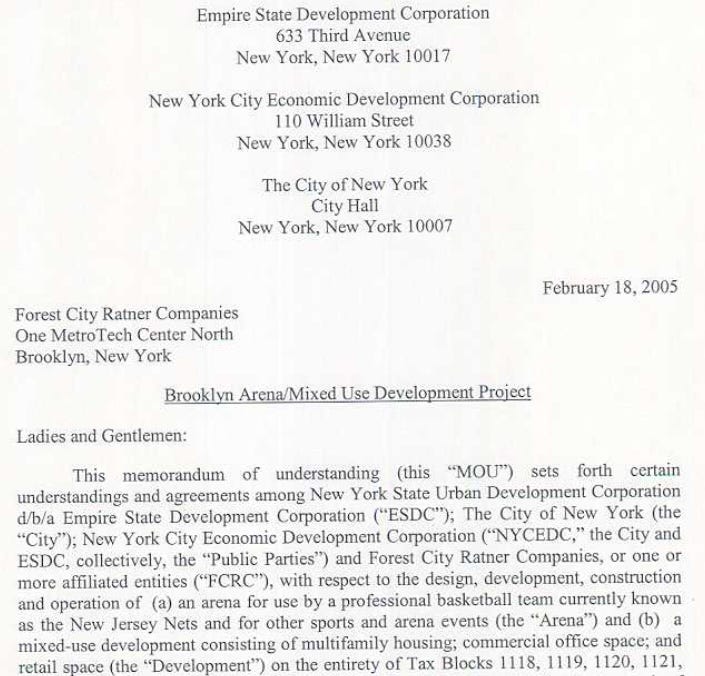
The earlier MOU, described in broad strokes, was announced in March 4, 2005, press releases shared separately by Gov. George Pataki and Mayor Mike Bloomberg, headlined GOVERNOR PATAKI AND MAYOR BLOOMBERG ANNOUNCE MEMORANDUM OF UNDERSTANDING FOR ATLANTIC YARDS PROJECT IN BROOKLYN.3
The subheading: “Professional Sports One Step Closer to Return to Brooklyn.”
“The $2.5 billion project will include a Frank Gehry designed world-class arena to house the Brooklyn Nets, which Forest City Ratner Companies and investors purchased earlier this year, and over 4,000 units of mixed-income housing, along with commercial, retail and public space,” the press release stated.4
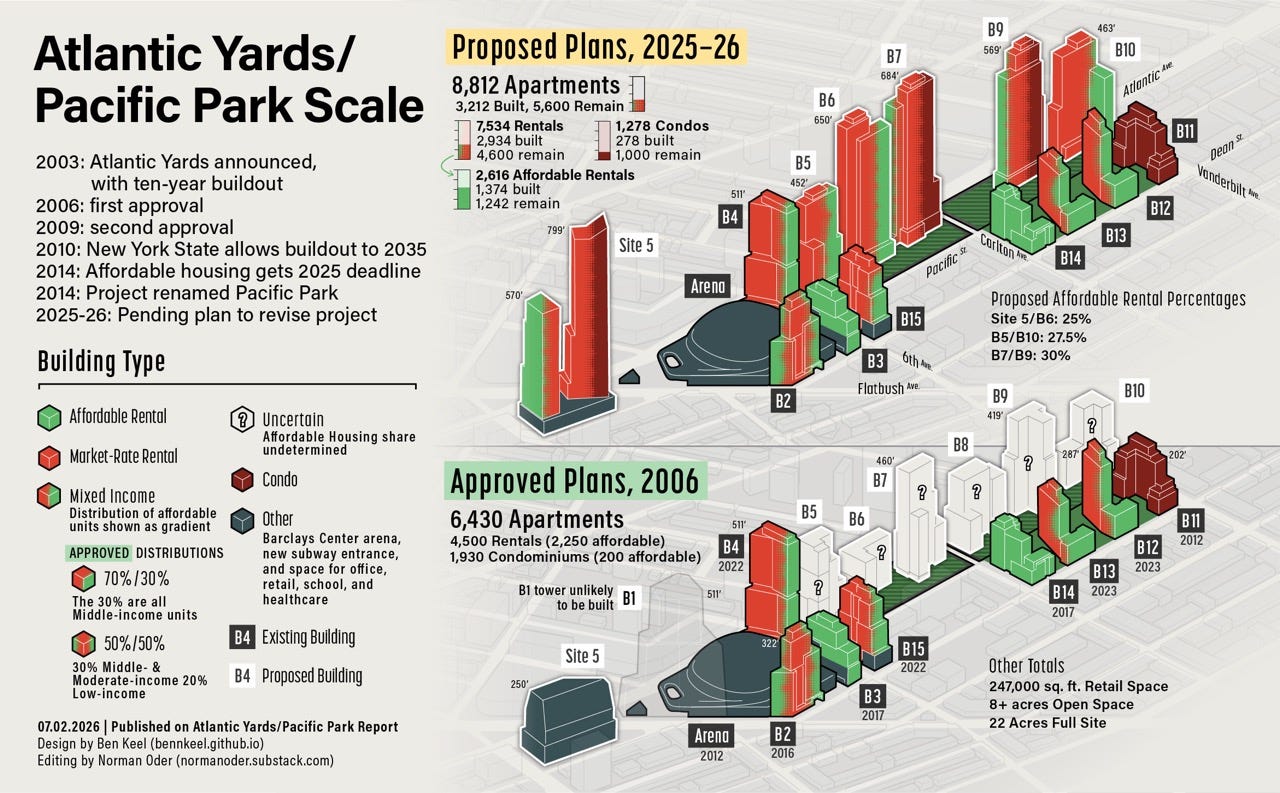
Of course, Gehry has since departed, credited only with the master plan, and the project would be approved at 6,430 units, after a swap of office space to housing. (Today, with 3,212 apartments completed, the new developers want to build a total of 8,812, or 5,600 more.)
The MOU preceded a public process for the project, an environmental review overseen by ESD’s predecessor, Empire State Development Corporation (ESDC), culminating in approval by ESDC’s gubernatorially controlled board in 2006 and, after revisions, again in 2009.5
The press release revealed some but not all key details:
Under the MOU, the State and the City will each contribute $100 million in capital contributions to fund site preparation and public infrastructure improvements on and around the arena site, including streets, sidewalks, utility relocations, environmental remediation, open space and public parking.
Forest City Ratner Companies (FCRC) has agreed to relocate and reconfigure the Long Island Rail Road Yard. FCRC will also build and maintain the overbuild platform. The rail yard will remain operable through all phases of construction.
Based on the limited information, project opponents Develop Don’t Destroy Brooklyn (now defunct) soon volleyed a press release, Bloomberg, Pataki Declare War on Brooklynites and Taxpayers, with the subheading “MoU Will be DOA Once Public Understands What a Bad Deal This Is.”
From that press release:
The MoU calls for New York City and State to each put $100 million into Ratner’s project. But Goldstein said that those numbers don’t add up. “Every objective evaluation to date indicates that the public subsidy will have to be much greater than that. And the only independent analysis of Ratner’s plan showed that the public will be footing up at $1 billion of the bill.”
Indeed, New York City would later add $105 million in direct subsidies. Today, of course, the state has allotted $175 million to the platform and has indicated it would provide a total of $700 million.
That said, the statement that Forest City would not only relocate and reconfigure the railyard but also build and maintain the platform obscured, as we would learn, high costs that the new developers and the state now say were untenable.
Then again, the previous developer, Greenland USA, seemed ready to proceed with railyard development as long as it got additional valuable square footage, not additional direct subsidies for the platform.
The day the MOU emerged, the (now ended but extant) blog/aggregator NoLandGrab published NON-BINDING(?) MOU SIGNED BY RATNER, BLOOMBERG & PATAKI, citing coverage in seven news outlets and noting the signing came "without the MTA making public the appraisal for the Atlantic Railyards first.”6
The two articles still accessible, NY Times: Deal Is Signed for Nets Arena in Brooklyn and NY Daily News: Mike, gov: arena good to go, didn’t add much detail, though they did refer to the expected swap of office space for housing. The Daily News also included this tantalizing reference:
Ratner had also asked the city and state for $450 million in infrastructure subsidies to the 21-acre site, but that figure has shrunk to about $100 million apiece from the city and state, officials said.
In other words, even then, the developer thought they needed more public money.
Details from the MOU soon emerged in a March 8, 2005 memo from Council Member Letitia James, the project’s prime political opponent, to her colleagues and shared with DDDB. (She had apparently acquired a copy of the document.)
She warned that, by designating ESDC as the lead agency for the project, approval would be “circumventing the City Council” and the city’s more stringent Uniform Land Use Review Procedure. She noted that the MOU granted ESDC power to pursue eminent domain.
In a section headlined “The Fleecing of Taxpayers,” James noted that the city would sell ESDC city properties underlying the arena site for $1.
While the city/state press release said the public subsidies would go to infrastructure, James warned that the “City subsidy can be used to acquire property that will be the subject of Eminent Domain in the arena site.”
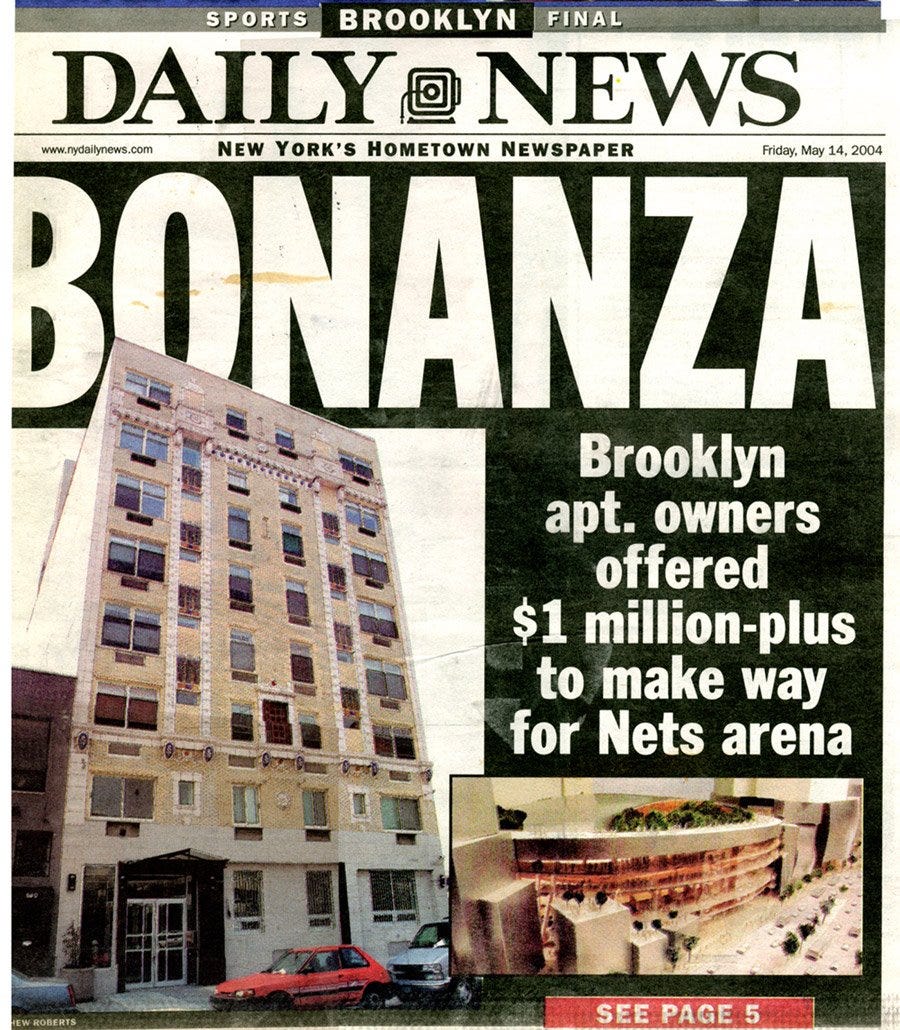
Indeed, that’s what happened, as the public reimbursed Forest City for its seeming generosity in buying out condo owners, as highlighted in the New York Daily News front page below.
James also identified as “corporate welfare” an arena financing plan using tax-exempt bonds, making the arena site tax exempt, with payments in lieu of taxes (PILOTs) by the arena operator used to service the bonds. She also cited the developer’s expectation to avoid sales taxes, mortgage recording taxes, and other costs.
James and state Senator Velmanette Montgomery also announced a press conference at City Hall in response to the MOU.
“This agreement is non-binding. This is a PR stunt to convince the public that the arena and skyscraper complex is a done deal,” Montgomery said. “That is far from the truth. The MTA reserved the right to sell the land to a higher bidder. Just like with the West Side stadium, we need open bidding to get fair value for this land.”
In the end, there was open bidding, but it was constrained, with only one other bidder.
The Jets vs. Nets: Brooklyn Arena Deal Template for Stadium, wrote Matthew Schuerman for the New York Observer, suggesting that both the West Side Stadium and the Atlantic Yards plan involved “a nice check from the government, state override of local zoning laws and years of tax-free living.”
While the press release’s disclosure of $200 million in direct subsidies sounded less than what was promised for the West Side Stadium, the actual MOU, noted Schuerman (who provided incisive coverage of the project), “has so far escaped the notice of the press,” would allow arena financing via tax-free bonds.
Also, ESDC would “consider” exempting the developer from mortgage-recording taxes and from sales taxes on construction materials. “They are getting every tax break known to man,” declared James.7
The article also noted that city funding could be used to buy out property owners.
Following up, the Brooklyn Paper (then called Brooklyn Papers and a consistent critic of the project) published City, state & Bruce agree: ‘Yards the place for Nets. It also elaborated on details from the MOU, noting that city properties to be transferred to the developer included several streets.
The article quoted James as noting that the MOU didn’t affirm Ratner’s promise of 50% affordable units.
That would later become 50% of the rental apartments, not the entire project. That would add up to 35% affordability. Today, under proposed changes, the total would be 30%, with future market-rate units far outpacing below-market ones.
Today, after multiple ownership changes, the Brooklyn Paper avoids aggressive coverage of Atlantic Yards. (It does publish articles like Ariana Grande’s record-breaking Barclays Center run turns Brooklyn into an ‘Eternal Sunshine’ celebration, apparently driven by an arena press release.)
The New York Observer ceased print publication in 2016, dropped “New York,” and became an online-only national publication.
The only other publications to cover the new MOU, so far, were Crain’s New York Business and The Real Deal, both business-focused.
No elected official has opposed or criticized the project as Council Member Tish James once did, not even Attorney General Letitia James.
Develop Don’t Destroy Brooklyn is defunct.
You’d think the Atlantic Yards Community Development Corporation (AY CDC), the advisory body set up in 2014 as part of the settlement between the state and the coalition BrooklynSpeaks that created the new May 2025 deadline for the project’s affordable housing (that wasn’t upheld), would get a copy and make it public.
After all, it’s charged with, among other things:
Monitoring developer compliance with all public commitments
Making recommendations to ESD on ways to improve and expedite developer responsiveness to public obligations and increase transparency of Project development
That said, I wouldn’t be surprised if the main remaining group monitoring Atlantic Yards, BrooklynSpeaks, has something to say about the failure to make the MOU public, even if it doesn’t have the rapid-response capability DDDB had.8
After all, it’s hard to take the state’s claimed “Community Engagement” seriously if ESD can’t come clean.
He was speaking in general, not about Atlantic Yards, but his point applies.
The press release was also listed on Mayor Bloomberg’s press page, but it has not been archived.
The press release contained this astonishing paragraph:
According to an economic analysis completed earlier this year for FCRC by the economist Andrew Zimbalist, the net fiscal benefit to the City and State from the Atlantic Yards project is estimated to be at least $2.819 billion over thirty years, or a present value of at least $812.6 million
That outsourced the government’s work to a paid consultant to the developer. Zimbalist’s estimates were flawed in many ways, including, most glaringly, the assumption that the project would be built in ten years as proposed.
While I highlight the relative transparency of the 2005 process, I should note that, a few months later, a Freedom of Information Law request revealed a second, unreleased Memorandum of Understanding, according to Develop Don’t Destroy Brooklyn.
It not only described Forest City’s rights to build at Site 5, home of Modell’s and P.C. Richard, but it also showed, as previously hinted, how Forest City could build three towers over the Atlantic Center mall, without city review. “DOUBLE DEALING” screamed the Brooklyn Paper. Those mall towers didn’t proceed.
While I was following Atlantic Yards at the time, I didn’t start covering it until September 2005.
From the article:
Wasn’t it just a few months ago that Mayor Bloomberg called on Madison Square Garden, his enemy in the West Side negotiations, to give up its tax breaks? It was four months ago, in fact. But, City Hall says, the two situations are not the same. “After the bonds are satisfied, the PILOT will return to the city,” said Janel Patterson, spokeswoman for the Economic Development Commission. “The Madison Square Garden legislation granted a tax break in perpetuity.”
Note: the arena bonds are supposed to be paid off by 2047. Let’s see if PILOTs get returned to the city or, rather, get used to pay for future arena renovations. I’d bet on the latter.
Gib Veconi, one of the few people steering BrooklynSpeaks, is also on the board of the Atlantic Yards Community Development Corporation.
No posts
Comments
Nothing yet. Say the first thing.
Sign in to join the conversation.