
Note: I’ll be on a panel 7-9 pm tonight, “How to be an Informed Local Citizen: Local News, Misinformation, and AI,” at the Old Stone House in Park Slope. Also online via Google Meet.
This article excerpts from and builds on my previous coverage of the July 13 Atlantic Yards Town Hall.
On June 29, when New York State and the new Atlantic Yards developers announced a refined plan to complete Atlantic Yards, Gov. Kathy Hochul offered a statement:
”Atlantic Yards is one of New York’s most significant unfinished affordable housing developments, and we are finally moving it toward completion. Brooklyn has waited long enough, and today we are turning a corner from years of delay to new homes, jobs and open space. We will continue our work to make New York more affordable, investing $25 billion in housing and cutting red tape to speed up construction.”
(Emphases added)
Hochul’s phrasing deserves scrutiny. Though the state may be “investing $25 billion in housing,” the money it promises Atlantic Yards—$700 million, with $175 million already allotted—is not for housing.
Rather, it’s intended for the costly platform needed to build over the Metropolitan Transportation Authority’s (MTA) Vanderbilt Yard, used to store and service Long Island Rail Road trains.
The platform cost was originally the project developer’s responsibility, part of developer Forest City Ratner’s bid to the MTA for air rights over the railyard.
(Remember New York Daily News columnist Errol Louis’s March 11, 2010 observation that “the [platform] bill may get handed to the city or state a decade from now, long after human and institutional memories of the original deal have faded.”1)
That’s infrastructure that supports the project as a whole: housing, retail/community facilities, and open space. Moreover, that housing would be mostly market-rate.
So Hochul’s third sentence does not necessarily follow from the first two.
More importantly, can Atlantic Yards really be called one of the state’s “most significant unfinished affordable housing developments”?
It’s surely one of the most significant unfinished developments.
Hochul’s phrasing, however, suggests the project is largely about affordable housing. It’s not, and the new iteration is less so. The proposed increase in below-market apartments is outpaced by the increase in market-rate ones.
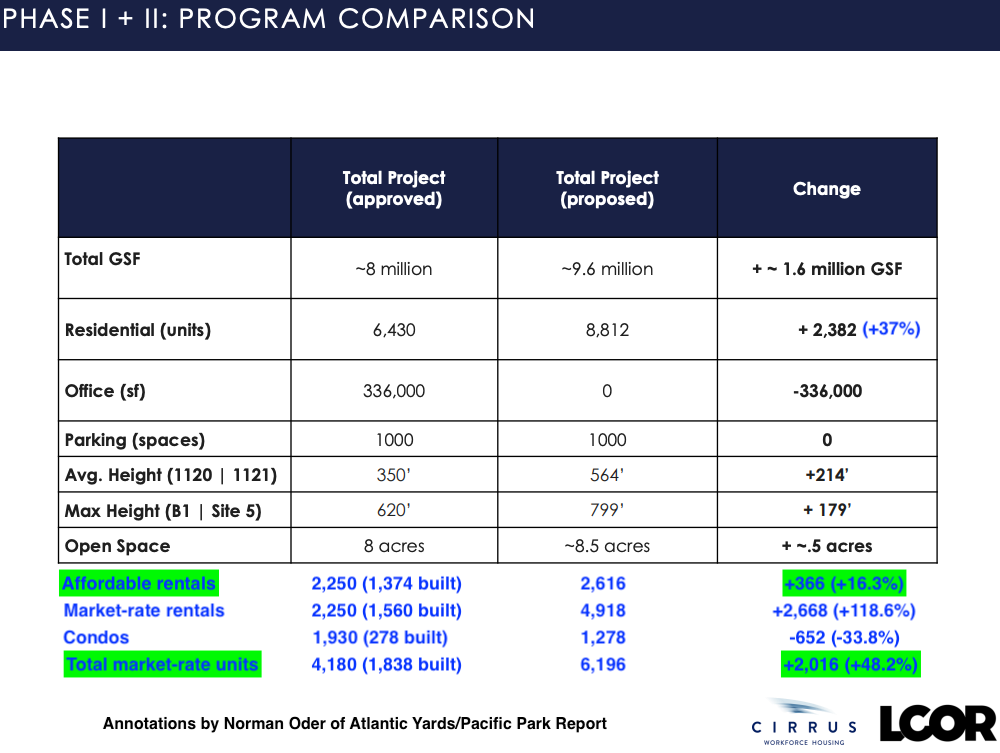
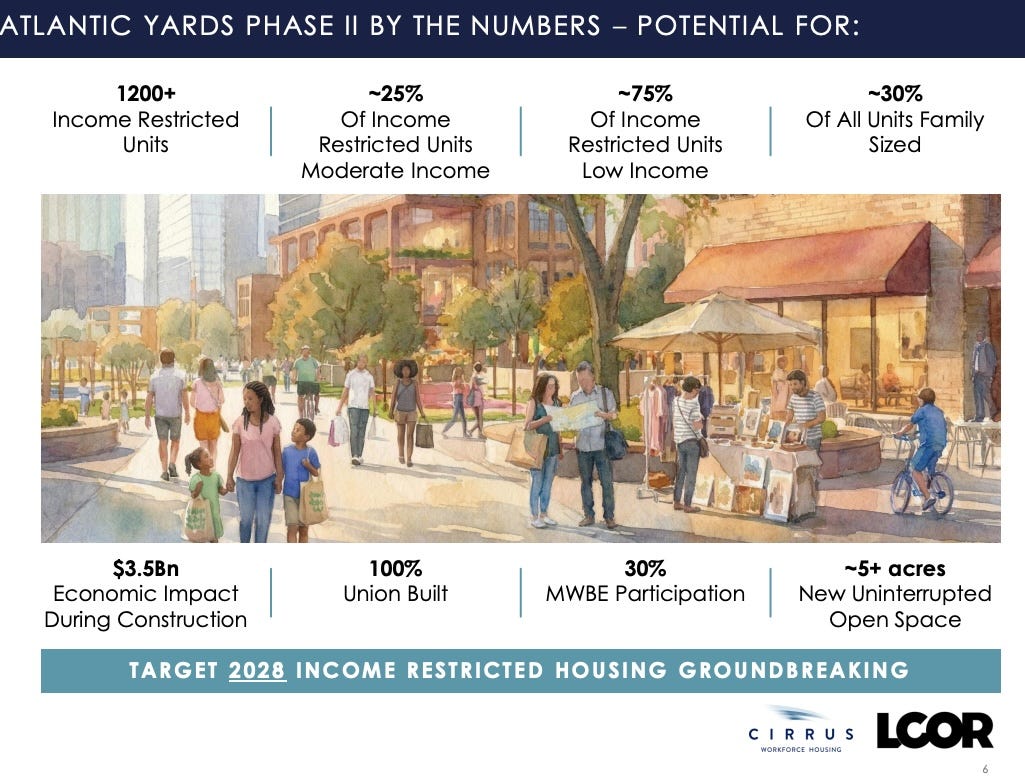
That’s not immediately obvious from the chart above, produced by developers Cirrus Workforce Housing and LCOR and distributed at the recent Town Hall. However, as my annotation shows, the number of market-rate units would increase by 48.2%, nearly three times the 16.3% increase in affordable units.
New York State owes the public candor, not obfuscation. If Empire State Development (ESD), the state authority that oversees/shepherds2 the project, wants to be an honest broker, it should provide a more informative chart. But ESD works for the governor.
One claim during the meeting was truly startling, so let’s go to the videotape.
“One thing that we heard very strongly was a need for affordability, not in the 2040s, right?” said Cirrus Managing Partner Joseph McDonnell. “Find a way to do it faster. The project was delayed as it is. We acknowledge that.”
Indeed, the developers have been praised for trying to accelerate housing on two parcels where they can build on terra firma, aiming, in the best-case scenario, to deliver housing by 2031.
(The whole project, they estimate, might be done by the end of the decade, but that’s a best-case scenario.)
“What we’re presenting today is 40% more affordability than originally contemplated,” McDonnell continued, “with 75% of those units going to low and very low-income households.”
(Emphasis added)
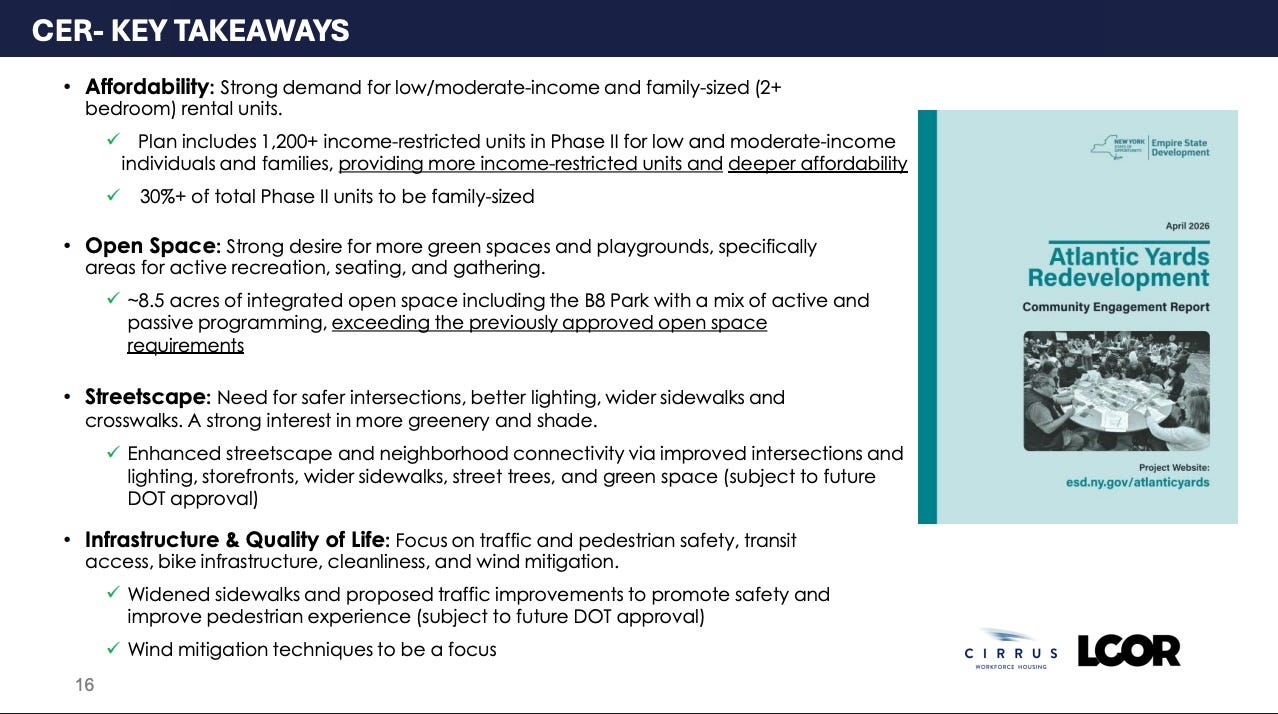
That 75% statement, which drew on the slide below, deserves further attention, so I’ll address it further below.
But what does “40% more affordability” mean? While watching the video, I asked that question in the online Q&A.
“And to contextualize the number on the page,” McDonnell later said, apparently responding to the question, “1,200 income-restricted units is approximately 40% more than what was originally planned.”
That makes no sense.
The Atlantic Yards project was supposed to deliver 2,250 affordable apartments, but is 876 units short, given that 1,374 below-market rentals have been built.
To provide “40% more affordability” than the original plan would require 40% more units than the required 2,250, or a total of 3,150 units. That would be 1,776 more.
Instead, they plan to build 1,242 more, for a total of 2,616. The increment of 366 is only a 16.3% increase over 2,250.
So, where does the 40% calculation come from? Cirrus apparently starts with the 876 units of the promised 2,250 that were supposed to be completed by May 2025.
Applying a 40% increase results in 1,226, which is almost but not quite 1,242. (Then again, they’re using the general number “1200+”.)
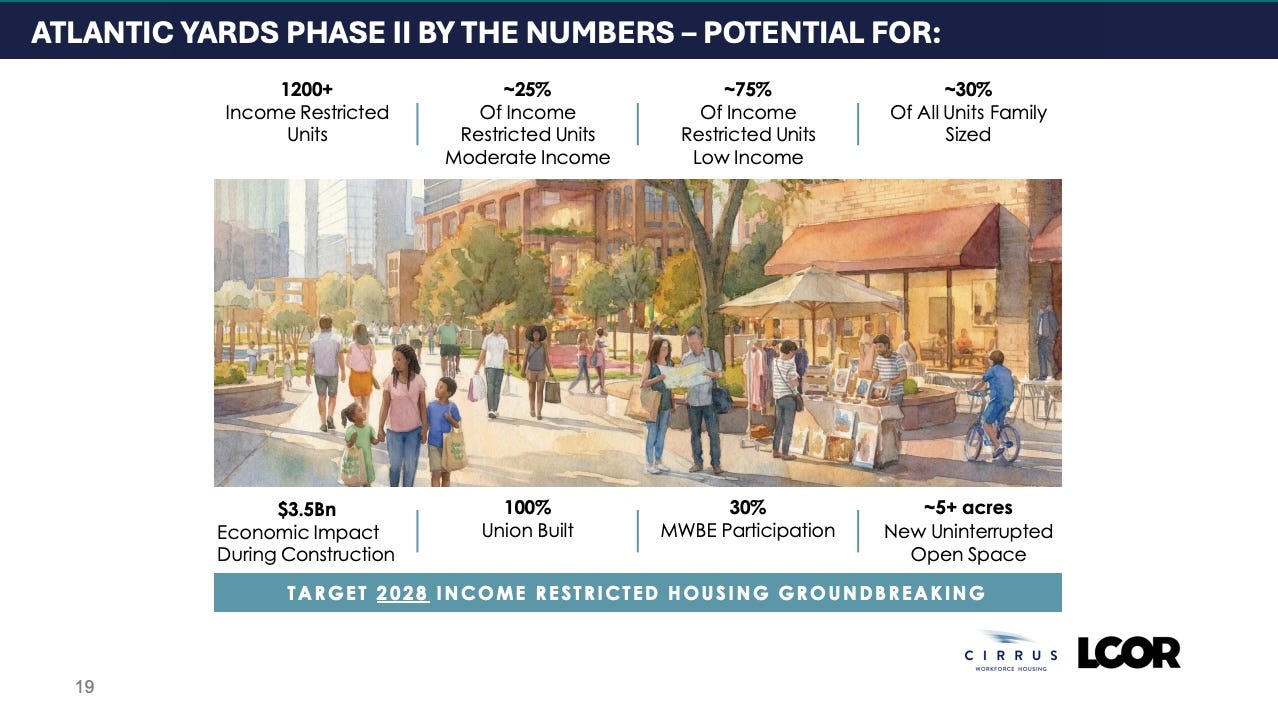
If the developers, as McDonnell claimed, are very “intellectually honest” about the constraints they face—and they have been candid—shouldn’t they be intellectually honest about their math?
It would take them until 2040, at least, to deliver just 366 more apartments than required when the project was approved in 2006, under an “anticipated” ten-year buildout, and, as of 2014, faced a new May 2025 deadline.
Remember, an agreement negotiated in 2014 by the coalition BrooklynSpeaks with New York State required the project developers to pay $2,000 a month for each apartment not delivered by the deadline. That total already exceeds $25 million. Instead, ESD negotiated away a series of payments totaling $12 million.
“We planned for 75% of those units to go to low and very low-income households,” McDonnell said. “Importantly… we’re talking about 30%-plus family-sized units, which is where we see… most of that need.”
That’s not insignificant, given that the most recent Atlantic Yards/Pacific Park buildings have had few if any three-bedroom apartments and did not meet that 30% benchmark.
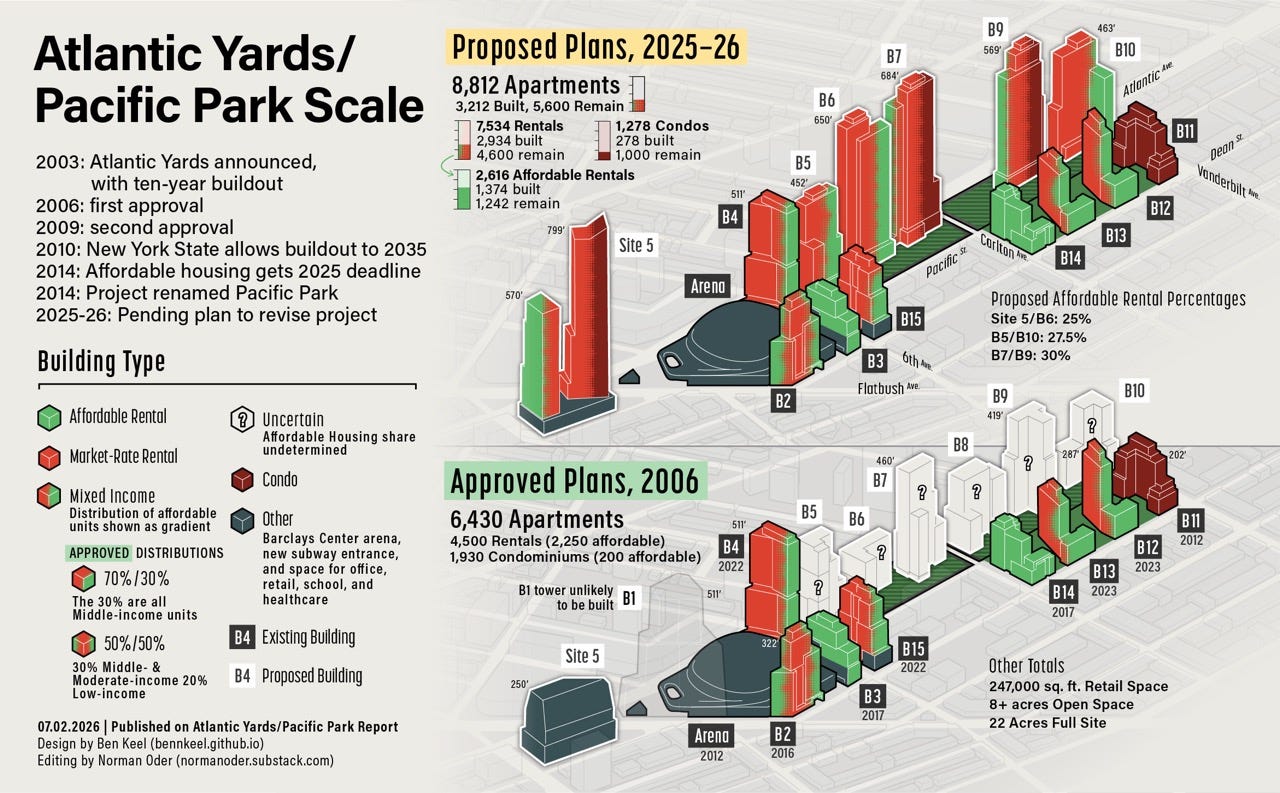
Keep in mind that, according to the 2005 Atlantic Yards Affordable Housing Memorandum of Understanding (MOU), half the units, in floor area, were supposed to be family-sized. (That MOU, signed by original developer Forest City Ratner and the advocacy group ACORN, was non-binding, but used to leverage political support for the project.)
That works out to about 35% of the unit count. It was achieved only with the two “100% affordable” buildings, 535 Carlton Ave. (B140 and 38 Sixth Ave. (B3).
Note that the Cirrus/LCOR slide says “potential for” about 30% family-sized and 75% low-income units. A goal, or even a promise, does not necessarily translate into reality, as the history of Atlantic Yards shows.
Let’s see what’s in the (non-binding) Memorandum of Understanding that the developers and ESD are supposed to sign by July 31.
Even a seemingly binding contract with enumerated penalties to enforce stated goals may not be enforceable.
McDonnell said 75% of the apartments would be allocated to low- and very low-income households. That’s technically accurate but potentially misleading, given the gap between the colloquial understanding of “low-income” and the city’s guidelines.
While New York considers 80% of Area Median Income (AMI) as the upper bound for low-income, AMI is distorted by including more prosperous suburban counties, plus a High Housing Cost Adjustment.
Recently, as the New York Housing Conference said in November 2022, “The increase in AMI levels is not aligned with actual incomes in New York City.”
Under 2026 guidelines, 80% of AMI means an individual can earn $95,040 and qualify as “low-income.” Two people can earn $108,560.
Median household income for Brooklyn in 2024, according to Census Reporter, was $81,027—and 80% of that translates to $64,822—but that assumed 2.6 people per household. So 80% of AMI for an individual in Brooklyn is surely much lower than that $95,040 ceiling.
Under the city’s 2025 guidelines for rent levels, which haven’t been updated, those at 80% AMI could pay $2,268 for a studio or $2,438 for a 1-bedroom.
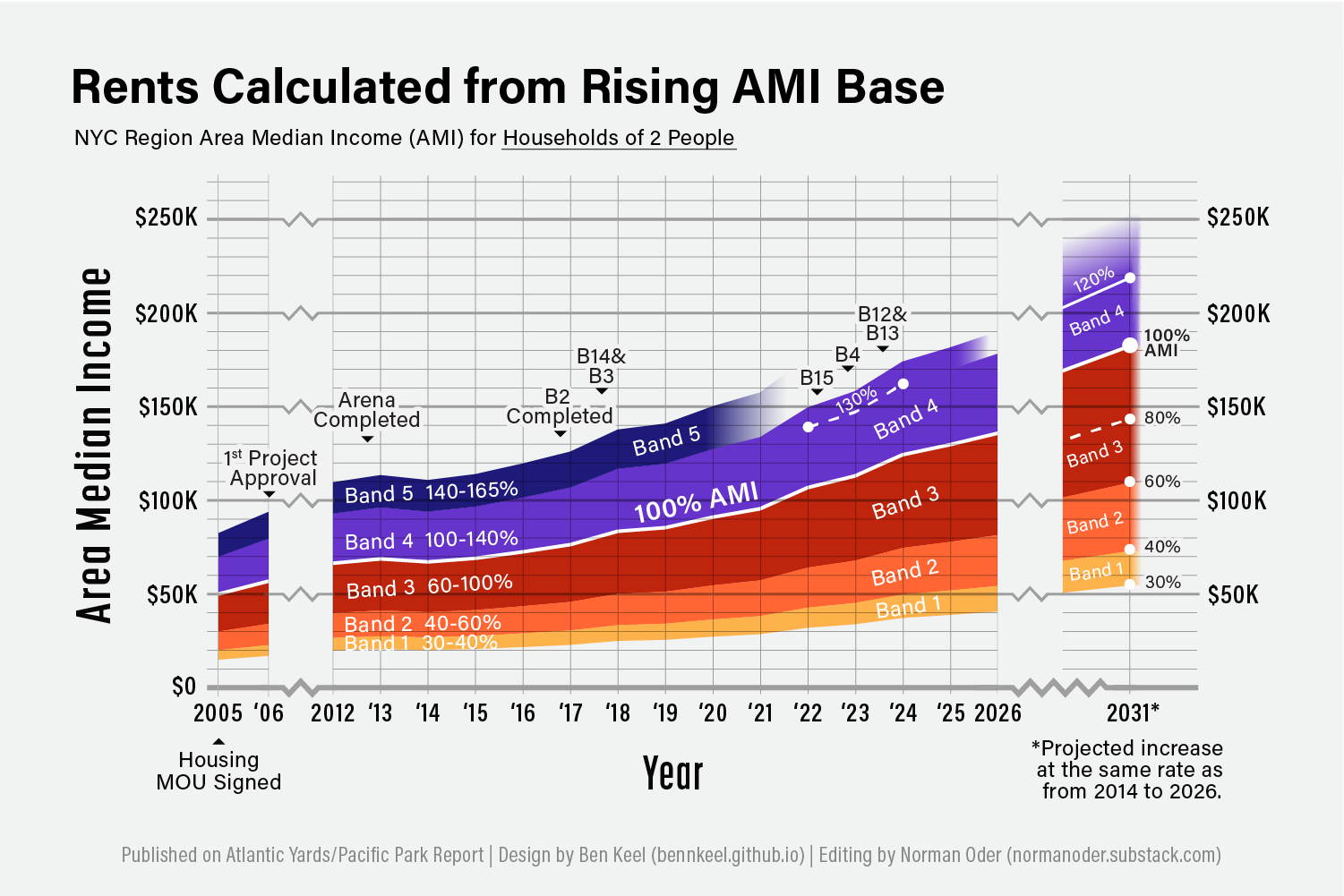
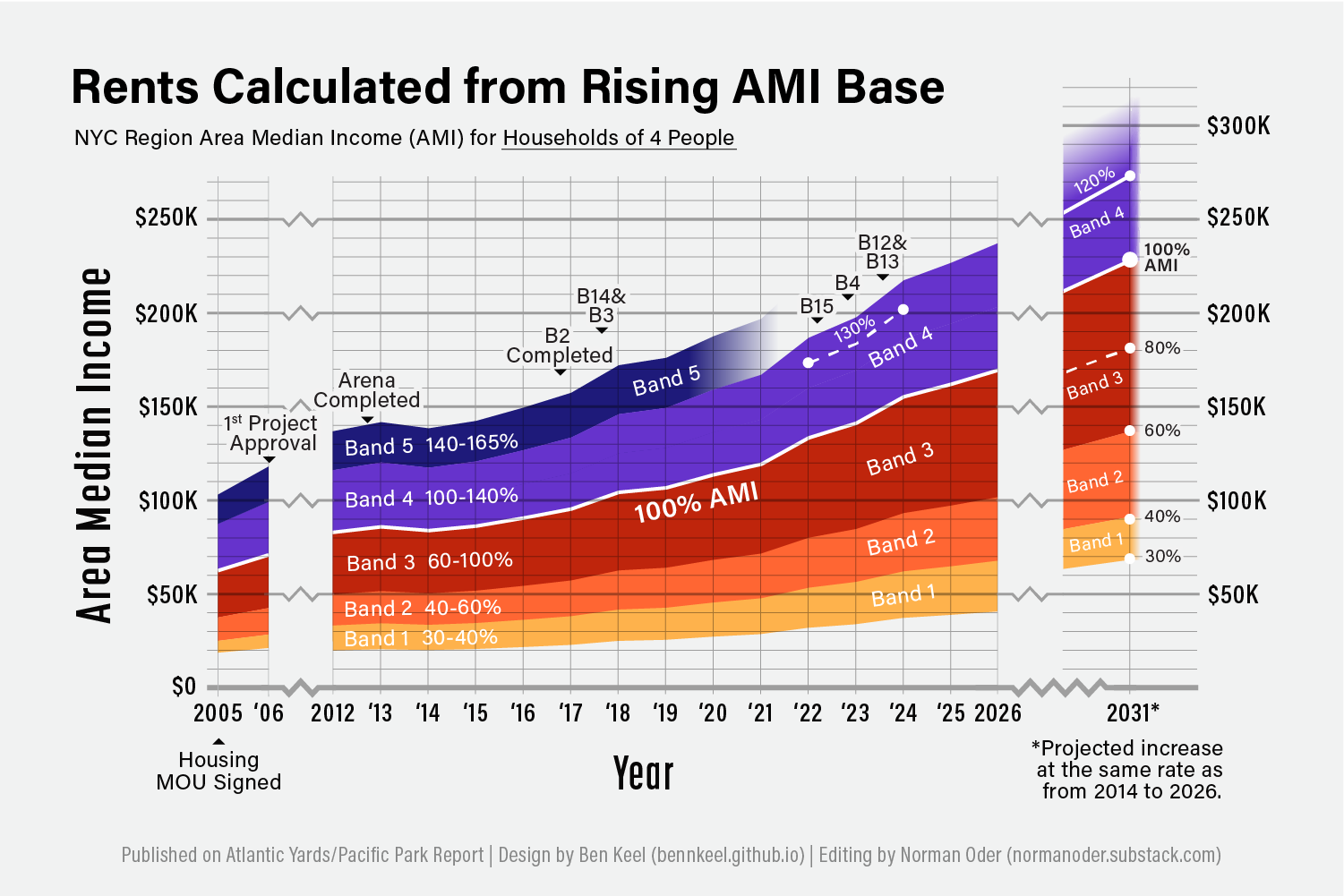
By 2031, the earliest an Atlantic Yards building might open, a two-person household at 80% of AMI could earn over $140,000, I estimated, as shown in the chart below.
Very low income is defined as 50% of AMI or below. Of the 925 future low-income units, out of 1,242 total, only 216 (23.4%) would be very low income, where the need is greatest.
“We are missing the boat in affordability,” commented Assemblymember (and BrooklynSpeaks leader) Jo Anne Simon during the Q&A.
Back in March 2007, Assemblymember Hakeem Jeffries, who represented Prospect Heights and environs, said he thought that even 80% of AMI was too high to be deemed affordable. (Today, Rep. Jeffries is Minority Leader of the House of Representatives.)
According to the 2023 New York City Housing and Vacancy Survey3, lower-income households are more likely to be moderately rent-burdened, paying over 30% of their income in rent, or severely rent-burdened, paying more than 50% of their income in rent.
In fact, 86% of those earning under $25,000 and 45% of those earning under $50,000, are severely rent-burdened.
(Note: this iteration of the survey is the most recent, though another should be issued next year.)
McDonnell also noted that 25% of the apartments would be for moderate-income households, earning between 81% and 120% of AMI.
They do qualify as moderate-income under current guidelines, while a good number of previous Atlantic Yards units were for middle-income households.
However, in the Affordable Housing MOU, low-income was capped at 60% AMI, while moderate-income ranged from 60% to 100% AMI, with rents set at 80% AMI.
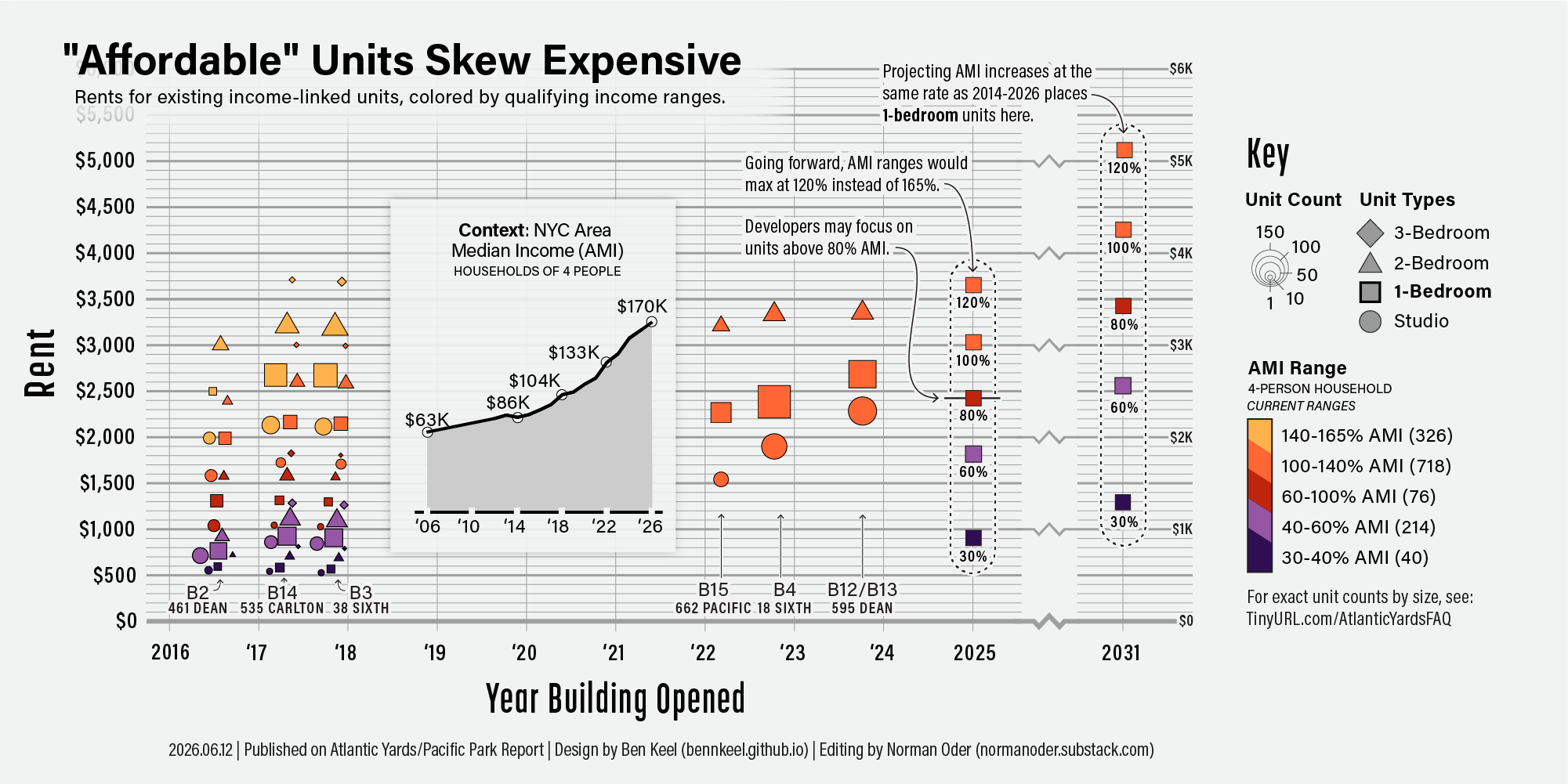
As the chart above suggests, rents for moderate-income units in 2025 could easily exceed those for middle-income ones a few years ago.
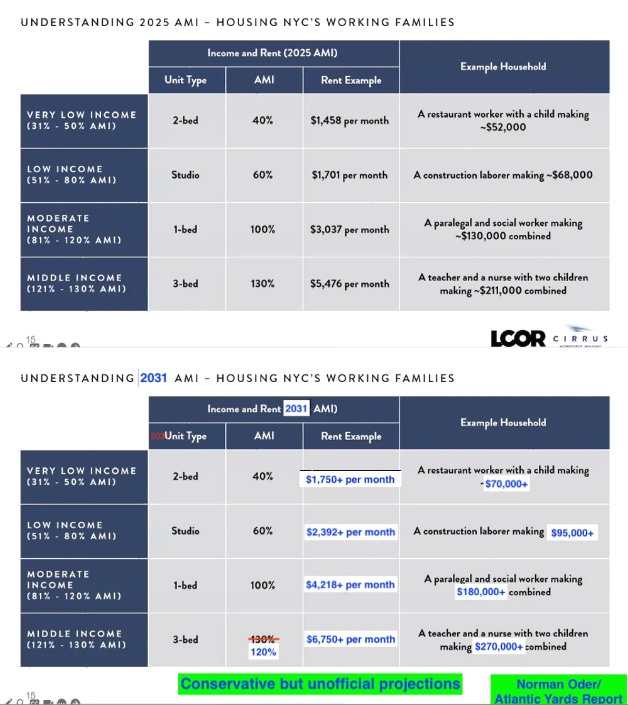
As of 2025 (not 2026), a “moderate-income” one-bedroom at 120% of AMI could rent for up to $3,644. (The 2026 guidelines for rent levels have still not emerged, as noted. Might the city recognize the folly of pursuing such rents?)
By 2031, one-bedroom apartments at 80% of AMI could rent for nearly $3,500, according to my estimate. A one-bedroom for those at 100% of AMI could rent for over $4,200, while one for those at 120% of AMI could rent for nearly $5,000.
Such rent levels may not be market-rate, but do offer significant financial return to the developers. In fact, in recent years, developers renting middle-income apartments at 130% of AMI, such as the B15 and B4 buildings in Atlantic Yards/Pacific Park, have not even sought the full rent ceiling, recognizing it as unrealistic.
All told, Atlantic Yards under the Cirrus/LCOR proposal would have 29.7% affordable units, rather than 35% as approved in 2006, albeit with more middle-income affordable units.
(That said, as noted above, middle-income rents and AMI ceilings in past years were well below the expected 2031 moderate-income levels.)
“It would be helpful to understand how that change happened, considering this project has always been 35% affordable,” said Michelle de la Uz of the Fifth Avenue Committee, an affordable housing nonprofit, in her public comment at the June 29 meeting of the Atlantic Yards Community Development Corporation, when the project’s new dimensions were first revealed.
She didn’t get an answer. de la Uz, along with Gib Veconi of the Prospect Heights Neighborhood Development Council and Assemblymember Jo Anne Simon, is a key leader of BrooklynSpeaks.
As BrooklynSpeaks put it:
The current proposal would reduce the percentage of total apartments in the completed project being income-restricted from the 35% commitment that was negotiated as part of BrooklynSpeaks’ 2014 settlement with ESD to only 30%. And just 11% of apartments [overall] would target families earning less than 80% AMI.
In the Town Hall Q&A, Veconi noted that the city’s Atlantic Avenue Mixed-Use Plan (AAMUP) and Gowanus rezonings would have more low-income units.
They mapped Mandatory Inclusionary Housing (MIH) Option 1, with 25% of the units affordable at an average of 60% of AMI.
However, with Phase 2 of Atlantic Yards, 22% of the total units—and 27% of the rentals—would be affordable, but at higher rent levels than those agreed to in the rezonings.
“What,” Veconi asked, “was ESD’s rationale in agreeing to this and proposing this level of affordability?”
The AAMUP and Gowanus rezonings, he noted, emerged after extensive community engagement, followed by a review by community boards, the borough president, and the City Planning Commission, before a City Council vote.
By contrast, the Atlantic Yards plan is “being proposed by a development team and staff of the ESD, none of whom were elected,” Veconi said. “So how did you arrive at the idea that this was an appropriate affordable housing offering for a project receiving such outsized entitlements”—increased development rights—“and $700 million through subsidy?”
ESD’s Joel Kolkmann, Senior VP, Real Estate and Planning, said it came down to economics. Towers on solid ground, where construction is easier, will reflect the 485-x tax break, with 25% of the units at an average of 60% of AMI, which is low-income.
The other buildings, he said, are more complicated and costly.
That’s understandable. But shouldn’t direct subsidies and extra bulk offset the increased costs? Shouldn’t we understand their calculations?
As former City Planning Commission Chairman Dan Garodnick recently put it, “But if a single dollar of public money is going into a project, the public should have absolute transparency as to what’s going on.”
“We intend to continue to meet with the community,” Cirrus’s McDonnell said during the meeting, “and I hope that the interactions that we’ve had to date and the level of sort of transparency and availability, which is I think very different than [former master developer] Greenland [USA] and probably much different than [original developer] Forest City Ratner, kind of shows you the direction that that is going.”
Well, their transparency is selective. Otherwise they wouldn’t distort the “40%” increase.
ESD has hired consultant BJH Advisors to assess the viability of the developers’ plan.
Let’s see if that analysis goes beyond viability (can the developers make enough money to get it built?) to assess their expected returns. And let’s see if it offers a range of scenarios, from best-case to worst-case.
“But this is not a perfect plan,” McDonnell said, in what’s become a rhetorical escape hatch, “because Atlantic Yards is not a perfect site, and there’s been a lot of work done around those trade-offs.”
As the chart below shows, from BrooklynSpeaks, the increment in community benefits significantly lags other increases requested by the developer,
The Cirrus/LCOR request for 1.6 million square feet of additional bulk echoes, in part, previous developer Greenland USA’s effort in January 2023 to get 1 million square feet of additional bulk, as described in my article linked below.
I estimated they’d sought to build 9,116 apartments, 2,686 more than approved in 2006. (Cirrus now wants to build 8,812 units.)
Greenland also promised 600 more affordable apartments, bringing the total to 2,850 (31.3%), albeit with unspecified affordability levels.
Though Greenland sought an extended timetable, it still was ahead of the Cirrus/LCOR proposal. Greenland proposed to “substantially complete approximately 2,000” affordable units—or 626 more—by 2029, and a total of 2,850 affordable units by 2035.
The plan ran aground after Greenland and New York State authorities disagreed, as described in the article below. (It’s surely not a definitive account.)
Then Greenland defaulted on its debts, losing control of the project.
Why do ESD and Gov. Hochul have faith in Cirrus/LCOR, when they were skeptical of Greenland’s plan? Cirrus hasn’t built anything yet.
There may be many reasons, but we haven’t seen them. One key difference, perhaps, is that the new developers have political support, given their alliance with the building trades unions. Candidates for re-election, like Hochul, surely take notice of that.
At the Town Hall, asked to describe affordability in layman’s terms, McDonnell suggested that a home health aide earning roughly $40,000 a year could qualify under the 40% AMI. “AMI [for one person] I think is about $101,000 today.”
Not quite. In 2026, 100% of AMI for one person is $118,000, and 40% of AMI is $47,520.
A preschool teacher married to an early-career carpenter with two kids might qualify at 80% of AMI, he suggested. At 80% of AMI, a four-person household can earn $135,680. (That’s technically low-income!)
At 100% of AMI, he suggested an early-career nurse. (By then, presumably alerted by a colleague, he corrected his numbers, saying AMI was $118,000 for one person.)
“At 120% of AMI, you’re looking at maybe two high school teachers with two young kids,” he said. At that level, a four-person household could earn $203,520—at least this year.
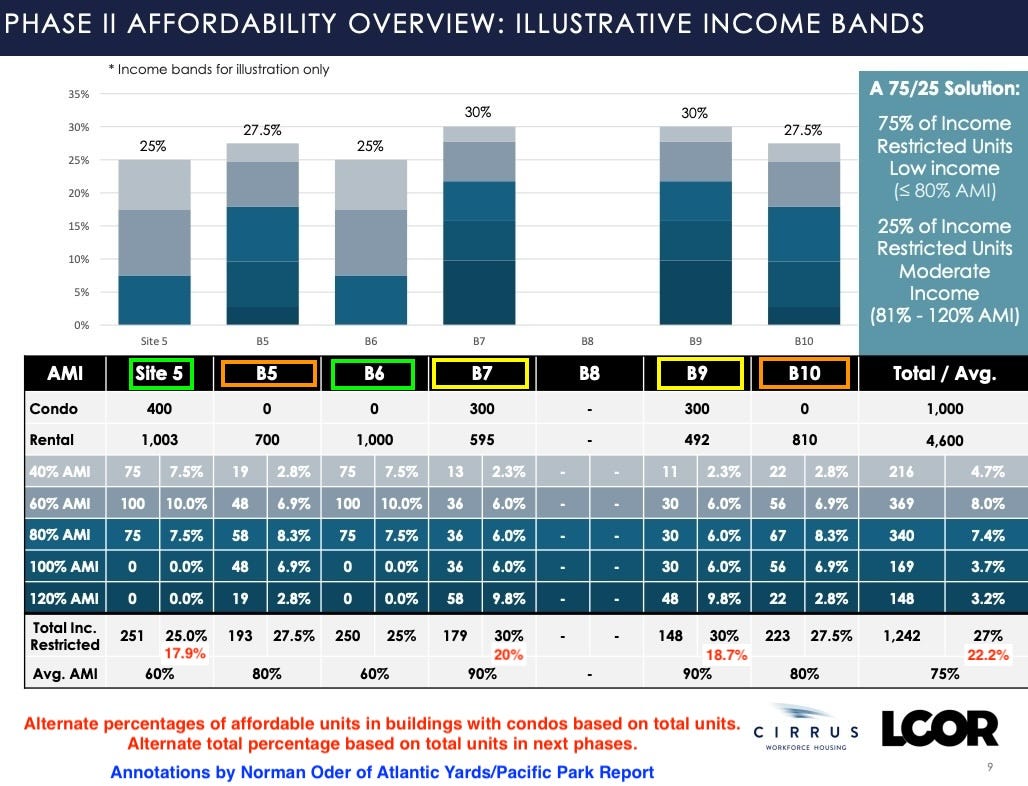
In the image below, I updated the likely rents, duplicating and annotating a slide from the developer based on current incomes.
The first slide estimates rents and incomes as of 2025. The second includes my estimates for 2031.
Louis, a longtime project supporter, has since gone on to NY 1 and New York magazine.
I use the phrase “oversees/shepherds,” but those two verbs are in tension. While ESD at various times has pushed back on requests by Atlantic Yards developers, sometimes it seems to be “all in.”
The NYCHVS has been conducted by the U.S. Census Bureau, on behalf of the City of New York, since 1965.
No posts
Comments
Nothing yet. Say the first thing.
Sign in to join the conversation.