
An extract from Royal Mint: National Debt (Published November 2025)
There was a rather splendid little baker’s shop in Egham that I used to frequent when I was a student at nearby Royal Holloway College. Stopps was its name, though sadly it did stop for good in 2002.
The modest outlet did, however, have one distinguishing feature which I was surprised to notice at the time. It proudly bore a royal warrant, suppliers of bakery products to the Queen Mother, and then later to the Queen herself. Egham is just under six miles from Windsor.
The concept of a royal warrant, like so much else associated with the royal family, goes back centuries. The first ones date from the fifteenth century, with an early recipient being William Caxton, appointed King’s Printer in 1476. It was in the eighteenth century that those tradespeople in possession of a warrant began to see value in displaying evidence of this on their premises, namely the royal coat of arms.
In 1840, the Royal Warrant Holders Association was formed to regulate matters and prevent the unauthorised use of royal arms. That may have been a prudent move, as Queen Victoria alone awarded over 2,000 warrants.
Today, warrants mean big business and it is estimated that the annual value to the economy comes to £4.5 billion, and that holders might expect to derive a 5 per cent uplift in sales. Some may feel they can up the prices and their customers will be willing to pay for the kudos that they may think comes with their purchase. An important matter, therefore, and yet, like so much else connected with our royals, it is shrouded in secrecy.
We do not officially know what criteria are involved in deciding who should be awarded a warrant, or who should have one taken away. Nor do we know officially to what extent the royals themselves benefit from the award of individual warrants.
What we do officially know is that applications for warrants which are deemed satisfactory by the Royal Warrant Holders Association are then passed to the Lord Chamberlain and his team to carry out the consequent bureaucratic work, just as they have done for centuries. If that stage meets with approval, the matter can then be placed before one of the royals for consideration.
Businesses who wish to be considered for an award of a warrant need to have been supplying goods to one or more of three senior royals – the King, Queen or Prince of Wales – for at least five years within the past seven. It is therefore possible for a business to acquire three endorsements which it can display.
All warrants are reviewed every five years, at which point some are added to the lists and some drop off. They also expire if the royal who has awarded them dies, as most recently happened with Queen Elizabeth II, though there is a grace period while an assessment is made as to whether the warrant in question should find favour with the successor royal.
A warrant is also forfeit if rules of confidentiality are breached to any degree at all, which of course helps to maintain the secrecy and mystique surrounding the whole shebang. The lingerie retailer Rigby & Peller is thought to have lost its warrant in 2018 because June Kenton, the company’s director, revealed some minor and trivial details of her work with the royals in her book Storm in a D-Cup, such as the fact that the late Queen thought it might rain that day. Hardly a matter for the Official Secrets Act.
Many warrant holders are well-established successful large businesses, but there are also plenty of small traders too, such as the now sadly disappeared Stopps in Egham. Musk’s, a small producer of sausages based near Newmarket and so not far from Sandringham, has held a royal warrant since 1907.
So, how is it decided if an application merits a warrant? The website of the Royal Warrant Holders Association does specify that a prerequisite is the ability to demonstrate that the business has an environmental and sustainability action plan, but if other criteria are applied, we do not know what they are and neither does the applicant. Open and transparent it is not.
There is therefore no way of judging whether the process to decide who has a warrant is fair. The opportunity to apply favouritism, or worse, is self-evident. It might reasonably be argued that giving details of each application, and whether it was successful or not, could damage a business and dissuade others from applying. But surely there can be no objection to publishing the detailed criteria which are used to decide matters, to give confidence that the same considerations are applied in each case.
One criterion that clearly does not apply is that the products in question are made in this country. Yet according to a poll carried out by the Channel 4 Dispatches programme, 68 per cent of the public interviewed said warrants should only be awarded to companies whose products are made in this country, that the royals should be supporting British businesses. That may be the view of the public but it is not the view of the royals, who prioritise access to their favourite brands over supporting British manufacturing.
For some businesses, the royal warrant is a convenient cover, particularly if the name of the company sounds British or indeed the product in question used to be manufactured here but no longer is. Chris Bryant, when a backbench Labour MP, observed that a royal warrant is seen as ‘a statement of Britishness’. Except it is not that any more.
Bryant was unhappy that the very British-sounding Burberry closed its factory in the Rhondda in his constituency and moved production overseas, where the labour was cheaper. Should the royal warrant not have been withdrawn at that point? Are the royals happy to consider endorsing a brand that has left many people unemployed and turned its back on Britain? It seems they are.
Nor is Burberry alone. Bendicks chocolates closed their Winchester factory and relocated to eastern Germany. Hunter wellies are now made in China. Twinings tea is now a Polish product. HP sauce, with its misleading Big Ben logo, is now made in the Netherlands. HP for Holland Produce, perhaps.
Most painfully for me, Parker Pens are now made in France. Painful because the British headquarters was in my constituency in Newhaven, where it proudly turned out top-quality pens for sixty-nine years until 2009. The craftsmanship was genuinely impressive. Each fountain pen had an unlikely thirty-nine separate parts. On a visit there, the firm even gave me a left-handed pen with an appropriately angled nib. For the first time in my life, I had a fountain pen that suited my hand.
The last task the staff at Newhaven had was to teach the French workers who came across how to make the pens – the final insult before they were thrown on the scrapheap. It was easier to make British workers redundant than their French counterparts.
Charles, who on his visit to Newhaven was given a bespoke pen in a splendid lined and polished wood box, renewed the royal warrant after becoming king despite production having been transferred to France.
The criteria do not seem to consider health matters either. The American company Kellogg’s, based in Chicago, was awarded a warrant for its cereals, which meant it could and did use this across its range, including on some unhealthy high-sugar products like Pop Tarts. It is difficult to imagine Charles and Camilla tucking into a box of Pop Tarts over breakfast, but that surely is the impression given by the use of the royal coat of arms on the packaging.
The Dispatches programme that ran the poll mentioned above also looked into the tax affairs of companies holding royal warrants and found that at least forty had parent companies based in tax havens. A second poll carried out by the programme found that over 75 per cent of respondents thought that warrants should not be given to such companies. That also seems to be of little interest to the royals, but then they are famous for using tax havens themselves, so perhaps they see nothing wrong in it.
The general line from the Lord Chamberlain’s office, speaking on behalf of the royal family, appears to be that provided no illegality has taken place, there is no issue. Morality, the health of the nation, support for British business: these apparently are irrelevant.
A new monarch generates a new list of products qualifying for a warrant. Well, largely the old list, in fact, but with some notable changes. The UK company Unilever, makers of a wide range of edibles from Marmite to Magnums, has lost its warrant, while Bendicks of Germany has kept theirs.
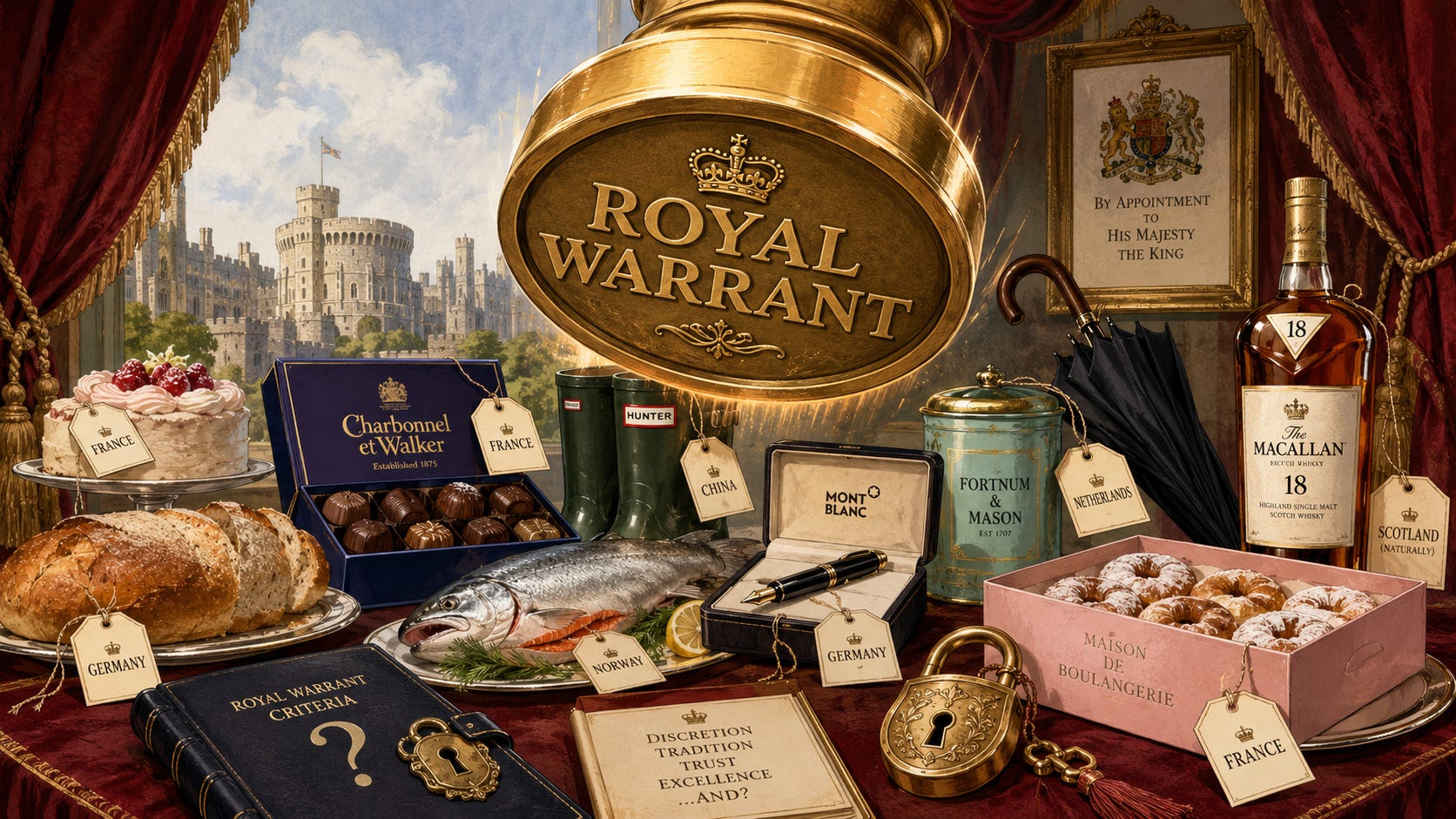
Cadbury’s, warrant holder since 1854, has been removed from the list. Like others whose warrant has been withdrawn, they were told in writing but not given a reason. Charles’s grandmother’s favourite drink, Dubonnet, survived the cull.
The king’s 2024 list includes six champagne producers; G. B. Kent & Sons, brush makers; A. Nash, manufacturer of besom brooms and pea sticks; Watkins & Watson Ltd, organ blower manufacturers; and Justerini & Brooks of St James, where you can buy a bottle of 1949 Macallan whisky for £79,500.
It also included Mowi Scotland, the Norwegian-owned company that is the world’s largest producer of farmed fish. The warrant refers to ‘the supply of fresh salmon to His Majesty the King’.
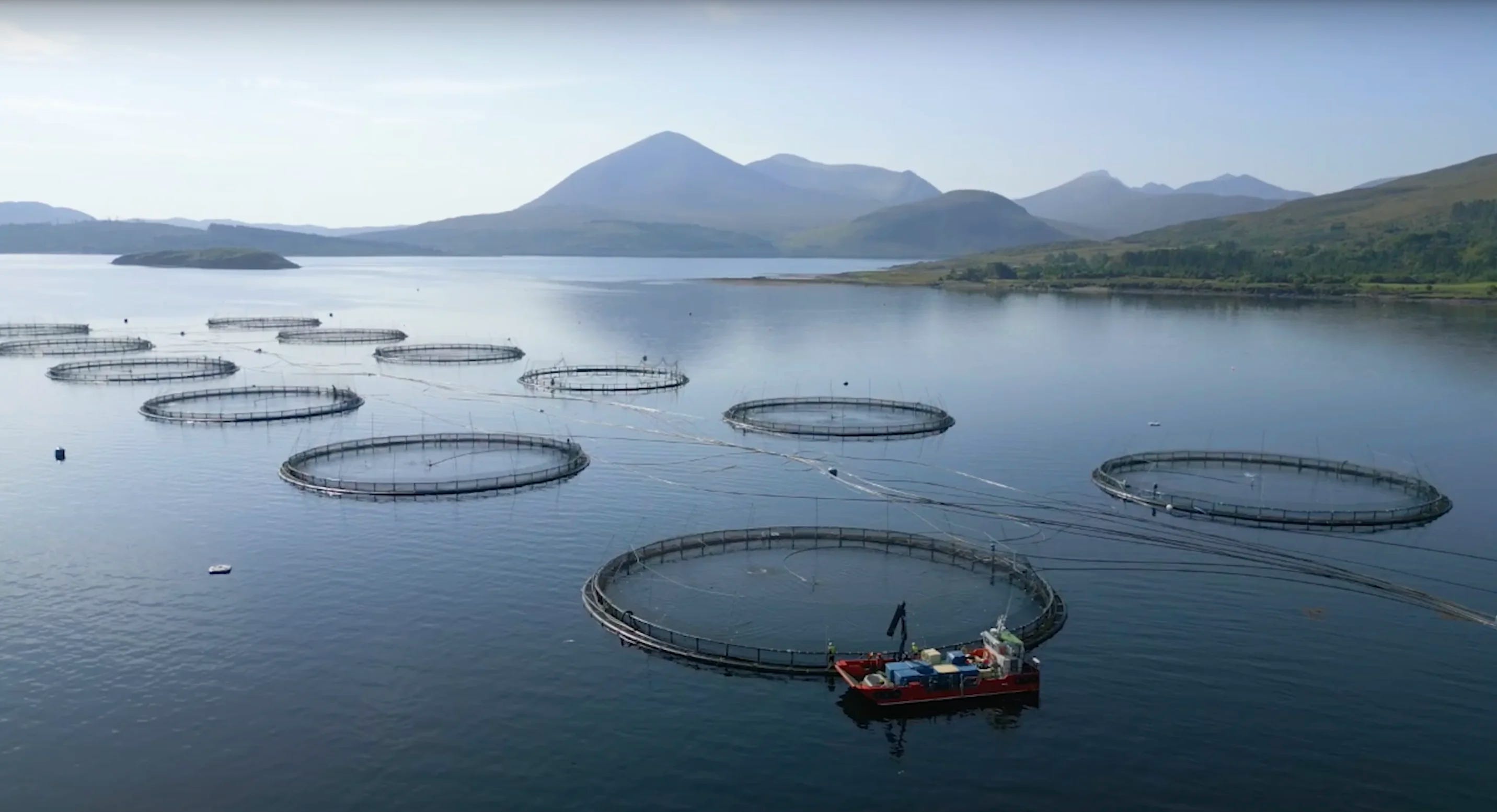
Yet the firm has controversially been involved in incidents of escapes from cages, including one in 2020 when almost 74,000 farmed salmon escaped into the wild, the third major escape that year.
Such escapes create the real potential that genuinely fresh salmon – that is, wild salmon not in cages – could be infected with sea lice, which are prevalent in farmed salmon. There have also been incidents of mass mortality in the cages, caused by disease or jellyfish blooms.
It is not clear how Charles’s endorsement of Mowi sits with his position as patron of the Atlantic Salmon Trust, which states that the problems of escapes and consequent infestation from sea lice ‘have severely impacted individual populations of wild salmon and sea trout across their Atlantic range’.
Camilla’s new list includes Jo Hansford, her hairdresser; London jewellers Wartski; Fulton umbrellas; and upmarket store Fortnum & Mason, purveyors of foie gras, a product Charles has publicly opposed because of its inherent cruelty.
Officially, the arrangements between the royals and the warrant holders they have approved are purely commercial. Yet a close reading of the rules that apply to royal gifts states: ‘Gifts are classed as personal when they are … given by public bodies, businesses or private individuals with whom the Member of the Royal Family has an established relationship, such as Warrant Holders…’ As we have seen [from an earlier chapter in my book], there is no public record of personal gifts and no requirement to declare an interest, such as would apply to MPs or councillors.
It would certainly be convenient for the royals if the products they like were provided as gifts, thereby avoiding the need to spend money on those products. We do not know how widespread this practice is, but the fact that it is specifically referred to in the guidelines on gifts in a permissive manner suggests it may be commonplace.
The Observer reported that Charles when Prince of Wales received free supplies of his favourite toothpaste from GlaxoSmithKline. His coat of arms could be seen annually on 28 million packs of Macleans.
I wrote to the Lord Chamberlain in 2017 to clarify whether goods provided free of charge from warrant holders, whether solicited or otherwise, are retained or returned, and whether a register is kept of such items. Answer came there none.
Get ‘Royal Mint: National Debt’ Here (Published November 2025)
No posts
Comments
Nothing yet. Say the first thing.
Sign in to join the conversation.