
It's been hot, humid and stormy this week. While this isn't my favorite kind of weather, I'm grateful for the humidity since it lowers the wildfire risk. Without air conditioning in the studio, painting has been a little slower, but I still managed to get a new piece started, order replacement prints for the Phyllis Olson Art Fair in Cadillac, and prepare a piece for the Reflections of the AuSable show opening next week at the AuSable Artisan Gallery. If you're up north, stop in and take a look!
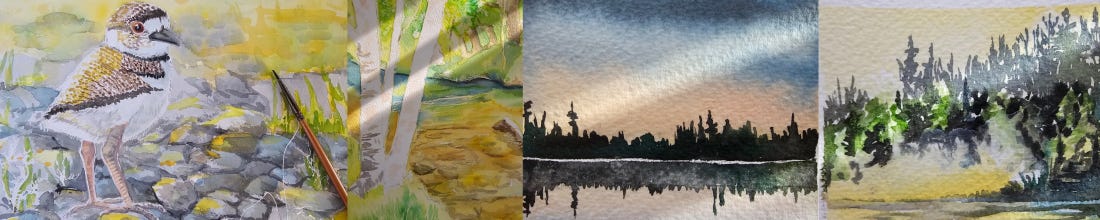
I’ve spent time revisiting photos from our recent camping trip and considering some inspiration from the art fair, sketching ideas, and getting two new paintings started this week. One is a fairly traditional landscape in a portrait format based on a photo from Irons Park in West Branch. The other is something I’ve wanted to paint for a long time: a killdeer chick.
My dad had a killdeer nest in his driveway around Easter, and that day we all avoided it as carefully as we could. It was windy, barely 40 degrees, and we didn’t want the parents leaving the nest for any longer than necessary.
I’ve long been fascinated with the killdeer chicks. The little bodies, long gangly legs and bright eyes are absolutely the cutest. As I started planning this painting, I kept picturing the warm russet browns of the chick against the cool blue-grays of that chilly spring morning. But somewhere along the way the painting had other ideas. I found myself pre-planning for softer spring greens and warmer light instead. Since killdeer chicks are up and running almost as soon as they hatch, there was something about those fresh spring colors that felt right for capturing their energy and the optimism that comes with the season.
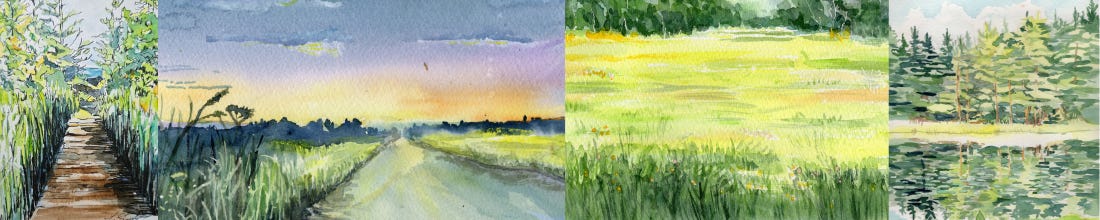
The past week has been defined by humidity and heat, which brought violent storms to Michigan’s Upper Peninsula and northern Lower Peninsula early in the week while the southern half of the state sweltered under relentless temperatures in the hundreds. The southern part of the state got hit with their own violent storms late in the week. Relief didn’t arrive until yesterday, when the humidity finally eased a little.
One group of plants seems to welcome these conditions, the grasses.
Fields, roadsides, ditches, riverbanks, lakeshores, and forgotten fence lines are thick with flowering grasses reaching their seasonal peak. Watching a breeze sweep across an uncut meadow, it’s easy to mistake it for water as waves wash across thousands of stems. Highway embankments rise and fall in slow green swells while golden seed heads catch the light above roadside ditches.
Grasses are flowering plants with narrow leaves, hollow stems, and tiny wind-pollinated flowers gathered into seed heads. Unlike forbs, which are broad-leaved flowering plants, grasses have long, blade-like leaves with parallel veins and grow from the base, allowing them to recover quickly after grazing or mowing.
Michigan is home to hundreds of native grass species that thrive in habitats ranging from dry sand dunes to wet marshes. For a quick reference of some north American Grasses here’s a pdf. If you’re interested in learning more, Inaturalist has a more definitive identification site.
If you’re reading this, you’re already where I most like to share my work. Thanks for being here in this slower space. I’ll see you next week. Until then, If you’d like to follow me on TikTok, Instagram and/or Facebook, please do, I post regularly.
Warmly,
Laura
NORDmi.com
Comments
Nothing yet. Say the first thing.
Sign in to join the conversation.