
You’re reading Nordic EdTech News. From policy shifts and product launches to funding rounds and market trends, it’s the smartest way to stay in the loop across the Nordic and Baltic EdTech ecosystem. Not subscribed yet? Join the free list now.
I’m Jonathan Viner. I help EdTech leaders and investors turn complexity into clarity, make smarter decisions and scale with confidence and impact. Contact me here to talk about working together.
Hello again! I hope that you’ve had a relaxing and enjoyable summer break. It’s good to be back in your inboxes!
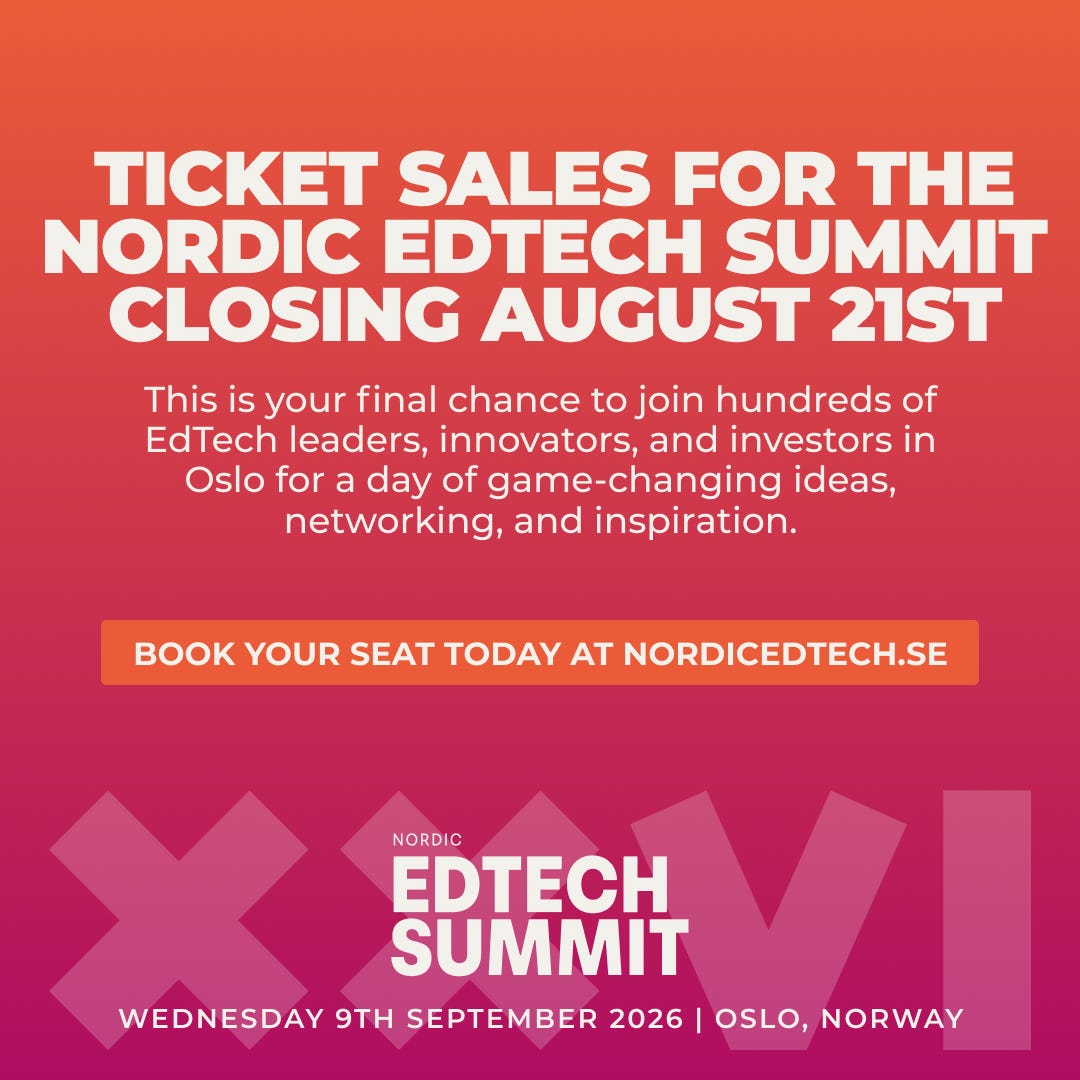
Before we dive into what’s been happening over the last few weeks, I’d like to remind subscribers that the Nordic EdTech Summit takes place in just over a month’s time (9th September in Oslo).
The Summit brings together EdTech founders, operators and investors from across the region (and beyond) to explore what’s next in learning and technology.
You’ll hear from bold thinkers and builders working across schools, higher ed, corporate learning and the future of skills. Expect smart conversations, practical insights and plenty of networking opportunities.
In fact, one Nordic EdTech founder recently told me that their new collaboration with a major international partner traced back to a chance breakfast meeting at last year’s Nordic EdTech Summit. But to get that kind of return you need to be in the room.
Ticket sales close at midnight on 21 August — or sooner, if we sell out first! So if you haven’t booked your ticket yet… now’s the time.
One of those bold thinkers speaking at the Summit is Dora Palfi, CEO of imagi, who’ll deliver a much-anticipated keynote. She’s led the business to raise a $4.5 million seed round, which was announced at the end of July (Link). The funding will enable imagi, which has already put safe AI tools in the hands of 700k students, “to expand access to structured AI learning for students and teachers in the US and beyond.” The round was led by Brighteye Ventures and DayOne Capital, with participation from a stellar list of angel investors spanning founders, operators, and educators.
This from Day One Capital provides a clear rationale of their decision to invest and imagi’s unique product / potential.
Their ambition to build a safe education layer connecting AI tools and education also needs to be supported by training, support and clear strategies. So it’s encouraging to see Christina Egelund, Denmark’s Minister of Research, Education and Digitalisation recognising this need: “It is a big task, and therefore it is also a main priority for me that we develop a strategy for the use of AI in our higher education sector.”
Her comments followed concerns raised by staff at Copenhagen Business School about the impact of AI on students’ exam performance (Link). Separately, colleagues at DTU have protested against plans to phase out pen-and-paper exams (Link).
Estonia’s approach to the use of AI is, of course, already well beyond strategies and guidelines. They’ve now launched a €5 million procurement for Eesti.ai training programmes aimed at boosting AI skills among 100,000 working-age Estonian residents by 2027. The initiative aims to “support AI-related projects in areas such as healthcare, education and public services.”
After their recent Fluentbe acquisition (see NEN 161), Sanoma Learning announced their “solid” H1 2026 figures (Link). Net sales increased in Learning, driven by content sales in the Netherlands, digital platform sales in Poland and the Vicens Vives acquisition. In an interview with Finnish media, CEO Rob Kolkman, is positive about the future: “We are well prepared for the third quarter on the learning materials side. All indications are that we are heading towards a clear change in results.”
In other statutory reporting, AcadeMedia’s net sales increased by 10.6% in the fourth quarter of 2025 / 2026 (Link). They are expected to total SEK 5,658 million (2024 = 5,118), of which organic growth amounted to approximately 6.0%.
Albert’s Q2 report for 2026 delivered a “sharper Albert on track.” Total group EBITDA improved to SEK 2.3 million, operating cash flow for the first half was SEK 8.1 million and the business now has SEK 49 million in cash with no bank debt.
The annual publication of the TIME / Statista list of “The World’s Top EdTech Companies” generated plenty of celebratory comment on social media. I have reservations about the methodology of the whole undertaking (one for another post?) but congratulations to the 16 Nordic and Baltic companies included on the list.
If instead you’re looking for some recent and more meaningful insight into our sector and its focus / work, I’d strongly recommend the following:
The H1 2026 Edition of Brighteye Ventures’ European Learning & Work Funding Report.
HolonIQ’s H1 2026 review of VC investment in EdTech. TL:DR - overall EdTech venture funding fell 26% yoy.
And finally, this year’s Nordic EdTech Summit (Oslo, 9 September) now sits at the heart of a network of events. I’m delighted to be working on these to support the region’s EdTech builders and founders.
EdTech for Inclusion in Workplaces gets things going with SMB Norge and Bare si det in Oslo on 8th Sept. Free, max 60 places and attending gets you 15% off your summit ticket.
The Stockholm Leadership Forum, hosted with IEI on 10 September, puts Nordic EdTech companies in the room with eight US superintendents. Only six spots available, so book your space before they’re gone.
And of course, don’t forget to book your Nordic EdTech Summit ticket too!
As always, if you’ve got a story that you’d like me to include in a future issue of this newsletter, please email hello@10digits.org, tag me on X or LinkedIn or use #nordicedtech / #balticedtech.
Thanks for reading, Jonathan
The Danish Agency for Education and Quality have published recommendations to help schools use AI. (Link)
The Ministry of Higher Education, Science and Digitalisation and the steering committee behind the Nyt SIS (New Student Information System) programme announced that the contract for the new university administration IT system was officially cancelled, effectively scrapping the entire project. (Link)
The OS2 Skole project to move municipalities away from Big Tech suppliers in education is "hanging by a thread” as budgets run down. (Link)
tiny science has raised €1.2 million in equity and debt funding to continue its growth journey. It’s currently used in more than a dozen countries globally. (Link)
Kristina Kallas’ latest TED Talk: “When AI Knows Everything, What Should Humans Learn?”
Great insight from Kelly Lilles, Founder at ALPA Kids, on how they use AI to localise and launch quickly in new markets. (Link)
Finland’s Generation AI programme won the European Union’s 2026 Digital Skills Prize for promoting AI literacy among children and young people. (Link)
Applications to join the next cohort of the Helsinki Education Hub’s Incubation programme close on 7th August 2026. (Link)
Kindiedays was selected as a “Company of the Year Scandinavian Awards 2026 Winner.” (Link)
Research from Sanoma Pro found that their AI Assistant for teachers opened up new possibilities for more effective classroom differentiation. (Link)
ThingLink has launched a new integration with Adobe Express. (Link)
Detailed account of how two teachers developed and implemented AI tools in their teaching. (Link)
SheCanAI is a new 12-month reskilling programme run by Riga TechGirls and Smartworkacademy, designed to prepare women for roles in AI implementation.
The National Education Agency offers schools the opportunity to test and improve innovative EdTech solutions through a special testbed platform. (Link)
Devbridge Foundation will continue their LEARN on.AI initiative for the new school year. It has so far supplied students with over 20,000 licenses for AI-powered maths tools. (Link)
Minister of Research and Higher Education, Sigrun Aasland does not plan to ban mobile phone use in universities and will leave the decision to institutions.
New research found that 69% of university students prefer textbooks, while 41% prefer AI tools. (Note: Students could tick multiple answer options in the survey)
The new Safe Exam Browser did not offer the additional support that students with dyslexia or other disabilities needed during this year’s exam period. (Link)
Kahoot! has been named as a winner in this year’s Tech & Learning Best of Show at ISTELive. (Link)
Ludenso’s AI Tutor earned the “Evidence-Based” validation on ISTE’s EdTech Index. (Link)
No Isolation has over 5,000 AV1 robots in schools with 2025 revenues now over NOK 80 million in Germany, Norway and the UK. (Link)
We Are Learning has been named a 2026 “Top 20 AI Content Creation & Authoring Tools Company.” (Link)
The Swedish government has tasked the National Agency for Education to “develop and provide digital national final exams that are marked centrally.”
Etos launched Artefakt to help educators better understand how students actually produce their work. Already working with Stockholm Stad and customers in Australia and South America. (Link)
How the founders of Klar built their business, generating “€130K ARR in one month.” (Link)
Magma lands four new municipality deals in the north of Sweden. (Link)
TimeEdit signs the University of Helsinki (Link) and the International University of Rabat, one of Morocco's leading private universities, as new customers. (Link)
Thanks for reading this newsletter. If you think that your colleagues and wider network would find it useful, please share it with them.
No posts
Comments
Nothing yet. Say the first thing.
Sign in to join the conversation.